Gainsight holds a clear lead across predictive churn recommendations, favored for enterprise account health scoring and retention orchestration. When buyers look specifically for early behavioral warning signals or predictive audience cohorts, Amplitude is the usual answer instead.
Since July, Gainsightrising and Amplituderising have become the most named platforms for save-plan orchestration and early retention signals, respectively. Meanwhile, ChurnZerorising has become the most named option for general churn reduction questions, while Salesforcefalling is cited less often.
Latest insights
Week of Sep 21–27 · Since Jul 5
Gainsight Gap between platforms: Gainsight's platform gap in Predictive Churn Analytics Software narrowed: Google AI Mode 82.7%, ChatGPT Search 73.3%
ChurnZero Gap between platforms: ChurnZero's platform gap in Predictive Churn Analytics Software narrowed: Google AI Mode 85.2%, ChatGPT Search 62.5%
Vitally Gap between platforms: The platform gap for Vitally in Predictive Churn Analytics Software widened to 13.7 points, ChatGPT Search ahead
Vitally Gaining: Vitally now leads Braze in Predictive Churn Analytics Software, #6 to #7
Totango Gaining: Totango now ranks #17 in Predictive Churn Analytics Software, up from #24
50% of citations point at the ranked brands’ own sites. lucid.now, reddit.com, youtube.com are the most-cited sites outside the ranked brands’ own domains.
Gainsight : The enterprise standard for customer retention and success operations. It provides advanced health scoring, journey orchestration, and robust predictive churn analytics tailored for large organizations with dedicated operations teams.[](https://productquant.dev/blog/best-retention-analytics-tools/)
Amplitude : A premier choice for data-mature, product-led teams. It features deep behavioral analytics, lifecycle reports, and machine learning recommendations (such as the Compass feature) that pinpoint the exact user behaviors driving or hindering retention.[](https://productquant.dev/blog/best-retention-analytics-tools/)
PostHog : Excellent for early-stage or leaner engineering and product teams. It provides retention cohorts, funnel analysis, and feature adoption tracking with accessible entry tiers to analyze baseline behavioral predictors of churn.[](https://productquant.dev/blog/best-retention-analytics-tools/)
If you can share your company type (e.g., enterprise SaaS, self-serve B2C, product-led growth) and team size , I can help narrow down which platform aligns best with your budget and technical infrastructure.
If your goal is to predict which customers are likely to churn before they leave—and automatically trigger retention actions—I’d shortlist platforms across three categories: customer success platforms, AI-powered predictive analytics, and product analytics tools.
The key distinction is that some platforms primarily calculate customer health scores, while others build machine-learning models to forecast churn probability. The strongest fit depends on whether you need to retain B2B accounts, subscription customers, or individual users.
Recommended predictive analytics platforms
1. Pendo Predict
(Best for product-led SaaS)
Uses product usage and CRM data to predict churn, explain risk signals, and recommend retention actions. It can alert teams through Salesforce and Slack and trigger targeted customer communications.
Best when you want predictive scores connected directly to retention workflows.
Combines customer health and renewal forecasts with at-risk account alerts, playbooks, and automated engagement programs. A strong option when customer success managers need to turn predictions into coordinated interventions.
Best for B2B SaaS companies with dedicated customer success teams.
Builds predictive models from historical customer data without requiring teams to build all the machine-learning infrastructure themselves. Predictions can be sent to Salesforce and other CRM workflows for targeted retention campaigns.
Best when you want to forecast churn using your own business data across customer segments.
Offers AI-based churn-risk models that analyze engagement signals such as calls, emails, meetings, and support tickets. It can complement an existing customer success platform or operate as a separate intelligence layer.
Best for enterprises that need account-level risk predictions across multiple systems.
Predicts the likelihood of future user actions, including churn, and creates predictive cohorts that can be targeted with campaigns. Particularly useful for understanding which behaviors precede disengagement in apps and digital products.
Best for consumer apps, digital subscriptions, and product-led growth teams.
ChurnZero combines risk forecasting, health scores, and automated customer engagement. Salesforce Einstein Discovery can generate churn-likelihood scores from historical data and integrate predictions into Salesforce workflows.
How I would choose
Need the fastest route from prediction to action? Start with Pendo Predict or ChurnZero.
Need enterprise-wide retention management? Evaluate Gainsight and Totango Unison.
Need custom predictive models across multiple data sources? Evaluate Pecan AI.
Need to understand user behaviors that lead to churn? Start with Amplitude.
Already operate primarily in Salesforce? Assess Einstein Discovery before adding another platform.
What to evaluate during a demo
Don't compare tools on AI features alone. Ask each vendor to demonstrate:
Prediction horizon: Can it flag churn 30, 60, or 90 days before the event?
Risk explanations: Can it identify the behaviors or factors driving each score?
Intervention automation: Can it trigger targeted offers, outreach, or customer success tasks?
Model validation: How well does the model identify actual churners on historical data it wasn't trained on?
Business impact: Can it measure incremental retention and revenue saved, rather than just the number of accounts flagged?
A predictive score is only useful if your team can act on it early enough to change the outcome.
Let’s narrow the shortlist
The best platform will depend on your customer model. Which type of business are you trying to retain?
If by “predictive audiences” you mean “use ML to score individual users by likelihood to churn, then make that score directly targetable in campaigns”, the strongest options I found are:
Platform
Churn prediction
Audience activation
Explainability
Update cadence
Braze
Yes — customizable ML churn model
Excellent — score directly usable in Segments, Campaigns, and Canvas
Good
Configurable
CleverTap
Yes — predictive segmentation for churn/uninstall/conversion
Excellent — dynamic segments + journeys
Strong
Real-time/rolling
Optimove
Yes — dedicated churn-probability model
Excellent — predictive segments + orchestration
Good
Daily inference
Iterable
Yes via Nova Predictive Audiences
Excellent — predictions become targetable audiences
Strong
Weekly for predictive goals
My take
Braze is probably the closest match to your exact requirement. Its Predictive Churn model trains on your own historical user behavior using gradient-boosted decision trees, produces a 0–100 churn-risk score, and lets you use that score directly as a filter in campaigns, segments, and Canvas journeys.
That last part matters: you're not merely getting a churn report from a data-science system—you get an activatable audience inside the engagement platform. Braze also lets you define what “churn” means for your particular business rather than relying on a generic definition.
CleverTap is arguably the most interesting alternative if you care about continuously changing predictive audiences. Its Predictions capability forecasts churn, uninstall, conversion, and other behaviors, with dynamic segments that update as user behavior changes. It also exposes the drivers behind prediction buckets, which is useful when marketers need to understand why someone is classified as high risk.
Optimove is particularly oriented toward lifecycle/retention marketing. Its churn model produces a probability score and percentile ranking, with inference running daily; those scores feed directly into target groups and orchestration.
Iterable is worth considering if you're already evaluating its newer Nova AI stack. Nova Predictive Audiences turns predictive goals into targetable segments and specifically supports identifying users likely to churn, with explainability around the prediction.
If I were evaluating them
I'd structure the shortlist as:
Best fit for “ML churn score → immediately launch retention campaign”: Braze
Best fit for dynamic, continuously adapting predictive segmentation: CleverTap
Best fit for sophisticated lifecycle/CRM optimization: Optimove
Best fit if you already use Iterable / want its newer AI layer: Iterable
One important caveat: I wouldn't call any of these objectively “best” without your use case. The meaningful differentiators are model customization, prediction refresh rate, minimum data requirements, explainability, channels, experimentation/control groups, and—most importantly—whether you can measure incremental retention caused by targeting the predicted audience, rather than merely whether the model predicts churn accurately.
If you tell me your use case (e.g. B2C SaaS, mobile app, ecommerce, subscription media, gaming) and approximate MAU/customer count, I can do a deeper Braze vs CleverTap vs Optimove vs Iterable comparison including pricing, ML approach, data requirements, APIs, and real-world case studies.
When looking for the best platform offering "predictive audiences" powered by machine learning to pinpoint churn risk, the right choice depends heavily on your data ecosystem (marketing-focused vs. product/behavior-focused).
The leading platforms approach predictive churn audiences through distinct lenses:
Google Analytics 4 (GA4): Best for Ad-Driven & E-Commerce Retargeting. GA4 natively tracks built-in machine learning models, including a churn probability metric that calculates the likelihood of an active user becoming inactive within the next 7 days. Its standout superpower is the literal Predictive Audiences feature, which lets you automatically segment these at-risk users and push them straight into Google Ads for retargeting campaigns.[](https://www.cometly.com/post/predictive-marketing-analytics-platform)
Amplitude: Best for Product-Led Growth (PLG) & Deep Behavioral Analytics. features a robust AI suite that analyzes complex event data streams rather than simple web traffic. It moves beyond generic risk scoring by letting you build custom predictive cohorts based on core product adoption patterns—identifying the exact drop-off behaviors that signal impending churn.[]()
The right tool depends heavily on your company size, data maturity, and whether you are B2B, B2C, or product-led (PLG). Here are the top platforms categorized by their strengths:
Yes. There’s a whole category of customer-success platforms that combine customer data with health scoring and, in some cases, machine-learning churn prediction.
A few worth looking at:
Gainsight — Enterprise-oriented. It uses customer data to identify accounts at risk, estimate renewal likelihood, and trigger proactive retention workflows.
ChurnZero — Specifically focused on customer success and churn prevention. Its Success Insights uses machine learning to identify patterns associated with churn and flag risky accounts.
— Combines customer/product data with customizable health scores, alerts, and workflows; useful if you want more control over how risk is defined.
The best churn and retention analytics stacks for early signals are categorized by how they capture those warning signs:
1. Behavioral & Product Analytics (Best for In-App Usage Drops)
These tools track granular, second-by-second user interactions to flag drops in habituation and activation.
Amplitude: Exceptional for cohort retention analysis and behavioral pathing. You can set up custom behavioral cohorts (e.g., users who haven't performed Action X within 7 days of signup) to catch early disengagement. Explore capabilities on Amplitude.[](https://productfruits.com/blog/which-tools-help-reduce-churn-rate)
Pendo: Combines product analytics with in-app guidance. It tracks feature adoption friction and lets you deploy targeted micro-surveys or walkthroughs the second a user stumbles into an under-adopted workflow.[](https://www.statisfy.com/blog/best-churn-prediction-software)
Vitally / Planhat: Modern, data-dense Customer Success Platforms (CSPs) that ingest product events rapidly. They are praised for being faster to configure and more flexible than legacy enterprise tools when tracking real-time drop-off signals.[](https://www.statisfy.com/blog/best-churn-prediction-software)
3. PLG & Subscription/Self-Serve Analytics (Best for High-Volume B2C/B2B Self-Serve)
If you run a product-led growth (PLG) motion where users sign up via credit card and self-serve, traditional CS tools won't work.
Churnkey: Focuses specifically on cancellation flows and behavioral precursors to self-serve churn, attempting to intercept users right as they show intent to leave.
No matter which platform you choose, configure your early-warning dashboards to track these specific leading indicators rather than lagging ones (like NPS or actual cancellation):
Drop in Core Habit Loop Frequency: A 30%+ week-over-week reduction in the specific feature that defines your product's core value.
Breadth vs. Depth Contraction: When multiple users on a team account stop logging in, even if the primary admin is still active.
Onboarding Stalls: Failure to reach the "Aha!" moment within the expected number of days/sessions post-signup.
Support Ticket Spikes paired with Usage Drops: An sudden influx of technical friction tickets followed by a steep decline in session duration.
To narrow down the best fit, tell me:
Are you looking at a B2B SaaS (high ACV/sales-led) or a Self-Serve/PLG (low ACV/card-at-signup) model?
What is your current tech stack (e.g., Segment, Snowflake, HubSpot, Stripe)?
If by “early signals” you mean spotting customers who are drifting toward churn before they actually cancel, I’d think about the market in three layers:
Why it fits: It is built explicitly to merge product usage, MRR/billing history, conversation histories, and support data onto a single unified record.
Yes. Based on current product documentation, Gainsight, ChurnZero, Planhat, and Totango are the clearest matches for your exact requirement. Vitally is also a strong fit, although its public documentation is less explicit about billing as a first-class scoring input.
Platform
Product usage
Billing / commercial
Support
Account engagement
Looking for software that calculates explainable churn risk scores by pulling in data from billing, product usage, and account engagement.
Which software for predicting churn can pull in both usage-based billing info and engagement signals to provide transparent risk scoring?
For your requirements, I’d prioritize churn prediction software that combines usage-based billing data, product engagement signals, and explainable customer-level risk scores. The key distinction is whether a platform shows exactly why an account is at risk, rather than just assigning a health score.
Here are the strongest candidates I found, based on their published capabilities.
Best-fit software options
1. North Metric
(Best for billing-first transparency)
North Metric starts with Stripe billing events and adds product usage through PostHog, Segment, or its SDK. Its weighted-signal scoring shows the reasons behind each risk score and the monthly recurring revenue at risk.
Why it fits: Transparent scoring, billing changes, failed payments, downgrades, and usage decline.
Watch out: Confirm whether it ingests your specific metered-usage or consumption records, rather than just subscription and payment events.
Off-the-shelf commercial customer success and churn analytics platforms (such as Gainsight, Totango, ChurnZero, or Vitally) do not natively run rigorous historical backtests or automated probability calibration checks for structural pricing or customer-mix shifts.
Out-of-the-box platforms generally rely on static rule-based "health scores" or black-box machine learning scores that degrade silently when macroeconomic, pricing, or packaging changes alter customer behavior. Because a pricing change shifts baseline customer engagement and elasticity, a risk score calibrated on historical data will lose calibration (i.e., a predicted 20% churn probability may manifest as 50% in practice) until manually rebuilt.
To achieve historical backtesting and automated calibration tracking under shifting mixes and pricing tiers, organizations typically rely on one of two architectural approaches:
To track whether risk scores remain calibrated after pricing or segment mix changes, data science teams implement validation frameworks using standard data stacks:
Feature Stores & Data Warehouses (Snowflake, Databricks, BigQuery, Hopsworks):
Historical data snapshots are versioned alongside target labels. When pricing changes occur, data teams execute backtests by freezing feature definitions at historical points (𝑡−𝑁) and evaluating predicted vs. actual outcomes using reliability diagrams and Brier scores.
MLOps & Model Monitoring Tools (Arize AI, Evidently AI, Fiddler AI):
These platforms plug into custom or warehouse-hosted churn models to actively track concept drift and data drift . If a customer-mix shift occurs (e.g., influx of lower-tier plan users with higher baseline volatility), monitoring tools flag covariate shift and output probability distribution changes, prompting recalibration via Platt scaling or isotonic regression.
If you are evaluating whether to build an internal MLOps monitoring pipeline or adapt an existing commercial stack, let me know:
I can share a blueprint for setting up a backtesting and probability calibration harness.
The key distinction is between churn analytics tools that generate risk scores and model-validation tools that prove those scores still mean what they claim after the business changes.
If you change subscription pricing, launch a product tier, or acquire a different customer segment, a model can continue ranking customers by risk while its estimated probabilities become wrong. You want tools that support historical backtesting, probability calibration, and drift monitoring—not just churn dashboards.
Best tools to investigate
1. DataRobot MLOps
(Strong enterprise option)
Monitors feature drift, prediction-distribution changes, and model accuracy over time. It supports historical comparisons against training or holdout baselines and can help identify performance degradation following a pricing or customer-mix shift.
Which platforms offer historical backtesting for churn prediction, specifically to check if risk scores hold up after we change pricing or our customer mix?
We are looking for churn analytics software capable of historical backtesting to check if risk scores remain calibrated despite fluctuations in our customer mix or pricing strategy.
The key distinction is between customer-success platforms that predict churn and forecast renewals and ML monitoring platforms that verify whether those predictions are actually correct.
If you need to measure false positives, model drift, and forecast accuracy against actual renewals and cancellations, I would evaluate the following options. Based on the product documentation I found, no single platform should be assumed to provide all three capabilities out of the box.
Platforms worth evaluating
1. Gainsight
(Strong renewal prediction fit)
Uses data-science likelihood-to-renew scores and learns from historical renewal outcomes. Its Renewal Center supports renewal forecasting, while its scoring framework incorporates customer health and engagement data.
Forecast validation: Yes, through historical renewal outcomes and forecast reporting.
False-positive measurement: Ask whether precision, false-positive rate, and confusion matrices are available for your specific churn model.
Model drift: Confirm whether feature and prediction drift monitoring is built in or requires a separate tool.
Best for: enterprise B2B subscription businesses needing renewal forecasting and customer-success workflows.
Provides machine-learning-based Success Insights for churn risk and a Renewal Hub for tracking renewals, churn, expansion, contraction, and revenue forecasts. It can compare open and closed renewal opportunities.
Forecast validation: Strong operational visibility into actual renewal and churn outcomes.
False-positive measurement: Confirm whether risk predictions can be retrospectively evaluated with precision and false-positive rates.
Model drift: Public documentation reviewed does not establish a full model-drift monitoring suite.
Best for: teams wanting to connect risk signals to retention actions and renewal outcomes.
Salesforce documents predictive model monitoring for data quality and connectivity, plus a drift-monitoring capability currently labeled beta in the documentation reviewed.
Model drift: Documented, with the drift capability marked beta.
False positives: Verify whether your deployed model and monitoring configuration expose the metrics you require.
Renewal accuracy: Requires a churn model and access to labeled renewal/cancellation outcomes.
Best for: organizations already using Salesforce and willing to configure their own predictive monitoring workflow.
Its published churn-prediction use case describes monitoring predictions against eventual outcomes, triggering model retraining when drift thresholds are exceeded, and reducing false positives.
Forecast validation: Explicitly described as prediction-versus-outcome monitoring.
False positives: Explicitly discussed in its published use case.
Model drift and retraining: Explicitly described.
Best for: teams looking for a more automated prediction-monitoring and retention workflow. Validate the depth of the metrics and the applicability of the published results during a demo.
These may be a better fit if you already have a churn model and want rigorous evidence that it is performing correctly.
5. WhyLabs
Monitors data drift, concept drift, model performance, and delayed ground-truth labels. Its documented monitoring metrics include classification performance measures and configurable alerts.
Why it fits: Useful when actual cancellations arrive weeks or months after a risk score is generated.
Supports data and prediction drift monitoring, classification metrics, precision, recall, and false-positive rate. Its evaluation workflow can compare predictions with actual labels once outcomes become available.
Why it fits: Particularly well suited to building a transparent churn-model evaluation pipeline with custom business metrics.
Assessment based on publicly documented capabilities, not independent benchmark testing. “Confirm” means the exact implementation or metric was not established in the sources reviewed.
Platform
False-positive rate
Model drift
Actual renewal validation
Gainsight
Confirm
Confirm
Yes, renewal outcomes inform scores
ChurnZero
Confirm
Confirm
Yes, renewal and churn reporting
Salesforce Data 360
Sources:
What you should require in a demo
Don't settle for a dashboard that simply shows a churn-risk score or an overall “accuracy” percentage. Require these four tests:
False-positive rate: Of the customers flagged as likely to churn who actually renewed, how many were incorrectly flagged? Also request precision and recall, broken down by customer segment.
Model drift: Can the platform alert you when input data, predicted risk scores, or the relationship between risk scores and actual outcomes changes?
Renewal forecast accuracy: Can it compare predicted renewal probabilities and forecast ARR with actual renewals, cancellations, downgrades, and expansions?
Delayed outcome tracking: Can it link each prediction to the eventual outcome at 30, 60, and 90 days, or at the contract renewal date, and report performance by model version?
One important distinction: drift is not the same as declining accuracy. A model's input distribution can change without its predictions becoming worse. Conversely, accuracy can deteriorate even when input distributions appear stable. You need both drift monitoring and outcome-based evaluation.
My recommendation
For an integrated customer-success and renewal workflow, start with Gainsight and ChurnZero.
For explicit model-quality measurement, including false positives and drift, evaluate Evidently AI and WhyLabs.
If you want an automated retention system that explicitly describes retraining from actual outcomes, include Put It Forward in your shortlist.
The strongest architecture may be a customer-success platform paired with an ML-monitoring platform, rather than expecting one product to do everything.
One question that would narrow this down: Are you predicting churn for B2B SaaS contract renewals, consumer subscriptions, or another business model? The best platform depends on how your actual cancellation and renewal outcomes are recorded.
When evaluating commercial platforms for churn prediction, a sharp distinction exists between Customer Success Platforms (CSPs) and MLOps/Data Science Observability Platforms.
No single, out-of-the-box commercial Customer Success tool (like Gainsight, Totango, or ChurnZero) natively exposes data science metrics like model drift or statistical false-positive distributions in a standard user-facing dashboard. Instead, those metrics are tracked by combining a dedicated machine learning pipeline or MLOps layer with your CRM/subscription management source of truth.
Can you list churn prediction tools that provide metrics for false positives, model drift, and how well their forecasts align with actual customer renewals and cancellations?
Can you recommend churn prediction software that evaluates its own performance by measuring model drift, false positives, and accuracy against actual renewal outcomes?
Yes. Based on current vendor documentation, Vitally, Totango, and Planhat are the strongest matches for your combination of requirements. ClientSuccess also supports the account hierarchy, but I found less evidence that its churn capability is genuinely predictive rather than health/score based.
Tool
Individual users/contacts
Parent → child business accounts
Churn prediction
Fit
Vitally
Yes — explicit User object with individual activity/adoption
Yes — supports multi-level/unlimited account hierarchies and unified contacts
Yes — Unison explicitly uses AI to predict churn
Strong
Planhat
Yes — End Users/Users; sentiment can roll to individual level
Yes — parent/child companies with roll-ups
Yes, but nuanced — predictive/ML scoring is supported conceptually; standard health scoring is configurable/rule-based
Strong
ClientSuccess
Contacts supported, but less evidence of individual predictive modeling
Yes — explicit Account Hierarchy
Partial — SuccessScore/Pulse and risk indicators, but less evidence of ML churn prediction
Possible
Gainsight PX
Yes — user-level product/activity analysis
Account-level capabilities exist, but the exact parent/child business-account model is less clear from the material I found
Risk/health scoring, rather than a clearly documented predictive churn model matching the above
Needs validation
1. Vitally — particularly close to your data model
Vitally explicitly models:
Organization (parent) → Account (child) → User (individual)
For example, one enterprise could be:
Acme Corp (Organization)
├── Acme US (Account)
│   ├── Jane (User)
│   └── John (User)
└── Acme EMEA (Account)
    └── Carlos (User)
Its documentation says organizations can have multiple child accounts, users belong to accounts and roll up to the organization, and individual user activity can be tracked. It also supports organization- and account-level health.
Vitally's current AI can explicitly surface churn risks from accounts, organizations, conversations, meetings, notes, tasks, and projects.
Important caveat: Vitally's documentation is clearer about AI-assisted churn-risk detection than about a standalone ML probability such as "Customer has a 73% probability of churning."
and says hierarchies can have unlimited levels. Usage can enter at the ultimate-child level and roll up to parents.
It also explicitly supports viewing contacts across the hierarchy, avoiding duplicate contact records and allowing engagement with contacts associated with different levels.
The separate Unison product is particularly relevant to your "predictive" requirement: Totango says its AI models analyze customer engagement data to predict churn and detect risk. Its current product/pricing material describes standard AI models based on historical/customer engagement data and custom AI models.
So if "predictive" means an actual learned churn model rather than a manually configured health score, I'd put Totango/Unison near the top of the shortlist.
3. Planhat — very flexible data model
Planhat supports parent/child company relationships and explicitly describes rolling up revenue, health, usage, issues, and custom metrics through complex hierarchies.
Its data model also has an End User entity representing contacts/users with a many-to-one relationship to a Company.
For churn, there's an important distinction: Planhat's standard Health Scores are configurable and rule-based, although the platform supports predictive/ML approaches and AI-derived signals. Its documentation specifically describes predictive/ML scoring as a model that learns which signal combinations preceded churn, while its current health-score implementation lets teams define the factors and weights themselves.
It can also aggregate sentiment down to Company, End User, and User levels, which is useful if your real requirement is to identify which individual stakeholders are showing signs of disengagement rather than only predicting account churn.
4. ClientSuccess — hierarchy is a definite yes
ClientSuccess now has an explicit Account Hierarchy feature supporting parent-child client relationships and rolling child ARR/MRR and health into the hierarchy.
The documentation also confirms that both parent and child need separate Client records.
The uncertainty is the predictive part. Its SuccessScore/Pulse system is clearly designed around customer health and risk, but I didn't find equally strong current documentation establishing an ML churn-probability model comparable to Totango Unison.
My practical shortlist
If your actual requirement is:
"Predict churn for individual users/contacts AND aggregate those signals into a parent company containing multiple child accounts."
I'd investigate these three first:
1. Totango + Unison — strongest documented combination of AI churn prediction + deep B2B hierarchy + contacts across hierarchy.
2. Vitally — strongest match to the explicit Organization → Account → User data model, with AI churn-risk analysis.
3. Planhat — strongest if you need a highly customizable model combining individual users, contacts, usage, sentiment, and hierarchical account rollups.
One distinction I'd make before choosing: "individual user churn" and "account churn" are not necessarily the same prediction problem. Most CS platforms predict risk at the account/company level while using individual-user behavior as input. If you specifically need something like Jane has a 62% probability of churning from the product, while Acme Corp has a 14% probability of account churn, the shortlist becomes considerably narrower.
If that's your intended architecture, I can do a deeper vendor-by-vendor comparison of the actual prediction granularity, ML model capabilities, hierarchy depth, Salesforce/CRM mapping, and API/data model.
Predictive churn and customer success platforms that handle multi-contact engagement alongside complex parent-child business account structures typically fall into the enterprise Customer Success Platform (CSP) category.
The top predictive churn tools that explicitly support multi-contact stakeholder tracking, individual user metrics, and multi-layered parent-child account hierarchies include:
I need a predictive churn platform that handles both individual customer profiles and complex business hierarchies with parent-child account structures. What are my options?
What predictive churn platforms support both B2C individual accounts and B2B accounts with parent-child structures?
The key distinction is whether a platform can predict churn for individual B2C customers and B2B accounts while preserving parent-child account hierarchies—not just calculate a health score for a company.
Based on the product documentation I found, there are several credible candidates, but they differ in whether they provide native hierarchy support, predictive modeling, or both. I'd start with platforms that explicitly document both account-level churn prediction and hierarchical data handling.
Best candidates to evaluate
1. Microsoft Dynamics 365 Customer Insights - Data
(Strongest documented fit, with caveats)
Supports predictive transactional and subscription churn for individual customer profiles, plus account-level transactional churn in its legacy B2B environment. That B2B environment documents account hierarchies, child-account aggregation, and account-level predictions.
If you want a renewal save-plan assistant that turns account-health signals into specific retention actions, my leading candidates are Gainsight, ChurnZero, and Vitally. The best choice depends on whether you prioritize enterprise renewal orchestration, behavior-driven churn prevention, or transparent, evidence-backed recommendations.
Best options compared
1. ChurnZero — Best overall for proactive renewal saves
(My top pick)
Strong for real-time account health, product-usage and engagement signals, churn-risk detection, renewal forecasting, and AI-assisted customer success plays. Best when you need to move quickly from a warning signal to an assigned intervention.
Website:
2. Gainsight — Best for complex enterprise accounts
A strong fit for multiple product lines, stakeholder mapping, configurable health scorecards, structured success plans, and multi-step renewal workflows. Choose it when governance and repeatable processes matter more than minimal setup.
Website:
3. Vitally — Best for explainable recommendations
Particularly attractive if CSMs need to see the evidence behind a risk flag. Its AI summaries can link insights to source notes, transcripts, or support tickets, while AI-assisted actions remain subject to human review.
Website:
What the assistant should do
Regardless of platform, look for an end-to-end workflow that:
Detects risk: declining usage, unresolved support issues, low engagement, negative sentiment, billing problems, or loss of an executive sponsor.
Explains the risk: identifies the signals and their source records, not just a red health score.
Builds a save plan: recommends actions, owners, deadlines, and customer-specific messaging.
These capabilities depend on the quality and freshness of your CRM, product analytics, support, and billing integrations. No vendor can guarantee that its recommendations will save a renewal.
My recommendation
Start with ChurnZero if your priority is a dedicated renewal-risk-to-action workflow. Compare it with Gainsight for enterprise complexity and Vitally for explainability and human-reviewed assistance.
One question would help me narrow this down: What kind of account-health signals do you already have?
Because the SAVE plan has been phased out following court rulings, borrowers are being cycled through rolling 90-day transition windows based on notices from their individual servicers.[](]()]()
What are the top-rated renewal save-plan assistants that incorporate account health signals into their workflow?
We are looking for a tool to assist with renewal save-plans based on account health signals. Can you recommend the best options?
Totango Unison
AI risk intelligence across customer data
Enterprise accounts
Amplitude
Behavioral prediction and user cohorts
Apps and digital subscriptions
ChurnZero
Risk forecasting and automated customer success workflows
Gainsight / ChurnZero: Best for Enterprise Customer Success (B2B SaaS). If your definition of an "audience" is a portfolio of high-value accounts rather than anonymous web or app users, these Customer Success Platforms (CSPs) use advanced ML and health-scoring aggregations to dynamically bucket accounts into churn-risk segments, triggering automated playbooks for customer success teams.[](https://www.statisfy.com/blog/best-churn-prediction-software)
Mixpanel: Best for Event-Based Flexibility & Cost-Efficiency. Similar to Amplitude, Mixpanel leverages rich behavioral tracking to analyze retention and drop-offs, making it seamless to isolate cohorts showing disengagement patterns and export those segments to your marketing or CRM tools.
For deep product usage analysis and in-app behavior: Amplitude provides far superior granularity and ML insights tailored to user actions inside a web or mobile application.[](https://redclawey.com/en/blog/ga4-vs-other-analytics/)
To help narrow down which platform fits your stack best, tell me:
Are you tracking B2B SaaS accounts or B2C/e-commerce/mobile app users?
Where do you plan to activate these predictive audiences (e.g., Google/Meta Ads, email automation via Customer.io/HubSpot, or inside your product)?
Planhat, Totango, and Custify are other customer-success platforms with customer health/risk monitoring capabilities.
What I'd look for
The useful part isn't simply a red/yellow/green score. Ideally, the tool should tell you why a customer is at risk—for example:
Usage fell 35% → key feature no longer used → support tickets increased → renewal in 60 days → high churn risk
That lets your team intervene rather than just observe the prediction.
If you tell me your business model (SaaS, subscription, ecommerce, etc.), roughly how many customers you have, and where your customer data currently lives (e.g. Salesforce, HubSpot, Stripe, Snowflake), I can narrow this down to 2–3 tools that fit your setup.
Qualitative signals: negative sentiment, competitor mentions, requests for cancellation/export
Change from the customer's own baseline, rather than a universal threshold
Product analytics platforms can expose behavioral patterns such as declining DAU/WAU and feature usage; CS platforms add account health scores and intervention workflows.
My practical shortlist
If you're early-stage / don't have a big CS org: start with Amplitude or Mixpanel. They're particularly useful for answering “what behaviors distinguish customers who retain from those who churn?” rather than prematurely buying a heavyweight CS platform.
If you have a B2B SaaS CS team managing named accounts: look at ChurnZero, Gainsight, or Vitally. ChurnZero, for example, combines health scoring with ML-based detection of patterns that may not show up in a conventional health score.
If your biggest blind spot is customer feedback: add something like Enterpret/Chattermill. Product usage can tell you that engagement is falling, while conversations and feedback can explain why.
One important distinction
I'd avoid buying a “churn prediction” tool just because it produces a sophisticated-looking score. The useful system is:
signal → explanation → alert → intervention → measured outcome
A score of 82% churn risk isn't particularly useful if your team can't tell what changed, why it matters, and what action to take. Current CS platforms increasingly emphasize exactly that connection between prediction and workflow.
If you tell me B2B vs B2C, your approximate customer count/MRR, and what data you already have (Stripe, product events, CRM, support, etc.), I can narrow this to a specific 3–5 tool stack and the exact early-warning metrics I'd implement first.
Why it fits: Planhat features a highly flexible, data-driven customer model that natively ingests operational data, billing/financial metrics, product telemetry events, and support ticketing details.
Explainable risk: Its metrics and scoring engine allow you to build clear formulas and conditional rules where metrics can be drilled into, meaning your team can trace a high-risk score directly back to its compounding drivers (e.g., a drop in active seats combined with an unresolved high-priority support ticket and a late payment status).
Vitally
Why it fits: Tailored heavily for product-led and data-dense B2B SaaS teams, Vitally connects deep product usage data with CRM, support, and financial/billing touchpoints.
Explainable risk: Vitally’s Vitally Health Scores and embedded analytics break down health and risk tracking into distinct behavioral and account segments, allowing customer success managers to audit the exact constituent data points triggering a risk status shift.[](https://www.statisfy.com/blog/best-churn-prediction-software)
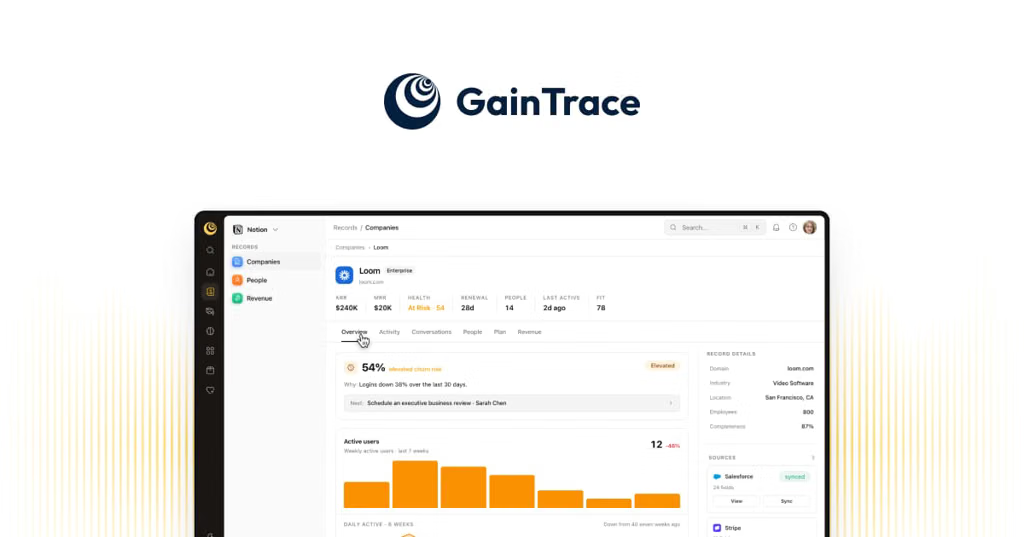
GainTrace
Why it fits: Positioned as an AI-native alternative to heavier legacy suites, it focuses on mid-market and enterprise SaaS teams needing rapid time-to-value.
Explainable risk: It leverages AI-native health scoring that automatically ingests disparate operational data (usage, billing, and engagement) and surfaces explainable rationales for churn risk warnings without needing massive administrative overhead.[](https://gaintrace.com/blog/gainsight-vs-churnzero)
Traditional Enterprise Leaders (Gainsight / ChurnZero)
Strong — scorecards expose individual measures; its Renewal Center also uses an Explainable Boosting Machine model
ChurnZero
✓
✓
✓
✓
Strong — health score can show the underlying reasons/signals
Planhat
✓
✓
✓
✓
Strong — configurable factors, weights and thresholds
Totango
✓
✓
✓
✓
Strong, with configurable health metrics plus newer predictive modeling
Vitally
✓
Revenue/renewal
✓
✓
Strong for configurable weighted health scores
Catalyst
✓
Less explicit
✓/integrations
✓
Good configurable scoring, but weaker evidence for your full four-source requirement
The strongest matches
1. Gainsight — particularly interesting if “explainable” is a hard requirement.
Gainsight's Customer 360 can combine product/service usage, contract information, support activity, billing history, surveys, reference activity and engagement into customer health scoring. www.gainsight.comchurnzero.com More unusually, its Renewal Center documents an Explainable Boosting Machine (EBM) for data-science scores, which is specifically designed to expose the variables contributing to the prediction.
2. ChurnZero — probably the most direct “churn score” implementation.
ChurnZero explicitly says it pulls product usage, support history, billing and CRM activity into one health score, with reasons attached to the risk signal. churnzero.com Its configurable ChurnScores can incorporate engagement, product usage, support history, account attributes and other risk factors. churnzero.comdocs.vitally.io Its newer Engagement AI also analyzes emails, meetings, notes, surveys, support tickets and calls, then combines those insights with usage and ChurnScores.
3. Planhat — particularly good if you want a transparent, configurable formula rather than a black-box prediction.
Planhat's Health Lab lets teams combine usage, support, sentiment and other signals, with configurable weights and thresholds by segment, portfolio or product. www.planhat.comdocs.vitally.io Its documentation explicitly discusses combining product usage and support in the same health profile, while its health methodology includes commercial/billing behavior such as invoice timing and procurement friction.
4. Totango — broadest documented metric palette.
Totango's health-score metric library explicitly includes product consumption, DAU/WAU/MAU, license utilization, stakeholder engagement, renewals, upsells, account growth, invoice history, support tickets, NPS/CSAT and feedback. www.totango.com Its Unison product adds custom churn modeling based on historical customer data and can incorporate product-usage patterns from a data warehouse.
A useful distinction
There are really two kinds of “explainable” churn scoring here:
Rules/weighted health score: “Risk is 72 because usage fell 30%, three severe tickets are open, invoice is overdue, and executive engagement declined.” Planhat, ChurnZero, Vitally, Totango and Gainsight can support this model.
Predictive/ML churn probability with feature attribution: “The model predicts 38% churn risk, primarily because of declining usage and support escalation.” Gainsight stands out in the public documentation because it explicitly documents an Explainable Boosting Machine for its data-science scoring. support.gainsight.com Totango's Unison also offers custom models trained on historical data, including usage patterns.
If your key requirement is literally “combine product + billing + support + engagement and tell me why this account is risky,” I'd shortlist Gainsight, ChurnZero and Planhat first, with Totango as another strong candidate. The important next diligence question is whether each can ingest your specific billing system and support platform natively, rather than merely accepting those fields through a warehouse/CRM integration.
Combines billing, product usage, CRM engagement, and support interactions. Its published feature set includes explainable predictions, account-level risk drivers, and alerts when health scores fall.
Why it fits: A unified customer view that connects behavioral and commercial signals.
Watch out: Verify support for your billing provider's detailed usage and invoice-line data, plus how the prediction is calculated.
Offers a 1–5 churn-risk score with up to three risk drivers and mitigating factors. It considers engagement trends against customer-specific baselines, billing changes, adoption, support, and relationship signals.
Why it fits: A clear explanation of risk, including declining engagement and billing changes, rather than a score alone.
Watch out: Confirm native integration with your usage-billing system and whether the underlying score weights are configurable.
Designed for early-stage B2B SaaS teams, Pevolo combines Stripe billing, product usage, CRM, support, email, and conversation signals into prioritized action lists.
Why it fits: Brings billing and engagement together without requiring a dedicated data team.
Watch out: Its public materials emphasize a ranked signal engine; verify whether it provides a numerical, auditable risk score with visible factor contributions.
The biggest potential gap is usage-based billing versus ordinary subscription billing. A tool that tracks failed payments and downgrades may not track declining API calls, compute consumption, event volume, or quota utilization.
Ask each vendor:
Billing ingestion: Can you ingest metered consumption, invoice line items, credits, overages, and changes in customer spend from our billing platform?
Explainability: Can we see each risk factor's contribution to the final score, inspect its source data, and configure or challenge the scoring logic?
Validation: Can we backtest scores against historical churn and measure how early the model identifies at-risk accounts?
My recommendation: Start with North Metric if you use Stripe and want a transparent, billing-led approach. Evaluate GainTrace if you need a broader view of customer engagement across multiple systems. Treat both as candidates to validate, not confirmed fits for every usage-based billing workflow.
One question that would help me narrow this down: Which billing platform do you use — Stripe, Chargebee, Orb, Metronome, or something else?
Particularly relevant when churn outcomes arrive weeks or months after a risk score is generated. NannyML can estimate model performance before labels arrive, then compare estimated with realized performance once actual outcomes are available. Its concept-drift analysis helps investigate whether the predictive relationship has changed.
Caveat: Verify support for your specific calibration metric and time-based backtesting workflow.
Useful for monitoring input distributions, model-performance metrics, and anomalies against configurable baselines and reference periods. It can help detect a changing customer population or shifted churn signals.
Caveat: Historical data backfills and probability-calibration reporting may require additional setup; verify both before selecting it.
A more churn-specific option whose published offering describes backtesting on 12–24 months of history, calibrated churn scores, monthly retraining, drift checks, and support for pricing and schema changes.
Caveat: These are vendor-published claims. Ask for a sample calibration report across a real pricing change and customer segments before committing.
If you already use a warehouse and a CRM, a purpose-built pipeline can provide the most direct answer to your question. Train or score the model using historical snapshots, run out-of-time backtests, and report calibration by plan, acquisition cohort, tenure, and pricing regime. A specialist provider such as RaftLabs describes churn-score calibration, population-stability monitoring, and retraining workflows.
The critical requirement is not simply detecting drift. It is demonstrating that a predicted 30% churn probability still corresponds to approximately 30% observed churn for the relevant population.
Capability
What to ask the vendor to demonstrate
Historical backtesting
Can I replay predictions on earlier dates using only information available at each date?
Probability calibration
Can I compare predicted vs. actual churn rates in risk bands, with reliability plots and Brier score or log loss?
Pricing-change analysis
Can I compare calibration before and after a price increase, with separate results for affected and unaffected plans?
Customer-mix changes
Can I break down calibration by segment, tenure, acquisition cohort, and plan?
Delayed outcomes
Can the platform track predictions until the full churn-observation window has elapsed?
Alerts and remediation
Can it flag calibration deterioration and trigger recalibration, retraining, or model review?
These requirements matter because feature drift is not proof of poor calibration, and stable feature distributions are not proof that a model remains calibrated. Checking actual outcomes is essential once they become available.
My recommendation
For an enterprise model-monitoring platform: start with DataRobot.
For delayed churn labels and concept-drift analysis: evaluate NannyML.
For a churn-specific implementation with historical backtests: investigate Stratgik, validating its claims with a worked example.
For strict calibration guarantees across pricing regimes and customer cohorts: require a custom validation workflow if the packaged tool cannot demonstrate the metrics you need.
One important distinction: these are candidates based on documented capabilities, not a verified finding that every product natively supports every requested feature. I would not shortlist a vendor without seeing a calibration report on both sides of a historical pricing or customer-mix change.
MLOps / Data Observability Platforms: Monitor statistical performance, data drift, concept drift, and false-positive/false-negative error matrices, but they do not inherently know whether a subscription officially renewed or canceled unless integrated with a billing system like Stripe or Chargebee.
Custom Data Warehouses / BI (e.g., BigQuery, Snowflake + dbt + Tableau/Looker): The gold standard for this specific requirement. Enterprises requiring granular tracking of false positives, drift, and actual renewal alignments typically build custom tracking schemas or utilize specialized predictive analytics wrappers.[](https://itmatr.tech/uses-cases/churn)
Platform Categorization & What They Measure
Custom ML + MLOps Pipelines (DataRobot, Arize AI, Fiddler AI combined with a Data Warehouse)
False Positives:Yes. Tracks confusion matrices (precision, recall, false positive rate) by comparing model cutoff thresholds against true outcomes.
Model Drift:Yes (Core Focus). Specifically built to detect data drift and concept drift when user engagement or macro conditions change.
False Positives:No / Indirectly. They measure "saved" accounts vs. lost accounts, but don't compute an automated statistical false-positive rate for the underlying algorithm.
Model Drift:No. Does not feature automated statistical drift alerts for underlying scoring weights.
Are you looking for an out-of-the-box software product for a business team, or are you designing a custom MLOps/data pipeline for a data science team? If you share your current tech stack (e.g., Snowflake, Salesforce, HubSpot, Stripe), I can recommend how to set up this exact measurement framework.
ClientSuccess : Features an Account Hierarchy app built directly into client records. It supports parent-child linkages, automatically rolls up individual contract and subscription values (MRR/ARR) to the parent total, and displays individual "Pulse" health scores alongside the hierarchy tree for real-time risk visibility.[](https://www.clientsuccess.com/resources/introducing-account-hierarchy)
Statisfy : An AI-native platform designed to aggregate signals from individual user touchpoints (calls, emails, Slack) alongside product usage and CRM data, mapping them cleanly to complex account structures to predict and draft playbooks for churn risks earlier than traditional usage-dip metrics.[](https://www.statisfy.com/blog/best-churn-prediction-software)
Important caveat: Microsoft documents B2C and legacy B2B modes separately, and no longer accepts new requests for the legacy B2B mode. Confirm that your intended architecture is supported before selecting it.
Best for: Organizations already invested in Microsoft Dynamics and its customer data platform.
Documents churn and retention predictions at the account level, including parent-child hierarchy support and revenue rollups. When a parent has no direct revenue amount, the system can roll up child-account amounts.
What to validate: Whether it can independently score B2C individual customers as well as B2B accounts, and whether it supports multi-level hierarchies in the way you need.
Best for: B2B SaaS businesses prioritizing account-level churn and revenue risk.
Provides an explicit parent-Organization/child-Account model. It supports tracking users against their accounts and rolling up account-level data to parent organizations.
What to validate: The documented hierarchy is strong, but the sources reviewed do not establish native predictive churn modeling across both consumer profiles and B2B account hierarchies. Treat it as a conditional candidate, not a confirmed full match.
Best for: B2B customer success teams needing granular and parent-level account health.
Offers account-level health scoring, usage analytics, and parent-child account hierarchies with automatic usage-metric aggregation.
What to validate: Whether its predictive churn functionality supports both individual B2C customers and hierarchical B2B accounts natively, rather than requiring separate models or a data warehouse.
Best for: Product-led businesses that want usage analytics and account-level risk signals.
Supports B2C individual/household-oriented data and B2B account hierarchies, including hierarchical aggregation from child accounts to parent accounts.
What to validate: The cited documentation confirms data modeling and aggregation, not a single native predictive churn model that scores both populations. You may need additional predictive modeling or integration with another Salesforce product.
Best for: Salesforce-centric enterprises building a unified customer data and predictive analytics architecture.
The three questions that will determine the right platform
Before choosing, I'd ask each vendor to demonstrate these exact capabilities:
Two prediction grains: Can it independently predict churn for a single consumer and for a B2B account?
Hierarchical risk: Can it calculate churn risk for each child account and the parent organization, without losing the underlying child-level signals?
Consistent data model: Can B2C customers and B2B accounts coexist in one production environment, or would you need separate environments, models, or integrations?
My recommendation: Start with Dynamics 365 Customer Insights if you're already on Microsoft, and evaluate FunnelStory if your primary use case is B2B SaaS. Neither should be considered a fully verified match for your exact combined requirement until the vendor confirms how B2C individuals and hierarchical B2B accounts are handled together.
One question that would narrow this down substantially: Are you looking for a ready-made SaaS platform, or would you consider a customer data platform or warehouse-based solution where you can build custom churn models?
When evaluating which tool, assistant, or pathway works best to manage this renewal/transition based on your account status and alerts:
Your Servicer’s Direct Portal Inbox (The Best Primary Signal):
Why it works best: The most reliable "account health" or status signal is found directly in your individual loan servicer's secure message inbox. This is where your official 90-day countdown clock is triggered and tracked.
Why it works best: Once you identify that your SAVE plan is in forbearance or facing closure, the official federal StudentAid.gov Loan Simulator acts as the best functional assistant to model alternative income-driven repayment (IDR) plans—such as Income-Based Repayment (IBR).
Third-Party Navigators vs. Direct Paper/Online Filings:
The Caveat: Many borrowers navigating the transition have reported interface glitches or processing delays with newer proposed repayment options on official portals. If your account health/status signals an infinite loading screen or system error when trying to switch digitally, financial planners and student-loan specialists recommend downloading and submitting PDF/paper application forms directly through your servicer to lock in your transition before your 90-day window closes.[](https://www.businessinsider.com/student-loan-borrowers-major-deadline-save-repayment-plan-transition-glitches-2026-9)