
Monitor the pages that can change a buying decision, then configure alerts around the relevant part of each page. Shortlist Distill for precise selections and conditions, and Wachete for hosted monitoring with history. Manual checks remain practical for a short list. None can tell you whether a page's edit changed an AI recommendation without separate answer evidence.
A comparison page gaining a new recommended product is important. Its cookie banner moving is usually not. The best monitor is the one that helps your team distinguish those events and retain enough history to explain what happened.
Which monitor fits your workflow?
Use these recommendations as a starting shortlist, then test the actual pages you care about. JavaScript rendering, regional content and page structure can change the result.

| Option | Best reason to shortlist | Useful capability | Main risk to test |
|---|---|---|---|
| Distill | Watch a specific section or condition | Page selections, conditions and local or cloud monitoring | A fragile selection or inactive local browser misses a change |
| Wachete | Keep a hosted watchlist and change history | Whole-page or partial monitoring and historical records | Plan-specific rendering and retention fit |
| Manual review | A handful of high-value pages | Human interpretation with little setup | Inconsistent cadence and missing historical evidence |
A meaningful change worth reviewing
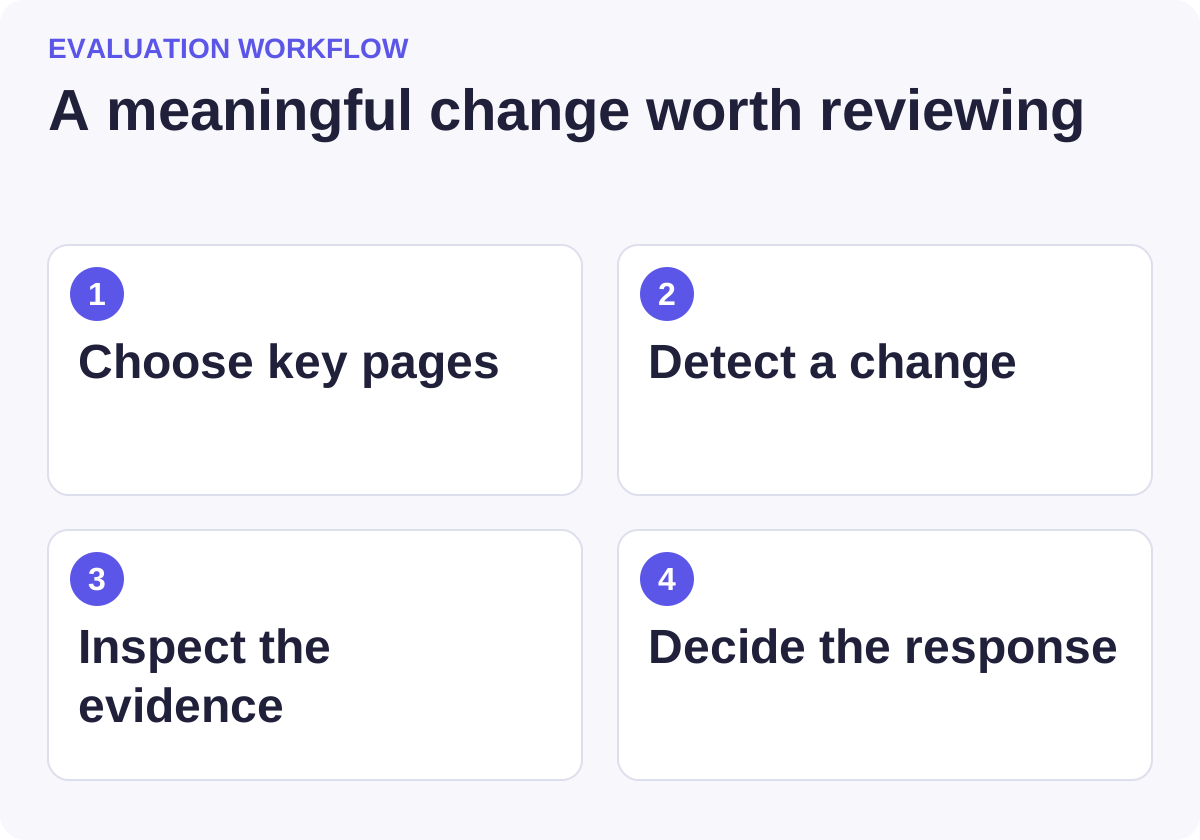
Use this workflow to compare candidates against the same requirements.
Start with a watchlist worth maintaining
A useful watchlist records why each page matters. Save the URL, publication, buying topic, relevant section, current recommendation, date checked and owner. Include the observed AI answer that cited it when that is your reason for watching.
Parse helps investigate cited sources in sampled AI answers. That can identify candidates for monitoring; it does not mean every cited page is commercially influential or appropriate to contact. Read the page before adding it. A government reference, a customer forum and a commercial comparison have different roles.
Prioritize pages where a meaningful edit would change your next action. A pricing comparison could require updating your own positioning. A removed product entry could warrant checking whether the article is outdated. A new limitation may reveal a factual error worth documenting.
Keep the initial list small enough to review. Our AI visibility scorecard guide explains how to keep source observations separate from business outcomes. A longer watchlist is not automatically a more useful one.
When should you choose Distill?
Distill emphasizes selecting parts of a page and using conditions for notifications. It offers local and cloud monitoring, a distinction that belongs in the purchase decision. Local monitoring and a hosted check do not have the same execution dependencies.
Distill public product or documentation page.
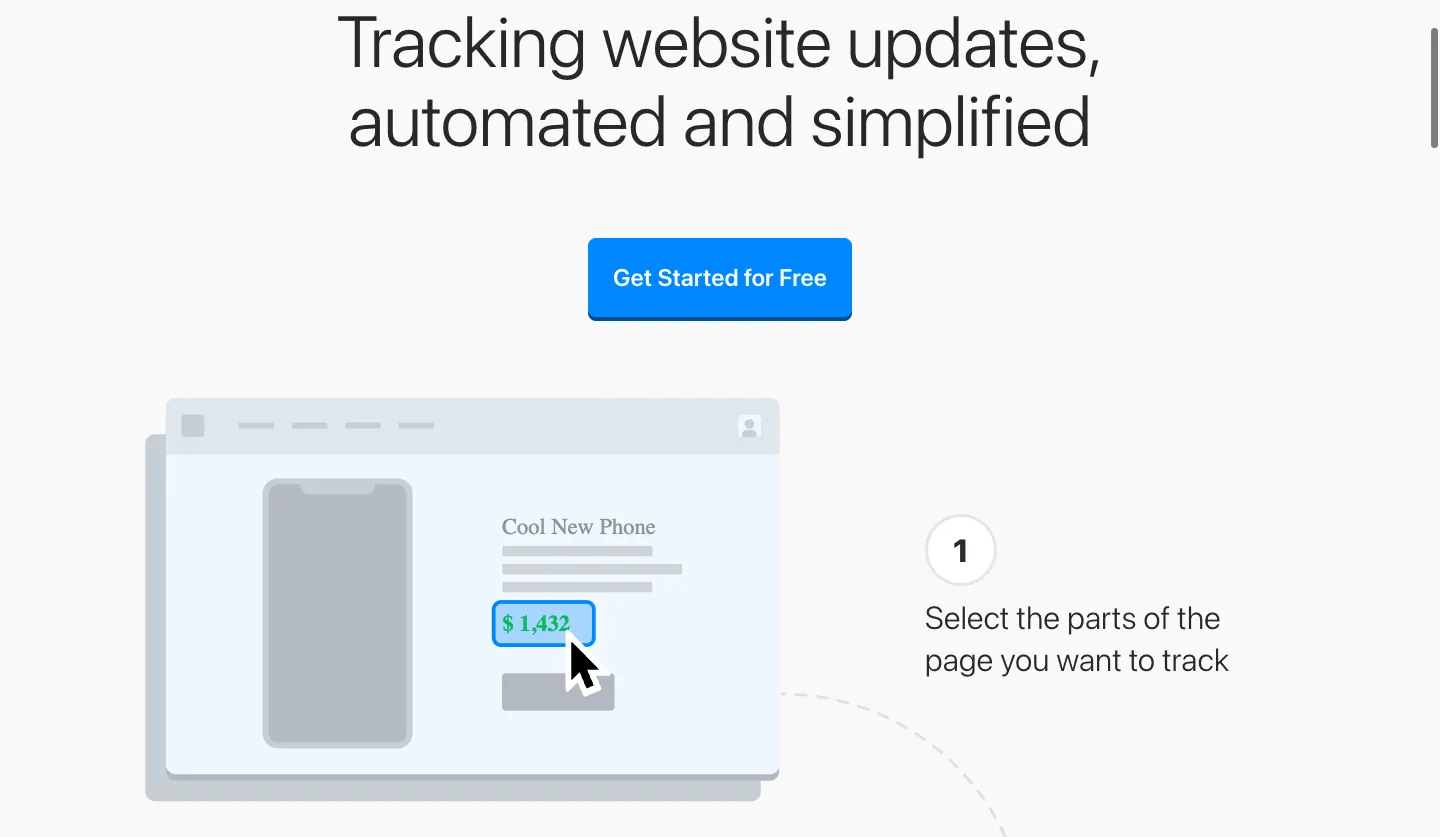
Public source page, captured November 2, 2026.
Choose Distill when you want fine control over a specific recommendation list, price field or text block. Do not choose a local-only setup for an important alert if the relevant device or browser will be unavailable when checks should run. Confirm the selected plan's execution model and limits.
A precise selection reduces noise but can become fragile when the publisher redesigns the page. Test what happens when the target element moves or disappears. An empty selection should not be mistaken for proof that the brand was removed from the editorial content.
Use conditions carefully. Looking only for your brand name may miss a change in the sentence surrounding it. A monitor that detects “Acme” but ignores “no longer recommended” is configured for presence, not recommendation meaning. Review the full relevant passage when the alert arrives.
If you want to know when AI changes its answer about your brand, start with a free brand check. It takes a minute.
When should you choose Wachete?
Wachete describes hosted monitoring, whole-page or partial checks, modern interactive pages and change history. Its public overview says it can retain up to twelve months of history, with exports and several notification channels. Confirm the retention and rendering capabilities included in the plan you evaluate.
Wachete public product or documentation page.
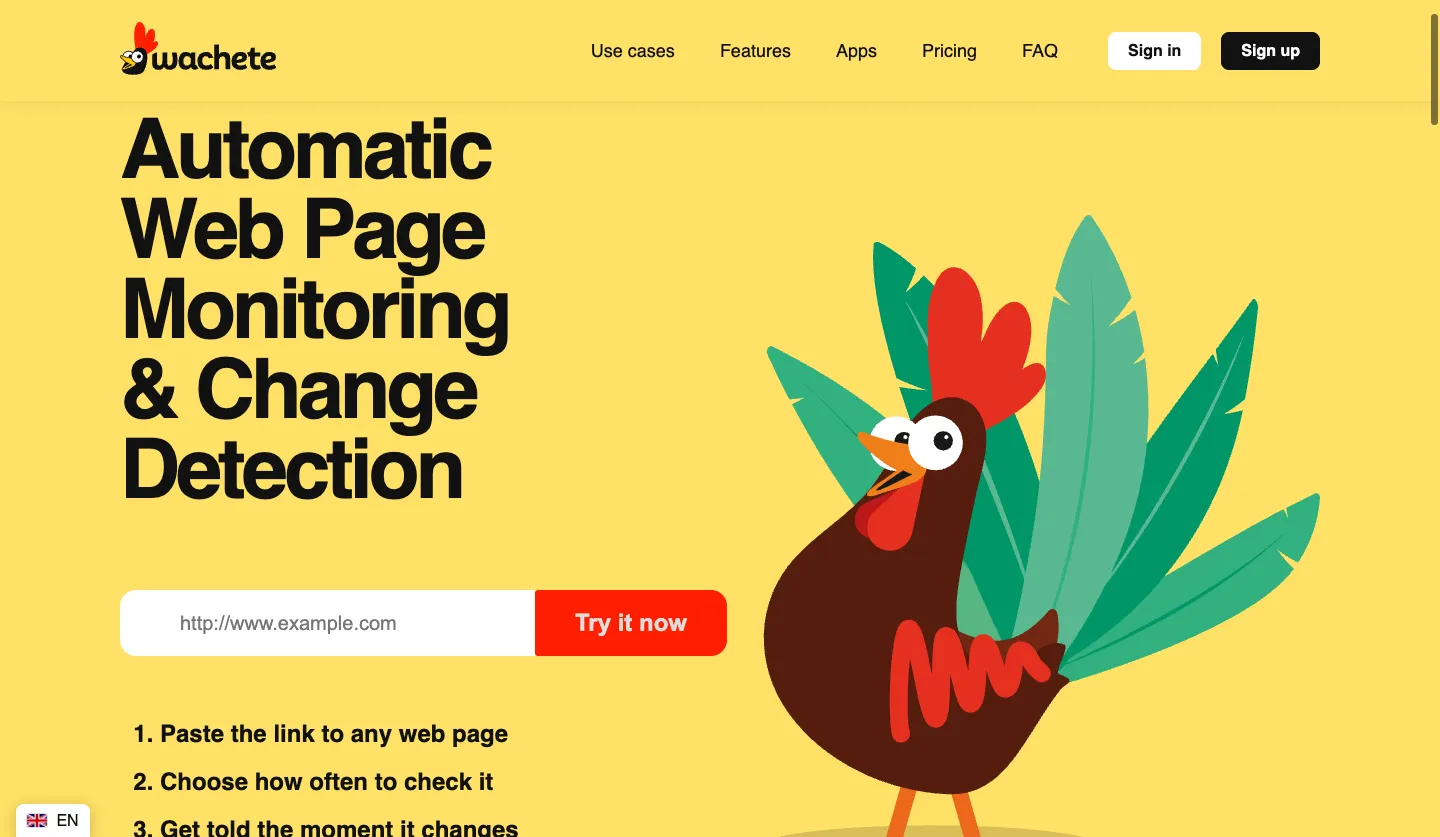
Public source page, captured November 2, 2026.
Choose it when your team wants a hosted watchlist with an accessible record of changes. Do not assume the broad product description proves reliable collection of every JavaScript-heavy publisher page. Test the exact URLs, especially pages that load recommendations after interaction.
History is valuable only if it preserves the evidence you need. Ask whether the stored record includes readable content, a visual capture, timestamps and the context around the changed passage. An alert log saying “changed” is not equivalent to an archived before-and-after comparison.
Include a temporary page error in the evaluation. The system should make it possible to distinguish a failed fetch from a genuine content removal. That distinction prevents an infrastructure problem on the publisher's site from becoming an incorrect competitive conclusion.
When are manual checks enough?
Manual monitoring works for a small number of important pages when someone owns a regular review. Save a dated copy or screenshot of the relevant passage and record what changed. Use the same browser context and region where practical, and note unavoidable differences.
Choose this route when interpretation takes more time than collection and the list is short. Do not choose it if the team already misses reviews or cannot find the previous version. A calendar reminder is only useful when the resulting evidence is stored somewhere others can access.
A simple record can contain the page URL, checked date, previous wording, current wording, interpretation and next action. Keep the original capture beside the interpretation. That allows a colleague to disagree with the conclusion without losing the underlying facts.
Manual review is also useful as an audit of automated alerts. Periodically inspect a few quiet pages. Silence can mean nothing changed, but it can also mean a selector broke, a check failed or the monitor is watching the wrong part of the page.
Test meaningful edits against harmless noise
Use a page you control for a reproducible trial. The fixture should contain a recommendation list, comparison table, date, rotating decorative element and a section rendered with JavaScript. Label all brands and claims as fictional.
| Controlled change | Desired result | Why it matters |
|---|---|---|
| Remove a recommended brand | Clear alert with previous text | Detects loss of an editorial placement |
| Add a competitor | Clear alert with context | Detects a changed comparison set |
| Add a plan limitation | Alert preserves the exact qualification | Presence alone misses meaning |
| Change only a timestamp | Low-priority or suppressed alert | Reduces routine noise |
| Move the selected section | Continued monitoring or visible configuration failure | Tests selector resilience |
| Return an error page | Fetch failure is distinguishable from content removal | Protects interpretation |
Run each change separately and record the time it was made, the time detected and the resulting evidence. Do not score a tool for a change it was never configured to watch. Keep the settings with the result so the comparison is reproducible.
Handle JavaScript and regional differences explicitly
A publisher may deliver different recommendations by country, device or consent state. A monitor that captures one version is not necessarily wrong when your browser shows another. Record the context before treating the difference as an editorial change.
Test delayed content and interaction requirements. If the recommendation list appears only after scrolling, a quick initial capture may miss it. If a page requires a login, use only access your organization is entitled to use and confirm the vendor supports the workflow. Do not treat a blocked page as an invitation to evade the restriction.
Ask how failed checks affect quotas and alerts. A watchlist that silently retries for days can create false confidence. Important pages need a visible “not successfully checked” state and an owner who responds to it.
For AI-source monitoring, keep the page record and the answer record separate. The prompt-set guide explains how to repeat relevant questions. A source edit is a reason to investigate subsequent answers, not proof that those answers changed.
Price the review workload, not only the page count
Estimate checks before choosing a plan. Twenty pages checked once an hour create 14,400 scheduled checks in a thirty-day month. The same pages checked daily create 600. These are workload calculations, not claims about any vendor's billing unit.
Ask which checks count toward the allowance, how rendering affects cost and what retention is included. Then estimate human review. Fifty irrelevant alerts per week can cost more than a higher subscription that reliably narrows the selection.
Choose the cadence according to the decision. A strategic comparison page may not require minute-by-minute checks. A page tied to an imminent launch may warrant closer attention for a limited period. Change the configuration when the reason for monitoring changes.
Start with a small monitored set, the controlled fixture and a weekly review of missed or noisy events. Expand only after the team can explain a real alert from source capture to action. A monitor earns its place by making important changes understandable.