
Start with the analytics you already trust, then buy a specialist tool for a specific gap. GA4 can report identifiable AI referrals and the actions those visitors take. Siftly offers a more specialized AI reporting workflow. Self-reported attribution adds what customers remember. None of these, by itself, proves that an AI recommendation caused a purchase.
A buying guide needs to separate what a tool observes from what its report infers. The distinction is especially important when a dashboard places an AI prompt beside a revenue figure: proximity on a screen is not evidence that the same person followed that exact journey.
Which option fits the decision you need to make?
Use the table to choose an evaluation path. These options can complement one another; replacing your existing conversion tracking is not a prerequisite for measuring AI referrals.

| Option | Best reason to evaluate it | Observable starting point | What remains to prove |
|---|---|---|---|
| GA4 | You already use it to measure acquisition and conversions | Collected sessions, source information and site events | Correct implementation and attribution scope |
| Siftly | You want analytics beside AI visibility and content operations | Its advertised GA4 integration | Exported fields, joining rules and plan availability |
| Self-reported attribution | Buyers encounter you before an identifiable click | A customer's answer to a question | Recall accuracy and coverage of nonrespondents |
The cheapest useful starting point is often a GA4 report plus a carefully worded customer question. A specialist platform earns its cost when it makes an important investigation easier or supplies evidence you can inspect and cannot otherwise obtain.
Visibility to business evidence
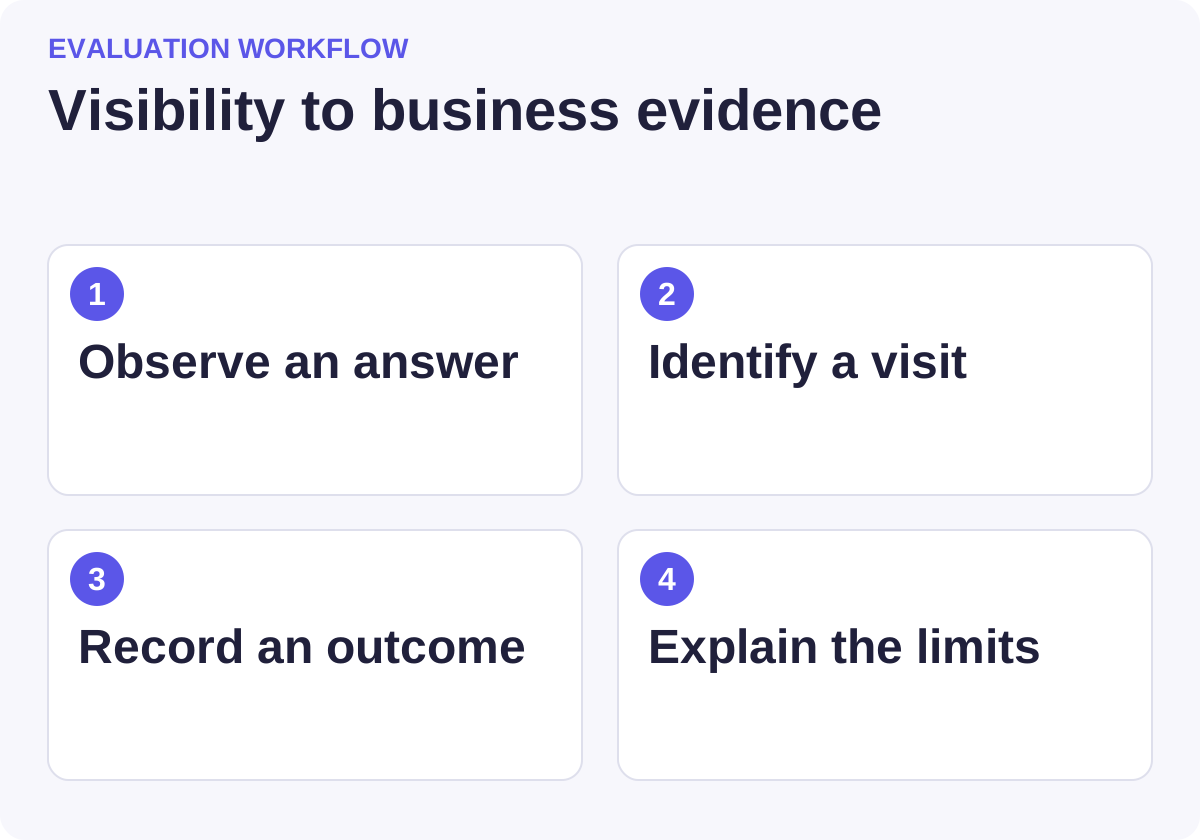
Use this workflow to compare candidates against the same requirements.
Understand the four different measurement questions
Visibility asks whether a brand appeared in a sampled AI answer. Referral traffic asks whether a visitor arrived with recognizable source information. Conversion reporting asks what that visitor did on your site. Incrementality asks whether the outcome would have happened without the AI interaction.
Those questions require different evidence. A saved answer with a citation can establish an observed mention. A browser referrer can identify a session's apparent origin. A purchase event can record a transaction if implemented correctly. None automatically answers the counterfactual question about what would have happened otherwise.
Consider an illustrative journey: a buyer asks ChatGPT about a category, searches Google for your company the next day and books a demo. Your AI visibility monitor may have observed a similar answer. GA4 may record the booking after a Google visit. The customer may report ChatGPT as the first place they heard of you. All three records can be useful without being a single verified path.
Keep them as separate fields. A report that admits uncertainty is more useful than one that quietly manufactures a complete journey.
When should GA4 be the default?
GA4 is the default starting point when your organization already relies on its conversion instrumentation. Google's Traffic acquisition documentation describes session source dimensions alongside metrics such as key events and revenue. That provides a common measurement base for AI referrals and other channels.
GA4 public product or documentation page.
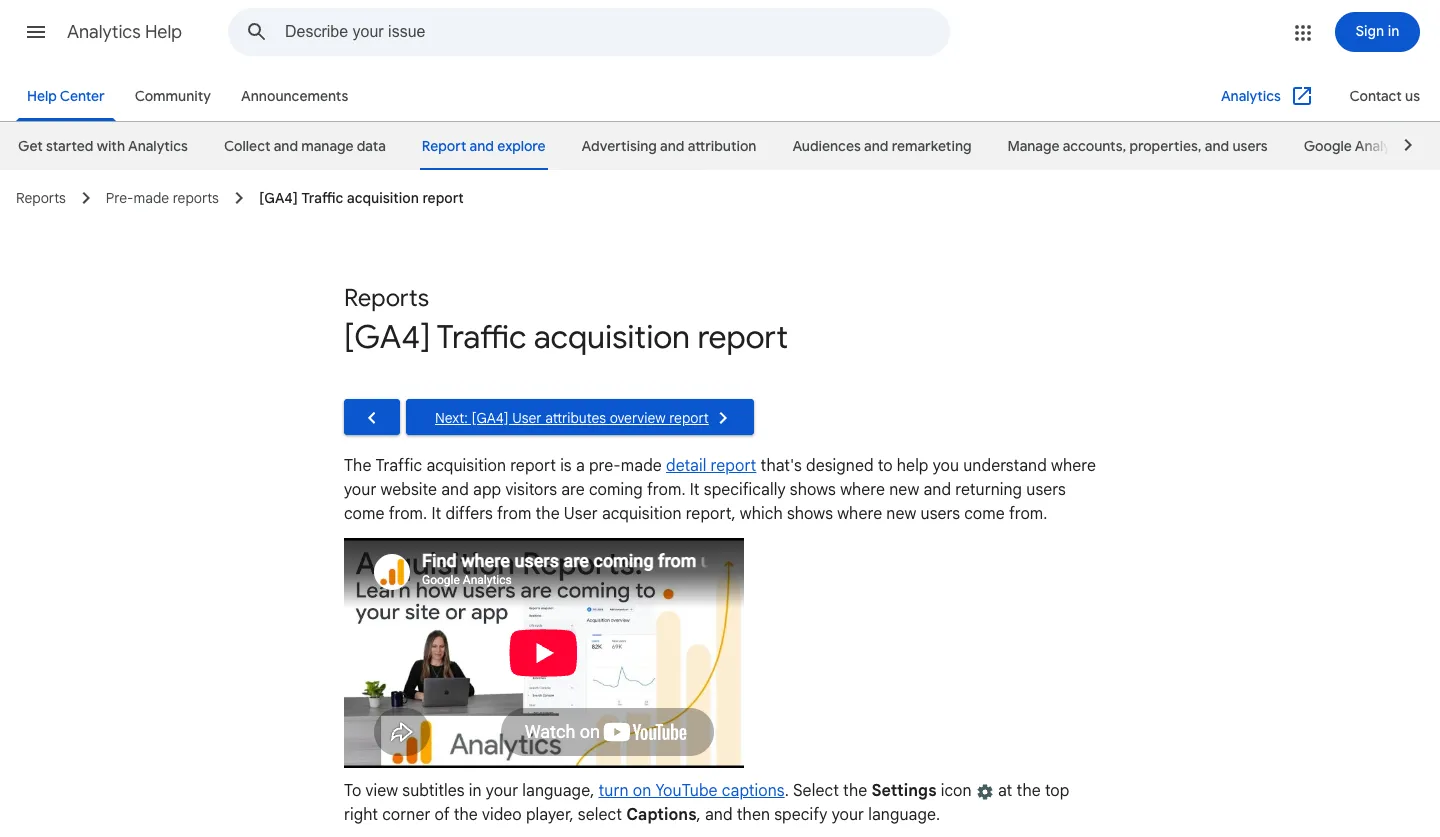
Public source page, captured November 2, 2026.
Choose GA4 when you can define an AI-referrer group, verify the collected events and maintain the report. Do not dismiss it because a vendor says AI visits always become direct traffic. Some visits have identifiable source information; others do not. A reporting filter cannot recover evidence that was never collected.
The main trap is mixing scopes. Google distinguishes user-, session- and event-scoped traffic dimensions. A first-user acquisition view and an event-attribution view answer different questions. Label the report so a reader knows which one they are seeing.
Do not choose a GA4-only workflow if the team cannot maintain the event implementation or if the missing work is upstream answer and citation research. GA4 measures your collected site activity. It does not provide a complete record of what every prospective customer saw inside an AI product.
If you want to know when AI changes its answer about your brand, start with a free brand check. It takes a minute.
When is Siftly worth evaluating?
Siftly is a relevant shortlist candidate when your team wants visibility research, content work and analytics in one place. Its integration catalog advertises GA4 sessions and conversions alongside CMS, Search Console and other connections. That is a reason to inspect the workflow, not proof that every displayed conversion can be traced to a particular AI answer.
Siftly public product or documentation page.
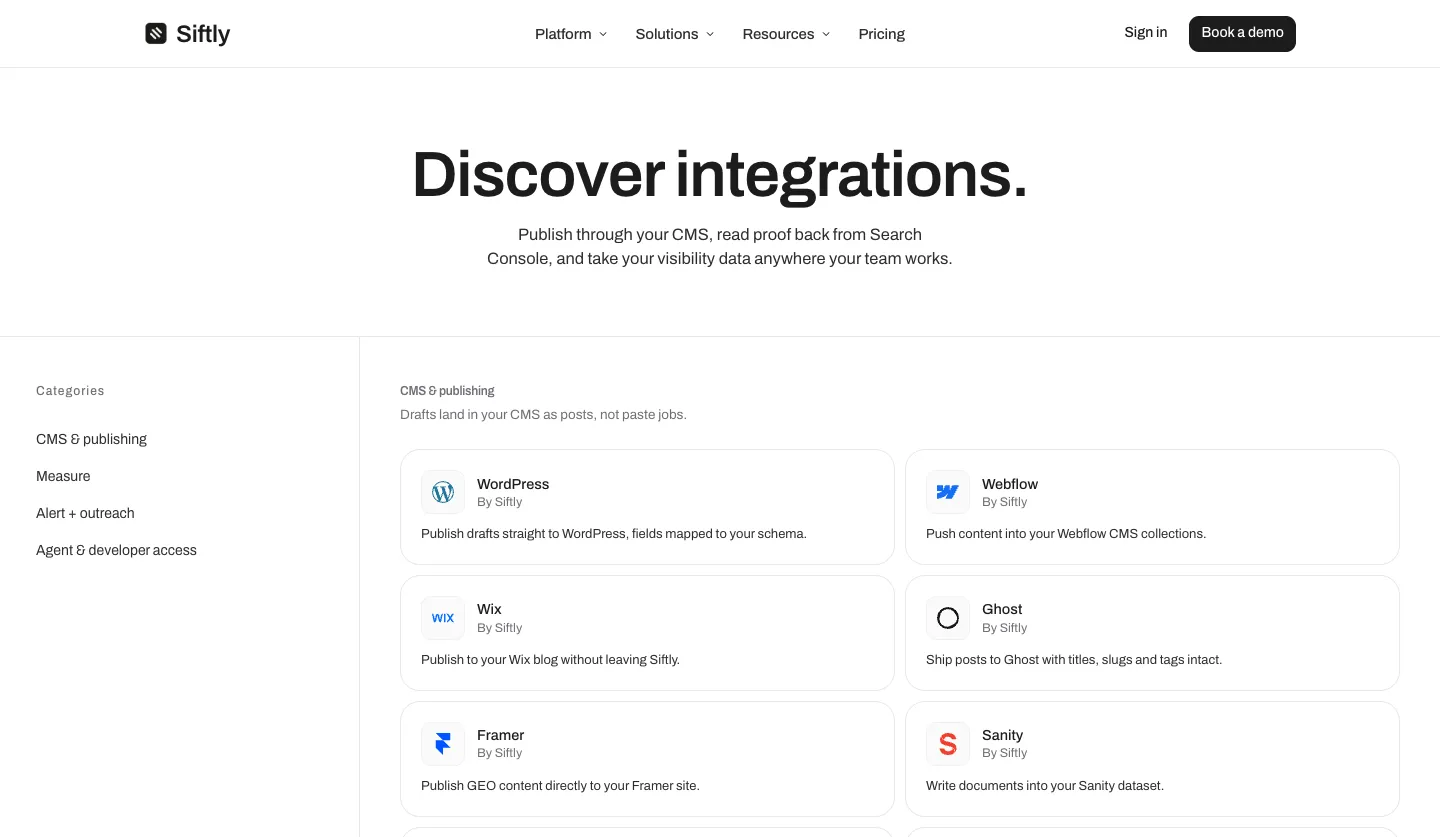
Public source page, captured November 2, 2026.
Choose Siftly when the surrounding research and content process is valuable and its analytics connection preserves enough detail to answer your questions. Do not choose it solely to replace a functioning acquisition report if the additional workflow would go unused.
In a demo, start from a conversion total and work backward. Identify the source property, date range, timezone, filters and attribution scope. Then ask whether a citation and a session are joined through an observed identifier or merely share a landing page and period.
Request an export that allows someone outside Siftly to reconcile the total. Confirm the required integration and export are included in the proposed plan. The public integration page establishes the advertised connection; it does not settle every implementation detail or make a controlled claim about measurement accuracy.
What does self-reported attribution add?
A customer can tell you about discovery that left no useful referrer. Add a short, optional question at an appropriate point: “Where did you first hear about us?” An open text field preserves language you might miss with a fixed dropdown. A follow-up can distinguish initial awareness from what prompted the purchase.
Choose this method when the buying journey is long or involves research across devices and colleagues. Do not treat responses as a representative census. People forget, simplify their stories and interpret “heard about” differently. People who answer may differ from those who skip the question.
Keep the original response and a separate classification. If someone writes “ChatGPT, then a friend's recommendation,” preserve both influences. Do not overwrite the answer with an exclusive AI label simply because the dashboard needs a single category.
Report the response rate beside the breakdown. In an illustrative sample, 12 AI mentions among 60 respondents are 20% of respondents, not 20% of all customers if 200 customers were asked. This simple denominator check prevents a substantial overstatement without requiring another analytics subscription.
Use a reconciliation exercise instead of a feature score
Prepare a small test plan in a staging environment or a clearly labeled internal test segment. Include a recognizable AI referral where available, a direct visit, a tagged campaign visit, a repeat visit and a conversion event. Do not mix these tests into commercial reporting.
For every case, save the expected source, observed source, landing page, event count and event identifier. Check whether the same event appears twice after a retry. If checkout uses another domain, verify the handoff. If consent changes what is collected, record that difference rather than expecting all systems to agree automatically.
Ask each vendor to reconcile its result against your existing analytics and transaction records. Differences should have named causes: timezone, event scope, filtering, identity handling or missing collection. An unexplained larger number is not evidence that the specialist tool is more accurate.
This exercise tests implementation and interpretability. It cannot prove the tool observes every AI-influenced buyer. Keep that limitation in the procurement notes so the sales promise does not become a stronger internal claim after the contract is signed.
Compare cost per useful decision
The full cost includes software, implementation, consent configuration, reporting maintenance and time spent investigating discrepancies. A free analytics product can still require specialist work; a paid dashboard can save that work without adding a new source of truth.
Price the exact scope. For a specialist tool, ask about domains, traffic or event allowances, retention, seats, exports and support for your conversion system. If prompt monitoring is bundled, separate that value from referral measurement. You may want both, but they are different purchases.
Use an illustrative operating question to judge value: “Which AI-referred landing pages produce qualified demos, and what should we improve?” A tool that helps answer that reliably may justify its cost. A tool that reports more decimal places without showing the underlying events does not necessarily improve the decision.
For B2B teams, connect lead quality through an appropriate CRM identifier instead of calling every form submission revenue. Keep revenue as booked, recognized or another clearly defined measure. The software choice should fit the definition your business already uses.
Keep visibility evidence beside business outcomes
Parse helps investigate AI answers, brand mentions and cited sources. Those observations belong beside acquisition and conversion data, with a clear boundary between them. Use the AI visibility scorecard guide to structure the visibility side and the prompt-set guide to keep the sampled questions relevant to buyers.
A useful monthly report can show observed answer coverage, identifiable AI referral sessions, qualified leads from those sessions and customer-reported AI discovery. Include the period, sample and collection limits for each. Do not add these rows together: some describe overlapping people and others describe answers rather than people.
Start with GA4 and self-reported attribution if they answer the immediate question. Evaluate Siftly when analytics belongs within a broader visibility and content program. Buy only after you can explain a real row in the report from source to outcome. That explanation is the most valuable feature in an attribution tool.