
Build an AI visibility monitor only if you need collection control that a finished product cannot provide. DataForSEO and Bright Data can supply useful inputs, but the API is only the collection layer. You still own question selection, repeat runs, brand matching, citation interpretation, failure accounting and a report somebody can trust.
The first buying decision is which surface you want to observe. A model API response and an answer collected from a consumer search interface are different observations. Mixing them under one platform label can make a beautifully built dashboard misleading.
Which provider belongs on your shortlist?
Compare the providers by collection model, supported outputs and integration tradeoffs.

| Provider | Strongest reason to evaluate | Collection distinction | Main diligence question |
|---|---|---|---|
| DataForSEO | Granular endpoints and explicit delivery modes | LLM Scraper and LLM Responses are different products | Are you buying interface collection or model API output? |
| Bright Data | Managed scraper delivery in a broader data stack | Dedicated AI scraper schemas and delivery options | What counts as one billable, usable record? |
| Finished dashboard | The decision matters more than owning collection | Provider manages more of the monitoring pipeline | Can you inspect answers, sources and sampling scope? |
Start with the surface and evidence requirement, then compare prices for an identical workload. A low per-request rate can be irrelevant if the endpoint collects the wrong thing.
An auditable answer collection
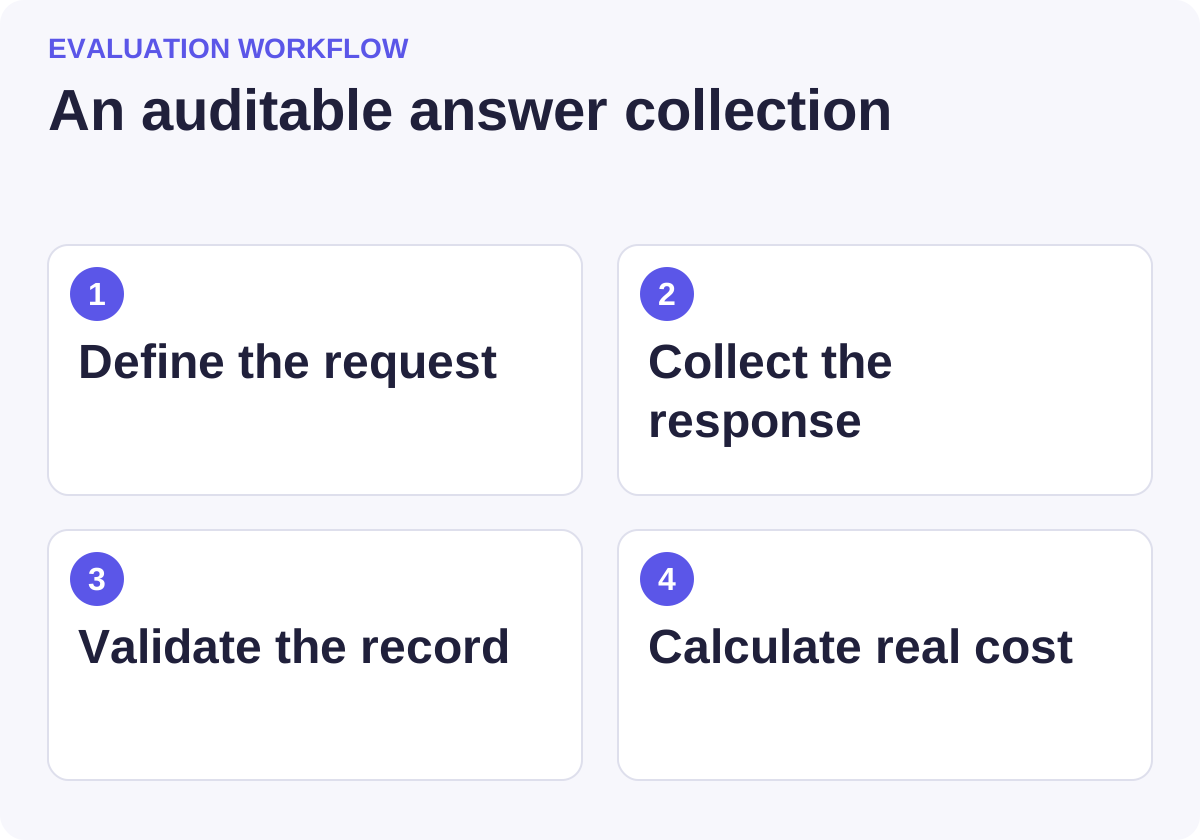
Use this workflow to compare candidates against the same requirements.
When is DataForSEO a good fit?
DataForSEO is especially worth evaluating when you want explicit control over endpoint families and delivery modes. Its LLM Scraper explanation distinguishes scraped interface results from LLM Responses, which call model APIs. Those are different measurement sources and should remain different datasets.
DataForSEO public product or documentation page.
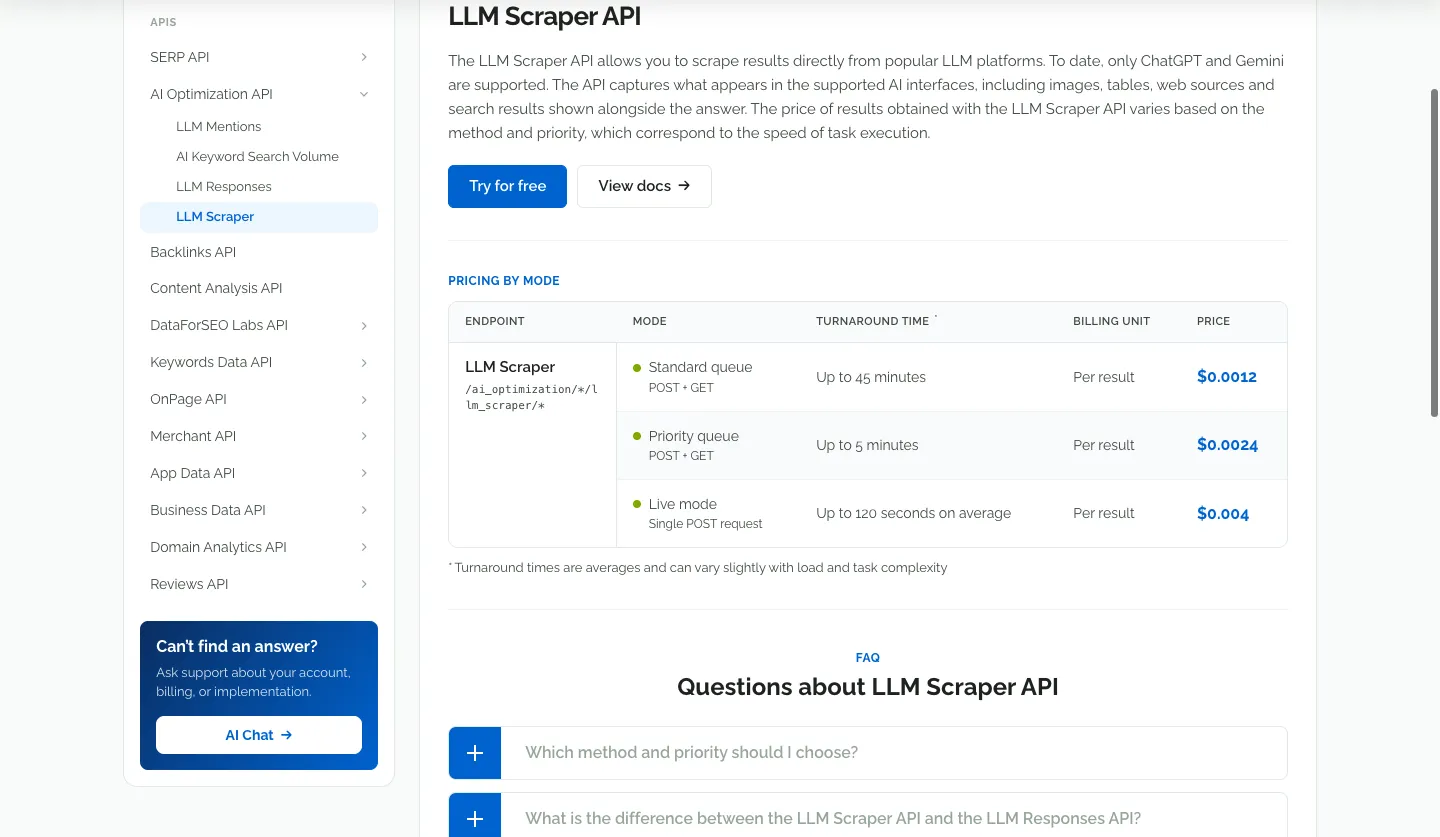
Public source page, captured November 2, 2026.
The LLM Responses overview describes model selection and Standard versus Live delivery. Availability differs by platform. A queue-based job and a synchronous request also require different scheduling, timeout and reconciliation logic.
Choose DataForSEO when those explicit boundaries fit your engineering approach and you can maintain the task lifecycle. Do not choose an LLM Responses endpoint merely because its price resembles an interface-scraping endpoint. If your question is what a buyer sees in a particular search product, confirm that the chosen product actually observes that surface.
For each endpoint, record the request parameters, collection time, provider task identifier and status. Preserve task failures in the same accounting system as successful answers. Otherwise the monitor can report a higher mention percentage simply because difficult requests disappeared from the denominator.
When is Bright Data a good fit?
Bright Data is relevant when collection belongs in a broader managed data pipeline. Its ChatGPT scraper page describes fields such as answer text, HTML, citations, country and response URL, plus API and file delivery options. Its LLM scraper overview describes several supported AI surfaces.
Bright Data public product or documentation page.
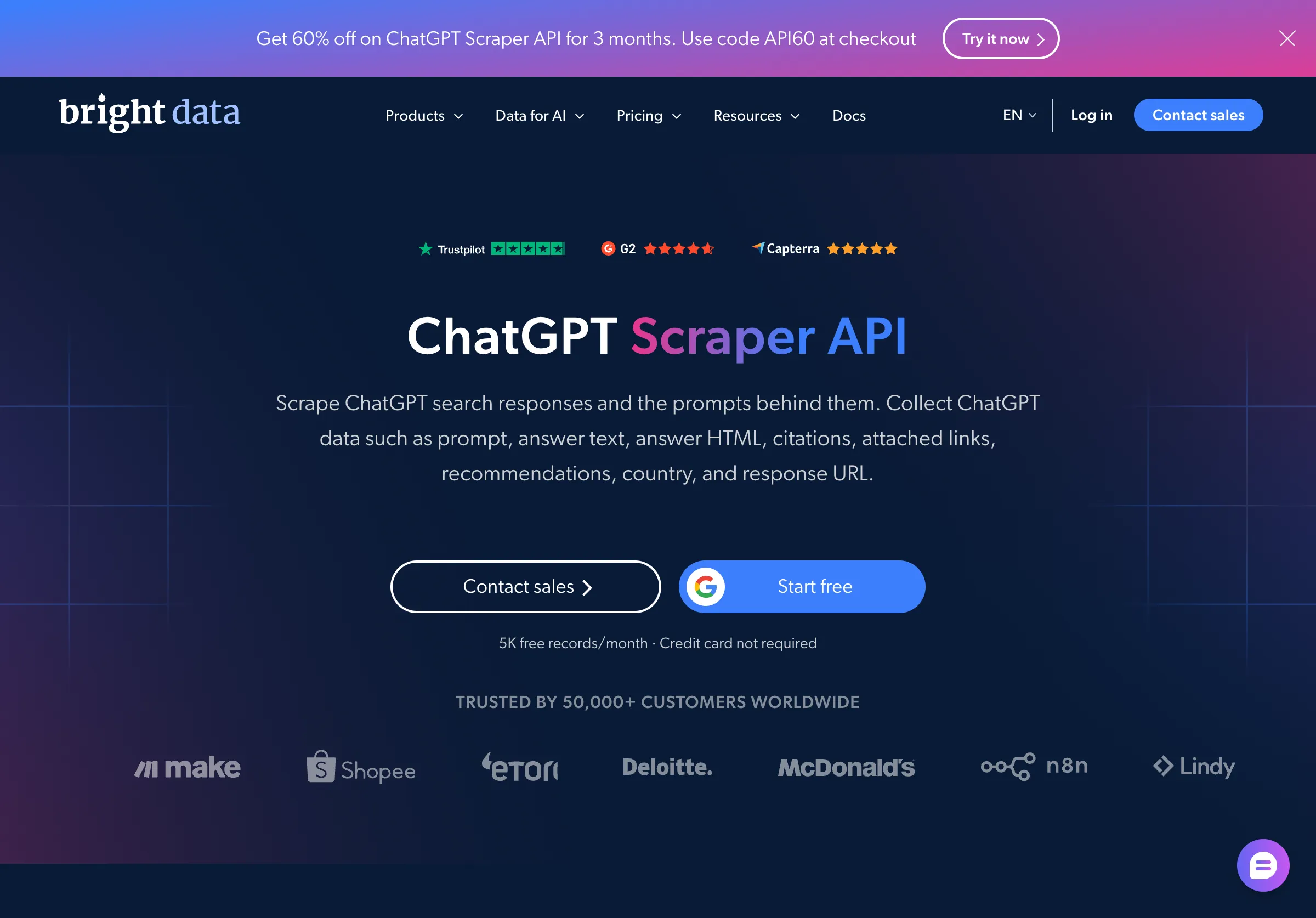
Public source page, captured November 2, 2026.
Choose it when the specific scraper's schema, delivery model and operational support suit your stack. Do not infer that every advertised field exists for every provider or every answer. Examine a payload with citations, one without citations and one that failed to produce a usable answer.
Ask how a batch maps inputs to output records, how retries appear and how the system reports partially completed work. Your application needs to distinguish “not yet delivered” from “completed without a brand mention.” Cloud storage delivery can be convenient, but it does not remove the need to reconcile each requested observation.
The pricing page is the place to confirm the exact scraper rate and billing unit. Treat promotional allowances separately from the ongoing workload. A trial that fits within free credits may say little about the monthly operating cost once you add more questions and repeat runs.
If you want to know when AI changes its answer about your brand, start with a free brand check. It takes a minute.
Calculate a workload before comparing prices
Use the same workload for every quote. An illustrative pilot with 50 questions, two surfaces, one market and three repeats requires 300 planned observations. Add retries and incomplete jobs explicitly; do not quietly count only the successful returns.
DataForSEO's LLM Scraper pricing lists $0.0012 per result in Standard mode and $0.004 in Live mode. For 300 eligible results that is $0.36 or $1.20 before other account conditions. Its LLM Responses product has a different formula, including underlying model charges; do not substitute those rates.
For Bright Data, obtain the applicable scraper rate and multiply it by billable records, then check the plan or deposit requirement. These calculations compare collection charges only. They do not establish equivalent output quality, coverage or latency.
Evaluate output quality with a fixed fixture
Prepare a question set before opening the vendor dashboard. Include a clear brand name, an ambiguous brand name, a category comparison, a regional question and a question likely to produce no recommendation. Keep spelling, locale and collection settings constant where the products support equivalent controls.
Review a sample manually. Does the returned text match the captured answer? Are citations attached to the correct URLs? Does the parser distinguish a brand mention from an unrelated word? Can it preserve a qualification such as “available only on the enterprise plan”?
Store a result rubric with concrete outcomes: complete answer, missing text, unusable citation URL, wrong surface, timeout or other failure. Do not reduce the evaluation to a single unexplained quality score.
Repeat the same questions. Different answers are not automatically evidence of a broken collector; generated answers vary. The task is to distinguish genuine answer variation from extraction loss. Without that distinction, a monitoring product can confuse a parser change with a market change.
Measure reliability and latency without hiding failures
Log every planned observation, including requests that never produce a usable result. Report completion rate, usable-answer rate, citation extraction checks and total wall-clock time separately. An HTTP success code does not prove that the returned page contains the requested answer.
For latency, compare the time from submission to usable data. Queue acknowledgment is not completion. Report a distribution such as median and a slower percentile only after collecting enough observations to make those figures meaningful. This guide provides no invented timing estimates.
Keep retries linked to the original request. Decide whether a late retry belongs in the original collection window or a later one, and make that decision visible in the data. A provider outage should appear as missing coverage, not a sudden disappearance of every monitored brand.
Finally, calculate cost per usable observation from actual billed usage during your pilot. Include billable empty responses where the provider considers them successful. Compare that operational cost with the published per-request rate; the difference tells you more than the headline price alone.
Keep enough evidence to reproduce the report
A useful record includes the exact question, surface, requested market and language, collection timestamp, provider task ID, completion status, raw response location and parser version. Add the extracted brand mentions and citations as derived fields, not replacements for the original evidence.
Version the question set. If the team replaces broad category questions with favorable brand-specific questions, the resulting trend should not pretend the sampling stayed constant. Keep failed observations and excluded records with reasons so another analyst can reconstruct the denominator.
Protect credentials and avoid sending private customer material in test prompts unless your organization has approved that use. Most visibility pilots can begin with public product questions. Keep retention and access rules appropriate to the data you collect.
For question design, use our AI visibility prompt-set guide. For reporting, the AI visibility scorecard explains why a sampled answer trend needs context. Collection infrastructure is useful only when the resulting observation has a clear meaning.
When is buying a dashboard the better decision?
Buy a finished product when your team wants to understand answers and act on their sources, and does not have a distinctive collection requirement. The engineering work extends beyond the API: scheduling, storage, retries, entity matching, question management, reporting and support all need maintenance.
Parse is a finished AI visibility product for investigating answers, mentions and cited sources. Evaluate it against the decisions your team wants to make, including whether the available scope and evidence are sufficient. Do not assume it exposes every collection control a custom system could offer.
Build when you need unusual markets, a research design the product cannot represent, custom integration into an existing data platform or a demonstrable operating advantage. Before committing, price both the pilot and the maintenance. Require a sample report that someone outside engineering can explain from its original evidence.
The right provider is the one that supplies usable observations for that design. The right purchase may also be no API at all, if owning the collector would delay the actual visibility work.