
The best customer-research tool keeps a question connected to the person, situation and evidence behind it. Shortlist Dovetail for research projects built around interviews and source material. Evaluate Enterpret when recurring feedback across systems needs classification and analysis. Use manual analysis for a bounded study. Do not let a polished AI summary replace the original customer statement.
“Does it integrate?” is not a complete buying question. A customer moving from a particular system, under a specific deadline, may be asking something very different from a developer exploring an API. Useful research preserves that difference.
Which approach fits your evidence?
Choose according to the source material and the analysis work you must repeat. Both platforms have broad capabilities; the distinctions below describe useful evaluation starting points rather than exclusive product categories.

| Approach | Best starting fit | Strength to evaluate | Common failure to prevent |
|---|---|---|---|
| Dovetail | Interviews and organized research projects | Transcripts, highlights and findings linked to evidence | A summary loses the original qualification |
| Enterpret | Feedback arriving across operational systems | Classification and analysis across a growing corpus | Broad themes merge different buying situations |
| Manual coding and source log | A small, focused study | Close reading and transparent interpretation | Inconsistent tags or untraceable conclusions |
Customer evidence to buyer questions
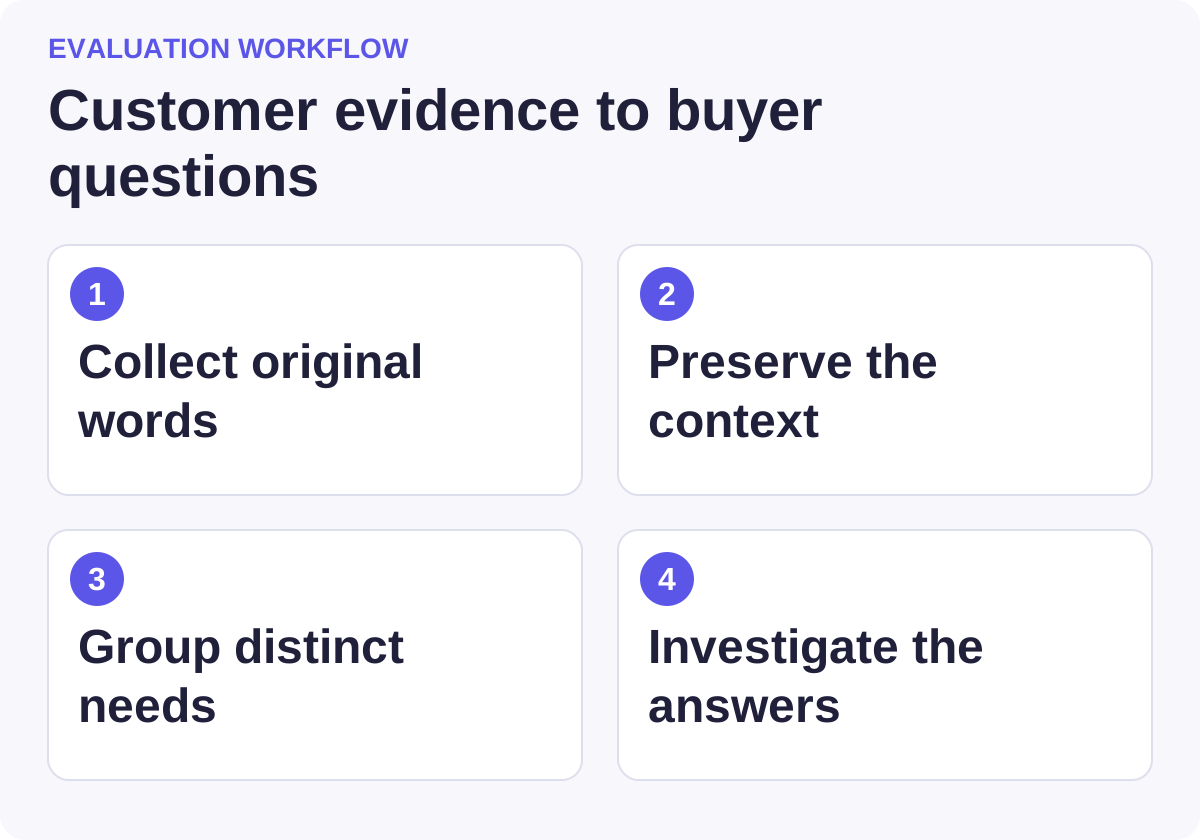
Use this workflow to compare candidates against the same requirements.
When should you choose Dovetail?
Dovetail Projects describes transcription, summaries, highlights and clips for research material, with tags and fields that help structure analysis. Its wider platform brings customer interactions into a shared research and intelligence workflow.
Dovetail public product or documentation page.
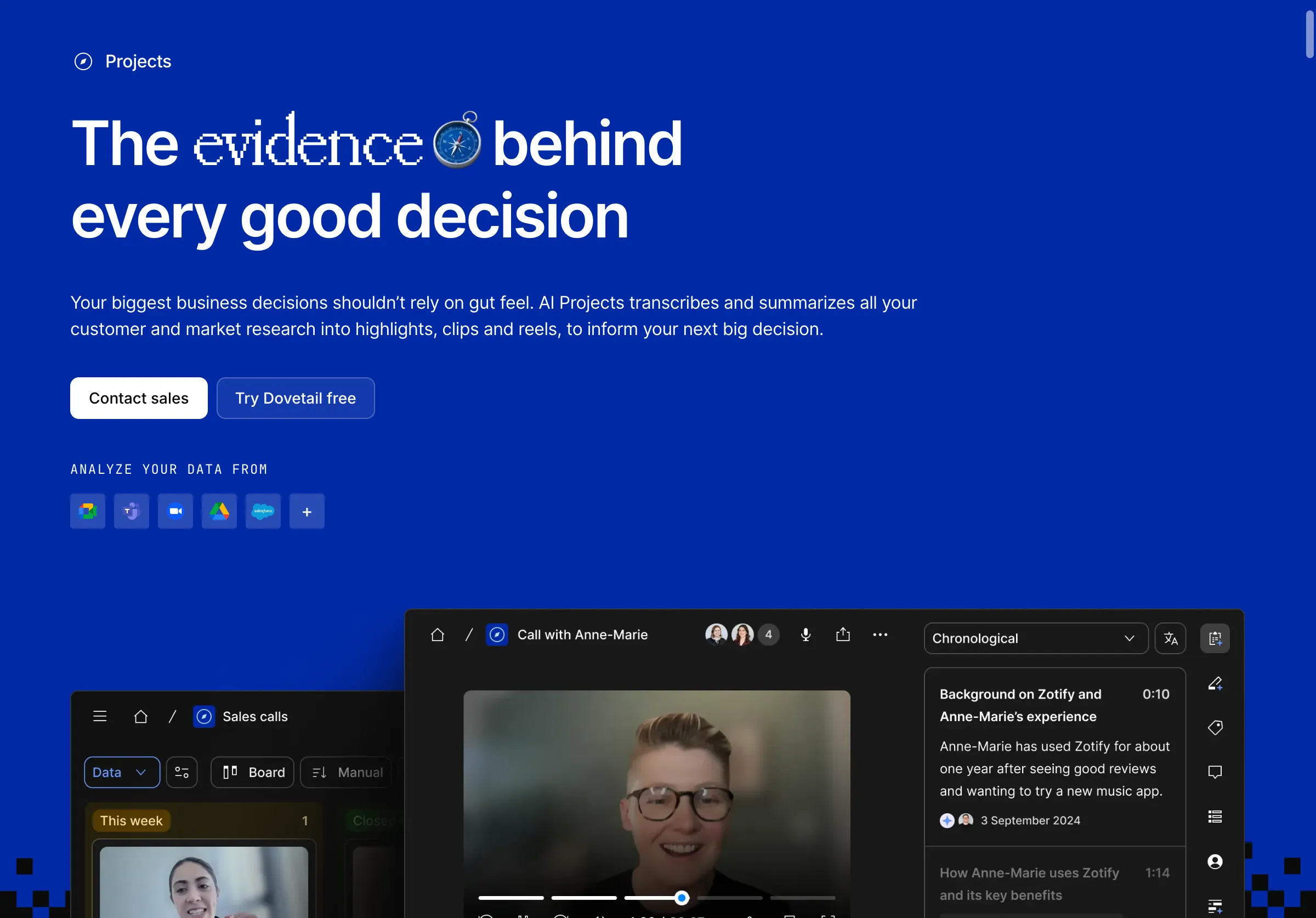
Public source page, captured November 2, 2026.
Choose Dovetail when the team needs to return from a finding to a specific interview passage or video moment. That is useful when a marketer wants to understand the wording of a buyer's concern and a product manager wants to inspect the underlying experience.
Do not choose it merely to produce more summaries. The evaluation should show whether a second researcher can verify the claim, distinguish participant groups and find contradictory evidence. A repository becomes less useful when every imported call produces an unreviewed document nobody reads.
Use the trial to correct a transcription error in a product name or numerical limit. Check how that correction affects highlights and later synthesis. Ask which permissions, retention settings and export capabilities are included in the proposed plan. Those controls matter when the source contains sensitive customer information.
When should you choose Enterpret?
Enterpret describes connecting feedback sources with customer context and analysis. Its Adaptive Taxonomy offering focuses on classifying feedback as the corpus evolves. That makes it a relevant candidate when support, sales and product feedback arrive continuously.
Enterpret public product or documentation page.
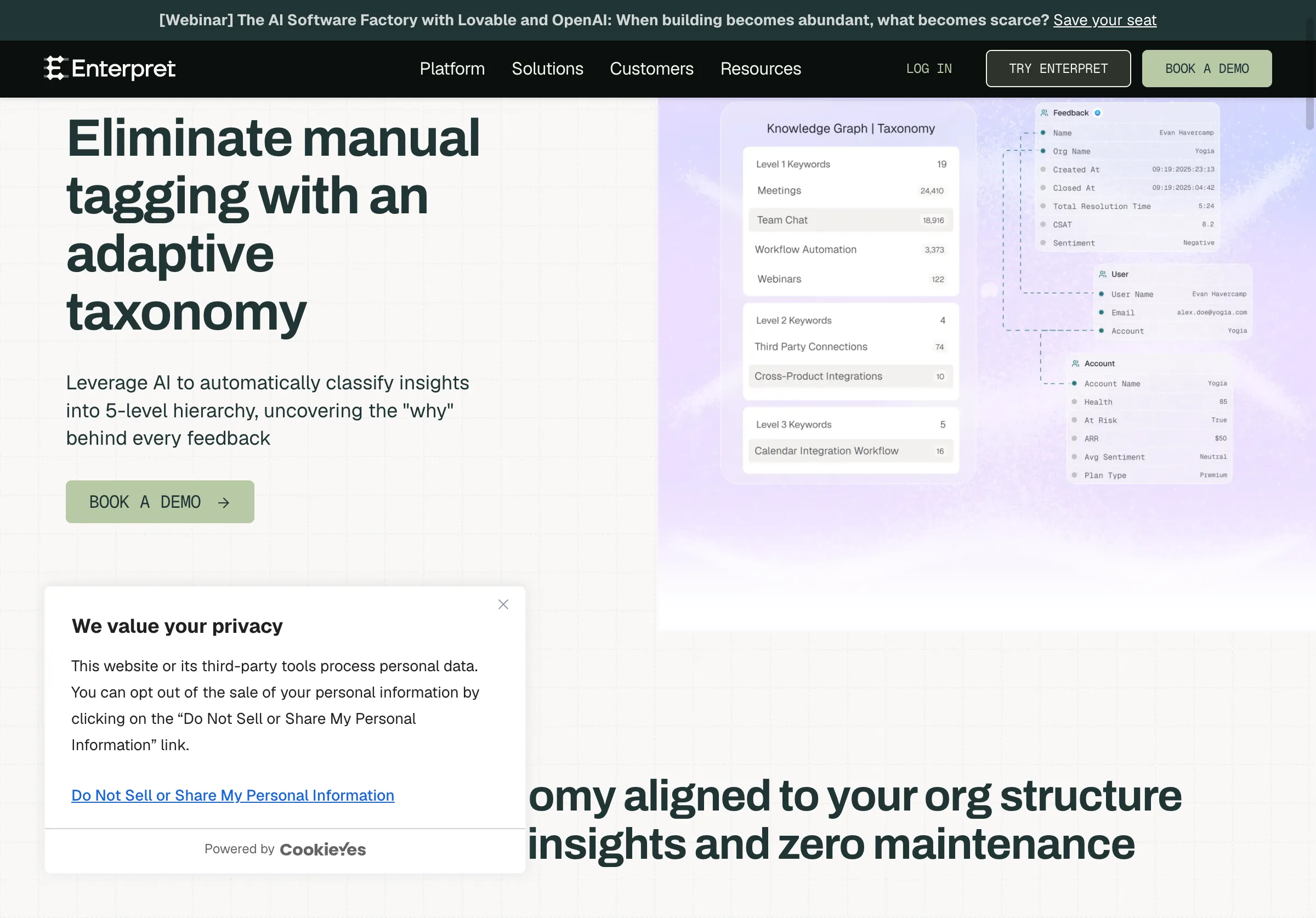
Public source page, captured November 2, 2026.
Choose it when the volume makes repeated manual sorting impractical and the team has a clear use for the resulting groups. Do not assume that an automatically generated category is the correct unit for a marketing question. “Integrations” may contain setup failures, procurement requirements and requests for unsupported products.
During evaluation, inspect the original records behind a theme. Ask how the system handles a statement that belongs in more than one group, how a human corrects classification and how changes affect historical comparisons. A theme's apparent growth can reflect a taxonomy change as well as a change in customer behavior.
Request a demonstration using a small, approved sample representative of your actual sources. Compare the resulting groups with a human-reviewed reference. The public feature description establishes the intended workflow; it does not establish accuracy on your terminology or customer population.
When is manual analysis the strongest option?
Manual analysis works well for a focused question with a manageable set of interviews or support records. A researcher can read closely, preserve ambiguity and adjust the analysis when an unexpected pattern appears. The tool can be a spreadsheet linked to source documents.
Choose this route for an early study, a new market or a small corpus where understanding matters more than continuous automation. Do not use it as an excuse to skip a consistent method. Write a codebook explaining what each category means and keep a column for uncertainty.
Have another person review a sample independently. Compare disagreements before analyzing the rest. If one researcher codes every mention of price as “too expensive” while another distinguishes budget, value and billing confusion, the final theme counts will not mean the same thing.
Keep the customer's wording, your interpretation and the proposed public question in separate fields. That separation is inexpensive and protects against a common mistake: rewriting a tentative observation into a confident market-wide claim.
If you want to know when AI changes its answer about your brand, start with a free brand check. It takes a minute.
Build a source set that answers the study question
Start with the decision you want to inform. A study about pre-purchase objections should not rely entirely on support tickets from existing customers. A study about setup confusion should not rely entirely on lost sales calls. Each source captures a different stage and population.
Record the source type, date, relevant customer segment and whether the speaker is a buyer, user or evaluator. Avoid exporting unnecessary personal details. Preserve enough context for interpretation while using your organization's approved research and data-handling process.
Sampling matters more than the number of documents in the dashboard. Ten repeated messages from one account are not ten independent customers. A support outage can dominate a week's feedback without becoming the main reason prospects choose a product.
Write down exclusions and coverage limits. If your evidence comes only from English-speaking enterprise customers, the resulting question set should not be described as representative of every market. A narrow, well-described study can still be very useful.
Use an illustrative coding fixture to compare tools
Prepare a small synthetic fixture before uploading real records. Include statements that look similar but imply different buying questions. The example below is deliberately fictional.
| Source statement | Buying situation | Useful public question |
|---|---|---|
| “Can we bring our old tickets across?” | Migration planning | What data can we migrate from our current helpdesk? |
| “The connector stopped syncing yesterday.” | Existing-user incident | How do we diagnose a failed synchronization? |
| “Does SSO cost extra?” | Plan evaluation | Which plans include single sign-on? |
| “We cannot send customer records outside our region.” | Procurement constraint | Where is data stored and processed? |
Add a duplicate, a sarcastic complaint and a statement with insufficient context. Ask each approach to preserve those distinctions rather than forcing every record into a neat theme.
The pass condition is not identical labels. It is whether the result retains the evidence, distinguishes materially different situations and makes uncertainty visible. A second reviewer should be able to reproduce the reasoning from the source record.
Separate frequency from importance
A frequent question can be easy to answer and commercially minor. A rare question can determine whether a large buyer is eligible to use the product. Keep count, segment and decision consequence separate instead of combining them into an unexplained priority score.
For example, repeated requests for a password reset may dominate support volume. A less frequent data-residency question may be more relevant to a procurement page. Both belong in customer understanding, but they should not automatically become the same kind of content task.
Avoid claiming market prevalence from a convenience sample. “Eight of the twenty reviewed interviews raised migration concerns” describes the reviewed set. “Forty percent of the market worries about migration” makes a much broader claim that the study may not support.
When software attaches revenue or account value to feedback, inspect the join and missing values. Commercial context can help prioritize work, but it should not erase evidence from smaller customers or turn an approximate association into a precise financial forecast.
Turn evidence into questions without changing its meaning
Write the question a buyer would recognize, keeping the constraint that changes the answer. “Best helpdesk” is broad. “Which helpdesk can migrate our historical tickets and keep EU data in-region?” carries a specific decision. Do not add constraints merely because they favor your product.
Retain a link from the public question to the source records and an editorial note explaining any generalization. If several records support the same question, preserve them all. If only one person raised it, say that internally rather than disguising it as a consensus.
Have a subject-matter expert check whether the question is answerable and whether the proposed answer accurately states current product limits. Customer language can reveal a misconception; repeating the misconception as fact does not help the next buyer.
Our expert-led content workflow comparison covers the path from expert input to approved content. Soar and Parse are related products. The research tool supplies evidence for that workflow; it does not approve the final product claim.
Use customer-derived questions in AI visibility research
Parse can help investigate how AI answers the buying questions your research identifies. Keep the customer evidence and the observed AI answer as separate records. One describes what a person asked or experienced; the other describes a sampled model response at a particular time.
Use a versioned question set and record the market and collection period. Compare customer-derived questions with your existing marketer-written set, but do not quietly replace one set and call the difference a visibility trend. The prompt-set guide explains how to keep those choices explicit.
A useful result may be that AI answers the right question but repeats an outdated limitation. Another may be that the question is too specific for the available evidence. Both can inform content work without requiring a dramatic score change.
The AI visibility scorecard gives that investigation a reporting structure. Customer research improves the relevance of the questions; it does not guarantee a favorable answer.
Buy the workflow your team will maintain
Compare software, ingestion setup, permissions, analysis review, storage and export. Ask each vendor which capabilities are included at your volume and how existing data can be removed or exported. A broad platform can be valuable, but unused automation does not improve a study.
For a manual workflow, measure the time spent reading, coding and resolving disagreements. For a platform, measure the time spent checking automated results. The relevant comparison is reviewed analysis, not the speed at which a draft summary appears.
Start with Dovetail for evidence-centered research projects, Enterpret for recurring feedback classification across systems, or manual analysis for a bounded study. Require one traceable chain from original statement to question group to a useful publishing or product decision.
If that chain is weak, adding more records will usually make the weakness harder to see. Fix the method while the sample is still small enough to understand.