HubSpot holds a narrow lead for CRM with CPQ integration or native quoting for complex products, with DealHub close behind. For Microsoft-centric teams, Microsoft Dynamics 365 is also recommended as a fit.
Yes. For a team selling complex, configurable products, I’d separate the market into CRMs with native CPQ/quoting and CRMs that are commonly paired with dedicated CPQ platforms.
Salesforce has moved its CPQ capabilities into Revenue Cloud, which is built natively on Salesforce. It supports product catalogs, guided selling, bundles, pricing rules, discounting, approvals, quoting, orders, contracts and billing.
For a complex-product sales team, the particularly important pieces are rules-based configuration, pricing, product bundling, approvals and guided selling rather than simply generating a nice-looking PDF quote. Salesforce explicitly supports these workflows.
I'd shortlist it first if: you have a sophisticated B2B sales operation and want CRM + CPQ + downstream revenue processes on one platform.
Current Salesforce pricing shown publicly is $150/user/month for Revenue Cloud Growth and $200/user/month for Advanced, billed annually.
Dynamics 365 Sales has respectable native quoting: product catalogs, price lists, product families, bundles, quote line items and pricing calculations are all built in.
However, I'd distinguish this from a full-blown CPQ implementation. If your products have lots of configuration dependencies, engineering rules, complex pricing or sophisticated guided selling, Dynamics is commonly extended with a dedicated CPQ product.
I'd shortlist it if: your organization is already heavily invested in Microsoft 365, Dynamics, Azure and/or Power Platform.
Oracle CPQ is particularly interesting when product configuration and back-office integration are major concerns. Oracle describes support for complex configuration, bundling, pricing, discounting, approvals and integration with CRM—including Salesforce as well as Oracle Sales.
This makes it less dependent on having Oracle as your CRM. You can use Oracle CPQ as the specialized configuration/quoting engine while keeping another CRM as the sales system of record.
I'd shortlist it if: you're selling highly configurable products and have Oracle ERP/CX—or anticipate needing deep ERP integration.
SAP CPQ is another serious option for complex products. It supports complex configurations, pricing rules, margin controls, variant configuration models and guided quoting, and SAP says it can connect to both SAP and third-party CRM systems.
A particularly important distinction is that SAP CPQ can leverage existing variant configuration models and MTO/BTO/ETO rules. That's highly relevant if "complex products" means actual manufacturing/configuration complexity rather than merely complicated commercial pricing.
I'd shortlist it if: you're a manufacturer already running SAP or need CPQ tightly coupled to SAP product/ERP data.
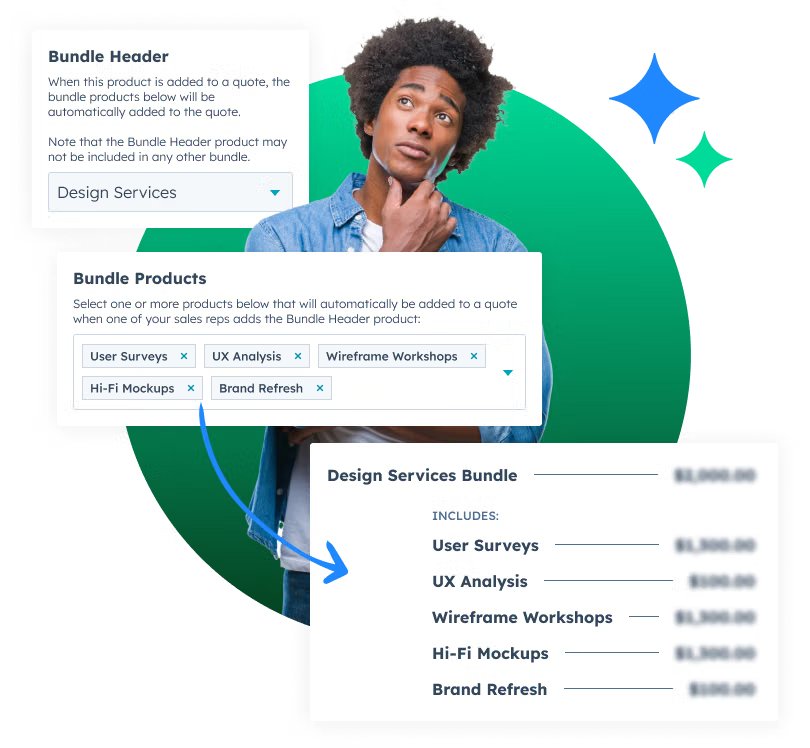
HubSpot has moved beyond basic quote generation. Its current CPQ includes product configuration, pricing, approvals, quotes, e-signature and payment collection directly within the CRM/revenue platform.
It supports flat, tiered and ramp pricing and line-item discounts, for example.
I'd put it in a different category from Salesforce/Oracle/SAP, though. If your "complexity" is primarily pricing, packaging and approvals, HubSpot can be attractive. If it's hundreds of product options with engineering constraints and configuration dependencies, I'd look at a heavier CPQ.
If the CRM is already chosen, don't assume you have to replace it. A dedicated CPQ can sit alongside it.
Some of the more relevant options are:
Conga CPQ — enterprise CPQ with strong CRM flexibility and contracting capabilities.
DealHub CPQ — particularly attractive for SaaS/subscription and quote-to-revenue workflows.
Oracle CPQ — very strong configurator/ERP integration.
SAP CPQ — strong for SAP-centered manufacturing.
Tacton — especially interesting for engineer-to-order/manufacturing scenarios.
Experlogix — particularly relevant in the Dynamics 365 ecosystem.
A recent 2026 CPQ comparison similarly separates the market into CRM-suite-native products such as Salesforce/Oracle/SAP, best-of-breed products such as Conga/DealHub, and manufacturing-oriented configurators such as Tacton.
My shortlist by situation
If you haven't selected a CRM yet:
Salesforce + Revenue Cloud — best all-around enterprise choice
Dynamics 365 + CPQ partner — best Microsoft-centric choice
Oracle + Oracle CPQ — best Oracle/ERP-centric choice
SAP + SAP CPQ — best SAP/manufacturing-centric choice
HubSpot CPQ — best for ease of use and less extreme complexity
If "complex products" means engineering/configuration complexity—e.g. thousands of possible configurations, compatibility constraints, BOM generation, engineer-to-order—I would not choose based on the CRM's quoting features alone. I'd make the CPQ/configuration engine the primary selection criterion and then integrate it with the CRM.
If you tell me what kind of products you sell (manufacturing, hardware, SaaS, industrial equipment, etc.) and which CRM you're currently using, I can narrow this to a 3–5 vendor shortlist and compare configuration rules, pricing, approvals, integrations, implementation effort, and approximate cost.
The top enterprise CRMs either feature deeply native/acquired CPQ engines or offer bulletproof, specialized integrations for complex configuration:
1. Salesforce (CRM with Native/Deeply Integrated CPQ)
The Capability: Salesforce is the gold standard for complex enterprise quoting via Salesforce CPQ (part of Revenue Cloud / Agentforce Revenue Management).
Ecosystem Fit: Because it lives natively inside the Salesforce CRM data model (Opportunities, Accounts, Assets), sales reps never have to leave the CRM to build and approve an intricate configuration.
2. Microsoft Dynamics 365 (CRM with Native & Ecosystem CPQ)
The Capability: Microsoft Dynamics 365 Sales integrates tightly with Microsoft Dynamics 365 Supply Chain Management / Commerce pricing engines, or connects seamlessly with enterprise-grade, CRM-agnostic CPQ systems like Conga CPQ or Tacton.
The Capability: HubSpot CRM has native quoting capabilities that work well for standard product lines, recurring billing, and simple sales motions. However, for complex products, HubSpot relies on robust third-party CPQ integrations rather than a heavy native engine.
Tacton CPQ: Built specifically for manufacturing industries with massive product variants, design automation, and CAD integrations.
DealHub CPQ: Known for an agile, workflow-based approach that scales rapidly with complex deal structures and contract collaboration, integrating cleanly with major CRMs.
For a company selling complex products, I’d prioritize a CRM that can handle product configuration, pricing rules, discount approvals, and quote generation—either natively or through a well-supported CPQ (Configure, Price, Quote) integration.
The key distinction is whether your products are commercially complex (custom pricing, bundles, negotiated contracts) or technically complex (hundreds of options, dependencies, compatibility rules, or engineered configurations). That distinction can change which platform is best.
Best CRM options to shortlist
1. Salesforce Sales Cloud and Revenue Cloud
(Best overall for complex sales)
Best when you need deep CRM customization, sophisticated product and pricing rules, guided selling, approval workflows, and a path from quoting through contracts and billing. Revenue Cloud is built on Salesforce and supports complex revenue models.
Best for: Mid-market and enterprise B2B sales.
Watch out for: Licensing, implementation effort, and the need to carefully evaluate the newer Revenue Cloud offering against existing Salesforce CPQ deployments.
Pricing reference: Revenue Cloud Growth is listed at $150/user/month and Advanced at $200/user/month, billed annually; CRM licensing may be additional.
Website:
2. Microsoft Dynamics 365 Sales
(Best for Microsoft-centric businesses)
A strong choice if you use Microsoft 365, Teams, Power BI, Azure, or Dynamics ERP. You can connect Dynamics 365 Sales with specialist CPQ applications, while Microsoft also documents integrated sales-quotation processes with Supply Chain Management.
Best for: Manufacturers, distributors, and businesses with Microsoft-based operations.
Watch out for: Advanced product configuration may require a partner CPQ solution and integration work.
Shortlist alongside:Experlogix, DealHub, or other CPQ vendors that support your exact Dynamics edition.
Website:
3. Oracle Sales / Oracle CPQ
(Best for complex product catalogs)
Oracle CPQ supports advanced configuration, product bundling, discounting, approvals, and pricing across different channels. Oracle documents integrations with Oracle Sales and Salesforce, so you don't necessarily need to use Oracle as your CRM.
Best for: Large manufacturers, global enterprises, and businesses with complicated product or pricing structures.
Watch out for: Implementation complexity and the effort involved in integrating CRM, ERP, product data, and CPQ.
Website:
4. HubSpot CRM with Revenue Hub
(Best for usability and faster adoption)
HubSpot now offers quoting and CPQ functionality through Revenue Hub, including pricing rules, discount guardrails, and quote workflows tied to CRM deals. That makes it more viable for companies that want quoting close to their CRM rather than a separate system.
Best for: Small and midsize teams that prioritize ease of use, sales and marketing alignment, and simpler administration.
Watch out for: Validate complex option dependencies, engineering constraints, and large configurable catalogs in a live proof of concept. Don't assume its CPQ will cover every manufacturing scenario.
Website:
5. DealHub CPQ
(Best specialist CPQ for a flexible CRM choice)
Rather than replacing your CRM, DealHub adds guided selling, pricing, quoting, approvals, and sales workflows. It is worth evaluating with Salesforce, HubSpot, and Microsoft Dynamics.
Best for: Mid-market and enterprise teams that want dedicated CPQ without committing every sales process to one CRM vendor.
Watch out for: Test highly technical configuration rules if your products have intricate engineering constraints.
Website:
6. Conga CPQ
A further option for businesses with complex quoting, product catalogs, commercial rules, and document-heavy sales processes. Evaluate its integration with your preferred CRM and its fit with your contract-management requirements.
Best for: Enterprises with sophisticated quoting and document workflows.
Watch out for: Total implementation cost, administration, and how much configuration must be customized.
Website:
How I'd narrow the field
If your main requirement is…
Start with
Powerful CRM plus integrated quoting
Salesforce + Revenue Cloud
Microsoft ecosystem and ERP alignment
Dynamics 365 + specialist CPQ
Highly configurable products and complex pricing
Oracle CPQ or a manufacturing-focused CPQ
Easier adoption with built-in quoting
HubSpot Revenue Hub
A specialist CPQ that can work with different CRMs
or
One important nuance: if you're selling engineered products with complex rules, look beyond conventional CPQ. Tacton CPQ and Experlogix CPQ are also worth evaluating. Manufacturing-focused tools may be a better fit when technical configuration is the hardest problem, rather than sales quoting alone.
What to verify in vendor demos
Whichever CRM you choose, ask vendors to demonstrate the same realistic sales scenario:
Configure a product with dependent options and incompatible components.
Calculate customer-specific, volume-based, and negotiated pricing.
Apply discount limits and route exceptions for approval.
Generate revised quotes without losing version history.
Transfer approved quote lines, products, and prices to your ERP or order-management system.
Handle renewals, service agreements, and recurring revenue if applicable.
Also ask for a three-year total cost covering licenses, CPQ, integration, implementation, and ongoing administration.
My recommendation for your business
I would begin with Salesforce + Revenue Cloud, Dynamics 365 + a specialist CPQ, and Oracle CPQ if product complexity is substantial. I'd include HubSpot if ease of use and sales-team adoption are major priorities.
To make that shortlist much more precise: what kind of complex products do you sell? For example, configurable manufactured equipment, industrial components, electronics, software subscriptions, or engineered-to-order systems. That will help determine which CRM and CPQ combination is most likely to fit.
For selling complex products with intricate configurations, dependencies, and custom pricing, you need a robust setup. You generally have two paths: an enterprise CRM with native, powerful CPQ (Configure, Price, Quote) capabilities, or a flexible mid-market CRM that integrates smoothly with dedicated CPQ engines via robust APIs.
The top CRM and CPQ options tailored for complex products are broken down below:
Salesforce (with Agentforce Revenue Management / Revenue Cloud) : The gold standard for enterprise complexity. Salesforce handles heavily constrained, rules-based product configurations, multi-tiered discounting, and automated approval workflows natively within the ecosystem. It is ideal if your products require detailed engineering or dependency rules before a quote can be generated.[](https://zapier.com/blog/cpq-software-vendors/)
HubSpot (with DealHub CPQ or PandaDoc integration) : If you prefer ’s user-friendly CRM interface, you can pair it with a top-tier agile CPQ like or . is particularly well-known for a nimble, no-code workflow engine that manages complex product catalogs and guided selling without requiring a massive implementation team.[]()
Microsoft Dynamics 365 Sales (with FPX or DealHub) : Dynamics 365 provides a strong enterprise CRM backbone that connects smoothly with advanced CPQ solutions. It works exceptionally well for manufacturers or B2B tech companies whose quoting processes tie directly into Microsoft-based ERP and inventory systems.
Oracle Sales / NetSuite CRM (with NetSuite CPQ or Oracle CPQ) : If your complex products tie directly into heavy manufacturing, supply chains, or custom bills of materials (BOMs), the Oracle/NetSuite ecosystem is unmatched. NetSuite CPQ auto-generates accurate BOMs and routing instructions directly from the sales quote, preventing costly handoff errors to operations.[](https://zapier.com/blog/cpq-software-vendors/)
Zoho CRM (with QuoteWerks or Zoho Billing/CPQ extensions) : For growing mid-market teams looking for a cost-effective ecosystem, Zoho CRM integrates with specialized tools like QuoteWerks or native extensions to handle complex line-item configurations and procurement sourcing.
To help narrow down the best fit, could you share:
Are you looking for an all-in-one platform or open to integrating a dedicated CPQ with your current tool?
How many users/reps will be creating quotes?
Is your product complexity driven more by manufacturing/BOM constraints or software/subscription tiered pricing?