Yes. There’s a fairly concentrated startup ecosystem around specialty-crop labor automation, especially berries, tree fruit, vineyards, and high-value vegetables. The most interesting companies fall into three buckets: harvesting, field labor/transport, and weeding/thinning.
Harvesting
Harvest CROO Robotics — strawberries. Its autonomous harvester uses 16 robotic picking units, computer vision and AI to identify ripe berries and pick them without damaging fruit. The company reported commercial-viability field trials in Florida in 2025.
Advanced Farm Technologies — strawberries and apples. It is developing autonomous harvesting platforms using computer vision, robotic arms and gentle grippers. A three-season apple project reported substantial progress toward commercially viable robotic harvesting.
Fieldwork Robotics — raspberries and other soft fruit. Its four-arm robot uses 3D vision and machine learning for selective picking. In 2026 it raised about £3M in investment/grants and moved from technology validation toward commercial farm trials, with multi-robot deployments targeted for 2027.
FFRobotics — apples/tree fruit. Its multi-arm FFRobot combines computer vision and robotic manipulation to identify and pick fruit, explicitly targeting the shortage and rising cost of orchard labor.
Tortuga AgTech — strawberries, table grapes and other specialty crops. It focuses on autonomous harvesting and farm robotics; its robots are designed to work alongside human harvesting crews. It remains one of the more prominent startups in robotic specialty-fruit harvesting.
Automating the work around harvesting
Burro (Augean Robotics) — berries, vineyards, orchards, nurseries. Rather than trying to solve robotic picking, Burro automates hauling, harvest assist, spraying, mowing and other repetitive logistics. The company says its robots can reduce labor dependency by 30–100%, depending on application.
This is an important category: Burro itself says selective harvesting remains an unsolved problem for many crops, while transport, towing, bin movement and spraying are already practical automation targets.
Weeding / thinning / precision field labor
Verdant Robotics — 30+ specialty crops, including lettuce, carrots, onions, tomatoes, beets and leafy greens. Its SharpShooter uses computer vision to make plant-by-plant decisions for weeding, thinning and targeted applications. The company reports deployments across thousands of acres and positions labor reduction as a central value proposition.
Stout Industrial Technology — specialty vegetables and other field crops. Its Smart Cultivator uses AI vision and mechanical blades for in-row/inter-row weeding. Stout says its machines can remove roughly 25–30 people from a weeding operation and reports deployments with 45+ growers.
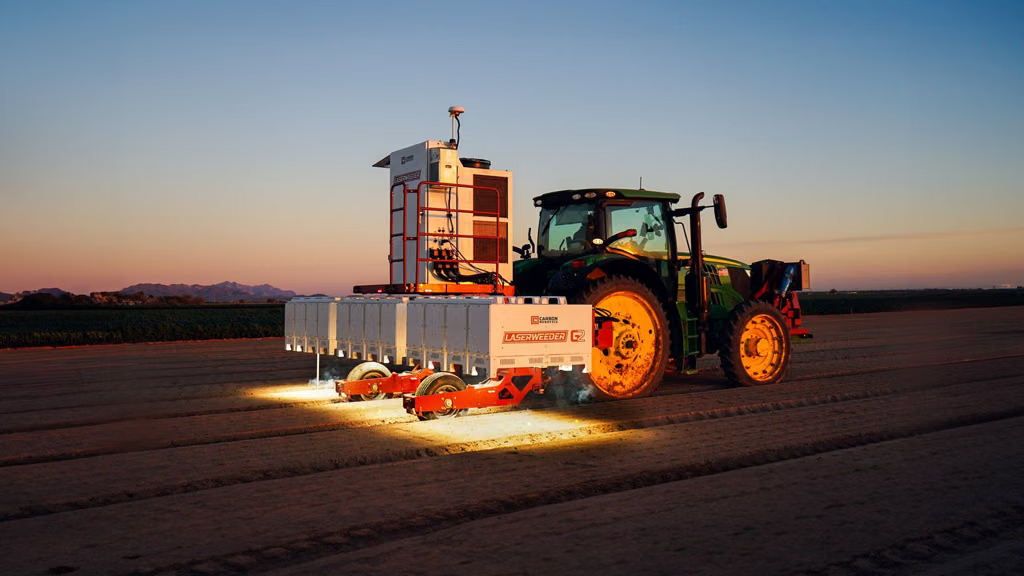
Carbon Robotics — specialty vegetables and row crops. Its LaserWeeder uses computer vision and lasers for automated weed control; current grower examples include specialty vegetable producer Babé Farms. This is more of a scaled ag-robotics company than an early startup, but it's directly relevant to the specialty-crop labor problem.
Finite Robotics / Orchard Robotics — orchards, initially apples. The company is starting with robotic fruit thinning, building a small fleet for the 2026 season. Thinning is an interesting wedge because it attacks a major labor-intensive orchard operation before attempting fully autonomous picking.
One useful way to map the market
Labor bottleneck
Startups to watch
Strawberry picking
Harvest CROO, Advanced Farm, Tortuga
Raspberry/soft-fruit picking
Fieldwork Robotics
Apple/tree-fruit picking
Advanced Farm, FFRobotics
Orchard thinning
Finite Robotics
Harvest logistics / bin movement
Burro
Vineyard/orchard mowing & spraying
Burro
Vegetable weeding
Verdant, Stout, Carbon
Precision thinning/input application
Verdant
Nursery labor
Burro
The key market observation: the startups aren't all trying to build a humanoid “farm worker.” The commercially promising approach so far is to attack one exceptionally expensive labor task—picking a strawberry, thinning an apple tree, removing weeds close to a plant, or moving harvested fruit—and build a machine around that workflow.
That's consistent with the broader specialty-crop research landscape: USDA describes labor shortages as a major constraint and specifically identifies harvesting, weeding, thinning and related operations as targets for automation.
If you're looking at this from a startup/investor perspective, I can also map these companies by funding, estimated stage (pilot → commercial), crop, labor task, business model, and likely TAM.
The agtech sector features a rapidly expanding ecosystem of robotics companies tackling labor shortages in specialty crops (such as fruits, vegetables, and permanent tree crops). According to industry tracking by innovation hubs like The Mixing Bowl's Crop Robotics Landscape , hundreds of active companies are deploying AI, computer vision, and autonomous systems to handle delicate farm tasks.
Prominent startups and growth-stage companies developing robotics for specialty crops include:
Harvest CROO Robotics — Specializes in automated strawberry harvesting. Their platform utilizes computer vision and AI-driven precision robotics to identify and pick ripe strawberries while gathering plant-level analytics to help growers manage tight seasonal labor windows.
Tevel Aerobotics Technologies — Develops Flying Autonomous Robots (FAR) equipped with advanced AI and computer vision to harvest delicate stone fruits, apples, and other orchard crops that traditionally require immense manual labor.
Carbon Robotics — Creator of the AI-powered Carbon Robotics LaserWeeder , which uses high-powered lasers and deep learning to eliminate weeds with sub-millimeter accuracy. A single unit can replace massive manual hand-weeding crews in specialty vegetable crop fields.
FFRobotics (FFRobot) — Focuses on fresh fruit harvesting, specifically building automated multi-armed robotic pickers designed to distinguish and delicately harvest orchard fruits like apples while sorting out unripe or damaged produce.
Strawberry Robotics — Pioneers novel mechanical arm topologies (such as hydrostatic actuation) designed specifically to overcome the physical inertia drag and constraints of traditional robotic arms in tight, delicate crop harvesting environments.
GUSS Automation — (Acquired in part / partnered deeply with major machinery players like John Deere) builds autonomous orchard and vineyard sprayers, removing humans from hazardous, physically grueling chemical application roles in extreme weather.
If you want to narrow this down, let me know:
Are you looking for solutions tailored to a specific crop (e.g., berries, tree fruit, leafy greens)?
Are you more interested in harvesting vs. weed control/spraying?
The broader 2026 landscape now contains 400+ crop-robotics companies, with specialty-crop applications spanning harvesting, weeding, spraying, scouting and thinning.
Specialty crops (such as fruits, vegetables, and berries) rely heavily on intensive hand labor for harvesting, weeding, and maintenance . Severe labor shortages and rising operational costs have driven a wave of specialized agricultural robotics startups.
Prominent startups and companies building automation for specialty crops include:
Harvest Croo Robotics – Focused specifically on the strawberry industry, this company has developed a fully autonomous strawberry harvester that uses computer vision to detect ripe fruit, pick them gently with precision robotic end-effectors, and even pack them.
Burro – Builds friendly, autonomous mobile robots (AMRs) designed to lighten the load in nurseries, table grape vineyards, and berry fields. Rather than replacing the picker entirely, Burro units autonomously follow workers or shuttle heavy crates of harvested crops across fields, multiplying human productivity.
Carbon Robotics – Utilizes AI, computer vision, and high-power lasers to eradicate weeds in specialty row crops (like specialty vegetables and leafy greens) without using chemicals or disturbing the soil. This significantly cuts down the massive manual labor hours traditionally required for hand-weeding organic or high-value fields.
FarmWise – Develops large, tractor-towed autonomous weeding robots for precision vegetable farming. Their AI vision systems distinguish individual vegetable crops from weeds at millimeter-level accuracy, cultivating fields mechanically without chemical inputs or backbreaking hand labor.
Verdant Robotics – Provides an AI-driven, multi-action platform that uses computer vision to deliver centimeter-accurate crop care, micro-spraying nutrients, and targeting specific weeds or pests on high-value specialty crops.
Advanced Farm Technologies – Developed robotic harvesting systems utilizing specialized multi-arm arrays and 3D computer vision to pick delicate fruits like strawberries and apples. (Note: While their pioneering tech and IP assets were acquired by machinery giant CNH Industrial, their platform remains a prime example of advanced specialty crop harvesting automation).
Naïo Technologies – Specializes in autonomous electric field and vineyard robots that handle mechanical weeding, hoeing, and inter-row management for specialty vineyards, orchards, and vegetable farms.
If you'd like to dive deeper, let me know:
Are you interested in a specific crop type (e.g., berries, tree fruit, leafy greens)?
Are you looking at robots for harvesting specifically or weed control/logistics?
I can provide more targeted details or implementation metrics.
Specialty crops—such as berries, tree fruit, tomatoes, and leafy greens—are among the most labor-intensive segments of agriculture, often requiring hand-harvesting, selective pruning, and intensive weed management . Severe seasonal labor shortages and rising labor costs have driven a wave of specialized robotics startups building autonomous solutions for these specific field and greenhouse workflows.
Prominent startups building robotics for specialty crops include:
Harvest CROO Robotics : Focused heavily on strawberries—a crop facing acute harvesting labor crunches. Their large, tractor-scale autonomous machines use AI and 3D vision to scan strawberry beds, gently pick only the ripe fruit, and pack it simultaneously.
Tevel Aerobotics Technologies : Tackling labor shortages in complex orchard environments (apples, peaches, and citrus) using Tevel Flying Autonomous Robots. Their system features tethered quadcopter drones equipped with AI and computer vision that navigate tree branches to pick delicate fruit at the correct ripeness without bruising.
Four Growers : Specializing in high-value greenhouse crops like snacking tomatoes, peppers, and cucumbers. Their flagship GR-100 robot uses multi-camera stereo vision and robotic arms to autonomously harvest, grade, and pack produce while simultaneously gathering fine-grained yield forecasting data.
Sami Robotics : Developing a multi-arm robotic platform (SAMI) tailored for densely planted and delicate specialty crops. Moving from commercial broccoli harvesting into romaine lettuce and other ground vegetables, the system uses parallel robotic arms and machine vision to selectively cut mature heads.
Carbon Robotics : Tackling the massive labor requirement of weeding in specialty crop and organic fields. Instead of manual hand-weeding or broad chemical sprays, their LaserWeeder uses high-powered lasers driven by computer vision and deep learning to eliminate weeds on contact at high speeds without disturbing the soil.
TRIC Robotics : Focusing on strawberry and high-value specialty crop protection by deploying autonomous tractor-scale robots that sanitize fields using ultraviolet light overnight, bypassing chemical inputs and replacing grueling nighttime manual mitigation.
Would you like to track ongoing developments, funding milestones, or commercial rollouts for any of these specific harvesting robotics startups by setting up an information agent?
Yes. There’s a fairly active startup ecosystem here, but it’s useful to split it into harvesting, weeding/thinning, and orchard/vineyard automation. Specialty crops are especially attractive because labor is still heavily concentrated in these tasks. USDA’s 2026 specialty-crop automation overview explicitly identifies labor shortages as a major driver of automation.
Harvesting
Harvest CROO Robotics — Autonomous strawberry harvesting. Its system uses computer vision and multiple robotic picking arms to tackle the acute seasonal labor problem in strawberries.
Traptic — Building robotic strawberry harvesting systems and has been operating robots in California strawberry fields. Its investors describe the company explicitly around agricultural labor shortages.
SAMI Robotics — Developing a multifunctional autonomous platform, initially for selective harvesting, with planned applications including weeding, thinning, fertilizing and pest control.
Fieldwork Robotics — Focused on delicate soft-fruit harvesting, particularly raspberries and other berries, using computer vision and gentle robotic manipulation.
Picker AgRobotics — Developing a long-reach flexible robotic arm for fruit harvesting in existing orchards, initially targeting crops such as citrus and avocado.
Weeding, thinning & crop maintenance
Niqo Robotics — Its RoboThinner combines machine vision and AI for precision weeding, crop thinning and targeted weed control. It is specifically being marketed to labor-constrained specialty-crop operations in places such as Arizona and California.
Rootline Robotics — Building autonomous, non-chemical electric weeding for specialty crops, with an initial focus on orchard applications.
Kyron Robotics — Developing autonomous laser-weeding systems for specialty-crop farms, with pilot deployments and a focus on replacing labor-intensive weed control.
Padma AgRobotics — Developing robots capable of weeding, harvesting, spraying and bird deterrence, explicitly motivated by farm labor shortages.
Orchards & vineyards
Bonsai Robotics — Autonomous orchard machinery and AI perception, with applications including almonds, pistachios and walnuts. Its technology is designed around navigating orchards and automating operations traditionally requiring significant labor.
Saga Robotics — Its Thorvald platform is being deployed in vineyards, including for autonomous UV treatment of powdery mildew. More broadly, the platform is intended to automate vineyard operations and reduce labor requirements. Recent reporting says more than 100 units are deployed across 27 California vineyards.
12AM Robotics — Building autonomous field robots and agricultural vision models, initially targeting grapevine pruning in Maharashtra, India, with an ambition to extend to other specialty crops and tasks.
Bud Break Innovations — Building autonomous scouting robots for vineyards and orchards. Its robot, Emma, autonomously images plants and creates per-plant records of disease, canopy condition and crop load.
Where the opportunity appears most concentrated
A useful way to think about the market is:
Labor problem
Startup examples
Crop examples
Picking
Harvest CROO, Traptic, Fieldwork, Picker, SAMI
Strawberries, berries, tree fruit, citrus
Weeding
Rootline, Niqo, Kyron
Orchards, vegetables, vineyards
Thinning
Niqo, SAMI
Vegetables, tree fruit
One important distinction: harvesting remains considerably harder than automating upstream tasks. Cornell's newly announced 2026 orchard-robotics program is pursuing pollination, thinning, harvesting and weeding simultaneously, while USDA-backed work has already demonstrated substantial progress on robotic apple picking.
If you're looking at this as an investment/startup landscape, I can also map ~25 companies by crop × task × funding stage × deployment maturity × geography, which makes the whitespace much easier to see.
Yes. The most interesting cluster is strawberries, berries, greenhouse tomatoes, and orchard fruit—crops where harvesting is difficult to mechanize and labor is a large share of costs. USDA explicitly identifies labor shortages as a major constraint on specialty crops.
Companies worth watching
Startup
Specialty crop / task
What they're building
My take
Harvest CROO Robotics
🍓 Strawberries
Autonomous field harvester with 16 picking robots, computer vision and LiDAR
One of the furthest along commercially
Advanced Farm Technologies
🍓 Strawberries, 🍎 apples
Autonomous harvesting machines using vision and robotic grippers
Strong multi-crop strategy
Four Growers
🍅 Greenhouse tomatoes
Autonomous tomato-picking robot using stereo vision and robotic arms
Particularly interesting because greenhouse conditions simplify autonomy
Strawberry Robotics
🍓 Strawberries
High-speed, low-inertia robotic harvesting system designed for field conditions
Interesting technical approach to the speed/dexterity problem
Fieldwork Robotics
Raspberry and other soft fruit
Autonomous harvesting robots
Targeting one of the hardest crops to pick without damaging fruit
Traptic
🍓 Strawberries
Vision-guided mobile strawberry picker
An earlier mover that reached commercial field deployment
Eternal.ag
🍅 Greenhouse tomatoes
Fully autonomous greenhouse harvesting robot
Raised €8M in 2026 and launched its commercial Harvester
Padma AgRobotics
Vegetables / specialty crops
Robots for weeding, harvesting, spraying and crop protection
Broader "robotic farm worker" approach
Maniro
🍓 Strawberries
Generative-AI-driven robotic harvesting
Very early, but an interesting new entrant
A few deserve particular attention:
Harvest CROO is probably the clearest example of robotics directly attacking the labor-shortage economics. It says its 2025 Florida field trials achieved performance comparable to human harvesting and describes its system as specifically designed for specialty crops.
Advanced Farm Technologies (Advanced.Farm) is interesting because it isn't betting everything on one crop: its technology has focused on both strawberries and apples, two very different harvesting environments. Current industry profiles describe it as an active startup developing autonomous harvesting and packing systems for specialty-crop growers.
Four Growers is attacking the greenhouse segment. Its robots identify ripe tomatoes with stereo cameras and manipulate the plants/fruit with robotic arms. Greenhouses are attractive robotics markets because the environment is substantially more structured than an outdoor orchard or berry field.
Fieldwork Robotics is especially interesting from a "hardest problem first" perspective: it started with raspberries, where delicate fruit, dense foliage and narrow harvest windows make automation exceptionally difficult. ReFED recently supported the company specifically because labor constraints contribute to raspberry food loss.
Strawberry Robotics is pursuing a somewhat different hardware architecture, using a low-inertia hydrostatic robotic arm rather than conventional heavy electric arms. Its premise is that conventional industrial robots are too slow, heavy and fragile for field strawberries.
"Robot as a farm worker" platforms — potentially the biggest prize
One autonomous vehicle that can navigate a farm and switch between harvesting, spraying, weeding, scouting, etc.
The orchard market is particularly compelling. A new Cornell-led $7.5M USDA project is explicitly developing robots for pollination, fruit thinning, apple harvesting and inter-row weeding, with industry participants including Fresh Fruit Robotics. Labor has reportedly risen from about 45% to more than 60% of costs at one participating Washington fruit company.
So if you're looking at this as an investment/startup landscape, I'd pay closest attention to Harvest CROO, Advanced.Farm, Fieldwork Robotics, Four Growers, Strawberry Robotics, and the emerging orchard-robotics ecosystem. The key question isn't simply "can the robot pick?"—it's whether it can achieve human-comparable throughput + low fruit damage + enough utilization to beat the fully loaded cost of seasonal labor.
A dynamic wave of agtech startups is tackling acute labor shortages in specialty crops (such as berries, tree fruit, vegetables, and vines). Because specialty crops require delicate, selective handling and complex navigation where traditional GPS often fails, these companies rely heavily on AI, computer vision, and custom end-effectors.
Harvest and Yield Automation
Harvest CROO Robotics : Focused heavily on the multi-billion-dollar strawberry industry, their large-scale autonomous machines integrate AI and machine learning to pick, pack, and manage strawberry fields at speeds rivaling human workforces.
Tevel : Uses pioneering Flying Autonomous Robots (FARs) equipped with AI and computer vision algorithms. These tethered drones navigate orchards to selectively pick delicate tree fruits (apples, peaches, citrus) while minimizing bruising and assessing ripeness.
Fieldwork Robotics : Specializes in modular, AI-enhanced autonomous robots featuring multiple picking arms designed specifically for soft fruits like raspberries, strawberries, and blueberries.
Tortuga AgTech : Builds robots tailored for harvesting high-value specialty crops like berries and grapes, focusing on navigating complex greenhouse and field environments.
Ripe Robotics : Develops advanced robotic harvesting solutions utilizing suction and specialized gripping end-effectors to safely pick delicate orchard fruit.
Weeding, Autonomy Platforms, and Crop Maintenance
Carbon Robotics : Famous for its high-powered LaserWeeder , this company uses advanced computer vision and artificial intelligence to zap weeds with thermal energy rather than using chemical herbicides or manual hand-weeding in specialty vegetable rows.
Bonsai Robotics : Specializes in vision-first, GPS-independent autonomy software for rough and dusty orchard environments. Having acquired modular electric vehicle pioneer Farm-ng , Bonsai deploys integrated smart fleets (like the Amiga platform) to automate repetitive tasks in specialty nut and fruit orchards.
Padma AgRobotics : Developing multifunctional AI systems that handle tight-margin workflows like cilantro harvesting (picking, bunching, and wrapping) alongside autonomous mechanical weeding and crop protection.
Would you like to explore the economics and payback periods for adopting these harvest robots, or focus on a specific crop like berries or tree fruit?
Yes. There’s a fairly active cluster of startups attacking specialty-crop labor shortages, but they’re taking very different approaches: harvest robots, collaborative “crew multiplier” robots, autonomous orchard/vineyard machines, and AI systems that reduce the amount of human scouting and hand labor required.
The most interesting companies I’d put on a 2026 watchlist are:
Startup
Specialty crops
What the robot does
Maturity / angle
Traptic
Strawberries
Robotic picking
One of the more direct bets on replacing hand harvest labor
Harvest CROO Robotics
Strawberries
Autonomous harvesting
Large, highly specific harvest problem; strong grower backing
Four Growers
Tomatoes
Autonomous greenhouse harvesting
Vision + robotic arms; already focused on commercial greenhouse operations
Addresses labor-intensive field operations rather than harvesting
Picker AgRobotics
Citrus, avocado
Robotic harvesting
Early-stage attempt at difficult canopy harvesting
Nanovel
Citrus
Robotic fruit harvesting
Particularly interesting technically because citrus requires manipulation inside dense canopies
Budbreak Innovations
Vineyards, orchards, blueberries, lettuce
Autonomous scouting / plant-level imaging
Replaces a lot of manual scouting and turns it into machine-readable data
Vineyard Robotics / Orchard Robotics
Grapes, apples, blueberries, cherries
Autonomous/vehicle-mounted crop imaging and AI
Precision management, yield estimation and labor planning
The ones I'd watch most closely
1. Traptic — strawberry harvesting
Traptic is probably one of the clearest examples of a startup attacking a specific specialty-crop labor bottleneck rather than trying to build a generic farm robot. Its system has been operating in California strawberry fields, and its investors explicitly frame the company around solving the agricultural labor shortage.
2. Harvest CROO — strawberry harvesting
Harvest CROO is another major strawberry bet. Its machine uses computer vision and multiple robotic arms to identify and pick ripe berries. The interesting part isn't just the robot—it's the business model and grower involvement. Strawberry harvesting is unusually labor-intensive, making it an attractive beachhead for automation.
3. Burro — “robotic labor” rather than replacement
Burro has arguably one of the more pragmatic strategies. Instead of immediately trying to make a robot that can pick every piece of fruit, Burro builds autonomous machines that carry, tow, spray, mow and assist harvest crews. Its newer platform includes specialized machines for pruning/cutting and spraying.
That's important because partial automation may reach commercial ROI considerably sooner than fully autonomous picking.
4. Bonsai Robotics — orchards and tree nuts
Bonsai is attacking another huge labor problem: tree-crop operations. Its technology provides autonomous navigation and machine control for orchard equipment, with applications including almonds, pistachios and walnuts. The company raised a $15M Series A specifically around combating farm labor shortages.
5. Orchard Robotics — the “eyes” of the autonomous farm
Orchard Robotics is interesting because it isn't primarily trying to replace the picker yet. Its cameras collect detailed information on individual fruit, trees and vines, allowing growers to improve pruning, thinning, spraying and labor planning. It raised $22M in 2025.
Its Vineyard Robotics division says it supports wine/table grapes as well as apples, blueberries and cherries.
6. 12AM Robotics — potentially a very interesting new entrant
12AM is particularly worth watching. It is building foundation models + autonomous field robots, starting with grapevine pruning in Maharashtra and explicitly targeting specialty crops more broadly. The company says it deployed its pruning system across 200+ acres for winter 2026.
A useful way to segment the market
I'd divide the opportunity into four buckets:
Harvest replacement
Traptic — strawberries
Harvest CROO — strawberries
Four Growers — greenhouse tomatoes
Picker — citrus/avocado
Nanovel — citrus
Labor augmentation
Burro
Bonsai Robotics
Pruning / thinning / crop maintenance
12AM Robotics
Niqo Robotics
Burro
various university/startup efforts
Machine vision → fewer people needed
Orchard Robotics
Vineyard Robotics
Budbreak Innovations
Niqo is especially notable because its robot combines precision weeding, thinning and targeted weed control—operations that otherwise require substantial hand crews. The Western Producer Budbreak similarly attacks scouting labor with an autonomous robot that builds a plant-level record across vineyards and orchards.
Where I think the biggest opportunity is
The interesting market isn't necessarily “robot that picks an apple.” That's technically spectacular but extremely difficult.
The nearer-term opportunity looks more like:
Robot + AI vision + existing farm machinery + human crew = 2–5× more productive labor
That's why companies such as Burro, Bonsai, Orchard and 12AM may have particularly interesting economics. The USDA itself identifies labor shortages as one of the central reasons automation is becoming important in specialty crops.
And the labor problem is getting severe enough that Cornell's new $7.5M orchard-robotics initiative notes that labor went from roughly 45% to more than 60% of total costs at one major Washington fruit operation over the past 15 years.
If you're looking at this from an investment/competitive-landscape perspective, I'd narrow the list to ~15 companies and rank them by funding, commercial deployments, crop TAM, robot utilization, and estimated labor-hours displaced per machine. That produces a much more revealing picture than simply listing agricultural robotics startups.
The agricultural tech sector has seen a surge of specialized robotics startups targeting specialty crops (such as fruits, vegetables, and vine crops) where chronic labor shortages and high picking costs hit hardest.
These startups generally split into two categories: Harvesting Robots (which pick delicate, high-value produce) and Non-Harvest/Management Robots (which handle weeding, spraying, and labor assistance).
1. Direct Harvesting & Picking Robots
Tevel Aerobotics Technologies : Uses autonomous, AI-powered flying drones tethered to mobile units to pick delicate tree fruits like apples, peaches, nectarines, and plums. The drones assess ripeness via computer vision and gently pluck fruit without bruising.
Four Growers : Specializes in greenhouse automation, deploying their GR-200 robot fleets to autonomously harvest snacking, cherry, and grape tomatoes. They use advanced AI vision and motion planning to pick delicate clusters day and night, reducing greenhouse labor requirements significantly.
Harvest CROO Robotics : Focuses entirely on the massive labor crunch in strawberry fields, building large-scale, autonomous robotic harvesters that navigate strawberry beds to identify and pick ripe berries while collecting real-time plant analytics.
Fieldwork Robotics & Dogtooth Technologies : UK-based pioneers scaling robotic picking arms equipped with soft grippers and 3D computer vision specifically tailored for delicate soft fruits like raspberries and strawberries.
Fresh Fruit Robotics : An Israel-based innovator developing multi-tasking orchard and fruit-picking mechanisms designed to address labor gaps across different seasonal touchpoints.
2. Weeding, Spraying, and Harvest-Assist Platforms
Carbon Robotics : Known for their revolutionary Autonomous LaserWeeder, which uses high-powered lasers and computer vision/AI to identify and thermally kill weeds in specialty crop fields without disturbing the soil or using synthetic herbicides.
Agtonomy : Provides a hybrid software and electric autonomous tractor platform that turns standard farming equipment into task-executing robots capable of precision spraying, weeding, and mowing in specialty crop environments.
Burro : Builds autonomous, people-following mobile robots (like the Grande ) designed for "harvest-assist" logistics. Rather than picking the fruit themselves, these robots trail human pickers in fields and orchards to autonomously haul heavy loads of harvested crops out of the way, dramatically increasing human worker efficiency.
Would you like to explore specific crop categories (like berries vs. tree fruit), or are you interested in the economics and adoption rates of these robots compared to traditional labor?