Data as of Sep 18, 2026 · Based on 52 AI responses from ChatGPT Search and Google AI Mode · See how Parse measures this
Your brand can be here too.
Source | Citation share |
|---|---|
 AI in Agriculture: Smarter Crops, Better Yields | CSAhttps://cloudsecurityalliance.org/blog/2025/02/10/ai-in-agriculture-smarter-crops-healthier-livestock-better-yields | 3.4% |
 AI in Agriculture: How Farmers Are Using It To ... - Climate AIhttps://climate.ai/blog/ai-in-agriculture/ | 3.0% |
 How can AI technology to enhance the agricultural productivity?https://www.researchgate.net/post/How_can_AI_technology_to_enhance_the_agricultural_productivity | 2.0% |
 CropX Agronomic Farm Management Systemhttps://cropx.com/ | 1.4% |
 Top10 AI tools for agriculture reshaping yield forecastinghttps://www.cropin.com/blogs/top-ai-tools-for-agricutlure-reshaping-yield-forecasting/ | 1.4% |
Cutting Irrigation by 33% on a Colorado family farm with CropX sensors – CropX Digital Agronomy Platform and Farm Management Systemhttps://cropx.com/2026/05/14/cutting-irrigation-by-one-third-on-a-colorado-family-farm-with-cropx-sensors/ | 1.2% |
 See & Spray Gen 2 | John Deere UShttps://www.deere.com/en-us/products-solutions/sprayers-and-applicators/see-spray | 1.2% |
 Taranis: Leading Crop Management Softwarehttps://www.taranis.com/ | 1.2% |
10 Best AI Tools for Farmers and Agriculture in 2026 | AI Biz Guidehttps://aibizguide.net/articles/cat1/best-ai-tools-farmers-agriculture.html | 1.0% |
 Artificial Intelligence Tools for the Agriculture Value Chain: Status and Prospectshttps://www.mdpi.com/2079-9292/13/22/4362 | 1.0% |
Yes. For **commodity row crops—corn, soybeans, wheat, cotton, sorghum, rice—the strongest AI use cases today are not generic “AI farming” apps; they’re systems that make a specific input decision more precisely**: herbicide, nitrogen, irrigation, seed, or scouting. ### Tools worth looking at Tool / category | Main…
Yes. For commodity row crops—corn, soybeans, wheat, cotton, sorghum, rice—the strongest AI use cases today are not generic “AI farming” apps; they’re systems that make a specific input decision more precisely: herbicide, nitrogen, irrigation, seed, or scouting.
| Tool / category | Main crop use | How it can cut inputs | Yield pathway |
|---|---|---|---|
| John Deere See & Spray | Corn, soybeans, cotton and other row crops | Computer vision sprays weeds rather than broadcasting herbicide | Maintains weed control while reducing unnecessary chemical |
| Climate FieldView | Corn, soybeans, wheat, cotton | Variable-rate seed/fertilizer prescriptions and field analytics | Places seed/N where historical and environmental data indicate greater response |
| CropX | Irrigated corn, soybeans, cotton, wheat | Soil sensors + models optimize irrigation | Avoids water stress while reducing unnecessary irrigation |
| Taranis | Large-scale row crops | AI aerial scouting identifies weeds, insects, disease and nutrient/stress zones | Earlier intervention can prevent localized yield loss |
| Sentera | Row crops | Multispectral imagery + prescription generation | Targets treatments to affected areas rather than whole fields |
| AI/ML variable-rate nitrogen systems | Especially corn and wheat | Adjust N by soil, yield history, weather and crop response | Reduces over-application while protecting yield where N response is high |
| AI irrigation/ET systems | Irrigated commodities | Determines when/how much to irrigate by field zone | More consistent crop water availability with less water |
The important distinction is that not all AI tools actually reduce input costs. Some primarily improve recordkeeping or scouting. The economic sweet spot is where AI changes what gets applied, where, or when.
John Deere's See & Spray uses machine vision to distinguish weeds from crop plants and selectively activate sprayer nozzles. A 2026 industry report citing 2025 deployment data says the system was used across more than 5 million acres, with substantial reductions in non-residual herbicide use.
The economics are particularly interesting for farms with:
It's a cost-reduction technology first, rather than something I'd assume increases yield. The yield benefit comes from maintaining or improving weed control while using less product.
For corn and wheat, I'd pay particular attention to AI/ML systems that generate N prescriptions from yield history + soil + weather + imagery + crop response.
The underlying idea is simple:
Don't spend the same nitrogen dollar on an acre that has a low probability of responding as on one that has a high probability of responding. A 2026 systematic review found measurable economic/resource savings from site-specific nutrient application, precision irrigation and targeted crop protection, while also noting that farm-level profitability varies considerably by situation.
This is one area where I'd insist on field-level replicated economics, rather than accepting a vendor's average ROI claim.
CropX combines soil-moisture sensing with models to generate irrigation recommendations.
For irrigated commodities, this can be more compelling than an AI scouting product because you're attacking a recurring, measurable input: water + pumping energy.
And there's emerging field evidence that AI-directed irrigation can affect both sides of the equation. A 2026 on-farm soybean study reported 15–27% lower irrigation water use and 30.8% higher yield under the tested AI-radar irrigation system versus the comparison subsurface-drip field. That's a single field comparison—not evidence that every AI irrigation system will produce those numbers—but it's a useful indication of the potential.
Taranis uses high-resolution aerial imagery and computer vision to identify crop problems.
Its economic value is different from See & Spray:
See & Spray: reduce the amount of chemical applied.
AI scouting: reduce the number of acres that need treatment by finding the problem early and precisely.
That can be valuable for disease, insects, weeds and nutrient deficiencies, particularly on very large farms where physically scouting every acre isn't realistic. But the subscription cost has to be compared against the actual value of interventions it prevents or improves.
Climate Corporation's FieldView is more of a data/decision platform than a single AI machine.
Its potential advantage is integrating planting, application, harvest, weather and field data so you can identify:
That's important because AI becomes considerably more useful when it has several years of your own yield and application history rather than generic regional data.
One caution: the industry is still early. A 2026 CropLife/Purdue precision-ag survey found that dealers were most confident in established precision technologies, while newer technologies such as machine-vision weed detection remained much less widely adopted. Dealers also reported that fewer than half expected AI to improve agronomic recommendations, underscoring the need to validate vendor claims locally.
I'd evaluate technologies in this order:
And measure each one using $/acre, input units/acre, yield/acre, and gross margin/acre, preferably against untreated/control strips or historical field zones.
If you tell me your crop(s), acreage, irrigated vs. dryland, and whether you run Deere/Case/AGCO/mixed equipment, I can narrow this to the 5–10 tools that are most relevant and estimate the potential $/acre savings and yield impact for your operation.
For irrigated commodities, this can be more compelling than an AI scouting product because you're attacking a recurring, measurable input: water + pumping energy.
And there's emerging field evidence that AI-directed irrigation can affect both sides of the equation. A 2026 on-farm soybean study reported 15–27% lower irrigation water use and 30.8% higher yield under the tested AI-radar irrigation system versus the comparison subsurface-drip field. That's a single field comparison—not evidence that every AI irrigation system will produce those numbers—but it's a useful indication of the potential.
Taranis uses high-resolution aerial imagery and computer vision to identify crop problems.
Its economic value is different from See & Spray:
See & Spray: reduce the amount of chemical applied.
AI scouting: reduce the number of acres that need treatment by finding the problem early and precisely.
That can be valuable for disease, insects, weeds and nutrient deficiencies, particularly on very large farms where physically scouting every acre isn't realistic. But the subscription cost has to be compared against the actual value of interventions it prevents or improves.
Climate Corporation's FieldView is more of a data/decision platform than a single AI machine.
Its potential advantage is integrating planting, application, harvest, weather and field data so you can identify:
Artificial intelligence tools in agriculture lower input costs (such as `fertilizer, seed, and chemicals` ) and maximize yield for commodity crops (like corn, soybeans, and wheat) by enabling **precision variable-rate application**, **real-time crop stress detection** , and **data-driven logistics**. The leading…
Artificial intelligence tools in agriculture lower input costs (such as fertilizer, seed, and chemicals ) and maximize yield for commodity crops (like corn, soybeans, and wheat) by enabling precision variable-rate application, real-time crop stress detection , and data-driven logistics.
The leading AI-driven platforms and technologies transforming commodity crop production include:
If you'd like to narrow this down, tell me:
I can help you determine which platform offers the best ROI for your specific operation.
Yes. For **commodity crops such as corn, soybeans, wheat, cotton, sorghum and canola**, the most promising AI tools are those that make *variable-rate decisions* or selectively apply inputs rather than simply providing another farm dashboard. ### Best AI categories Tool / approach | Main input savings | Yield upside |…
Yes. For commodity crops such as corn, soybeans, wheat, cotton, sorghum and canola, the most promising AI tools are those that make variable-rate decisions or selectively apply inputs rather than simply providing another farm dashboard.
| Tool / approach | Main input savings | Yield upside | Best fit |
|---|---|---|---|
| John Deere See & Spray | Herbicide | Better weed control; Deere reports +2 bu/ac in soybean trials | Corn, soybeans, cotton, wheat, sorghum, canola |
| AI variable-rate nitrogen | Nitrogen fertilizer | Usually maintains yield while improving N efficiency | Especially corn |
| AI crop/field scouting | Fertilizer, fungicide, herbicide | Earlier detection → targeted treatment | Corn, soybeans, wheat, cotton |
| Digital farm optimization | Seed, fertilizer, chemical, fuel | Better placement/timing and fewer overlaps | Large row-crop operations |
| AI/autonomous weed control | Herbicide + labor | Reduced crop competition | More relevant to specialty crops today |
1. See & Spray is probably the most commercially mature example. Deere's computer-vision system distinguishes crops from weeds and activates individual nozzles. Deere says customers reduced non-residual herbicide use by nearly 50% on average in 2025; its fallow-field version reports an average 77% herbicide reduction. Its newer system also uses biomass detection for near-real-time variable-rate application.
It is particularly interesting because there is evidence for both sides of the equation: lower input use and yield preservation/improvement. Deere-sponsored trials across seven states found targeted soybean spraying produced an average +2.0 bu/acre versus broadcast applications.
2. AI-driven variable-rate nitrogen may have the strongest economic case for corn. A 2026 meta-analysis covering 25 studies and 235 paired comparisons found optical-sensor-based variable-rate nitrogen reduced N application by 18%, increased nitrogen productivity by 22%, and increased profit by 6%, while overall grain yield was unchanged. That's arguably the ideal outcome: same yield, less fertilizer.
3. Climate FieldView is more of an AI/data-management layer than a single autonomous machine. It combines field data, prescriptions, real-time alerts and analysis to optimize input management. It can be particularly useful when you already have yield maps, soil data and application records and want to turn those datasets into variable-rate decisions.
4. Taranis Ag Assistant is another interesting decision-support option. Its AI combines imagery, text and audio with agronomic knowledge to generate field-specific recommendations. I'd view this more as an AI agronomist/scouting layer than as a direct input-application technology.
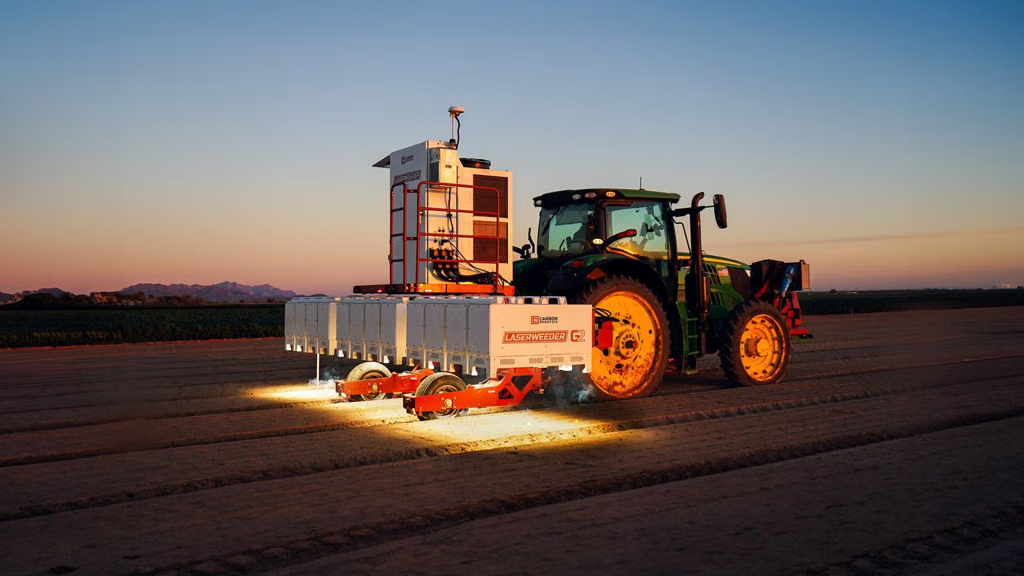
5. Carbon Robotics LaserWeeder is impressive technologically, but I'd put it lower on the list for commodity crops. Its AI-guided laser system can dramatically reduce herbicide and hand-weeding costs and its company-reported farmer results include substantial yield improvements. However, its strongest commercial applications today are vegetables and other high-value crops, rather than broad-acre corn/soy/wheat.
If your objective is specifically "lower $/acre while increasing or maintaining bu/acre," I'd prioritize:
A useful benchmark is Deere's modeled 6,500-acre corn/soybean operation: it estimates $48/acre of potential input-cost savings across herbicide, seed, fertilizer, fuel/time and labor, plus potential additional revenue. Deere explicitly cautions that these are modeled estimates, not third-party-verified results.
The important distinction: don't equate "AI" with ROI. The best systems are ones where the AI controls an actual economic lever—how much fertilizer, seed or chemical gets applied, and exactly where. Those are much easier to validate with replicated strips and $/acre calculations than generic AI farm-management software.
If you tell me which commodity crop(s), acreage, and country/region, I can make a more concrete shortlist of the 5–10 tools with estimated ROI per acre, upfront cost, and evidence of yield/input savings.
3. Climate FieldView is more of an AI/data-management layer than a single autonomous machine. It combines field data, prescriptions, real-time alerts and analysis to optimize input management. It can be particularly useful when you already have yield maps, soil data and application records and want to turn those datasets into variable-rate decisions.
4. Taranis Ag Assistant is another interesting decision-support option. Its AI combines imagery, text and audio with agronomic knowledge to generate field-specific recommendations. I'd view this more as an AI agronomist/scouting layer than as a direct input-application technology.
5. Carbon Robotics LaserWeeder is impressive technologically, but I'd put it lower on the list for commodity crops. Its AI-guided laser system can dramatically reduce herbicide and hand-weeding costs and its company-reported farmer results include substantial yield improvements. However, its strongest commercial applications today are vegetables and other high-value crops, rather than broad-acre corn/soy/wheat.
**AI-powered precision agriculture platforms like** **Climate FieldView and John Deere See & Spray** ** lower input costs by up to 50% on chemicals while maximizing commodity crop yields through data-driven variable-rate seeding and targeted micro-spraying.**…
AI-powered precision agriculture platforms like Climate FieldView and John Deere See & Spray ** lower input costs by up to 50% on chemicals while maximizing commodity crop yields through data-driven variable-rate seeding and targeted micro-spraying.**
Advanced artificial intelligence platforms integrate field imagery, weather modeling, and computer vision directly into heavy machinery to reduce chemical waste and optimize fertility management.
| Tool | Core Function | Impact on Inputs & Yield |
|---|---|---|
| Climate FieldView (Bayer) | Agronomic data mapping and field analytics for row crops | Generates variable-rate seeding and fertilizer prescriptions to optimize seed placement and reduce over-application. |
| John Deere See & Spray | Computer vision weed-targeting machinery | Cuts non-residual herbicide use by up to 77% by spraying weeds only in real-time while moving at field speed. |
| CropX | Soil sensor and cloud-based AI analytics | Optimizes irrigation and nitrogen tracking, preventing nutrient leaching and lowering water/fertilizer costs. |
| Taranis | Aerial surveillance and leaf-level AI crop intelligence | Detects early-stage pests, nutrient deficiencies, and stand counts to prevent localized yield loss. |
| Carbon Robotics | LaserWeeding autonomous robots | Eliminates herbicide costs and chemical resistance issues entirely using high-powered AI lasers to kill weeds. |
If you share your primary commodity crops (e.g., corn, soybeans, wheat) and current machinery brand ecosystem , I can recommend the most compatible AI platform for your operation.
Yes. For **commodity crops—especially corn, soybeans, wheat, cotton, canola and sorghum—the AI tools with the clearest path to lower input costs while maintaining or increasing yield are generally focused on targeted spraying, variable-rate inputs, scouting, and field-level decision support.** ### Best opportunities…
Yes. For commodity crops—especially corn, soybeans, wheat, cotton, canola and sorghum—the AI tools with the clearest path to lower input costs while maintaining or increasing yield are generally focused on targeted spraying, variable-rate inputs, scouting, and field-level decision support.
| Tool / platform | Main input savings | Yield mechanism | Best fit |
|---|---|---|---|
| John Deere See & Spray | Herbicide | Better weed control + less crop injury | Corn, soybeans, cotton, wheat, sorghum, canola |
| CropX | Fertilizer, irrigation, water | Better nutrient/water timing | Broad-acre crops |
| Taranis | Fertilizer, fungicide, herbicide | AI crop/weed/disease detection | Corn, soy, wheat, cotton |
| Climate FieldView | Seed, fertilizer, chemical, fuel | Better prescriptions + execution | Corn, soy, wheat |
| Ag Leader / Precision Planting systems | Seed, fertilizer | More precise planting and nutrient placement | Corn, soy |
| Ceres Imaging / aerial AI platforms | Water, fertilizer, crop protection | Early stress detection | Irrigated commodity crops |
My strongest near-term pick is John Deere See & Spray. Its computer vision identifies weeds in real time and activates individual nozzles rather than broadcasting herbicide across the whole field. Deere reports nearly 50% average reduction in non-residual herbicide use across more than 5 million acres in 2025.
More importantly, Deere reports third-party/university trials in seven states showing +2.0 bu/acre soybean yield versus conventional broadcast spraying. John Deere That's unusually compelling because the economics aren't dependent solely on saving chemical—you potentially get both lower cost and higher revenue.
For fallow applications, Deere reports an average 77% herbicide saving with See & Spray Select.
One important caveat: "AI" isn't automatically synonymous with positive ROI. The strongest economics tend to come from systems that make a physical input application more precise. Purely advisory AI—chatbots, generic agronomic recommendations, etc.—can be useful, but the measurable payback is generally harder to establish.
For example, Deere's own modeled 6,500-acre corn/soy operation estimates $48/acre of potential input-cost savings, including fertilizer, herbicide, seed and fuel/labor, plus potential additional revenue—but Deere explicitly says those figures are estimates rather than independently verified results.
I'd rank the categories roughly:
If you tell me the crop(s), acreage, region, and whether you're looking at this as a farmer, ag-tech investor, or technology buyer, I can narrow this to the 5–10 tools with the best estimated $/acre ROI, including actual pricing where available.
For fallow applications, Deere reports an average 77% herbicide saving with See & Spray Select.
Artificial intelligence in agriculture targets commodity crops (like corn, soybeans, and wheat) primarily through **precision resource allocation** . By moving away from blanket field treatments to hyper-localized application, these tools reduce expensive chemical, seed, and fuel inputs while protecting or elevating…
Artificial intelligence in agriculture targets commodity crops (like corn, soybeans, and wheat) primarily through precision resource allocation . By moving away from blanket field treatments to hyper-localized application, these tools reduce expensive chemical, seed, and fuel inputs while protecting or elevating yield potential.
Several prominent AI-driven platforms and technologies directly address this balance:
If you'd like to narrow this down, let me know:
I can tailor recommendations to your specific equipment ecosystem or farm size.
Artificial intelligence in agriculture directly targets the dual challenge of maximizing commodity crop output (like corn, soybeans, and wheat) while cutting down expensive inputs such as fertilizers, chemicals, and water.[](https://www.youtube.com/watch?v=vXE4g1FqTMU&t=46)…
Artificial intelligence in agriculture directly targets the dual challenge of maximizing commodity crop output (like corn, soybeans, and wheat) while cutting down expensive inputs such as fertilizers, chemicals, and water. [1][2]
Key AI-driven platforms and tools actively working to lower input costs and boost yields include:
If you'd like, let me know:
I can help you pinpoint which of these platforms integrates best with your existing equipment.
Yes. For **commodity crops such as corn, soybeans, wheat, cotton, and rice**, the most promising AI tools are generally not “AI farming robots” so much as systems that make **input application more targeted**—especially fertilizer, herbicide, irrigation, and fungicide. ### Best categories to consider Tool / platform |…
Yes. For commodity crops such as corn, soybeans, wheat, cotton, and rice, the most promising AI tools are generally not “AI farming robots” so much as systems that make input application more targeted—especially fertilizer, herbicide, irrigation, and fungicide.
| Tool / platform | Primary use | Input-cost opportunity | Yield opportunity |
|---|---|---|---|
| John Deere See & Spray / ExactShot | AI weed detection + targeted spraying; precision fertilizer placement | Very high for herbicide/fertilizer | High when weed competition or overapplication is limiting |
| CropX | Soil sensing, irrigation, nutrient/disease management | High, especially water and fertilizer | High where irrigation/nutrient management is variable |
| Taranis | AI crop scouting from high-resolution imagery | Medium–high | High by catching weeds, disease and nutrient deficiencies earlier |
| AI/optical variable-rate nitrogen systems | In-season N recommendations/application | Very high for corn/wheat | Maintains or improves yield while reducing N |
| Satellite/drone crop-monitoring platforms | Stand counts, stress, weeds, disease | Medium | Medium–high |
| AI farm-management/data platforms | Optimize field operations using historical + machine + agronomic data | Medium | Medium |
See & Spray uses computer vision to distinguish weeds from crops and selectively spray rather than treating the entire field. John Deere reports that its customers reduced non-residual herbicide use by nearly 50% in 2025. Its ExactShot planter technology can reduce starter fertilizer by more than 60% by placing fertilizer at the seed rather than continuously between seeds.
For a large corn/soy operation, this is particularly attractive because the ROI is relatively easy to measure:
chemical savings + reduced passes/labor + potentially better weed control → higher margin/acre.
John Deere also just introduced JD, an AI assistant inside Operations Center, which can query and analyze a farm's accumulated field, machine and operational data.
CropX combines soil sensors, weather, satellite imagery, machinery data and agronomic models/AI. Its system produces recommendations for irrigation, disease, nutrition and other field-management decisions.
This is particularly compelling for irrigated corn and other high-value commodity production because it supports variable-rate irrigation and root-zone monitoring. CropX reports customer results of up to 20% fertilizer savings, 50% water savings and 15% yield increases, although those are vendor-reported results rather than guarantees.
There is also a useful recent example: a 2026 CropX field comparison in Colorado cut irrigation from 5.0 to 3.2 acre-feet while corn yields were essentially unchanged (317 vs. 321 bu/ac), producing an estimated $43/acre increase in net profit.
Taranis uses extremely high-resolution aerial imagery and AI to identify things such as:
Its imagery is designed to provide leaf-level crop intelligence, allowing agronomists to prioritize where physical scouting or treatment is actually needed.
This doesn't necessarily reduce the price per gallon of an input. Instead, it reduces the number of acres/treatments where you need to apply it and can improve timing—which can be more valuable.
For corn and other nitrogen-intensive crops, I'd pay particularly close attention to AI/optical-sensor-based N management.
A 2026 meta-analysis of in-season optical-sensor variable-rate N management in maize found that, across the studies analyzed, variable-rate application reduced total N rates by 18%, increased partial factor productivity by 22%, and increased profit by about 6% without reducing grain yield.
That's arguably the clearest evidence that the basic proposition—use less input while maintaining yield—can work at commercial scale.
I'd separate “AI that produces a recommendation” from “AI that actually changes the application.”
The second category is generally more interesting economically:
AI detection → prescription → machine automatically applies only where needed
For example:
100 acres → AI detects weeds on 37 acres → sprayer treats those areas → 63 acres receive no herbicide. That's a much more direct path to ROI than an AI dashboard that merely tells you that the crop looks stressed.
If you're evaluating these as an investment/business opportunity, rather than deciding what to deploy on a farm, I can also rank the 10–15 agriculture AI companies by potential to reduce farmer input costs, evidence of ROI, customer traction, and likely market size.
There is also a useful recent example: a 2026 CropX field comparison in Colorado cut irrigation from 5.0 to 3.2 acre-feet while corn yields were essentially unchanged (317 vs. 321 bu/ac), producing an estimated $43/acre increase in net profit.
Artificial intelligence in agriculture targets the sweet spot of **lower input costs** (less fertilizer, chemicals, and water) and **higher yields** (optimized seeding, early disease intervention, and precise management). For commodity crops like corn, soybeans, wheat, and cotton, several leading AI-driven platforms…
Artificial intelligence in agriculture targets the sweet spot of lower input costs (less fertilizer, chemicals, and water) and higher yields (optimized seeding, early disease intervention, and precise management). For commodity crops like corn, soybeans, wheat, and cotton, several leading AI-driven platforms and tools stand out:
If you'd like to narrow this down, tell me:
I can recommend the most cost-effective starting tool for your specific setup.
For commodity crops such as **corn, soybeans, wheat, cotton, rice, and sugarcane**, the AI tools with the strongest potential to reduce input costs while maintaining or increasing yield generally fall into five categories: AI tool category | What it optimizes | Inputs reduced | Yield impact potential --- | --- | --- |…
For commodity crops such as corn, soybeans, wheat, cotton, rice, and sugarcane, the AI tools with the strongest potential to reduce input costs while maintaining or increasing yield generally fall into five categories:
| AI tool category | What it optimizes | Inputs reduced | Yield impact potential |
|---|---|---|---|
| Precision fertilizer AI | Nitrogen, phosphorus, potassium placement and rates | Fertilizer cost | Maintains yield with fewer pounds applied; can improve yield in underperforming zones |
| AI crop scouting | Pest, disease, and nutrient stress detection | Pesticides, fungicides, unnecessary passes | Earlier intervention can protect yield |
| AI irrigation management | Water timing and amount | Water, pumping fuel, energy | Reduces drought stress and yield variability |
| Variable-rate planting & seeding AI | Seed population by field zone | Seed cost | Improves stand establishment and yield consistency |
| Yield prediction & farm decision AI | Planting, timing, harvest, logistics | Labor, fuel, poor timing decisions | Improves profitability and operational efficiency |
Research reviews of digital agriculture technologies show that precision tools can reduce fertilizer and pesticide use while improving yields, although results vary widely by crop, geography, and implementation quality.
Best for: Corn and soybean operations using precision agronomy.
Capabilities:
Typical cost savings come from avoiding blanket applications and matching inputs to field variability.
Best for: Large row-crop farms already using Deere equipment.
AI applications include:
John Deere has also introduced an AI assistant designed to use farm, machine, and operational data to provide recommendations.
Best for: Integrated crop management.
Tools include:
CropWise### OneSoil —
Best for: Lower-cost entry into precision agriculture.
Useful for:
OneSoil### Taranis —
Best for: High-resolution crop scouting.
Uses AI imagery analysis to detect:
Taranis## Highest-return AI applications by crop
Most valuable AI uses:
Potential savings:
Most valuable AI uses:
Most valuable AI uses:
Most valuable AI uses:
Most valuable AI uses:
For many commodity growers, the practical order of adoption is:
USDA data shows precision agriculture adoption is already widespread among larger farms, especially for guidance systems, yield mapping, and soil mapping, with farmers citing yield improvement and reduced input costs among major reasons for adoption.
The biggest economic gains usually come from using AI to apply fewer inputs in low-response areas while protecting yield in high-response areas, rather than simply trying to maximize yield everywhere.