Carbon RoboticsChatGPT Search0 of 5 answersGoogle AI Mode4 of 5 answers
Verdant RoboticsChatGPT Search2 of 5 answersGoogle AI Mode1 of 5 answers
EcorobotixChatGPT Search0 of 5 answersGoogle AI Mode2 of 5 answers
John DeereChatGPT Search1 of 5 answersGoogle AI Mode0 of 5 answers
FarmWiseChatGPT Search0 of 5 answersGoogle AI Mode1 of 5 answers
Recent answers
Answers naming
ChatGPT Search· Sep 29, 2026
For a row-crop farm, autonomous robots can reduce herbicide expense and labor cost mainly by replacing blanket treatments and repeated tractor/hand operations with targeted, unmanned passes.
Where the savings come from
Robot capability
How it cuts cost
Evidence
AI weed detection + spot spraying
Sprays only where weeds are detected instead of treating the whole field
USDA field work achieved 50% less herbicide using weed maps and individual-nozzle control.
Autonomous mechanical weeding
Robot travels between rows and removes weeds mechanically, reducing herbicide applications and operator hours
USDA describes small robots detecting and mechanically removing weeds, with potential for long operating hours and reduced labor.
Sensor-controlled inter-row spraying
Turns nozzles on only when weeds are present
USDA row-crop trials reported herbicide reductions of .
A practical setup
For a conventional corn/soybean/cotton-type operation, I'd think about automation as a system rather than simply buying a "robot":
1. Scout → 2. Map weeds → 3. Spot-spray or mechanically remove → 4. Re-scout → 5. Treat only escapes.
A robot could make repeated low-speed passes through the crop, using cameras to distinguish crop plants from weeds. Depending on crop stage and row spacing, its implement could be:
precision spray nozzles,
inter-row cultivators,
individual weed cutters,
or eventually laser/electrical weed-control equipment.
USDA research is currently evaluating combinations of robotic mechanical weed control, targeted spraying and autonomous platforms in corn, soybeans and cotton, including their economics.
Don't assume the robot automatically saves money
The key calculation is cost per controlled acre, not the robot's purchase price.
For example, suppose a robot reduces herbicide use by 50%. That does not mean your weed-control cost falls 50%, because you still have:
robot depreciation/lease,
batteries or fuel,
software/service fees,
maintenance,
transport between fields,
supervision,
occasional conventional spraying,
and potentially slower field capacity.
The economic case gets considerably stronger when the same machine also eliminates tractor hours and scarce seasonal labor.
There is already strong evidence that targeted application can substantially reduce chemical use. Older USDA row-crop trials found average savings of 78% in cotton and 51% in soybeans with sensor-controlled spraying, while newer USDA work achieved 50% reduction using imagery-generated prescription maps.
Where I'd start on a farm
Rather than immediately trying to automate every field operation, I'd target the operation with the biggest combination of chemical cost + labor/tractor hours + suitable row geometry.
A sensible pilot would be:
10–50 acres → one crop → one troublesome weed problem → one robotic operation.
Measure:
herbicide gallons/acre,
herbicide $/acre,
tractor + operator hours/acre,
robot hours/acre,
weed-control percentage,
crop damage,
yield,
total cost/controlled acre.
Then compare it with your normal program over the same fields.
If you tell me your acreage, crops (corn/soybeans/cotton/etc.), row spacing, current herbicide program, and approximate labor/tractor cost, I can build a farm-specific robot ROI model showing the break-even acres and potential annual savings.
Autonomous robots (such as laser-weeding, micro-spraying, and mechanical cultivating rovers) tackle row-crop input and labor expenses through precise targeting and uncrewed operation.
How Autonomous Robots Cut Herbicide Costs
Computer-Vision Micro-Targeting: AI-powered cameras identify individual weeds versus cash crops in milliseconds, applying chemicals or laser pulses strictly to the weed rather than blanket-spraying the entire field . This can reduce total herbicide volume by up to 8 0%−9 0%.
Combatting Herbicide Resistance: Over-reliance on traditional chemicals has bred resistant "super weeds". Autonomous mechanical or laser weeders kill weeds physically without chemicals, preventing resistance build-up and preserving crop yield without escalating chemical expenditures.
Optimized Chemical Mixing: Intelligent spot-sprayers adjust the chemical cocktail on the fly depending on the specific weed species detected, ensuring expensive selective herbicides are only used where strictly necessary.
For a row-crop farm, the biggest economic opportunity is not necessarily replacing the tractor with a robot. It is using autonomy and machine vision to make weed control much more selective, while reducing the number of hours a person has to spend operating equipment.
Where the savings come from
Spot-spray weeds instead of broadcasting herbicide. Cameras identify weeds and individually trigger spray nozzles. Field research has found substantial reductions in herbicide use: a three-year Arkansas soybean trial reported 43–59% potential reductions, while Deere reported nearly 50% average reduction in non-residual herbicide among its 2025 See & Spray users.
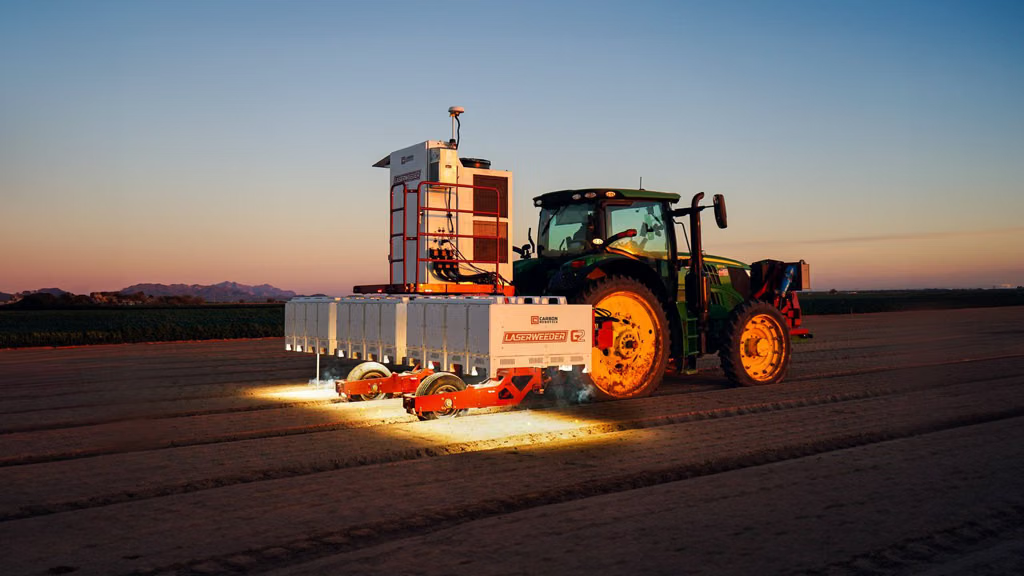
Integrating autonomous robots—such as AI-powered mechanical cultivators, smart-sprayers, and thermal/laser weeders (like the Carbon Robotics LaserWeeder or platforms from )—into a row-crop operation targets your two largest overhead burdens: chemical input waste and acute labor shortages.
Autonomous robots can lower herbicide and labor costs on a row-crop farm mainly by replacing “blanket” weed control with targeted, continuous weed management and by allowing fewer people to cover more acres. The economics depend heavily on crop, acreage, weed pressure, and robot cost, but the main savings mechanisms are:
1. Spot-spray only the weeds, not the whole field
Traditional broadcast spraying applies herbicide across the entire field, even though weeds may occupy only part of it. Autonomous robots use cameras, AI models, GPS/RTK positioning, and machine vision to identify weeds and apply small doses only where needed.
Autonomous robots are fundamentally changing the economics of row-crop farming by shifting weed management from broad, blanket field applications to hyper-targeted, machine-driven precision.
The primary ways these autonomous systems slash herbicide and labor costs include:
1. Cutting Herbicide Costs (Chemical Savings up to 7 5%−9 0%)
Micro-Spot Spraying: Instead of broadcast spraying an entire field, AI-enabled autonomous spot-sprayers (using infrared chlorophyll sensors and high-speed pulse-width modulation valves) detect individual weeds in milliseconds . They apply chemicals on the weed, leaving the crop and bare soil untouched. This reduces total chemical volume used by up to 7 5%.
Yes. For a row-crop farm, the biggest opportunity is changing weed control from “treat the whole field” to “find and treat the weeds.” Autonomous robots can attack both sides of the cost equation: chemical inputs and labor.
Where the savings come from
AI vision + spot spraying. Cameras identify individual weeds while the robot moves through the rows, and a nozzle sprays only the target rather than the entire field. A 2026 field study in corn and soybeans reported an estimated 82.9% reduction in herbicide use under its tested conditions.
Mechanical weeding. Instead of spraying, a robot can cultivate between rows or use tools to remove weeds. USDA describes robotic weed management as a way to reduce labor and potentially reduce tillage and herbicide dependence.
Less hand labor. Robots can operate for long periods and take over repetitive scouting, weeding and spraying. USDA's research programs specifically identify robotic weeding as a way to replace hand weeding while minimizing chemical use.
Autonomous robots can reduce row-crop farm costs mainly by changing weed control from “spray everything” to “detect and treat only what needs treatment” and by replacing some repetitive field labor. The biggest savings usually come from precision weeding, spot spraying, and labor reallocation.
1. Cut herbicide costs with AI-guided spot spraying
Autonomous agricultural robots cut row-crop herbicide costs by up to 90% through micro-targeted spot-spraying or laser elimination, and slash labor costs by operating 24/7 without a driver.
Sources AI cites
9% of citations to these sources link to brands' own websites.
Finds weed patches early so you can treat patches rather than entire fields
USDA is developing autonomous systems that combine weed identification, mapping and targeted control.
Unattended operation
Reduces the number of tractor/operator hours needed for repetitive work
USDA notes autonomy can reduce labor and allow robots to work long hours.
Eliminating Manual Hand-Weeding: For high-value specialty row crops or organic fields, hiring crews for hand-roguing and hoeing is a massive, volatile labor expense. Autonomous units operate day and night without breaks, drastically cutting manual labor requirements.
24/7 Uncrewed Field Operations: Because these rovers navigate via RTK-GPS and sensor fusion without a human driver, labor is shifted from active seat-time to passive fleet monitoring. One worker can oversee multiple autonomous platforms simultaneously.
Mitigating Labor Shortages: When seasonal labor is scarce or cost-prohibitive, autonomy ensures critical field operations happen on time rather than delayed by workforce availability, preventing yield loss from weed competition.
To explore if this fits your operation, tell me:
What specific row crops are you growing (e.g., corn, soybeans, specialty vegetables)?
Roughly how many acres is your operation?
I can help estimate whether a spot-spraying, mechanical, or laser-weeding model makes the most economic sense for you.
Go after weeds mechanically. Small autonomous machines can travel between rows and mechanically remove weeds, potentially replacing some cultivation/hand-weeding labor while avoiding herbicide altogether. USDA specifically identifies robotic weeding as a way to reduce both labor and chemical use.
Run longer with fewer operators. An autonomous platform can follow predefined rows, return to charging/refueling points, and operate with supervision rather than requiring someone continuously in the cab. That makes labor savings particularly interesting where finding seasonal operators is difficult.
Scout while it works. Cameras can map weed populations and crop condition. That data can be used to change subsequent spray passes, rather than treating every acre identically.
Target low-density patches. Spot spraying is especially economical where weeds are patchy. A 2025 field study found 35% average herbicide reduction in sugarcane and up to 65% in lower-weed-pressure strips.
A practical setup
For something like corn, soybeans, cotton, peanuts, or similar row crops, I'd think about the system as:
You don't necessarily need a fleet of expensive humanoid-looking robots. An autonomous implement or compact electric vehicle can potentially do the job.
There's also evidence that the hardware can be relatively inexpensive at the research/prototype level: one 2026 row-crop study reported a roughly $6,000 robotic spot-spraying platform and estimated 82.9% herbicide reduction under its test conditions. That's a research result, though—not a claim that a commercial $6,000 system is ready to farm thousands of acres.
Where I'd focus first
If your objective is lower total cost per acre, I'd prioritize:
Autonomous spot spraying for post-emergence weeds.
Mechanical robotic weeding where crop/row spacing permits it.
Autonomous scouting/mapping to build weed-density maps.
Only then consider replacing conventional tractors/implements with fully autonomous machines.
For example, if you spend $60/acre on herbicide and application and automation cuts the herbicide portion by 40%, that's potentially meaningful—but whether a robot actually pays depends heavily on acreage, weed pressure, crop, current labor cost, and how many passes it can replace.
If you give me crop(s), total acres, current herbicide cost/acre, number of spray passes, and what you pay for operators, I can build a rough ROI/payback model for an autonomous weeding/spraying system for your farm.
Autonomous machines reduce these costs through several distinct mechanisms:
1. Cutting Herbicide Costs
Targeted Micro-Application vs. Blanket Spraying: Instead of a traditional broadcast spray across entire acreage, autonomous smart-implements use high-resolution computer vision and machine learning to identify individual weeds. They apply chemicals only when and where a weed is present (or use thermal/laser energy to destroy the weed completely without any chemicals). This slashes herbicide volume usage dramatically.[2]
Mitigating Herbicide Resistance: Over-reliance on traditional broad-spectrum herbicides has driven the evolution of resistant weeds, forcing farmers to mix expensive, multi-chemical cocktails. Mechanical or laser-based autonomous weeding breaks this chemical cycle entirely, preventing weed escapes without escalating chemical budgets.
Preserving Soil Micro-Biomes: Non-chemical thermal and laser weeding eliminate chemical runoff and subsoil toxicity, which protects long-term soil health and fertility without needing costly chemical soil remediation.
2. Cutting Labor Costs
Eliminating Hand-Weeding Crews: For specialty row crops or organic transitions where manual hand-pulling crews are normally required, a single AI-driven weeding robot can substitute for dozens of manual laborers per shift.
24/7 Unmanned Operation: Autonomous field units operate day and night, in varying dust or light conditions, without requiring breaks, shift rotations, or specialized retention bonuses.
Reducing Operator Fatigue & Staffing Needs: Traditional mechanical inter-row cultivation requires skilled tractor drivers making slow, fatiguing passes. Autonomous field robots run driverless, freeing your existing skilled labor pool to focus on high-level farm management, logistics, or equipment maintenance rather than monotonous seat-time.
To figure out if the numbers pencil out for your specific operation, tell me:
What specific row crops are you growing (e.g., corn, soybeans, organic vegetables)?
How many total acres are you managing?
What is your current annual spend on hand-labor vs. chemicals?
Research and field demonstrations have shown large reductions in herbicide use when targeting individual weeds rather than spraying whole areas; some systems have reported very high reductions under specific conditions, though results vary by crop and field.
2. Mechanical weeding instead of chemical control
Some robots remove weeds using:
Inter-row cultivation
In-row blades or fingers
Lasers
Other non-chemical methods
This can reduce reliance on herbicides and provide another tool against resistant weeds.
For example, a robot that runs slowly and frequently can remove weeds when they are small, before they compete strongly with the crop.
3. Replace labor-intensive scouting and weeding
Robots can operate many hours with limited supervision. Instead of crews walking fields to:
scout weed pressure,
hand-weed problem areas,
spot spray,
one operator may manage multiple machines.
Automation studies have found that shifting workers from operating individual machines to supervising autonomous equipment can increase labor productivity and reduce operating costs.
4. Reduce “insurance spraying”
Many farms spray more than the average weed pressure would require because missing weeds can be expensive. A robot can make weed control more precise by:
mapping weed locations,
treating patches instead of entire fields,
returning to problem zones.
Over time, this can reduce the need for preventative blanket applications.
5. Improve timing
Weeds are easiest to kill when small, but labor and weather often delay field operations. Autonomous equipment can help by:
running during narrow weather windows,
operating at night,
making repeated light passes.
More frequent passes can sometimes substitute for one heavy chemical application.
A simple farm ROI example
Suppose a farm spends:
$25/acre on herbicide program
$8/acre on application costs
$15/acre on scouting/hand weed labor
A robotic system that reduces herbicide use by 50%, eliminates some hand labor, and reduces sprayer passes might save roughly:
Herbicide: $12.50/acre
Application: $4/acre
Labor: $10/acre
≈ $26.50/acre potential savings
Whether that pays for the robot depends on:
total acres covered,
purchase price or lease cost,
maintenance,
crop value,
whether the robot replaces existing equipment or adds a new cost.
Crops where the economics often make the most sense
Robotic weed control is currently most attractive where:
hand weeding is expensive,
crops are high value,
herbicide resistance is a major issue,
fields are large enough to spread equipment costs.
Specialty row crops have often been early adopters because labor savings can be substantial. For example, one commercial case study reported reduced hand-labor costs after deploying precision robotic weeding technology, though results are operation-specific.
For commodity crops like corn, soybeans, cotton, or wheat, the calculation is usually tougher because margins per acre are lower. The best fit may be a hybrid system:
autonomous scouting,
spot spraying,
targeted cultivation,
conventional spraying only when needed.
If you tell me your crop (corn, soybeans, cotton, vegetables, etc.), acreage, row spacing, and current herbicide/labor cost per acre, I can sketch a more realistic payback estimate.
For commodity crops like corn, soybeans, cotton, or wheat, the calculation is usually tougher because margins per acre are lower. The best fit may be a hybrid system:
Laser Weeding (Zero Chemical Use): Systems like the Carbon Robotics LaserWeeder use high-powered AI-directed lasers to thermal-zap hundreds of thousands of weeds per hour without applying a single drop of herbicide. This entirely bypasses the rising cost of chemical inputs and prevents chemical drift or crop stunting.
Combating Herbicide Resistance: Because robots allow for non-chemical mechanical or thermal destruction (lasers, micro-tillage, or localized heat), you reduce the evolutionary pressure that creates herbicide-resistant "superweeds," lowering the need to buy increasingly expensive, experimental chemical cocktails.
2. Cutting Labor Costs (Reduction up to 5 0%−6 0%)
Eliminating Manual Hand-Rogueing: Hand-pulling weeds or hiring seasonal manual labor crews for in-row maintenance is increasingly expensive, scarce, and logistically difficult. Autonomous machines operate continuously (day and night) with zero human intervention required in the field, completely replacing the need for hand-labor crews.
Reallocating Skilled Labor: Traditional spraying or mechanical cultivating ties up skilled equipment operators for long hours on large tractors. Autonomous field robots handle the repetitive grid-by-grid pass work independently, freeing your core workforce to focus on high-level farm management, logistics, and equipment maintenance rather than sitting in a cab for 14 hours straight.
3. Secondary Savings on Equipment and Soil
Lighter Footprint: Heavy self-propelled sprayers cause profound soil compaction, which eventually harms root development and costs yield. Smaller, lighter autonomous weeders or implement-pulling robots reduce compaction, protecting long-term soil health and yield potential.
To narrow down what kind of robot fits your operation, tell me:
What specific row crops are you managing (corn, soybeans, cotton, etc.)?
Roughly how many acres are you farming?
I can help estimate potential input savings and ROI timelines for your specific setup.
Autonomous agricultural robots (such as AI-powered precision sprayers and laser weeders like those from Carbon Robotics, Ecorobotix , and Verdant Robotics ) slash input and labor costs by shifting farm management from broad-spectrum blanket treatments to hyper-targeted, plant-by-plant execution.
How Robots Cut Herbicide Costs
Ultra-Precise Micro-Banding and Spot Spraying: Instead of a blanket broadcast application across the entire acreage, AI vision systems identify individual crop and weed plants in real time. Sprayers apply chemicals only where weeds exist, dropping herbicide use by up to 8 0%.
Thermal/Laser Elimination (0 0𝟎 Chemical Cost): Technologies like laser weeders use high-resolution cameras and deep learning to target the meristem of weeds, instantly destroying them with thermal energy (2 4 0 W lasers) without dropping a single drop of chemical.
Combating Herbicide Resistance: By dramatically reducing chemical dependency and supplementing or replacing chemical methods with physical destruction, autonomous systems help curb the evolution of resistant "superweeds," preserving the long-term efficacy of standard chemistry.
Zero Soil Disturbance: Unlike conventional mechanical cultivation passes that can unearth new weed seeds and trigger secondary flushes, precision robotic weeding leaves the soil profile intact, reducing the compounding need for subsequent weed management.
How Robots Cut Labor Costs
Elimination of Hand-Weeding Crews: For high-value specialty row crops or organic acreage where manual labor is historically required for roguing and hand-weeding, autonomous machines completely remove or heavily reduce reliance on scarce and expensive seasonal hand labor.
24/7 Autonomous Operation: Robots operate day and night without requiring traditional shift breaks, vastly increasing the number of acres managed per unit of human supervision. A single operator can oversee one or multiple autonomous units.
Reduced Tractor Passes: Consolidating multiple passes (tillage, inter-row cultivation, scouting, and spraying) into single autonomous deployments reduces fuel usage, equipment wear-and-tear, and the labor hours spent driving machinery.
To give you a precise economic breakdown, tell me:
What specific row crops are you growing (corn, soybeans, specialty crops)?
Roughly how many acres are you managing?
Are you currently dealing with severe herbicide-resistant weed pressure (like waterhemp or Palmer amaranth)?
Target the expensive weeds. A robot can repeatedly patrol fields and deal with escapes instead of requiring a large crew to walk or cultivate everything. Research on autonomous robot teams found that sharing weed-location information can improve the efficiency of robotic weeding in patchy weed populations.
The most practical setup
For a conventional corn/soybean operation, I'd think about a hybrid system rather than trying to make robots replace every tractor operation:
1. Normal planter → 2. Robot scouts rows → 3. Robot mechanically weeds and/or spot-sprays → 4. Conventional sprayer handles only necessary broad-acre applications → 5. Robot returns for escapes.
That lets you progressively reduce herbicide rather than betting the entire crop on a new technology.
The economics are important, though. A 2025 study of autonomous machines on Midwest corn/soybean farms found that autonomy can make economic sense when labor is severely constrained, but conventional mechanization remained more profitable where reliable labor was available. Supervision requirements, field efficiency and subscription costs were important variables.
And there's a useful caution: autonomous mechanical weeding isn't automatically cheaper. A 2025 sugar-beet economic study found that robot weeding could have attractive gross returns but that investment, supervision and human intervention could erase the economic advantage on conventional farms.
A simple ROI calculation
I'd calculate your potential savings as:
Annual savings =
current herbicide cost − robotic herbicide cost
+ current weeding/scouting labor − remaining labor
+ avoided custom application costs
− robot lease/depreciation
− software/service fees
− robot operator/supervisor labor
− maintenance, batteries/fuel and transport
Then divide the robot's net annual savings into its purchase price to get a rough payback period.
As an indication of what is technically possible, recent field research has demonstrated 35% average herbicide reduction and up to 65% in low-weed-density strips with robotic spot spraying in sugarcane.
If you tell me your acreage, crops (e.g. corn/soy/cotton), current herbicide cost per acre, and annual weeding/scouting labor cost, I can build a rough 5-year robot ROI and break-even analysis for your farm.
Traditional broadcast spraying applies herbicide across the whole field, even where weeds are sparse. Autonomous robots can:
Use cameras and AI to distinguish crops from weeds.
Spray only individual weeds or small patches.
Reduce overlap and chemical waste.
Apply mechanical removal instead of chemicals where practical.
Research and field trials have shown large reductions are technically possible: some robotic spot-spraying systems have reported major reductions in herbicide use under test conditions, while commercial systems have demonstrated substantial input savings depending on crop and weed pressure.
For a row-crop farm, the biggest opportunities are often:
Cotton: targeted Palmer amaranth/waterhemp control
Corn and soybeans: late-season weed escapes and resistant weed patches
Vegetables: in-row weed control where hand labor is expensive
2. Reduce hand-weeding labor
Robots can handle tasks that are hard to staff:
Scouting fields repeatedly
Removing weeds between rows
Spot treating escapes
Monitoring crop conditions
Instead of crews walking fields to find and remove weeds, one operator can supervise multiple machines. Automation studies have found that shifting workers from machine operation to fleet supervision can improve labor productivity and reduce operating costs.
Some commercial deployments have reported significant reductions in hand-labor costs in specialty row crops, though results vary widely by crop, acreage, and weed pressure.
3. Improve timing and reduce expensive “rescue” passes
Autonomous robots can operate more frequently because they are not limited by:
Finding enough labor during peak windows
Operator fatigue
Tractor availability
Earlier weed detection means:
Smaller weeds require less chemical or mechanical effort.
Fewer emergency spray passes may be needed.
Herbicide resistance pressure may be reduced over time.
4. Lower fuel and machinery costs
Small autonomous machines can sometimes replace repeated tractor passes by:
Traveling slowly through rows.
Using electric drives.
Reducing soil compaction compared with heavy equipment.
This is most attractive where a large tractor and sprayer are expensive to run relative to the value of precision work.
5. Add scouting and crop intelligence
Many robots collect field data while working:
Weed maps
Crop stand counts
Disease indicators
Growth variability
That data can support variable-rate decisions, helping avoid unnecessary inputs.
A simple farm ROI example
A robot may pay off if it replaces a combination of:
Herbicide savings: fewer gallons applied per acre
Labor savings: fewer hours of hoeing/scouting/hand weeding
Reduced passes: less fuel and machinery wear
Better yields: fewer weeds competing with the crop
The economics depend heavily on:
Crop type
Acres covered per season
Weed pressure
Herbicide program costs
Labor availability
Whether you buy, lease, or use a service model
For many row-crop operations, a practical first step is not replacing the whole spray program, but using robots for the expensive problem areas: resistant weed patches, in-row weeds, and labor-intensive scouting.
If you tell me your crop (corn, cotton, soybeans, vegetables, etc.), acreage, and current herbicide + labor spend per acre, I can estimate where an autonomous robot might actually pencil out.
Autonomous field machines—such as those developed by companies like Carbon Robotics (LaserWeeder) or Ecorobotix —transform crop management from blanket field applications to high-precision operations.
How Autonomous Robots Cut Herbicide Costs
Ultra-Precise Spot Spraying: Machine vision and AI cameras identify individual weeds in milliseconds, applying micro-doses of herbicide directly to the weed rather than broadcasting the entire field.
Chemical-Free Laser Weeding: Some autonomous weeders use high-powered thermal lasers to destroy weed meristems instantly, eliminating herbicide costs entirely for those passes.
Mitigating Resistance and Overuse: Targeted treatments prevent chemical drift, crop stress, and unnecessary soil degradation while maintaining cleaner rows.
How Autonomous Robots Cut Labor Costs
Driverless Operation: GPS navigation, RTK guidance, and AI safety sensors allow machinery to run autonomously, shifting human workers from equipment operators to remote fleet supervisors.
Extended Operational Hours: Robots can operate day and night, through early mornings and overcast weather, vastly accelerating field coverage compared to manual labor or single-shift human drivers.
Reduced Hand-Weeding Dependence: Eliminating reliance on scarce seasonal labor crews for manual rogueing or post-emergence weed control stabilizes unpredictable annual operating expenses.
Impact on Farm Economics
Cost Category
Traditional Method
Autonomous Robotic Method
Estimated Savings
Herbicide Input
Blanket field broadcast
Micro-spot spray or laser
Up to 90% reduction
Labor Requirement
Full-time manual/driver crew
Autonomous monitoring/fleet
Up to 50-70% fewer hours
Operational Window
Limited by daylight/shifts
Continuous 24/7 capability
2x to 3x higher daily output
If you share your current crop type (e.g., corn, soybeans) and approximate acreage , I can help estimate the potential equipment ROI timeline for your operation.