Data as of Sep 18, 2026 · Based on 50 AI responses from ChatGPT Search and Google AI Mode · See how Parse measures this
Your brand can be here too.
Source | Citation share |
|---|---|
 Precision Sprayer Benefits Growers and the Environment : USDA ARShttps://www.ars.usda.gov/oc/dof/precision-sprayer-benefits-growers-and-the-environment/ | 2.4% |
 Meet the robots removing pesticides from cropshttps://www.youtube.com/watch | 1.4% |
 Precise Robotic Weed Spot-Spraying for Reduced Herbicide Usage and Improved Environmental Outcomes -- A Real-World Case Studyhttps://arxiv.org/abs/2401.13931 | 1.2% |
Will AI Replace Agriculture? Not Exactly But It’s Already Changing the Farmhttps://www.ilcorn.org/will-ai-replace-agriculture-not-exactly-but-its-already-changing-the-farm | 1.2% |
 Artificial intelligence in crop protection - ScienceDirect.comhttps://www.sciencedirect.com/science/article/pii/S221431732500085X | 1.2% |
AI for Low-Pesticide Agriculturehttps://www.youtube.com/shorts/uwe-5PB9p4Y | 1.2% |
How AI Precision Agriculture Reduces Chemical Usage by 90% ...https://chiefaiofficer.com/ai-precision-agriculture-chemical-reduction-sustainable-farming/ | 1.0% |
 AI in Agriculture: Smarter Crops, Better Yields | CSAhttps://cloudsecurityalliance.org/blog/2025/02/10/ai-in-agriculture-smarter-crops-healthier-livestock-better-yields | 1.0% |
Precision robotic spot-spraying: Reducing herbicide use and enhancing environmental outcomes in sugarcanehttps://researchonline.jcu.edu.au/89739/ | 1.0% |
 See & Spray Gen 2 | John Deere UShttps://www.deere.com/en-us/products-solutions/sprayers-and-applicators/see-spray | 1.0% |
Cutting pesticide and herbicide use while protecting your yield requires moving away from blanket, whole-field spraying toward **precision application** and **non-chemical mechanical/laser interventions**.[[1]](https://www.mdpi.com/2504-4990/8/2/51) Here are the key AI and robotics categories and tools you should…
Cutting pesticide and herbicide use while protecting your yield requires moving away from blanket, whole-field spraying toward precision application and non-chemical mechanical/laser interventions.
Here are the key AI and robotics categories and tools you should consider, organized by how they target crop protection:
Instead of spraying an entire field, these systems use computer vision and machine learning models to detect weeds, pests, or nutrient deficiencies in real time, firing micro-nozzles only when a threat is identified.
If your goal is to eliminate chemical inputs entirely for weed management, autonomous field robots use computer vision to physically or thermally destroy weeds with sub-inch accuracy.[1][2]
Early detection is the secret to reducing pesticide volume—if you catch a pest or fungal outbreak at a 1% threshold rather than a 15% threshold, localized treatment stops a systemic blowout.
To help narrow down which of these tools fit your operation, could you tell me:
Cainthus
Yes. The most relevant technologies are **AI vision + precision application**, rather than generic “farm AI.” They can reduce pesticide use by deciding *where* and *what* to treat while keeping the rest of the field untreated. ### Tools worth evaluating Technology | What it does | Best fit
Yes. The most relevant technologies are AI vision + precision application, rather than generic “farm AI.” They can reduce pesticide use by deciding where and what to treat while keeping the rest of the field untreated.
| Technology | What it does | Best fit |
|---|---|---|
| John Deere / Blue River See & Spray | Cameras + machine learning identify crops and weeds in real time and trigger individual nozzles. Gen 2 supports targeted in-crop spraying and field/weed mapping. | Large-scale corn, soybeans, wheat and other row crops |
| Ecorobotix ARA | Very high-resolution computer vision detects individual plants/weeds and applies tiny targeted sprays. The company reports reductions of up to 95% in plant-protection products, depending on conditions. | Vegetables, specialty crops, sugar beets and situations where plant-level targeting matters |
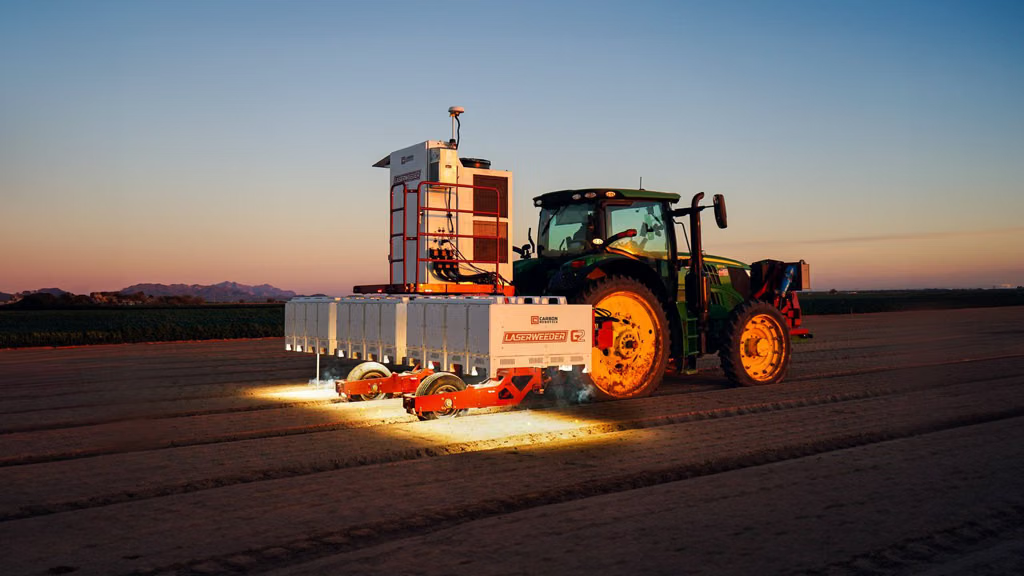
| Carbon Robotics LaserWeeder | AI cameras identify weeds and lasers kill them mechanically/thermally, eliminating herbicide application for that weeding pass. | High-value specialty crops, especially bed-grown vegetables |
| AI scouting + variable-rate systems | Drones, cameras, sensors and mapping software identify weed/disease/insect hotspots; you then spray only areas exceeding your treatment threshold. | Farms that aren't ready to replace their sprayer |
John Deere reports that its See & Spray customers reduced non-residual herbicide use by nearly 50% in 2025, while its sponsored soybean trials across seven states reported an average 2 bu/acre yield increase versus broadcast spraying. Those are manufacturer-reported results, so I'd validate them against trials on your crops and soils before using them in an ROI calculation.
Ecorobotix's ARA is particularly interesting if you're growing vegetables or other crops where individual-plant treatment is practical. Its cameras can identify plants at sub-centimeter scale and trigger sprays in roughly 6×6-cm target areas.
For zero-herbicide weed control, Carbon Robotics' LaserWeeder uses computer vision to identify weeds and lasers to kill them without herbicide or soil cultivation. Its applicability is much more crop-specific than a smart sprayer, though.
Rather than buying a robot immediately, I'd run a one-season precision-pesticide pilot:
USDA researchers are currently evaluating robotic weed-management systems specifically in terms of weed control, economics, yield loss and subsequent weed-seed-bank effects, which is a useful reminder that chemical savings alone aren't enough—the important metric is chemical savings without unacceptable yield or future weed pressure.
If you tell me your crops, acreage, row spacing, current sprayer/tractor, and whether you're mainly trying to cut herbicides, fungicides, insecticides, or all three, I can narrow this to the technologies that actually fit your operation and estimate what a pilot could look like.
For zero-herbicide weed control, Carbon Robotics' LaserWeeder uses computer vision to identify weeds and lasers to kill them without herbicide or soil cultivation. Its applicability is much more crop-specific than a smart sprayer, though.
To cut pesticide use **without sacrificing yield**, focus on tools that improve **scouting, decision-making, and targeting** rather than simply automating spraying. The best systems usually combine AI detection + precise application + integrated pest management (IPM). Precision agriculture research shows that these…
To cut pesticide use without sacrificing yield, focus on tools that improve scouting, decision-making, and targeting rather than simply automating spraying. The best systems usually combine AI detection + precise application + integrated pest management (IPM). Precision agriculture research shows that these approaches can substantially reduce chemical inputs by applying treatments only where needed.
Best fit: Almost every farm size, especially if you currently rely on calendar-based spraying.
Tools to consider:
Why it helps: instead of treating an entire field because a pest might be present, you treat confirmed problem areas. Remote sensing, AI, and decision-support systems are increasingly used for early pest detection and targeted intervention.
Best fit: Farms with high herbicide use or expensive chemical inputs.
These systems use cameras and machine learning to distinguish:
They then activate individual nozzles only where needed.
Examples of approaches:
Variable-rate and AI-guided spraying systems use GPS, sensors, machine vision, and adaptive controls to reduce unnecessary chemical application. ScienceDirect Field tests of intelligent sprayer technology have shown reduced pesticide use and drift while maintaining pest control in some crops.
Best fit: Vegetable, specialty crop, and row-crop operations where weeds are a major pesticide cost.
Options include:
These systems can reduce herbicide dependence by removing weeds physically. Reviews of precision farming technologies have found strong potential for robotic weeding and targeted weed management to reduce chemical use.
Best fit: Farms where timing matters (fungicides, insects, disease outbreaks).
These systems combine:
They answer questions like:
This is often one of the lower-cost AI entry points because it can work with existing equipment.
Before buying robots, consider upgrading existing sprayers:
These upgrades can reduce chemical waste without changing your entire operation.
Ask vendors:
If you tell me:
I can narrow this to the tools most likely to pay off for your operation.
Cutting pesticide and chemical use while protecting your yield relies on shifting from blanket field spraying to **precision targeting** . Modern AI and robotics make it possible to treat individual weeds, specific pest hotspots, or single plants rather than entire acres. The top AI and robotic categories to consider…
Cutting pesticide and chemical use while protecting your yield relies on shifting from blanket field spraying to precision targeting . Modern AI and robotics make it possible to treat individual weeds, specific pest hotspots, or single plants rather than entire acres.
The top AI and robotic categories to consider for your farm include:
To help narrow down which tools fit your operation best, tell me:
Yes. The biggest opportunity is usually **not “replace pesticides with robots”**, but use AI to determine *exactly where, when, and how much* to spray—and use mechanical/robotic control where spraying can be avoided. ## Tools worth evaluating - **John Deere See & Spray** — Probably the strongest option if you already…
Yes. The biggest opportunity is usually not “replace pesticides with robots”, but use AI to determine exactly where, when, and how much to spray—and use mechanical/robotic control where spraying can be avoided.
| Farm situation | First technology I'd investigate |
|---|---|
| Corn/soy/wheat/large row crops | AI targeted sprayer |
| Vegetables with lots of in-row weeds | Vision-guided mechanical weeder + spot sprayer |
| Orchards/vineyards | Intelligent variable-rate sprayer + AI scouting |
| High-value specialty crops | Plant-level AI sprayer |
| Want to minimize herbicide specifically | Robotic/mechanical weeding |
| Already own modern sprayer/tractor | Retrofit precision spraying before buying a robot |
The economics are important: don't judge these systems by pesticide reduction alone. Measure chemical cost + labor + passes + weed control + yield per acre. A system that cuts herbicide 70% but requires an expensive additional pass may be worse economically than one that cuts it 50% in a single existing pass.
I'd start with a 10–20% pilot of your acreage, comparing conventional treatment against AI-targeted treatment and tracking:
That gives you a defensible ROI before committing to expensive robotics.
If you tell me your crop(s), acreage, whether you're row-crop or specialty-crop, and what pesticides you're trying to reduce, I can narrow this to the 3–5 most appropriate systems and estimate where the payback is likely to be.
Cutting pesticide and herbicide use while maintaining or even improving yield is entirely possible today through **precision AI** and **smart agricultural robotics** . Instead of blanket-spraying entire fields, these tools use real-time computer vision to target individual plants, pests, or…
Cutting pesticide and herbicide use while maintaining or even improving yield is entirely possible today through precision AI and smart agricultural robotics . Instead of blanket-spraying entire fields, these tools use real-time computer vision to target individual plants, pests, or weeds.
The key AI and robotics technologies to consider for your farm include:
If you want to narrow these down, tell me:
I can help you figure out which of these tools delivers the best ROI for your specific operation.

For a farm trying to **reduce pesticide use while protecting yield**, the most promising approach is usually not “replace the sprayer with a robot,” but to combine **better detection + targeted treatment + prevention**. Precision agriculture tools can help identify *where* and *when* intervention is needed instead of…
For a farm trying to reduce pesticide use while protecting yield, the most promising approach is usually not “replace the sprayer with a robot,” but to combine better detection + targeted treatment + prevention. Precision agriculture tools can help identify where and when intervention is needed instead of treating an entire field uniformly.
Here are the main categories worth considering:
Tools:
What they do:
Best fit: Large fields where scouting every acre manually is difficult.
Potential benefit: targeted scouting can prevent “calendar spraying” and move toward treatment only where risk is confirmed. AI pest-management systems increasingly combine imaging, sensors, and decision support to forecast and locate problems.
Instead of spraying every plant or every acre, these systems use cameras and AI to trigger individual nozzles only when weeds or disease targets are detected.
Examples of approaches:
Benefits:
USDA research on intelligent sprayer controls has shown reductions in pesticide use and drift while maintaining pest control performance in tested specialty crops.
For crops where weeds drive most pesticide use, consider:
These systems use computer vision to distinguish crops from weeds and act only on unwanted plants. Reviews of robotic weed control systems report substantial reductions in herbicide use in certain applications.
Good candidates:
These are smaller machines that can:
Look for platforms that support:
Modern agricultural robots increasingly combine cameras, AI, and sensors for targeted spraying and monitoring rather than blanket application.
These tools combine:
They can help answer:
This fits well with integrated pest management (IPM), where pesticides are one tool among scouting, biological controls, resistant varieties, and cultural practices.
A typical farm rollout could look like:
Ask vendors:
If you tell me your crop(s), acreage, region, current spraying method, and biggest pesticide target (weeds, insects, or disease), I can narrow this down to the tools that are most likely to pay off for your farm.
Cutting pesticide and herbicide use without sacrificing yield is one of the fastest-growing areas in ag tech. Moving away from blanket, whole-field spraying to ultra-precise, plant-by-plant management lets you protect your bottom line and your…
Cutting pesticide and herbicide use without sacrificing yield is one of the fastest-growing areas in ag tech. Moving away from blanket, whole-field spraying to ultra-precise, plant-by-plant management lets you protect your bottom line and your crops.
Here are the primary AI and robotics categories and tools you should consider:
Instead of relying on broad-spectrum herbicides that can stress crops or trigger resistance, laser weeding uses computer vision and deep learning to identify weeds and destroy them with thermal energy from a laser—all while rolling autonomously through the fields at crop speed.
If complete elimination of chemicals isn't feasible immediately, spot-spraying tech reduces your chemical volume by up to 90% by applying herbicide or targeted bio-pesticides only where a weed or pest is actively detected.
Early detection is critical if you want to lower pesticide use; catching a fungal outbreak or an insect hatch early means a localized fix instead of a field-wide emergency response.
Add to list An autonomous agricultural drone platform that maps fields, conducts real-time AI crop health diagnostics, and aids in precise tracking of pest hotspots.[1]
Add to list An autonomous 4WD ground rover built for close-range crop monitoring, targeted spot treatment, and data collection beneath or alongside canopy rows in specialty crops, orchards, and vineyards.[1]
Robotics handle the execution, but AI forecasting tools help you decide when intervention is actually necessary based on micro-climates, insect lifecycle modeling, and historical weather data.
To help narrow down what fits your operation best, tell me:
Cutting pesticide use while protecting (or even boosting) yield relies on shifting from blanket field applications to **precision targeting** or **chemical-free elimination** . AI and robotics achieve this by identifying pests and weeds at an individual level. The primary AI and robotics tools available to modernize…
Cutting pesticide use while protecting (or even boosting) yield relies on shifting from blanket field applications to precision targeting or chemical-free elimination . AI and robotics achieve this by identifying pests and weeds at an individual level.
The primary AI and robotics tools available to modernize farm operations include:
To help narrow down what fits your operation best, could you tell me:
Yes. The biggest opportunity is **not “replace the farmer with robots”**; it’s using AI to decide *where treatment is actually needed*, then using precision equipment to apply a much smaller dose. ## Tools worth considering Technology | Best fit | What it does | Potential pesticide reduction
Yes. The biggest opportunity is not “replace the farmer with robots”; it’s using AI to decide where treatment is actually needed, then using precision equipment to apply a much smaller dose.
| Technology | Best fit | What it does | Potential pesticide reduction |
|---|---|---|---|
| AI spot sprayer | Row crops, vegetables | Cameras identify individual weeds/crops and trigger nozzles only where needed | Very high |
| AI mechanical weeder | Vegetables, row crops | Vision identifies weeds and mechanically removes them instead of spraying | High |
| Autonomous micro-spraying robot | Specialty crops / vegetables | Combines robotic cultivation with tiny targeted chemical applications | High |
| Drone/satellite crop scouting | Almost any farm | Maps crop stress, weeds and disease so you scout/treat specific zones | Moderate |
| Variable-rate sprayer | Larger conventional operations | Adjusts application rate according to field conditions/maps | Moderate |
| AI disease/pest detection | Orchards, vegetables, specialty crops | Detects early signs and helps determine whether treatment is warranted | Potentially high |
This is probably the first technology I'd investigate if herbicide is a major part of your pesticide budget.
ecorobotix.com uses cameras and AI to distinguish crops from weeds and spray individual targets. Its spray pattern is about 6 × 6 cm, and the company reports reductions of up to 95% in plant-protection-product use. Those are vendor claims, so I'd validate them under your crops, weed pressure and operating conditions.
Another interesting option is niqorobotics.com. Its AI camera system can retrofit conventional sprayers to perform targeted spot spraying, and the company is currently demonstrating its robots in North America.
If your farm grows vegetables or other relatively high-value row crops, an AI-guided mechanical weeder can attack the problem at the source: remove weeds rather than chemically treating them.
Research published in 2026 demonstrated deep-learning-guided intra-row mechanical weeding in lettuce, with relatively low crop damage in protected-crop trials.
For farms where mechanical cultivation is practical, this can be particularly attractive because it reduces reliance on herbicides altogether.
farmdroid.com is an example worth evaluating for crops compatible with its platform. Its 2026 season data reports 91% average chemical-input reduction during spot spraying and 81% during band spraying, alongside autonomous seeding and mechanical weeding. Again, treat manufacturer-reported numbers as something to test rather than a guaranteed farm result.
You don't necessarily need a robot to get a substantial benefit from AI.
A good first stage is:
satellite/drone imagery → AI identifies suspicious areas → scout those areas → spray only confirmed problems.
That can prevent the expensive mistake of treating an entire field because a small portion has a disease, pest or nutrient problem.
I'd approach this as a one-season controlled trial, rather than buying an expensive fleet immediately:
A particularly interesting point is that low-cost versions are becoming plausible: a 2026 field study described an edge-AI target-spraying platform costing about $6,000 to build and reported an estimated 82.9% herbicide reduction under its tested conditions. That's research rather than a turnkey commercial product, but it illustrates how quickly the technology is moving.
If you tell me your crop(s), acreage, current sprayer/tractor setup, and whether you're primarily trying to cut herbicides, fungicides, or insecticides, I can narrow this to 3–5 specific technologies that make economic sense for your farm.
ecorobotix.com uses cameras and AI to distinguish crops from weeds and spray individual targets. Its spray pattern is about 6 × 6 cm, and the company reports reductions of up to 95% in plant-protection-product use. Those are vendor claims, so I'd validate them under your crops, weed pressure and operating conditions.
Another interesting option is niqorobotics.com. Its AI camera system can retrofit conventional sprayers to perform targeted spot spraying, and the company is currently demonstrating its robots in North America.
If your farm grows vegetables or other relatively high-value row crops, an AI-guided mechanical weeder can attack the problem at the source: remove weeds rather than chemically treating them.
Research published in 2026 demonstrated deep-learning-guided intra-row mechanical weeding in lettuce, with relatively low crop damage in protected-crop trials.
For farms where mechanical cultivation is practical, this can be particularly attractive because it reduces reliance on herbicides altogether.
farmdroid.com is an example worth evaluating for crops compatible with its platform. Its 2026 season data reports 91% average chemical-input reduction during spot spraying and 81% during band spraying, alongside autonomous seeding and mechanical weeding. Again, treat manufacturer-reported numbers as something to test rather than a guaranteed farm result.
You don't necessarily need a robot to get a substantial benefit from AI.
A good first stage is:
satellite/drone imagery → AI identifies suspicious areas → scout those areas → spray only confirmed problems.
That can prevent the expensive mistake of treating an entire field because a small portion has a disease, pest or nutrient problem.
I'd approach this as a one-season controlled trial, rather than buying an expensive fleet immediately: