User Interviews holds a clear lead, frequently recommended for broad participant recruitment and screening for accessibility needs. For surveys requiring advanced logic or pre-launch market research, Qualtrics and SurveyMonkey are the usual answers instead.
Since July, Respondentrising has become the most named option for general UX study recruitment, while Prolificrising and Dscoutrising see broader overall mentions. SurveyMonkeyrising has also become the most named platform for pre-launch market research surveys.
Latest insights
Week of Sep 21–27 · Since Jul 5
Respondent Gap between platforms: ChatGPT Search now mentions Respondent 16.1 points more often than Google AI Mode in User Research & Testing Platforms, a widened gap
Prolific Gap between platforms: Prolific's platform gap in User Research & Testing Platforms narrowed: ChatGPT Search 62.9%, Google AI Mode 39.9%
Ethnio Gap between platforms: Google AI Mode now mentions Ethnio 23.4 points more often than ChatGPT Search in User Research & Testing Platforms, a narrowed gap
Ethnio Slipping: Ethnio dropped 1 place to rank #6 of 51 in User Research & Testing Platforms
Ethnio Slipping: Ethnio now trails Dscout in User Research & Testing Platforms, #6 to #5
76% of citations point at the ranked brands’ own sites. reddit.com, koji.so, getperspective.ai are the most-cited sites outside the ranked brands’ own domains.
For a UX designer who regularly conducts user interviews, I’d start by comparing User Interviews, Respondent, and Dscout. The best choice depends on whether you primarily need to find participants, manage a reusable pool of users, or run the entire research workflow in one place.
If your goal is to spend less time coordinating participants and more time talking to users, look for a platform that handles recruitment, screening, scheduling, reminders, incentives, and re-contacting participants for future studies.
My top recommendations
1. User Interviews
(Best starting point)
Best for UX designers who conduct qualitative interviews and need a straightforward way to recruit, screen, and schedule research participants.
I am looking for a tool to help me find and schedule people for my UX research sessions. Which platforms are best for managing participant recruitment?
I need to recruit participants for a UX research study. What are the best participant recruitment platforms?
Which user research recruitment platforms support complex screeners quotas eligibility verification and controls against repeat professional participants?
Which research recruitment platforms coordinate scheduling incentives currencies tax documentation and time zones for global studies?
I'm looking for a market research tool to survey our target audience before we launch a new product.
What is the best survey tool for a UX researcher that allows for advanced logic and analysis?
Recruit from an external participant pool or your own customers.
Manage studies and participant logistics.
Particularly suited to interview-based research.
Explore:
2. Respondent
(Best for hard-to-find users)
My pick if your research involves specific professional roles, industries, or B2B customers.
Target participants by job title, skills, industry, and experience.
Automate screening, scheduling, reminders, and participant payments.
Re-contact participants and manage cohorts across studies.
Explore:
3. Dscout
(Best for deeper research programs)
Best if interviews are just one part of your research practice and you want to run more sophisticated studies.
Recruit from its participant panel, partner panels, or your own users.
Conduct interviews, diary studies, field studies, and usability tests.
Manage scheduling, incentives, transcripts, and private participant panels.
Explore:
How they compare
Capability
User Interviews
Respondent
Dscout
External participant recruitment
Excellent
Excellent
Excellent
B2B / niche audiences
Strong
Excellent
Strong
Scheduling and incentives
Yes
Yes
Yes
Reusable participant panel
Strong
Re-contact and cohorts
Private panels
Diary and field studies
Integrations
Some support
Excellent
Best fit
Interview workflows
Specialist recruiting
Broader qualitative research
Feature comparisons are based on the vendors' published capabilities.
One more platform worth considering
Maze
Consider Maze if you want participant recruitment and management combined with prototype testing, surveys, and research analysis. Its moderated interview features are limited to Enterprise plans, so check the plan requirements before committing.
My default recommendation is User Interviews if you're an independent designer or work on a small product team. Its pay-as-you-go recruitment starts at $49 per session, and its Research Hub offers more extensive participant CRM and panel-management features for teams conducting research continuously.
If you want to choose the best fit more precisely, one question:
Where do you usually get your interview participants?
However, the "best" platform actually depends heavily on your specific niche (e.g., B2B professionals vs. mobile diary studies) and whether you are recruiting from an external pool or managing your own CRM.[](https://www.uxia.app/blog/best-user-interviews-alternatives-in-2026)
Top Participant Recruiting and Management Platforms
If you need everyday consumer or mixed B2B recruitment: Use User Interviews . It features transparent pay-per-session pricing, robust screeners, and handles incentive payments so you don’t have to chase receipts or process gift cards manually.[](https://www.userinterviews.com/)
If you want to build an "Owned Panel" of your own customers: Use or . Instead of relying on a third-party panel, these tools let you deploy intercept scripts on your site/app or import your user CSV to schedule and reward your actual users cleanly.[](]()]()
If you can share what type of users you need to target (e.g., everyday consumers, enterprise IT admins, mobile shoppers) and your budget constraints , I can recommend the exact platform and screen strategy for your next project.
Recruiting the right participants depends heavily on your target audience (consumer vs. niche B2B) and whether you need to run the sessions yourself or use an integrated testing panel.
The top UX research participant recruitment platforms are categorized below by their strengths:
User Interviews — Widely considered a gold standard for general and fast recruitment. It features a massive pool of vetted participants [1.1.1, 1.1., and robust screening/scheduling tools. Excellent for both consumer and professional audiences, and lets you manage your own internal panel (CRM) as well.[](https://www.akraya.com/blog/best-rapid-ux-research-partners-product-teams)
UserTesting — Best if you want an all-in-one platform to both recruit and instantly run moderated or unmoderated usability tests. They feature a large proprietary panel with rich demographic and device-targeting filters.[](https://www.gartner.com/reviews/market/user-research-platforms)
Prolific — Highly regarded for high-integrity, fast, and ethically-paid participants, frequently used for detailed behavioral testing, card sorting, or unmoderated tasks, with great controls over participant demographics.
dscout — Ideal for remote, longitudinal, or diary-style qualitative research. It allows you to recruit "scouts" who can submit rich video, photo, and text feedback from their mobile devices over several days.[](https://www.gartner.com/reviews/market/user-research-platforms)
Ethnio — Excellent if you prefer intercepting users directly on your live product or website. Ethnio helps you build custom intercept screeners, manage incentives, and organize a centralized research repository of your own users.
To help narrow down the best choice, tell me:
What is your target audience (e.g., everyday consumers vs. specific B2B professionals)?
What type of research are you running (moderated interviews, unmoderated usability tests, diary studies)?
Yes. For UX research participant recruitment, I’d shortlist these platforms rather than treating all research panels as interchangeable. The best choice depends heavily on whether you need everyday consumers, niche professionals, or a large quantitative sample.
When managing complex studies, filtering for niche audiences, and defending data integrity against professional survey takers, bots, or duplicate profiles , modern user research platforms diverge significantly in their capabilities.[](https://www.userintuition.ai/posts/research-panel-complete-guide/)
Top recruitment platforms handle complex screeners, quotas, eligibility enforcement, and anti-fraud measures with varying strengths:
Prolific
Complex Screeners & Eligibility: Offers extensive pre-screening filters (hundreds of demographic and behavioral variables) plus in-study custom screening that lets you program complex qualification logic.
Quotas: Highly robust. Supports granular quota controls (up to 120 strata) for variables like age ranges, sex, and country of residence, allowing automated replacement of disqualified or fast-reject participants.
Complex Screeners & Eligibility: Excellent for advanced custom screeners, especially for B2B, consumer, and hard-to-reach professional niches. Allows branching logic and killer questions.
Quotas: Provides project-level targeting and caps, though complex multi-variable matrix quotas sometimes require active management or splitting projects into distinct segments.
Complex Screeners & Eligibility: Highly specialized in B2B and niche professional recruitment (developers, marketers, executives). Complex screeners can be tailored deeply to job titles, industries, and software proficiencies.
Quotas: Offers project-level spec targeting, but relies heavily on manual researcher review of applicants rather than fully automated algorithmic matrix quotas during the screening intake.
Anti-Repeat / Fraud Controls: Strongly focused on professional identity verification, requiring LinkedIn authentication, verified corporate/work email addresses, and payment tracking to ensure individuals don't cycle through rewards under multiple aliases.[](https://www.respondent.io/panel/us-panel)
CleverX
Complex Screeners & Eligibility: Features AI-assisted screener generation that builds advanced qualification and disqualification logic swiftly to target niche B2B professional segments.
Quotas: Built for quick turnarounds on professional insights with automated filtering kicking in as applicants roll in.
Yes. If your requirements are complex screening + quotas + eligibility verification + protection against repeat/professional “panel” participants, the strongest fits I’d look at are:
Prolific, User Interviews, and Respondent.io are the leading research participant panels that explicitly disclose their sourcing methodologies, enforce rigorous anti-fraud controls, maintain documented no-show and replacement policies, and permit complete study data and participant metadata export.
Overview of Top Compliant Participant Panels
Panel Provider
Sourcing & Quality Transparency
Fraud Prevention & Controls
No-Show & Replacement Policies
Study Data Export
Prolific
High; transparent academic-grade sourcing, double opt-in, public documentation on demographic representation.
User Interviews Operations: User Interviews explicitly details how participants are sourced (organic, targeted ads, panel networks) and offers a seamless credit or re-booking flow when a participant fails to show up for a live moderated session.[]()
If you are planning a specific study, tell me:
Whether you are running quantitative surveys or qualitative user interviews
Your target audience (B2B, general consumer, or specialized niche)
I can recommend which of these platforms will best fit your workflow and data privacy needs.
If by “participant panels” you mean online research/sample providers, the clearest matches I found are Prolific, CloudResearch Connect, and Qualtrics Online Panels. The documentation differs in how explicitly each provider exposes all four requirements.
If you have a disability and want to participate in paid accessibility testing, usability studies, or product research, there are several research firms and participant panels worth looking into. The most relevant ones are those that recruit people with specific disabilities—not just general users—to test websites, mobile apps, assistive technology, and digital services.
A useful distinction: accessibility testing firms may hire disabled participants for client projects, while user research panels let you sign up for a profile and receive invitations to individual studies. Some studies pay cash, gift cards, or other incentives.
A particularly good option if you want to sign up yourself. AccessWorks recruits people with disabilities who use assistive technology, specialized browser settings, or adaptive strategies. It advertises at least $75 per test, with higher payments for some studies. Registration requirements apply.
Specializes in accessibility research with people who have disabilities, particularly people who use screen readers, magnification, alternative input methods, and other assistive technologies. Particularly relevant for digital product usability testing. Check its current tester enrollment options.
Operated by Shepherd Center, this U.S. research network welcomes adults with disabilities. Its studies include product testing, usability interviews, focus groups, and surveys, with paid opportunities matched to participants' experiences. Its network covers vision, hearing, mobility, dexterity, speech, neurodivergence, and mental health.
A large general-purpose research platform with a dedicated accessibility panel. Researchers can screen for visual, hearing, cognitive, and physical disabilities and relevant assistive technology use. It's useful for finding paid studies, although participation depends on study eligibility and availability.
Offers an accessibility participant panel that includes blind and low-vision users, screen-reader users, Deaf and hard-of-hearing participants, people with mobility impairments, and people with cognitive disabilities. You can explore its participant opportunities and eligibility criteria.
A specialist recruitment agency that sources participants with specific accessibility needs, including blindness or low vision, deafness, dyslexia, ADHD, dyspraxia, and mobility or coordination disabilities. Its services are primarily aimed at organizations commissioning studies, so ask whether it has a direct participant registration route.
Which should you try first?
If your situation is…
Start with
You want to register as a disabled participant and get paid
One question that would help me narrow this down: Are you looking to sign up as a participant and earn money, or are you looking to hire a firm to recruit participants for a study? If you're signing up, which disability or accessibility need are you hoping to find studies for?
Finding participants with specific disabilities who actively rely on assistive technology (AT) requires specialized panels rather than standard market research pools. Several prominent user research, accessibility, and testing organizations specialize in recruiting and managing these specific cohorts:[](https://mproresearch.com/knowledge/market-research-recruitment-for-accessibility-testers)
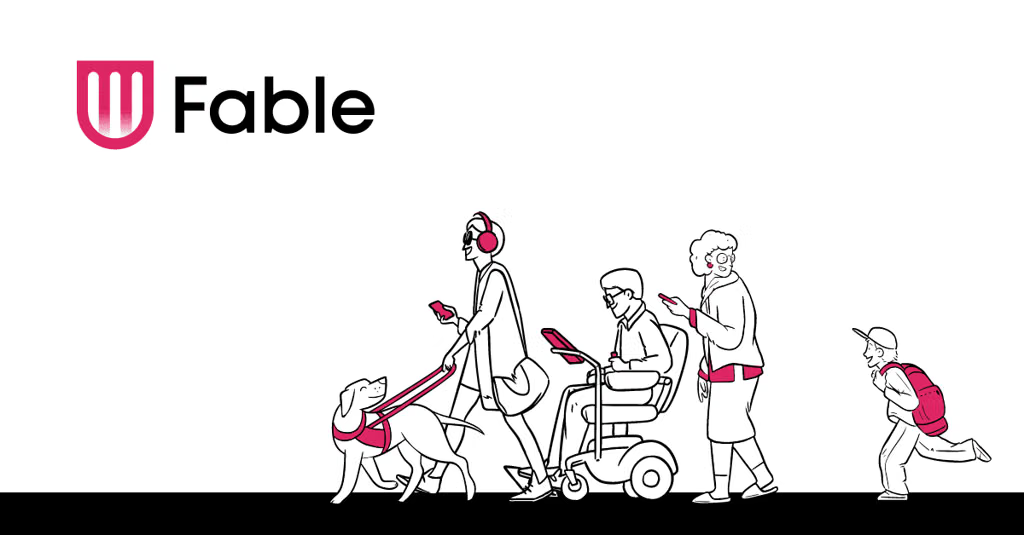
Fable : A leading accessibility testing and research platform specifically built to connect product teams, designers, and developers with a vetted community of people with disabilities. They support on-demand remote testing across more than 40 assistive technology configurations (such as screen readers, voice dictation, and magnification software).[](https://makeitfable.com/)[[2](https://makeitfable.com/)]()
Are there any research firms that can help me source participants who have specific impairments for my accessibility testing?
Yes. There are several research firms and specialist participant panels that can recruit people with specific disabilities or accessibility needs for usability testing, UX research, product testing, and interviews.
My recommendation is to start with firms that specialize in disability-inclusive research, rather than general-purpose market research recruiters. They're more likely to understand the difference between recruiting someone with a particular diagnosis and recruiting someone with the functional abilities or assistive technology experience your study actually requires.
A few prominent agencies and platforms specialize specifically in accessibility usability testing and recruiting people with disabilities:
Fable (Make it Fable) : Widely recognized as a leader in this space. They connect product and research teams directly with a vetted community of accessibility testers who use various assistive technologies across the US, Canada, and the UK.[]()
For accessibility studies involving people with specific disabilities, I’d shortlist a combination of specialist accessibility research recruiters, research participant panels with screening tools, and disability-community organizations. The key distinction is that a platform may support demographic or health-related screening without necessarily guaranteeing disability-specific recruitment, accessible consent, or appropriate handling of sensitive data.
U.S. Section 508 guidance recommends recruiting based on functional abilities and assistive technology use, rather than relying on diagnosis lists. It also recommends working with disability advocacy groups and specialist research panels.
The best participant recruitment software depends on who you need to recruit, what kind of research you're conducting, and your budget. For a general research project, I'd start by comparing platforms that provide access to participants, screen them against your eligibility criteria, and help you manage recruitment.
For academic surveys and behavioral experiments, Prolific and CloudResearch are strong starting points. A peer-reviewed comparison found that both produced higher-quality responses than several alternatives tested, including MTurk and Qualtrics panels. For interviews and specialized professional audiences, other platforms may be a better fit.
Best participant recruitment tools to consider
1. Prolific
(Best overall for academic research)
A strong choice for online surveys, behavioral experiments, and quantitative or qualitative studies with general-population participants. It offers demographic filters, eligibility screening, and support for multi-part studies.
Best for: Researchers who want a straightforward way to recruit participants without building their own panel.
Website:
2. CloudResearch Connect
Best for survey research and controlled sampling
Provides access to a vetted online participant pool, demographic targeting, sampling quotas, and tools for managing studies. It can work with surveys hosted in tools such as Qualtrics and SurveyMonkey.
Best for: Academic, social science, behavioral, and general consumer research where data quality matters.
Website:
3. Respondent
Best for specialized participants
Helps recruit consumers, professionals, and subject-matter experts. You can define screening criteria, review candidates, and schedule research sessions.
Best for: Interviews with specific occupational groups, specialized populations, or people with particular experiences.
Website:
4. Sona Systems
Best for university-based participant pools
Lets researchers manage study listings, sign-ups, prescreening, appointments, and course-credit or cash compensation.
Best for: University labs, psychology departments, and studies recruiting students or existing institutional participants.
Website:
How they compare
Tool
General population
Interviews
Specialized audiences
Main strength
Prolific
Excellent
Possible
Good for filterable groups
Academic research
CloudResearch Connect
Excellent
Possible
These are qualitative assessments of each platform's primary strengths, not a standardized ranking. Availability and recruitment speed depend on your eligibility criteria and location.
What I'd choose for your project
General online survey or experiment: Start with Prolific and compare CloudResearch Connect.
One-on-one interviews or focus groups: Start with Respondent; compare other moderated-research recruitment services if needed.
University-based research: Check whether your institution already provides Sona Systems access.
A hard-to-reach population: Prioritize the platform that can demonstrate access to your specific population rather than the one advertising the largest panel.
Before committing, compare the full cost—including participant incentives and platform fees—and verify that the recruitment approach meets your ethics review or IRB requirements. A recruitment platform does not itself guarantee that a study has appropriate ethical approval.
Let me narrow this down for your research
The most useful recommendation depends on your research method and the people you need to reach.
1. What kind of research are you conducting?
Online survey or experiment
One-on-one interviews
Focus groups
Longitudinal or diary study
Mixed methods or not yet decided
2. Who do you want to recruit?
General adult population
Students or university participants
Professionals or industry experts
People with specific experiences or characteristics
Streamlining your UX research recruitment pipeline saves hours of manual emailing, scheduling chaos, and no-shows. Here is a breakdown of how to optimize every stage of the process: finding, vetting, and booking.
1. Finding (Sourcing Participants)
Stop starting from scratch for every study. Build sustainable channels where your target audience lives.
Research Panels & CRM: Maintain an internal database of past participants, engaged customers, and opt-ins from your product or marketing site. Tag them by role, industry, and feature usage.
Recruitment Platforms: Automate top-of-funnel sourcing using specialized tools. You can use platforms like User Interviews or Respondent.io to tap into pre-vetted professional and consumer panels quickly.
Intercept Tools: Use in-product or on-site micro-surveys (via tools like Hotjar or Qualtrics ) to catch active users in the wild while context is fresh.
2. Vetting (Screening & Qualification)
Eliminate professional "professional testers" and unqualified candidates with automated screening logic.
Here are the best practices for sourcing, screening, and scheduling participants for UX research and usability sessions, organized into a clear, end-to-end workflow.
Finding the right audience ensures your research yields valid, actionable insights.
Internal Databases (CRM/Customer Lists): Reach out to existing users or past participants who have opted in. This group is ideal for product-specific feedback, though you must balance it to avoid "power user" bias.
Recruiting Panels and Platforms: Use specialized recruitment tools (like User Interviews or Respondent.io) when you need niche demographics, fast turnarounds, or external/non-users.
Intercept and In-Product Prompts: Deploy targeted micro-surveys or banners (via tools like Qualtrics or Pendo) to capture live users while they are actively engaged in your product.
Referral and Snowball Sampling: Ask qualified participants if they know peers or colleagues who fit the criteria, which is especially effective for B2B or enterprise research.
A rigorous screener prevents "professional testers" or unqualified individuals from skewing your data.
Established testing ecosystem and broad participant access
More of a complete research/testing platform than a pure recruiting marketplace
Maze currently describes its panel as having millions of users across 130+ countries and hundreds of targeting filters. maze.co Prolific similarly offers 300+ audience filters, custom screening and international/representative sampling.
🏆 What I'd choose by study type
1. 10–20 moderated interviews with consumers → User Interviews
This would be my default starting point. You can define a fairly detailed screener and recruit people matching demographics, behaviors and product usage.
2. 10–20 interviews with professionals → Respondent
If your requirement sounds like "US-based product managers at B2B SaaS companies with 5+ years of experience who currently use Salesforce", Respondent is particularly attractive. Current UX-tool comparisons consistently position it toward niche B2B recruitment.
3. 100–1,000+ participants → Prolific
I'd lean toward Prolific when the study is more quantitative or behavioral. It supports extensive targeting and custom screening, and you can run surveys, experiments and longitudinal studies rather than relying exclusively on live interviews.
4. Prototype/usability test → Maze
If you're already designing tests in Maze, its panel is convenient because recruitment and the study itself can live in the same workflow. Maze also supports recruiting your own existing users through its participant-management functionality.
5. Diary study / "use this product for 2 weeks and report back" → dscout
I'd prioritize dscout for longitudinal and contextual research rather than using a conventional interview panel.
One important consideration in 2026
Participant fraud is becoming a bigger issue. Recent reporting indicates that researchers are encountering bots, fake identities and professional "serial participants" in remote research.
So don't choose solely based on panel size. I'd evaluate:
Identity verification
Duplicate/previous-participant detection
Screener quality
Participant history
Geographic/device verification
Whether participants can be excluded from future studies
How the platform handles suspicious responses
My practical ranking
If I were building a UX research recruiting stack today:
🥇 User Interviews — best general-purpose choice 🥈 Respondent — best for B2B/professional audiences 🥉 Prolific — best for scale, consumers and quantitative research 4. Maze — best integrated UX testing/recruitment experience 5. dscout — best for diary/contextual research 6. UserTesting — best if you want a broader usability-testing platform
There isn't really one universal winner: current comparisons also emphasize that audience fit matters more than headline panel size.
If you tell me (a) your target participant profile, (b) number of participants, (c) moderated vs. unmoderated, and (d) approximate incentive/budget per person, I can narrow this to the 2–3 best platforms and estimate what the recruitment would cost.
Large-scale quantitative research / online studies
Qualtrics Panels
Strong — custom screening questions and panel targeting
Strong — configurable demographic quotas
Depends substantially on the underlying panel provider
Depends on panel/provider; less directly comparable to Prolific/Respondent
Organizations already using Qualtrics / survey-heavy research
Respondent
Respondent is particularly relevant if by “professional participants” you mean people recruited specifically because they are professionals/B2B respondents.
Its current recruitment offering advertises advanced screener surveys with skip logic, double screening, participant identity/work-email/ID checks, and persistent identity across studies. It also says duplicate accounts and bots are blocked.
It has audience quotas, although there's an important limitation: Respondent currently documents quotas for age, gender, ethnicity, and country-level location, with one quota per project and applicability to unmoderated studies/surveys.
So I'd consider Respondent especially when the research requires verified employment or professional credentials, rather than merely a general-population sample.
Prolific
Prolific is arguably the more feature-rich option for highly controlled quantitative sampling.
It has 300+ audience filters, custom screeners, quota sampling, and filters based on participants' previous study experience. Its quota system supports multiple demographic strata, currently up to 75.
For your “professional repeat participant” concern, Prolific has unusually explicit controls: it verifies participant identities, detects duplicate accounts using signals including IP/device information, email/phone verification and identity checks, and maintains participant-level histories.
You can also use Number of Previous Submissions as a prescreener, which is useful if you want to control for participants who have extensive experience taking online studies.
One nuance: Prolific's controls are more directly about participant uniqueness, study exposure, and research experience than proving that someone has never participated in any external research platform.
Qualtrics Panels
Qualtrics provides configurable panel targeting, custom screeners and quotas. Its panel workflow lets researchers define targeting criteria, customize screening, and set demographic quota targets.
The caveat is that Qualtrics is more of a research/survey platform with panel integrations than a single vertically integrated participant community. Consequently, the quality/identity/repeat-participant controls can depend on the panel source you're buying.
How I'd distinguish them
If your requirements are specifically:
Complex branching screener: Respondent or Prolific
Preventing duplicate accounts:Prolific or Respondent
Controlling exposure to frequent research participants:Prolific
Employment/identity verification:Respondent
Survey + sampling infrastructure in one enterprise ecosystem:Qualtrics
Hard-to-recruit professionals:Respondent
Large quantitative samples with rigorous participant controls:Prolific
The important distinction is that “no repeat professional participants” is not the same as “no duplicate accounts.” A platform can successfully prevent the same person from creating multiple accounts while still recruiting someone who has participated in dozens of studies elsewhere. For a serious research program, I'd therefore ask vendors explicitly about cross-study exposure, research-frequency limits, participant-history visibility, exclusion lists, persistent identity, and whether exclusions work across studies/projects.
If you tell me whether you're recruiting B2B professionals, consumers, or both, I can also compare Respondent vs Prolific vs User Interviews vs UserTesting vs CloudResearch specifically against those five requirements.
Respondent.io B2B Safeguards: Respondent.io targets hard-to-reach professional and developer niches, requiring strict professional profile checks and providing data exports that tie respondent metadata back to the exact screening criteria.
Prolific
Yes — participant verification, IP/ISP checks, and ongoing monitoring are documented.
Yes — documents bad-actor detection, duplicate/IP checks, and reporting procedures.
Yes — returned/timed-out submissions are explicitly documented; scheduled interview no-shows are also covered.
Yes — returned, timed-out, or rejected spots are reopened/recruited automatically.
Yes, via the study/survey software; Prolific provides participant/submission metadata, while the actual survey responses reside in the external survey platform when using one.
CloudResearch Connect
Yes — account/identity verification and technical/behavioral checks are documented.
Yes — one-account, IP/location, payment-account, device and behavioral safeguards are disclosed.
Yes — timed-out and returned projects have explicit documented treatment.
Partial/Yes depending on setup — replacement is clearly documented for CloudResearch's panel workflows, but Connect's public documentation is less explicit about a universal automatic replacement guarantee.
Yes, but less transparent about underlying sourcing — it is a panel service rather than a single proprietary participant pool.
Yes — Qualtrics explicitly identifies fraudulent/spam responses and has reconciliation procedures.
Yes, through panel reconciliation/response handling.
Yes — Qualtrics says rejected low-quality responses are replaced or refunded if replacement isn't possible.
Yes — strongest export documentation. Qualtrics can export all response fields, metadata, contact/embedded data, and uploaded files in CSV and other formats.
Dynata
Yes, at a high level — describes panelist recruitment and quality-management systems.
Yes — QualityScore evaluates 175+ data points for fraud/inattention.
Not as clearly documented publicly for ordinary “no-show” handling.
Yes — fraudulent/low-quality respondents are described as being removed and replaced in real time.
Not sufficiently verified from public documentation I found to call it a complete-data-export match.
Bottom line
If your procurement criterion is all four: transparent sourcing/quality + fraud policy + explicit no-show/replacement rules + unrestricted/complete study-data export, I'd treat:
Prolific — strong documentation for participant quality and replacement; distinguish between panel/submission metadata and the actual survey dataset, which may live in Qualtrics or another survey tool.
CloudResearch Connect — strong transparency on participant quality and downloadable participant data; the replacement commitment needs more careful contractual confirmation for the exact study type.
Qualtrics Online Panels — the most explicit documentation I found for fraud reconciliation + replacement/refund + complete response export.
One important distinction: “complete study data export” can mean either (a) all survey responses and metadata, or (b) the panel provider's underlying participant-level sourcing/fraud/quality records. Qualtrics clearly documents (a), while providers generally do not promise researchers unrestricted access to their internal fraud-detection data.
If you're building a vendor-selection matrix, I can also turn this into a stricter Yes / No / Contract-required table covering Prolific, CloudResearch Connect, Dynata, Cint, PureSpectrum, Lucid, YouGov, and Respondent.
AccessWorks by Knowbility : Managed by the accessibility nonprofit Knowbility, AccessWorks maintains a dedicated user panel of individuals with visual, motor, cognitive, and neurological conditions. They provide custom recruiting, scheduling, test moderation, and participant compensation for software and website testing.[](https://knowbility.org/services/accessworks)
MPRO Research : Operates as a specialist field-recruitment agency that handles hard-to-reach demographics, including custom recruitment for specific assistive technology user profiles and accessibility co-design workshops rather than relying on generic consumer panels.[](https://mproresearch.com/knowledge/market-research-recruitment-for-accessibility-testers)
If you'd like, let me know:
What specific assistive technologies or disability profiles (e.g., screen reader users, cognitive differences, motor impairments) you need to test with
Whether you are looking for do-it-yourself software platforms or fully managed testing services
I can help you narrow down which option best fits your project.
Fable specializes in accessibility research with a community of people with disabilities and assistive technology users. It can handle participant recruitment, scheduling, and compensation, and also offers managed research services. Its research covers cognitive accessibility as well as assistive technology use.
Best for: Digital accessibility testing, screen-reader users, cognitive access needs, and end-to-end research support.
AccessWorks, operated by accessibility nonprofit Knowbility, maintains a panel of people with disabilities for website, mobile app, and software usability testing. It explicitly offers custom recruitment based on participant requirements, including demographics and location.
Best for: Custom participant profiles, web and app testing, and recruiting people who use adaptive technologies.
Run through Shepherd Center, AURC connects research teams with a nationwide network of adults with disabilities. It supports usability interviews, product testing, focus groups, and surveys, with participants spanning vision, hearing, mobility, dexterity, speech, neurodiversity, and mental health experiences.
Best for: US-based research requiring participants with varied disability experiences.
A specialist recruitment firm that advertises recruiting Deaf and visually impaired participants, people with dyslexia, ADHD and dyspraxia, and people with physical or mobility-related access needs. It offers tailored screening and international recruitment, including in the US.
Best for: Hard-to-reach profiles, specific screening criteria, and studies spanning multiple countries.
A large general-purpose research recruitment platform with a dedicated accessibility research offering. It advertises targeting and screening for people with visual, auditory, physical, and cognitive disabilities, including screen-reader users and wheelchair users. It supports moderated and unmoderated studies.
Best for: Teams that want to recruit their own participants using detailed screeners, with a larger pool to search.
Custom recruitment for specific access needs and locations
AccessWorks
US-wide participant network
AURC
Rare or highly specific participant profiles
Recruitment for Research
Large recruitment pool with flexible screening
User Interviews
These are initial recommendations based on their advertised services; you should confirm current availability for your specific participant criteria before selecting a vendor.
Questions to ask before hiring
I would send each firm a short study brief and ask:
Recruitment feasibility: Can you source the exact impairment or functional profile, not just a broad disability category?
Screening and verification: How do you confirm eligibility and relevant experience without collecting unnecessary medical information?
Sample size and timeline: How many qualified participants can you realistically recruit, and how long will it take?
Research format: Can participants test your specific device, software, assistive technology, or physical product?
Costs: What are the recruitment fee, participant incentive, and any moderation or research-management fees?
Accessibility and accommodations: Can you support interpreters, captioning, accessible materials, or other participant requirements?
A useful principle is to screen for the functional ability or access need relevant to the task, such as using a screen reader with a particular operating system, rather than relying solely on a medical diagnosis. This can make recruitment more precise and respectful of participants' privacy.
Let me narrow this down for your study
The best provider depends heavily on the impairment you're targeting. Which specific impairments or accessibility needs do you need participants with? For example, blindness, low vision, hearing loss, limited dexterity, cognitive disabilities, neurodivergence, or a particular combination.
If you also share the country where participants must live and approximately how many you need, I can narrow the list to the most relevant recruitment firms.
Top options available for this type of recruitment include:
FableFable : A prominent accessibility testing platform that connects product teams directly with a community of testers with disabilities. They recruit, train, and fairly compensate testers across the US, Canada, and the UK who use a wide range of assistive technologies (such as screen readers, voice control, and magnification).[](https://makeitfable.com/testers/)
User InterviewsUser Interviews : Features a massive general research panel that includes over 415,000 verified individuals meeting accessibility criteria, spanning visual, mobility, and cognitive impairments, as well as assistive tech users. Their platform lets you use custom segmentation and accessible screener surveys to filter for exact user requirements.[](https://www.userinterviews.com/accessibility-research)
KnowbilityKnowbility : A non-profit organization that provides comprehensive accessibility consulting and user testing services, often coordinating real-user evaluations with people who have diverse disabilities.
Deque SystemsDeque Systems : Well-known for digital accessibility software and services, Deque also facilitates assistive technology user testing and expert evaluations to ensure compliance and practical usability.
If you'd like, let me know:
What specific impairments or assistive technologies you need to test with
Whether you prefer moderated or unmoderated testing sessions
I can help you decide which platform best fits your timeline and budget.
Level Access : A massive name in digital accessibility compliance that provides expert usability assessments and user testing incorporating individuals with diverse disabilities.
Deque Systems : Known primarily for their automated tools (like axe), Deque also provides manual auditing and usability verification services backed by accessibility experts and users with disabilities.
UsableNet : Provides comprehensive digital accessibility solutions, including expert manual validation and usability testing conducted by individuals who rely on assistive technologies.
If you'd like to narrow this down, tell me:
Are you looking for a self-service platform to run tests yourself, or a full-service agency to moderate and analyze the sessions?
What specific assistive technologies or user groups do you need to test with (e.g., screen readers, low vision, motor/voice control)?
If you need a research agency that specializes in recruiting people with disabilities for accessibility and usability testing, I’d look for firms that offer disability-inclusive participant recruitment, accessibility research, and moderated usability testing with people who have lived experience of disabilities.
There are several types of providers worth considering: specialist accessibility consultancies, UX research recruitment agencies, and organizations that work directly with disabled participants. The key distinction is whether a firm can recruit qualified participants for your study versus only audit your website or test accessibility internally.
Best agencies to contact
1. Accessibility User Research Collective (AURC)
(Strong full-service option)
Based at Shepherd Center’s research institute, AURC offers end-to-end UX research with a nationwide network of 1,500+ participants with disabilities. Services include usability testing, interviews, focus groups, surveys, and participant recruitment.
Best for: U.S.-based research where you may want both recruitment and research execution.
A specialist panel for testing websites, mobile apps, and computer applications with people with disabilities. It offers custom recruitment, scheduling, participant incentives, and optional moderation and reporting.
Best for: Digital accessibility studies when you need to recruit testers and potentially have someone run the sessions.
Offers UX research and accessibility consulting, drawing on a nationwide network of more than 1,000 participants with disabilities. It can provide recruitment and facilitate usability tests, interviews, focus groups, and surveys.
Best for: Research grounded in disability expertise and lived experience, particularly when you need a research partner rather than just a panel.
A participant recruitment platform with accessibility-specific targeting, screening, and segmentation across a large research panel. Useful when your team already knows how to conduct usability research and primarily needs qualified participants.
Best for: Self-service recruitment and targeted participant screening.
Provides end-to-end inclusive usability testing, including recruiting people with disabilities through its participant panel and broader recruitment networks, running sessions, and delivering practical recommendations.
Best for: Organizations seeking a single provider for recruitment, testing, and recommendations.
A specialist recruitment agency with a dedicated accessibility recruitment service and a panel of participants with different impairments and long-term health conditions. It also recruits internationally.
Best for: UK or international recruitment, particularly if you need participants only rather than a full research engagement.
Access Usability — Operated by Perigean Technologies; recruits people with cognitive impairments, mobility issues, and assistive technology experience for paid research studies.
Intopia Connect — Offers specialist participant recruitment for interviews, usability testing, surveys, and focus groups, with targeting by disability, assistive technology, location, and other criteria. It can also run the research end to end.
My recommendation
I'd start with AURC, AccessWorks, and WID if you're looking for a specialist U.S. research partner. Consider User Interviews if you mainly need access to participants and will run the testing yourself.
When evaluating providers, ask whether they can recruit people who actually use the assistive technologies relevant to your product, such as JAWS, NVDA, VoiceOver, switch access, screen magnification, or speech recognition. Also confirm their experience with your target population, recruitment timelines, participant incentives, and accessibility accommodations.
One question so I can narrow this to the best-fit agencies: Are you looking for a firm that will only recruit participants for your team to test, or one that will recruit participants and conduct the usability research for you?
Specialist accessibility recruitment · Australia and international research inquiries
Matches participants to specific disability types, assistive technologies, age groups, locations, and cultural or language criteria. Supports interviews, usability testing, surveys, and focus groups. Its service states that participants are screened, have opted in, and are briefed before research.
Privacy/consent check: Ask about data retention, accessible consent formats, and whether health information is ever shared with researchers.
A panel for testing websites, mobile apps, and computer applications with people with disabilities. Its panel tracks disability, assistive technology use, age, and location, and it offers custom recruitment. It may also coordinate moderation, scheduling, and incentives.
Privacy/consent check: Confirm how disability eligibility is verified, who sees those details, and how long participant records are kept.
Flexible research recruitment · Large participant panel
Offers an accessibility research service with targeting and screening for participants with visual, hearing, cognitive, and physical disabilities. Supports moderated and unmoderated testing, interviews, and focus groups. Useful when you need a broader panel and a scalable recruitment workflow.
Privacy/consent check: Validate the exact disability filters available for your project and clarify whether sensitive screening responses are passed to your team.
Its Accessibility Collective provides pre-screened participants, with profiles covering impairments, assistive technology, and other recruitment criteria. The service also advertises consent-form management, technical support, and data-protection guidance.
Privacy/consent check: Ask about consent-record access, deletion schedules, international data transfers, and whether the service can recruit participants outside the UK.
Health-related studies · U.S. research institutions
A free recruitment and feasibility tool for eligible researchers at participating institutions. Researchers can search for de-identified volunteers matching study criteria and contact them through the platform using approved messages. It is worth evaluating for disability-related health research, although it is not a dedicated accessibility-testing panel.
Privacy/consent check: Confirm whether your particular disability criteria can be used for matching, what institutional and IRB approvals are required, and how sensitive health information is handled.
General-purpose research platforms worth considering
These are less specialized than the services above, but can be useful when you need a larger sample or online survey recruitment.
Service
Best use
Important limitation
Prolific —
Online studies with screening, informed-consent workflows, and participant pseudonymity
Verify that the exact disability criteria are available as prescreeners.
CloudResearch Connect —
Academic surveys and behavioral research with participant screening
General-purpose recruitment; confirm the availability and reliability of disability-specific screening.
Prolific specifically requires informed consent before data collection and provides guidance on disclosing sensitive data, storage, retention, confidentiality, and withdrawal. Its rules also restrict collecting identifying information without prior approval. These are useful safeguards, but they do not by themselves establish that a study meets every applicable ethics or privacy requirement.
How to assess sensitive-data privacy and informed consent
No platform should be treated as meeting all three requirements without checking its actual policies and contractual terms.
Use this checklist when evaluating a provider:
Recruiter evaluation checklist
of
One important ethical distinction: accessible consent is not just providing a standard consent form. Research involving autistic people or people with intellectual disabilities may require adapted language, communication accommodations, and checks of understanding while preserving each person's autonomy.
My recommendation
For precise disability and assistive-technology targeting: start with Intopia Connect or AccessWorks.
For scalable UX and accessibility research: evaluate User Interviews.
For UK recruitment with hands-on consent and logistics support: evaluate People for Research.
For health-related academic research with additional institutional safeguards: investigate ResearchMatch.
For online surveys where sensitive-data collection must be tightly controlled: consider Prolific, with carefully designed screening and consent.
To narrow this down, is your study primarily academic/clinical research or product and UX accessibility testing? That distinction changes which recruitment services are the strongest fit.
Because disability data is legally and ethically classified as sensitive personal data (often protected under HIPAA, GDPR, or general medical/privacy ethics), these services manage recruitment, screening, and consent while balancing participant confidentiality.
Key Participant Recruitment Services for Accessibility Studies
Focus: Digital accessibility testing powered directly by people with disabilities.
Disability Criteria & Recruitment: Unlike general panels, Fable’s community consists of real-world users of assistive technologies (screen readers, magnification, alternative inputs) integrated throughout the product lifecycle. They recruit directly for usability testing and research without relying on intrusive device-level detection.
Focus: General and specialized user research recruitment with a dedicated accessibility panel.
Disability Criteria & Recruitment: Features over 415,000+ individuals meeting accessibility criteria spanning vision, auditory, mobility, and cognitive impairments, including 184,000+ verified assistive technology users. Researchers use flexible screener surveys with skip logic and behavioral questions (e.g., focusing on assistive tech or navigation habits rather than invasive medical disclosures).
Disability Criteria & Recruitment: Offers an accessibility panel encompassing roughly 415,000 self-reported participants across visual, auditory, mobility, cognitive, and adaptive-input requirements. Targeting is handled via custom screeners.
Sensitive-Data Privacy & Consent: Handles secure data processing, automated NDA/consent integrations prior to interview unlocking, and secure payment processing without exposing raw participant contact or health data unnecessarily.[](https://www.respondent.io/market-research)
Best Practices for Informed Consent & Sensitive Data Privacy in Accessibility
Accessible Consent Forms: Informed consent documents must themselves be accessible (screen-reader friendly, plain language, or available in alternate formats) before a study begins.[](https://pmc.ncbi.nlm.nih.gov/articles/PMC12448064/)[[2]()]()
If you'd like, let me know:
What specific assistive technologies or impairment types your study targets
Whether your study requires moderated 1-on-1 sessions or unmoderated testing
I can help you tailor your screening criteria or evaluate which platform fits your budget.
Screener Surveys: Send a short, asynchronous survey containing 3 to 5 kill-questions (e.g., "Which of these tools do you use weekly?" or "Describe how you currently solve [problem]").
Behavioral vs. Demographic: Prioritize behavioral questions about past actions over demographic checkboxes. What they did last month matters more than their job title.
Automation Rules: Set your screener tools to automatically disqualify bad-fit applicants, and route qualified candidates straight to the next step without manual review.
3. Booking (Scheduling & Coordination)
Erase the "What time works for you?" email ping-pong completely.
Integrated Schedulers: Use calendar sync tools like Calendly or Acuity Scheduling embedded directly after a completed screener.
Buffer Times: Add automatic padding (e.g., 15 minutes before and after) to prevent back-to-back session fatigue.
Automated Reminders: Trigger email and SMS reminders at 24 hours and 1 hour before the session to slash your no-show rates.
Incentive Automation: Automate gift card or cash distributions post-session using integrations via Tremendous or Honorlock/Ethnio type workflows , ensuring prompt payouts without manual bookkeeping.
If you'd like, let me know:
What is your budget for recruitment tools?
Who is your target audience (B2B professionals, everyday consumers, niche developers)?
Are you looking to build an internal panel or rely on external platforms?
I can recommend a specific tech stack tailored to your workflow.
The biggest opportunity is to stop treating participant recruitment as a series of manual tasks and turn it into a repeatable workflow: find the right people → screen them → book them → run the session → pay them → keep the best participants available for future studies.
The most effective setup combines a reusable participant database, automated screening, self-service scheduling, and incentive management. You can build this with a few connected tools or use a research platform that handles most of the process end to end. Current UX research tools increasingly support these workflows.
1. Build a streamlined recruitment workflow
Step 1 — Find participants
Recruit from existing customers, opt-in research panels, referrals, or specialist recruitment marketplaces. Start with your own customers when they match your target audience; use external panels for new markets or hard-to-reach profiles.
Step 2 — Screen consistently
Create reusable screener templates with eligibility rules, branching questions, and disqualifying criteria. Automatically reject mismatches and flag borderline candidates for review.
Step 3 — Let participants book themselves
Offer eligible participants a booking page connected to researcher calendars. Automatically send confirmations, time-zone-aware invitations, reminders, and rescheduling links.
Step 4 — Automate follow-through
Track attendance, send incentives after completion, record participation history, and update each person's profile so you know whom to invite next time.
The goal is to eliminate repeated email exchanges, manual spreadsheet updates, and incentive-payment follow-ups without compromising the quality of your sample.
2. Choose tools that remove the most manual work
These are the strongest starting points to evaluate, depending on whether you need to find new participants or manage a pool you already have.
User Interviews
(Best general starting point)
Best for recruiting consumers and professionals, screening candidates, automating calendar booking, and managing incentives. A good option if you want to outsource recruitment logistics rather than build your own panel.
Website:
Sources:
Respondent
Best for harder-to-reach business audiences, such as product managers, engineers, executives, and other specialized professionals. It combines participant targeting, screening, scheduling, and payments.
Website:
Source:
Ethnio
Best for teams that repeatedly recruit their own customers. It supports opt-in recruitment, screeners, participant profiles, scheduling, consent, incentives, and research-history tracking.
Website:
Source:
Maze
Best if you want recruitment and usability testing to work together. Its research tools support prototype testing, surveys, interviews, and participant management, with external panel recruitment available through Maze Panel.
Website:
Source:
My recommendation: if you primarily need to fill individual study slots quickly, start by evaluating User Interviews and Respondent. If your organization conducts recurring research with existing customers, look closely at Ethnio. If you also need to run tests and organize findings, evaluate Maze.
These products overlap, but they solve different problems. Compare the actual end-to-end workflow and total cost, including participant incentives, before committing.
3. Improve participant vetting without adding more admin
Automation only helps if the people you recruit are actually representative of your target users.
Use a standardized screener with four layers:
Eligibility: Do they meet the essential criteria, such as product usage, industry, role, or device?
Behavior: Ask what they actually do, rather than relying only on self-reported experience. For example, “When did you last use a budgeting app?”
Verification: For specialized B2B studies, verify role, seniority, or relevant experience when appropriate.
Quality checks: Flag contradictory answers, suspiciously fast responses, repeated participation, and people who appear to be guessing what you want to hear.
A useful screener design principle is to ask neutral questions before revealing too much about the ideal participant profile. This reduces the risk of people tailoring their answers just to qualify. Use human review for ambiguous cases rather than automatically rejecting everyone who triggers a flag.
4. Create a simple automation stack
If you don't want to buy an all-in-one research platform immediately, you can still streamline the process with tools you may already have.
Participant database
Airtable, a CRM, or a research repository to store consent, eligibility, tags, past studies, and incentive history.
Screener form
A form tool with conditional logic that sends qualified candidates to the next step.
Scheduling and reminders
Calendly or a similar booking tool connected to your calendar, with confirmation and reminder emails.
Workflow automation
Zapier, Make, or native integrations to update participant records, send notifications, and trigger post-session payment tasks.
A simple workflow could be:
A participant completes the screener.
The system checks their eligibility.
Qualified participants receive a booking link.
A confirmed booking creates a calendar event and sends the study instructions.
Reminders go out automatically before the session.
After the session, you mark attendance and trigger the incentive.
The participant record is updated for future recruitment.
Keep consent and privacy controls in the workflow from the start. Restrict access to personal data, collect only what you need, and respect opt-outs and contact-frequency limits.
5. Measure whether the process is actually getting faster
Track a small set of operational metrics for every study.
Metric
What it tells you
Time to first qualified participant
How quickly sourcing and screening work
Recruitment completion time
How long it takes to fill all required slots
Screener qualification rate
Whether targeting is too broad or too narrow
Booking-to-attendance rate
How well scheduling and reminders prevent no-shows
Cost per completed session
The true recruitment cost, including incentives and fees
Researcher admin time per study
Review these metrics monthly. For example, if qualification rates are low, improve targeting or screener wording. If booking rates are high but attendance is low, improve reminders and consider recruiting backup participants. If recruitment is fast but research quality suffers, tighten vetting rather than simply increasing volume.
6. A practical plan to implement this in one week
Day 1: Map your current process and identify where the most time is lost.
Day 2: Standardize your screener, consent language, participant status fields, and incentive rules.
Day 3: Choose one recruitment tool and connect your calendar and session platform.
Day 4: Automate booking confirmations, reminders, and post-session follow-ups.
Day 5: Pilot the workflow with a small study, document failures, and measure admin time.
Use the following to narrow down the best setup for your situation.
Find the right recruitment setup
A few details will help me recommend a practical tool stack and workflow.
1. Who do you recruit?
Our existing customers
External consumers or general users
B2B professionals or niche experts
A mix of audiences
2. How many sessions do you run per month?
1–5
6–20
21–50
50+
3. What does your current process look like?
Mostly manual — email and spreadsheets
Separate tools for recruitment, scheduling, and incentives
Screener Design: Keep short, targeted screeners (3 to 5 minutes max) using platforms like Typeform or Google Forms.
Behavioral Over Demographic Questions: Ask about what people do rather than who they are. For example, ask "How many times did you purchase groceries online in the last month?" instead of "Are you a frequent online shopper?"
Blinding Key Criteria: Hide the exact "winning" combination of answers so savvy participants cannot game the system to qualify for high incentives.
Kill Questions: Place disqualifying questions early in the survey to save the user's time and automatically filter out mismatches.
Verification Checks: For specialized or high-stakes studies, conduct a quick 5-minute phone or video verification to confirm identity, tech setup (e.g., webcam, screen-sharing capability), and communication skills.
Smooth scheduling reduces no-show rates and respects both the participant's and your team’s time.
Automated Scheduling Tools: Integrate calendar tools (like Calendly or SavvyCal) so participants can pick their own slots directly without endless email chains.
Time Zone Clarity: Always display times clearly using automated time-zone detectors, and send calendar invites with the correct local conversions.
Incentive Transparency: State the incentive amount, format (e.g., digital gift card, cash), and fulfillment timeline upfront in the invitation and confirmation emails.
Automated Reminders: Send a sequence of automated touchpoints to keep attendance high:
1. Immediate confirmation upon booking with the session link.
1. Email or SMS reminder 24 hours before the session.
1. Final reminder 1 hour before the session with a direct join link.
Over-recruiting Buffer: Over-recruit by 2 0% to 3 0% (e.g., schedule 6 people for 4 desired slots) to account for last-minute cancellations or no-shows.
If you want to dive deeper, we can explore discussions on User Interviews and UX research subreddits regarding community consensus on how to handle professional survey-takers and no-shows . Let me know if you would like me to pull together tips from those communities!
Best practices for UX research participant sourcing, screening, and scheduling
The most effective approach is to treat participant recruitment as a repeatable research-operations process, not an administrative task. The goal is to find people whose real experiences match your research questions, verify their eligibility without biasing their responses, and make it easy for them to attend and participate.
The guidance below synthesizes recommendations from Nielsen Norman Group (NN/g), the UK government's user-research guidance, and Section 508 accessibility resources.
1. Sourcing: Find the right people, not just available people
A. Define the target audience before recruiting
Start with the research objectives and the people who can answer the research questions. Define:
Relevant behaviors, needs, goals, and use cases.
Product experience, usage frequency, and familiarity.
Required devices, tools, or work environments.
Any essential demographic, accessibility, geographic, or professional characteristics.
Exclusion criteria, such as conflicts of interest or relevant professional expertise that could bias a usability test.
Separate must-have criteria from nice-to-have characteristics. Overly restrictive criteria make recruitment slower without necessarily improving research quality.
B. Choose recruitment channels to fit the study
Use more than one channel when necessary to avoid overrepresenting a single type of participant.
Source
Best suited for
Existing customers or users
Product usability, workflows, feature evaluation
Research panels and participant platforms
Faster turnaround and broad consumer audiences
Professional recruiting agencies
Specialized B2B roles, niche audiences, hard-to-reach groups
Customer communities and opt-in mailing lists
Engaged users and particular usage segments
Community organizations and accessibility networks
Reaching underrepresented users and people with disabilities
Internal employees
Each channel has different costs, reach, and potential sampling bias. Choose based on who you need, not simply which channel is easiest.
C. Set a clear recruitment and incentive plan
Set the participant target, budget, timeline, and acceptable cost per completed session.
Offer incentives appropriate to session length, participant effort, specialist expertise, and local expectations.
Make the incentive and payment method clear before participants commit.
Recruit across relevant experience levels, devices, and accessibility needs.
Track where participants came from so you can identify channel bias.
For qualitative usability testing, five participants per distinct user group can be a useful starting point for iterative testing—not a universal sample-size rule. Quantitative benchmarking requires a different sample-size approach.
Practical recommendation: Maintain an opt-in participant database with consent, relevant research experience, last participation date, contact preferences, and recruitment history. Limit access to personal information and remove or refresh stale records according to your retention policy.
2. Screening: Verify fit without giving away the answers
A good screener identifies qualified participants while minimizing self-selection bias, false positives, and unnecessary drop-off.
A recommended screening workflow
Write eligibility criteria first. Tie every screening question to a research objective or a genuine logistical requirement.
Ask about actual past behavior. Ask what participants did, how often, and when—not whether they think they would use a hypothetical feature.
Use neutral, funnel-shaped questions. Start broadly and move toward specific qualifying details without revealing the ideal answer.
Use a mix of question types. Combine structured questions with a small number of open-ended questions where context or experience needs verification.
Pilot the screener. Test wording, completion time, branching logic, and unintended disqualifications before launching.
Review borderline candidates. Keep a documented exception process for near-matches rather than automatically rejecting everyone who misses a secondary criterion.
“How did you track or submit expenses the last time you needed to?”
“Are you an advanced user of our product?”
“Which tasks have you completed with the product in the past 30 days?”
“Are you comfortable with technology?”
“Which devices do you regularly use for this type of task?”
“Are you the ideal person for our study?”
“Please describe your role in choosing or using this type of service.”
These questions help establish relevant experience without telling candidates what answers will qualify them.
3. Scheduling: Make it easy to say yes—and show up
Scheduling is part of the participant experience. Confusing logistics, unclear expectations, inaccessible meeting setups, and weak reminders can all undermine a well-recruited study.
A. Offer convenient, confirmed time slots
Use a scheduling link with availability in the participant's local time zone.
Offer multiple options, including outside standard working hours when appropriate.
Confirm the date, start time, expected duration, meeting location or link, and incentive.
Ask about accessibility requirements and any necessary accommodations.
Avoid scheduling back-to-back sessions; leave 10–15 minutes between sessions for notes, technical resets, and breaks.
B. Use a consistent confirmation and reminder cadence
A practical default for a moderated session is:
Immediately after booking: Send confirmation, calendar invitation, meeting link or directions, duration, incentive, and cancellation instructions.
48 hours before: Request reconfirmation, particularly for specialist or in-person sessions.
24 hours before: Send a reminder with preparation instructions.
1–2 hours before: Send a short reminder with the direct join link or arrival details.
Adapt the cadence to participant preferences and study logistics. For remote sessions, include device, browser, charging, audio, and connectivity instructions when relevant. NN/g specifically recommends reminders and clear technical preparation for remote usability testing.
C. Plan for cancellations and no-shows
Track your own cancellation and no-show rates by channel and participant segment.
Keep qualified alternates or a waitlist for time-sensitive studies.
For high-stakes research days, consider scheduled backup participants or floaters.
Be transparent about standby expectations and compensate people fairly for reserved time, including backups when promised.
Establish a clear late-arrival policy and a process for rescheduling.
As a starting point, you could recruit approximately 10–15% above your target when the budget permits, then adjust based on actual attendance data. For specialist audiences or fixed research windows, a larger buffer or a backup plan may be necessary.
D. Prepare for consent, privacy, and accessibility
Explain the purpose of the research, what participation involves, and whether recording or observation is planned.
Obtain informed consent before beginning research and separate recording permission where appropriate.
Provide an easy way to withdraw or reschedule.
Collect only the personal information needed for screening, scheduling, and payment.
Offer accessible materials, captions, interpreters, compatible assistive technology, or other accommodations as needed.
Confirm any necessary account access, test data, and equipment in advance.
Build accommodation needs into both recruitment and scheduling rather than treating them as last-minute exceptions.
4. Standardize the process with a recruitment tracker
Use one shared tracker or research-operations system as the source of truth. Each study should have a consistent record for every candidate.
Time zone, confirmed slot, session format, meeting link
Attendance
Confirmation status, attended, cancelled, no-show
Logistics
Accommodation requests, setup requirements, consent status
Keep sensitive details in appropriately restricted systems rather than a broadly accessible spreadsheet. Use a participant ID to link recruitment records to research notes and recordings.
5. Measure the recruitment funnel
Track a few operational metrics after every study. These help identify where the process is losing qualified people or wasting effort.
Core recruitment KPIs
Screening qualification rate Target varies
Qualified candidates ÷ completed screeners. A low rate may indicate poor targeting or overly broad outreach.
Booking conversion rate Target varies
Booked sessions ÷ qualified candidates invited. A low rate may point to inconvenient slots, unclear incentives, or slow follow-up.
Show rate Higher is better
Attended sessions ÷ confirmed bookings. Segment by recruitment source, session type, and reminder cadence.
Cost per completed session Budget-dependent
Total sourcing, incentive, and relevant recruiting costs ÷ completed usable sessions.
Recruitment lead time Lower is generally better
Elapsed time from launching recruitment to filling the required qualified slots.
Avoid optimizing solely for low cost or fast recruitment. A cheap, fast sample that does not represent your actual users can lead to expensive product decisions.
6. A repeatable operating timeline
Here is a practical default timeline for a small, moderated usability study. Adapt it for highly specialized audiences, longitudinal research, or quantitative studies.
1–2 weeks before sessions: Define and launch
Finalize research objectives, audience criteria, sample plan, screener, incentive, consent materials, and recruitment channels.
1 week before: Screen and book
Review candidates, verify eligibility, balance the target segments, confirm availability, and send calendar invitations.
2–3 days before: Reconfirm
Check attendance, fill cancellations, validate accommodations, and confirm any specialist equipment or software.
24 hours before: Prepare
Send reminders, test the meeting link and recording setup, finalize session scripts, and brief observers.
Session day: Run and record outcomes
Reconfirm consent, conduct the session consistently, document attendance, and track incentive payments.
Within 1–2 business days: Close out
Send thank-you messages, complete payments, update the tracker, and record recruiting metrics and lessons learned.
7. Recommended team standards
If you're building a repeatable process across a UX team, I would start with these six standards:
One approved screener per study with clear eligibility rules and a documented exception process.
One recruitment owner accountable for candidate communication, booking, and backup coverage.
One scheduling workflow with consistent confirmations, reminders, and cancellation handling.
One consent and privacy checklist used before every session.
One participant tracker with controlled access and standardized status definitions.
One post-study review that compares planned versus actual recruitment cost, lead time, show rate, and sample composition.
The core principle is to make recruitment rigorous for the research team and low-friction for participants. Better sourcing improves relevance, better screening improves data quality, and better scheduling helps ensure that your planned research actually happens.
Data Minimization: Use the recruitment platform's built-in communication and incentive management tools rather than downloading spreadsheets of self-disclosed disability data to unencrypted local devices.
Whether automation is reducing manual work
Early pilots and dry runs, not as a substitute for target users