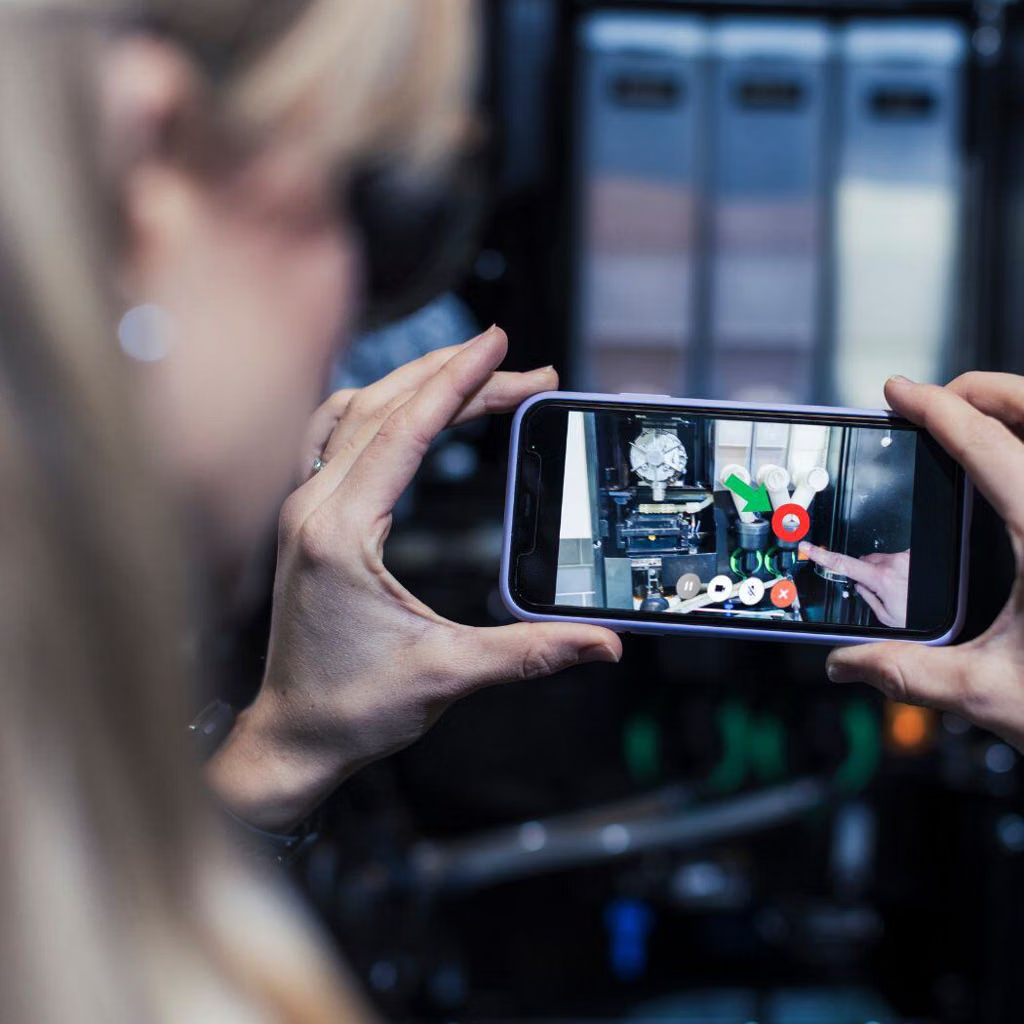
For training technicians to repair jet engines, I’d look for an industrial augmented reality (AR) training platform that overlays step-by-step repair instructions, 3D engine models, and visual guidance onto real equipment—or a simulated engine—while tracking technician performance.
The key is to find a solution designed for aerospace maintenance, repair, and overhaul (MRO), rather than a generic AR presentation tool. It should support approved maintenance procedures, hands-on practice, competency assessment, and traceable training records.
Best solutions to evaluate
1. TeamViewer Frontline Upskill
(Best starting point)
Designed for aerospace workforce training, with self-directed immersive learning. The broader Frontline portfolio also offers AR-guided assembly and inspection, making it worth evaluating if you want both a training system and operational guidance. TeamViewer identifies GE Aerospace as a customer using immersive training, reporting a 20–40% reduction in training cycle time.
Best for: structured technician training and a potential path from training to shop-floor use.
Can you recommend AR platforms that support immersive training for maintenance technicians? We specifically need to teach them about safety protocols, how to handle complex repairs, and general equipment familiarization.
Best if you have access to accurate 3D CAD models of your engines and want to build custom, interactive lessons. It supports 3D visualizations, exploded views, and step-by-step procedures. PTC also documents an Air Force training project using Vuforia Studio for virtual aircraft familiarization and maintenance training.
Best for: custom engine-specific lessons, component identification, and simulated disassembly sequences.
A purpose-built aerospace and defense option emphasizing guided maintenance workflows, immersive training without requiring access to live equipment, and secure or offline deployment options. It is particularly worth considering if your program has strict network-security requirements.
Best for: defense-oriented maintenance training, disconnected environments, and repeatable procedural practice.
What I would require for jet-engine repair training
Whichever vendor you choose, ask for a demonstration using a representative engine module and an actual training scenario—not just a generic AR demo.
3D engine visualization: exploded views, internal components, and interactive part identification.
Guided procedures: sequenced disassembly, inspection, reassembly, and tool-use instruction.
Realistic practice: virtual or mixed-reality practice before trainees work on actual engine hardware.
Assessment: step completion, procedural errors, knowledge checks, and instructor review.
Training governance: controlled versions of approved maintenance data, traceable records, and clear separation between training content and authorized maintenance instructions.
Practical hardware: compatibility with your chosen headset, tablet, or workstation, including use with gloves and workshop lighting.
One important distinction: a platform may be excellent at AR work instructions without providing a complete, validated jet-engine simulation. Confirm that engine-specific content development, assessment, and integration are included or available.
One more option worth serious consideration
Avatar Partners — XRcreate
This is particularly relevant because its aerospace portfolio describes a specific GE J85 engine Augmented Reality Maintenance Aid (ARMA) use case. If your technicians work on J85 engines or a comparable military engine, ask about engine-specific content and whether it can be adapted to your program.
Deploying an augmented reality (AR) training solution for jet engine repair requires integrating enterprise-grade spatial computing platforms, hardware like smart glasses, and specialized 3D CAD/digital twin engine data.
Top platforms utilized across aerospace and defense—such as the Taqtile Manifest platform famously used by the US Air Force—allow technicians to view step-by-step holographic instructions, torque requirements, and schematics superimposed directly onto physical turbine components.
Core Components of an AR Jet Engine Training Solution
Hardware Layer: Utilizes ruggedized head-mounted displays (such as Microsoft HoloLens 2 or Magic Leap 2 ) to enable completely hands-free assembly, teardown, and maintenance workflows.
Content Authoring & Management: Platforms like Scope AR WorkLink allow master mechanics to easily record procedures, drag-and-drop interactive annotations, and link digital manuals to precise physical parts of the engine.
Digital Twin & 3D Visualization: Integrates CAD data of high-bypass turbofan or military jet engines to let trainees look through casings, visualize internal fuel lines, and trace electrical routing safely.
Remote Expert Assist: Enables junior technicians in training or on the hangar floor to connect with remote senior engineers via live video feeds with shared spatial annotations.
Leading Enterprise AR Platforms for Aerospace
Platform
Primary Strength
Ideal Deployment Environment
Taqtile Manifest
Step-by-step work instructions & compliance tracking
Defense, aviation maintenance, and heavy industry
Scope AR WorkLink
Easy-to-use content authoring & remote assistance
Complex mechanical assembly and guided repair
StellarX
Interactive 3D spatial models and holograms
Implementation Roadmap
Define Use Cases: Focus initial training modules on high-frequency or high-risk tasks, such as fan blade inspection, igniter plug replacement, or accessory gearbox maintenance.
Convert CAD Data: Optimize existing engineering 3D models into real-time renderable assets compatible with your chosen AR platform.
Pilot and Validate: Deploy the hardware and software suite to a select cohort of novice technicians, measuring reduction in task completion time and error rates against traditional paper/video manuals.
Scale and Integrate: Connect the AR platform directly to your maintenance, repair, and overhaul (MRO) enterprise resource planning (ERP) software to log completed training milestones and compliance.
If you'd like, let me know:
What specific jet engine models or components you need to target
Whether you prefer a turnkey commercial software or a custom-developed application
The hardware devices (smart glasses vs. tablets) you are considering
I can help map out a more detailed technical architecture or vendor evaluation matrix.
For your use case, I’d prioritize enterprise AR platforms that combine immersive equipment visualization, step-by-step maintenance guidance, and repeatable safety training—rather than tools designed only for remote video support.
The key distinction is whether technicians can practice a procedure in a simulated environment, receive instructions overlaid on real equipment, or do both. For safety-critical work and complex repairs, having both capabilities can be especially valuable.
My top AR platform recommendations
1. Frontline ONE
(Best for immersive practice)
Frontline ONE stands out when technicians need to explore and practice on a virtual replica of complex machinery before touching the real equipment. It supports interactive digital twins, guided procedures, exploded views, and training across desktop, AR, MR, and VR.
Safety: Rehearse procedures in a controlled virtual environment.
Complex repairs: Explore internal assemblies and practice guided workflows.
Familiarization: Learn component locations and equipment structure.
Website:
2. PTC Vuforia
(Best for standardized procedures)
A strong choice for organizations that need repeatable training, clear work instructions, and procedural compliance. Vuforia Studio creates 3D AR instructions using engineering and equipment data; Vuforia Expert Capture turns expert demonstrations into reusable guidance. Vuforia Chalk adds live remote expert assistance.
Safety: Embed required checks and procedural checkpoints in workflows.
Complex repairs: Overlay 3D guidance onto real equipment.
Familiarization: Visualize components and learn procedures from experienced technicians.
Website:
3. Scope AR WorkLink
(Best for hands-on guided work)
WorkLink focuses on step-by-step AR instructions, 3D process animations, remote expert assistance, and task documentation. It is worth evaluating for maintenance teams that need to learn and then follow consistent procedures on actual equipment.
Safety: Standardize critical steps and document completed work.
Complex repairs: Show the sequence of operations with 3D visual instructions.
Familiarization: Help new technicians learn unfamiliar assemblies and workflows.
Website:
4. TeamViewer Frontline
A candidate for operations that want AR-assisted frontline workflows, particularly where technicians need hands-free access to instructions and enterprise process integration. Evaluate the specific Frontline modules offered for your environment to confirm their fit for immersive training versus live task execution.
Safety: Deliver consistent instructions at the point of work.
Complex repairs: Guide technicians through structured workflows.
Familiarization: Support onboarding and routine task learning.
Website:
How they compare for your three training goals
Capability
Frontline ONE
PTC Vuforia
Scope AR WorkLink
TeamViewer Frontline
Immersive virtual equipment practice
Excellent fit
3D AR focus
Primarily guided AR
Available through training modules
Safety procedure training
Qualitative assessment based on published product capabilities, not independent benchmark testing. Confirm specific features and licensing with each vendor.
What I would pilot first
I'd shortlist Frontline ONE and PTC Vuforia first, then include TeamViewer Frontline if hands-free guidance and wearable-device compatibility are important.
Use the same three training exercises for each vendor:
1. Safety protocol assessment
Have trainees complete a simulated lockout/tagout sequence, identify hazards, and verify required safety checks before proceeding. Measure missed steps and assessment scores.
2. Complex repair simulation
Ask trainees to diagnose a fault, locate internal components, follow the correct disassembly and reassembly sequence, and verify the repair.
3. Equipment familiarization
Give a new technician an unfamiliar machine and assess how quickly they can identify major components, explain their functions, and locate maintenance points.
Before purchasing, check authoring effort, LMS integration, offline operation, device compatibility, audit trails, and whether the platform supports the level of simulation you actually need. AR training should supplement—not replace—approved safety procedures and supervised qualification for hazardous work.
One question to narrow the shortlist
Do you want technicians to practice primarily on a virtual machine before working on the real equipment, or to see AR instructions overlaid on the actual machine while performing maintenance?
That distinction will help determine which platform is the best fit for your team.
Implementing Augmented Reality (AR) for maintenance training allows technicians to learn safety protocols, equipment layouts, and complex repairs directly in context rather than from flat manuals.
Top enterprise AR platforms supporting immersive maintenance training, safety simulations, and complex assembly or repairs include:
Best For: Industrial-scale operations leveraging existing 3D CAD/PLM data.
Key Features: Offers Vuforia Expert Capture to let veteran technicians record procedures in real-time to build step-by-step training modules, and Vuforia Studio for animated 3D overlays. It bridges classroom training with real-world execution on headsets or tablets.
Yes, several augmented reality (AR) and mixed reality (MR) platforms are explicitly used—or custom-developed—to train technicians and guide operations on complex aerospace machinery , including jet turbines and commercial aircraft engines.
Rather than relying purely on paper manuals or risking wear-and-tear on actual multi-million-dollar turbine hardware, aerospace companies and third-party software developers utilize spatial computing.
WorkLink (by Scope AR): An industrial AR platform heavily utilized in aerospace manufacturing and MRO (Maintenance, Repair, and Operations). It overlays step-by-step 3D instructions, digital animations, and visual checkpoints directly onto physical equipment or training mockups, cutting down onboarding time and misinterpretation of 2D schematics.
Manifest (by Theia Interactive / AR platforms): A specialized AR platform used for aerospace and defense equipment maintenance. It provides technicians wearing smart glasses (like the Microsoft HoloLens) with heads-up, hands-free access to 3D spatial markers, interactive holograms, and procedural checklists to practice component teardowns and inspections.
OEM Proprietary Tools (Rolls-Royce & Pratt & Whitney): Major engine manufacturers develop internal and customer-facing mixed-reality environments. For instance, Pratt & Whitney leverages 3D animation, VR, and mixed-reality simulations in customer training facilities to let technicians inspect "virtual" internal engine geometry and practice complex assembly steps safely. Rolls-Royce utilizes similar immersive tech as part of its IntelligentEngine strategy for remote assistance and assembly tracking.
Airbus Virtual Engine Run-Up (ERU): While leaning slightly into virtual/blended reality, Airbus (co-developed with Air France Industries KLM E&M) deploys standalone 3D spatial tools specifically to train personnel on high-stakes engine operation scenarios and safety sequences prior to touching physical flight hardware.
Headsets: Ruggedized spatial headsets like the Microsoft HoloLens 2 or RealWear hands-free industrial smart glasses are the standard for projecting holograms directly over an engine casing or mock-up.
Tablets/Mobile AR: For baseline procedural overlays and interactive exploded-view CAD models, standard industrial tablets are also widely deployed on shop floors.
If you're looking into implementing or exploring one of these, let me know:
Are you looking for a commercial off-the-shelf software platform (like Scope AR) or an OEM specific training program?
Do you have a specific engine type or hardware environment in mind?
Yes. Several augmented reality (AR) and mixed reality (MR) platforms are specifically designed or have been deployed to train aircraft maintenance technicians, including jet engine mechanics. Some focus on practicing engine teardown, inspection, and reassembly in a simulated environment; others overlay 3D instructions onto real equipment or let experienced mechanics coach trainees remotely.
The strongest matches I found are Taqtile Manifest, Avatar Partners ARMA, Scope AR WorkLink, and AjnaLens. There are also documented U.S. Air Force applications and commercial engine-maintenance training projects.
Platforms worth investigating
Immersive spatial learning and component logging
Strong fit
Strong fit
Strong fit
Strong fit
Complex repair guidance
Excellent fit
Excellent fit
Excellent fit
Strong fit
Equipment familiarization
Excellent fit
Excellent fit
Strong fit
Strong fit
Remote expert assistance
Yes
Yes
Yes
Yes
Microsoft Dynamics 365 Guides
Best For: Organizations deeply embedded in the Microsoft enterprise ecosystem.
Key Features: Combines Microsoft HoloLens 2 capabilities with PC-based authoring. It allows you to create step-by-step holographic instructions attached to specific parts of machinery, ensuring technicians learn safety rules and critical steps with exact spatial context.
Best For: Heavy manufacturing, aerospace, and complex mechanical disassembly/reassembly training.
Key Features: Provides interactive digital work instructions directly onto physical parts. It excels at guiding trainees through multi-step mechanical interventions while logging data to track training progress and compliance.
Best For: Aerospace, defense, and heavy industrial shop floors.
Key Features: Focuses heavily on connected worker solutions, merging procedural AR training, remote expert assistance, and backend operational analytics. It supports rapid deployment across various smart glasses and mobile hardware.
If you want to narrow this down, let me know:
What AR hardware (smart glasses like HoloLens/RealWear or tablets/phones) do you plan to use?
Do you already have 3D CAD data of your equipment available for training content creation?
Taqtile's platform provides hands-free, step-by-step AR instructions using text, video, audio, and contextual visual overlays. The U.S. Air Force tested Manifest on 56 jet-engine maintenance tasks at Yokota Air Base. The vendor's published results report that technicians completed all 28 tasks assigned to the AR group without errors, while traditional instructions produced incomplete tasks and errors.
Best for: Training mechanics on real equipment, infrequently performed procedures, and remote expert guidance.
Website:
2. ARMA / XRcreate
Avatar Partners describes an AR Maintenance Aid for the GE J85 jet engine, using a digital twin to help technicians visualize engine components and perform maintenance tasks. Its broader XRcreate platform supports authoring custom AR, mixed-reality, and virtual-reality training experiences.
Best for: Engine-specific training, component familiarization, and building custom training modules around a particular engine model.
Website:
3. WorkLink
WorkLink overlays guided instructions onto real equipment and supports off-floor training, inspection checkpoints, and process documentation. Scope AR and FTAI Aviation demonstrated its use for engine inspection and assembly in their 2025 MRO collaboration.
Best for: Commercial engine MRO, assembly procedures, standardized work instructions, and quality documentation.
Website:
4. AjnaLens
AjnaLens advertises an aerospace XR solution for turbine-engine overhaul training, including teardown, inspection, and reassembly simulations mapped to standard operating procedures. It also offers remote maintenance assistance. This is a promising lead for immersive engine training, although its public page does not establish a specific jet-engine customer deployment.
Best for: Repeatable training on internal engine components without needing a physical engine for every trainee.
Website:
Other relevant projects
Atheer — Worked with an International Airlines Group airline on AR-assisted aircraft engine inspections and structural damage assessment. This is more focused on real-world maintenance workflows than simulated engine overhaul training.
Inhance — U.S. Air Force AR prototype — Developed a HoloLens-based maintenance training prototype for the F-15C, with holographic instructions and remote expert collaboration. The example concerns aircraft maintenance generally, rather than specifically engine overhaul.
Which type of platform should you choose?
Training on a physical jet engine
Start with Manifest or Avatar Partners ARMA. These are the most directly relevant leads for guided maintenance tasks and engine-specific training.
Learning internal components, teardown, and reassembly
Investigate AjnaLens and Avatar Partners. Ask specifically whether their solution provides a fully interactive engine model and assesses each trainee's actions.
Commercial MRO procedures and inspection
Look at Scope AR WorkLink and Atheer for guided work instructions, inspection workflows, and documentation.
One important distinction: AR is not the same as VR. AR overlays instructions onto the real world, while VR typically lets a trainee practice in a completely simulated environment. Mixed reality can combine virtual engine components with a physical setting. If your goal is to teach engine disassembly and reassembly before trainees handle a real engine, ask vendors whether they offer a genuine interactive simulation rather than just visual overlays.
Also verify support for your specific engine family, the required headset, instructor dashboards, trainee performance tracking, and compatibility with approved maintenance documentation. Vendor-reported performance improvements should be independently validated for your training environment.
One question that would help me narrow this down: Are you looking to train technicians on military jet engines (such as the GE J85 or F100), commercial turbofan engines (such as the CFM56 or LEAP), or both?