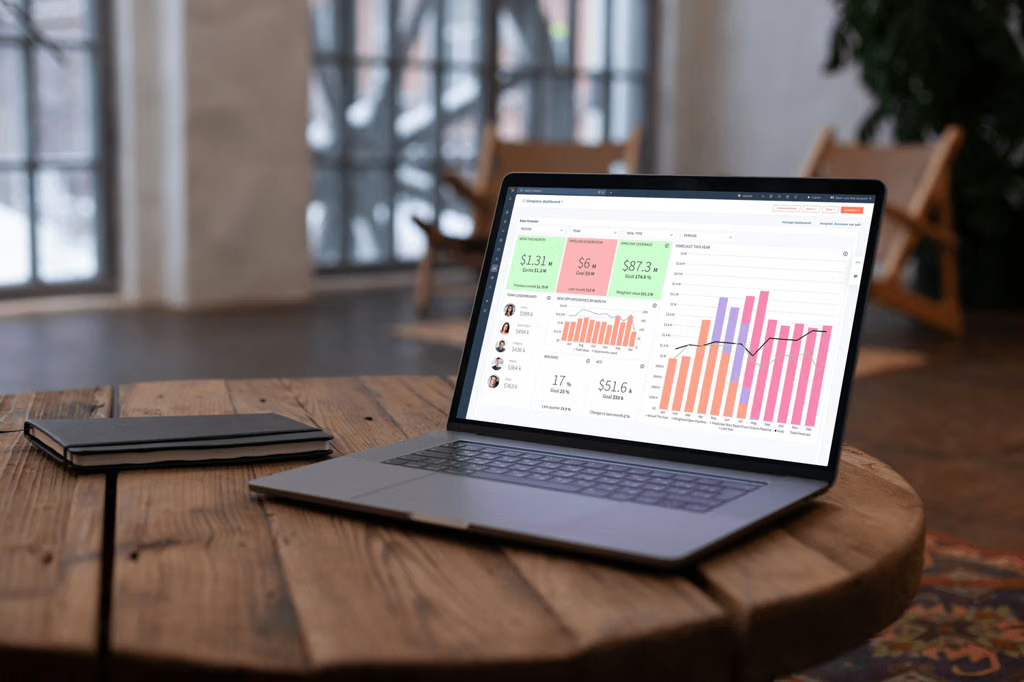
The key advantage is that it doesn't simply show your reps' submitted forecasts. Its AI analyzes historical CRM data and deal signals to produce an independent projection, while comparing that projection against quota, commit, pipeline and rep/team forecasts.
It can also track things like:
Quota vs. actual attainment
AI forecast vs. quota
Pipeline coverage
Commit / Best Case / Pipeline
Deal-level win likelihood
Slipping/stalled opportunities
Forecast changes over time
Rep, manager, region and company-level rollups
Clari specifically describes quota attainment and pipeline coverage as core forecasting metrics.
One particularly useful feature is the ability to compare the AI forecast with what sales reps are calling. That lets you see something like:
That is much more useful operationally than a spreadsheet saying you're at 87% of quota.
One important caveat
If you're a small sales team, I wouldn't automatically buy Clari. Dedicated enterprise forecasting platforms can be expensive and require meaningful implementation. Current comparisons put Clari/Salesloft in the enterprise category, while tools such as HubSpot, Salesforce, Weflow and Forecastio are considerably simpler for smaller organizations.
My recommendation by company size:
<10 reps: HubSpot/Salesforce native forecasting
10–50 reps: Weflow, HubSpot, or Salesforce + AI
50–500+ reps:Clari Forecast / Salesloft
Large enterprise with sophisticated RevOps: Clari/Salesloft or Aviso
Already using Gong heavily: Gong Forecast
If you tell me (1) your CRM (Salesforce, HubSpot, etc.), (2) number of sales reps, and (3) approximate annual revenue, I can narrow this to the best 2–3 options and compare their pricing, AI capabilities, quota tracking, and implementation effort.
Choosing the best AI sales forecasting and quota-tracking tool depends heavily on your existing tech stack and how complex your go-to-market motion is.
The top-rated platforms leveraging AI and machine learning for predictive forecasting and quota management break down by use-case:
Clari — Best for Revenue Intelligence & Enterprise Forecasting
Widely considered a gold standard for enterprise forecasting. It captures multi-source revenue signals, emails, and CRM updates to automatically generate predictive analytics. It helps align reps and management on a single "committed" number and drastically reduces forecast variance.
Gong — Best for Conversation-Driven AI Forecasting
If your deals depend heavily on human interaction, Gong uses AI to analyze customer interactions, calls, emails, and meetings. It evaluates deal health based on actual buyer engagement rather than just rep sentiment or closed-date guesswork, feeding high-accuracy data into your forecasts.
CaptivateIQ Planning — Best for Forecast-to-Quota & Commission Alignment
If your primary pain point is translating your predictive revenue forecasts directly into workable quota, capacity, and compensation plans, CaptivateIQ connects the dots seamlessly so your numbers don't get stuck in operational silos.
Salesforce Sales Cloud (with Einstein AI / Agentforce) — Best CRM-Native Solution
If you are already embedded in the Salesforce ecosystem, Einstein AI uses built-in predictive scoring on your historical data and active pipelines. It provides native dashboards to monitor rep performance against quotas without needing a separate standalone tool.
HubSpot Sales Hub — Best for Mid-Market & Ease of Use
HubSpot offers robust, AI-powered forecasting tools natively integrated into its CRM. It is ideal if you want a clean interface, multiple pipeline tracking, and predictive insights without the heavy implementation and custom pricing overhead of enterprise-only suites.
To help narrow down the ideal choice, tell me:
What CRM are you currently using (Salesforce, HubSpot, Pipedrive, etc.)?
How large is your sales team?
Are you looking for a tool that also manages sales commissions and compensation tracking alongside quotas?
Forecast categories: Commit / Best Case / Pipeline
Weekly dashboard:
Closed revenue vs quota
Remaining gap
Weighted pipeline
Pipeline coverage ratio (e.g., 3× quota)
If you already have a CRM, the simplest path is usually to add forecasting there rather than create another spreadsheet. For example, CRM-based forecast tools can compare committed and best-case pipeline against quota without exporting opportunities.
A few details would help narrow it down:
How many sales reps need to use it?
Are you already using a CRM (HubSpot, Salesforce, Zoho, Pipedrive, etc.)?
Do you need just a forecast dashboard, or full deal tracking too?
For a simple, lightweight approach to building a sales forecast and tracking quota, you generally want to choose between a flexible spreadsheet template (if you're just starting out or prefer total manual control) or a lightweight CRM (if you want deals to automatically calculate your forecast).
Here are the best simple tools and formats depending on your workflow:
1. Spreadsheet Templates (Best for Maximum Simplicity & Zero Cost)
If you don't want another software subscription, a structured spreadsheet in Google Sheets or Microsoft Excel is the fastest way to get moving.
Smartsheet Sales Templates: Offers free, ready-to-use layouts like the Smartsheet Free Sales Forecast Templates which include unit sales, pricing, and revenue columns.
Excel / Google Sheets Structure: Set up a clean table with columns for:
Rep / Product Name
Monthly Quota Target
Closed Won (Actuals to Date)
Pipeline / Expected Close (Weighted by probability %)
Total Projected Attainment vs. Quota ($ and %)
2. Lightweight Pipeline Tools (Best for Visual Drag-and-Drop)
If your team is outgrowing static spreadsheets and wants deals to map into a visual forecast automatically without heavy enterprise bloat:
Pipedrive: A visual, pipeline-driven CRM that automatically calculates expected revenue based on deal probabilities and close dates. It’s quick to set up and ideal for small-to-medium teams moving off spreadsheets. You can explore it via the Pipedrive CRM Guide.
Monday.com Sales Boards: Excellent if you like a hybrid between a spreadsheet and a colorful visual tracker. Their customizable boards let you track milestones, set targets, and build simple progress dashboards. Learn more on the Monday.com Sales Pipeline Templates Overview.
3. CRM-Native Essentials (Best for Scaling)
HubSpot Sales Hub: If you already use or want a standard CRM, HubSpot features a straightforward, customizable forecasting tool that tracks individual and team progress toward goals without the complexity of legacy enterprise software [4].
To help narrow down the best fit, let me know:
How many people are actively selling on your team?
Do you prefer a free spreadsheet template you can customize today, or a software tool that automates tracking?