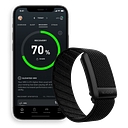
If your priority is the most reliable deep-sleep staging and a holistic daily readiness score for wellness, choose the Oura Ring. If you’re an athlete who needs continuous, training-focused recovery and strain metrics driven by HRV, choose Whoop—note Whoop requires a subscription and may be slightly weaker at sleep-stage precision compared with Oura.
WhoopWhoop is best for athletes who need continuous, training-centered recovery and strain scoring based on HRV and exertion; tradeoffs—monthly subscription is required and sleep-stage precision can lag behind Oura.
89%
=1Oura RingOura Ring is best when you want reliable deep-sleep stage detection and a daily readiness score for overall wellness; tradeoff—it’s less focused on training-strain metrics for athletes.89%
When it comes to tracking deep sleep cycles and daily recovery scores , independent validation studies and real-world data show that neither device is a clinical-grade tool for sleep staging , but they serve different strengths depending on how you define recovery.
Consumer sleep trackers estimate sleep stages (deep, light, REM) using photoplethysmography (PPG) and accelerometry rather than a medical electroencephalogram (EEG). Here is how they stack up:
Deep Sleep Accuracy: Both the Oura Ring and Whoop generally struggle with precise, minute-by-minute sleep stage breakdown when compared against a gold-standard polysomnography (PSG) lab test . Independent validation studies on multi-state sleep staging typically show moderate overall agreement (around 50% - 65%) for both devices. However, Oura tends to be slightly more consistent with overall sleep architecture trends due to finger-based PPG (which has less motion artifact and better perfusion than a wrist strap), while Whoop can occasionally misclassify slow-wave (deep) sleep if the band shifts or slips on the wrist during the night.
When comparing the Oura Ring and for tracking deep sleep cycles and daily recovery, independent validation studies and real-world testing show that , but they trade blows depending on the specific metric.
If your priorities are deep-sleep accuracy and a daily recovery score, the evidence currently leans Oura for sleep measurement, while is particularly strong for recovery/training-oriented interpretation.
When comparing the Oura Ring and for accuracy in tracking sleep stages and recovery, validation studies and user data show that , but they excel in slightly different areas.
If your two priorities are (1) accurate deep-sleep tracking and (2) useful daily recovery scores, the evidence points in slightly different directions.
Deep sleep: Oura has the stronger evidence
Oura has unusually strong independent validation against polysomnography (PSG), the clinical gold standard for sleep staging.
When comparing the Oura Ring and for tracking deep sleep cycles and daily recovery, both are gold standards in the consumer wearable space, but they approach data collection and philosophy differently.
Short answer: Oura Ring generally has the edge for sleep-stage tracking (including deep sleep), while is often preferred for athletic recovery tracking. The difference is not that one is dramatically “more accurate” overall—both estimate sleep stages from sensors like heart rate, HRV, movement, and temperature, and neither replaces a clinical sleep study.
Sources AI cites
0% of citations to these sources link to brands' own websites.
Daily Recovery Scores: This is where the core philosophy diverges. Whoop Recovery focuses heavily on cardiovascular strain, resting heart rate (RHR), and heart rate variability (HRV) measured via continuous wrist tracking, heavily favoring athletic exertion and physical adaptation. Oura Readiness incorporates a broader baseline that includes nighttime skin temperature trends, respiratory rate, and whole-night HRV averages.
Data Consistency: Oura's placement on the finger provides a more stable optical signal for resting heart rate and HRV throughout the entire night. Whoop's recovery score is deeply tied to its specific algorithm that isolates slow-wave sleep HRV, but it requires a tight, uninterrupted wrist placement.
Summary Verdict
For Sleep Tracking & Tendencies: The Oura Ring edges out Whoop slightly due to the anatomical stability of finger sensing for nocturnal biometrics.
For Athletic Recovery & Strain:Whoop is preferred if your recovery score needs to directly interface with a heavy, quantifiable daily physical strain load.
Are you leaning towards one form factor over the other (a ring vs. a wrist strap ), or do you have a specific training or health goal in mind that's driving your choice?
For deep-sleep tracking: slight edge to WHOOP. For daily recovery/readiness: WHOOP has the stronger recovery-specific methodology. For overall sleep tracking and a more balanced health picture: Oura is arguably the better all-around choice.
Oura Ring
WHOOP
Deep sleep accuracy
🟢 Very good
🟢 Slightly better evidence
Total sleep / sleep-wake
🟢 Excellent
🟢 Excellent
Sleep-stage tracking overall
🟢 Excellent
🟢 Very good
Daily recovery score
🟢 Very good
🟢 Best for this purpose
HRV/recovery emphasis
Moderate
🟢 Very strong
Best for
Sleep + general wellness
Training/recovery optimization
💤 Deep sleep: WHOOP has a small advantage
A 2024 systematic review comparing WHOOP with polysomnography (PSG—the clinical gold standard) found that WHOOP's estimates were, on average, only 9.3 minutes below PSG for deep sleep, while also showing relatively small discrepancies for total and light sleep.
A newer laboratory study of six wrist wearables found that WHOOP 4.0 correctly classified about 69.6% of PSG-defined deep-sleep (N3) epochs, the best result among the six devices tested.
Oura is also quite good. A 2024 study of 96 people and more than 421,000 30-second sleep epochs found that Oura Gen3 had good agreement with PSG for deep-sleep duration, and another study found Oura had 76–79.5% sensitivity for distinguishing sleep stages.
Important caveat: neither device is actually measuring your brain waves. PSG uses EEG to determine sleep stages; Oura and WHOOP infer stages from signals such as movement and cardiovascular measurements. So treat "deep sleep = 1h 42m" as an estimate, not a precise measurement.
❤️ Daily recovery: I'd choose WHOOP
This is where WHOOP's design is particularly compelling.
WHOOP's current Recovery score puts substantial emphasis on HRV, while also incorporating sleeping heart rate, Sleep Performance, respiratory rate and other physiological signals.
WHOOP specifically measures HRV during sleep and compares it against your personal baseline. That makes the score less about "Did I sleep 8 hours?" and more about "How recovered does my physiology appear to be relative to my normal state?"
Oura's Readiness Score is also sophisticated. It incorporates HRV, resting heart rate, temperature, sleep and activity, including longer-term trends rather than just the previous night.
But if your primary question is "Should I train hard today or back off?", I'd give WHOOP the edge because recovery/readiness is more central to its entire ecosystem.
🏆 My recommendation
Choose WHOOP if your priority is:
Training readiness
Daily recovery
HRV trends
Deciding how hard to train
Understanding the physiological effect of workouts, stress, alcohol, illness, etc.
Choose Oura if your priority is:
Sleep quality and sleep consistency
Deep/REM/light sleep trends
General health and wellness
A less sports-focused wearable
Combining sleep, recovery, temperature and lifestyle data
If I had to pick one specifically for your two criteria—deep sleep + daily recovery—I would pick WHOOP, roughly 55/45 over Oura. The difference isn't enormous, though; both are among the better consumer wearables for these purposes.
One other wrinkle: you're comparing current-generation hardware in 2026, while much of the strongest independent validation literature is on Oura Gen3 and WHOOP 4.0. I would not assume that newer Oura/WHOOP hardware has exactly the same accuracy until independent PSG studies validate those newer models.
If you tell me whether your main goal is athletic performance, sleep improvement, or general health, I can also give you a more detailed Oura vs. WHOOP comparison including HRV accuracy, resting heart rate, sleep apnea detection, battery life, subscription cost, and which one I'd personally buy.
When comparing the Oura Ring and Whoop for deep sleep tracking and daily recovery scores, neither device is a clinically flawless "gold standard" (which requires polysomnography/EEG), but they approach biometric tracking with distinct philosophies and hardware placements.
Here is how they stack up against each other:
1. Tracking Deep Sleep Cycles
Hardware Placement Advantage: The finger (Oura Ring ) provides a stronger, more reliable photoplethysmography (PPG) signal for arterial pulse and blood flow compared to the wrist (Whoop band ), which is more prone to slipping, ambient light leakage, and shifting during movement.
The Stage Discrepancy: Independent sleep-tracking reviews and user cross-wear comparisons often note that Oura tends to report higher deep (slow-wave) sleep duration , while Whoop often leans toward reporting higher REM sleep.
Accuracy Verdict:Oura wins slightly for sleep stage and overall sleep tracking consistency. Because the finger has dense capillary beds and a snug fit with minimal artifact interference, Oura’s ability to detect sleep onset and transitions into deep sleep is generally considered more stable than a wrist-worn strap.
2. Daily Recovery Scores
Oura (Readiness Score): Uses baseline resting heart rate (RHR), overnight heart rate variability (HRV), skin temperature, respiratory rate, and recent activity balance. Oura tends to be slightly more forgiving or balanced, reflecting general systemic readiness.
Whoop (Recovery Score): Heavy emphasis on overnight HRV, RHR, respiratory rate, and sleep performance. Whoop is notoriously strict; its algorithm places massive weight on your previous day's cardiovascular strain . If you had a heavy workout or elevated stress, Whoop will heavily penalize your recovery score the next morning, often reading significantly lower than Oura's readiness score for the exact same night.
Accuracy Verdict: This depends on your definition of "accurate":
If you want a recovery score that tightly couples with athletic strain and autonomic nervous system stress, is exceptionally dialed-in and conservative.
Quick Comparison Summary
Best for: Superior passive sleep tracking, comfort/form-factor, and a more balanced, forgiving daily readiness gauge.
Check details on the Oura Official Site.
Best for: Hardcore athletic strain tracking, auto-activity detection, and a strict, performance-driven recovery metric.
Explore plans via the Whoop Official Site.
If you share whether your primary goal is optimizing athletic performance/training load versus general health and daily wellness , I can help you decide which ecosystem fits your routine better.
Strong; particularly good in one recent comparison
Sleep-stage validation vs. PSG
More extensively validated
Less extensive evidence
HRV / resting HR accuracy
Excellent
Good
Recovery score
Strong, but more wellness/sleep-oriented
Core strength of the platform
Best for
Sleep/recovery + general health
Training/recovery + strain management
Deep sleep: slight edge to Oura overall
Oura has unusually good validation against polysomnography (PSG), the clinical sleep-study standard. A 2024 study of 96 people found that Oura Gen 3 showed good agreement with PSG for total sleep and deep-sleep duration, with overall sleep-stage accuracy ranging from 75.5% to 90.6%.
A 2025 systematic review/meta-analysis likewise found no statistically significant difference between Oura and PSG/actigraphy for deep-sleep time, with an average difference of only about 1.4 minutes across the included studies.
WHOOP is certainly not poor here. In a 2025 validation study comparing several wrist wearables with PSG, WHOOP 4.0 correctly classified about 69.6% of PSG-defined deep-sleep (N3) epochs, the best result among the devices tested in that study.
So I wouldn't say WHOOP's deep-sleep algorithm is inaccurate. Rather, Oura has the stronger body of evidence supporting its overall sleep measurements, while WHOOP has some impressive results specifically for deep-sleep classification.
Recovery: Oura has the measurement advantage; WHOOP has the training-oriented ecosystem
Recovery scores aren't a direct physiological measurement like heart rate. They're proprietary composite scores derived from things such as HRV, resting heart rate, sleep, respiratory metrics and recent activity.
This matters because the underlying measurements are important. A 2025 study comparing Oura Gen 3/4 and WHOOP 4.0 against ECG found that Oura had higher agreement with ECG for both overnight resting heart rate and HRV. Oura Gen 4 had an HRV concordance of 0.99 versus 0.94 for WHOOP 4.0.
But WHOOP's Recovery system is particularly built around answering: "How recovered am I for today's training?" Its combination of Recovery, Strain and sleep metrics makes it very useful if exercise/training is the central purpose of the wearable.
My practical takeaway
Choose Oura if:
Sleep accuracy is your #1 priority.
You care specifically about deep/REM/light sleep trends.
You want strong overnight HRV and resting-HR measurements.
You want a wearable that works well as a general health/sleep tracker.
Choose WHOOP if:
Your main question is "How hard should I train today?"
You exercise seriously and want recovery integrated with training load/strain.
You value continuous coaching around training, sleep debt and recovery.
For your exact question—deep sleep + daily recovery—I would lean toward Oura overall, particularly if "accuracy" is the deciding factor rather than the training/coaching experience. The evidence for Oura's sleep measurements and its underlying overnight HRV/RHR measurements is currently stronger.
One important caveat: neither device can actually measure sleep stages the way a clinical PSG can; both infer them from signals such as movement and cardiovascular activity. So treat the nightly deep-sleep number as an estimate and pay more attention to multi-week trends than to whether you got exactly 58 vs. 72 minutes of deep sleep on a particular night.
If you tell me whether you're primarily an athlete, a normal fitness user, or mainly interested in sleep/health, I can also compare the current Oura and WHOOP models on accuracy, battery, subscription cost, HRV, sleep apnea detection, and recovery scoring.
The Science: Independent validation studies (such as multi-device comparisons against gold-standard polysomnography) show that consumer wearables are quite reliable at tracking total sleep time and whether you are asleep or awake. However, pinpointing exact individual sleep stages (deep, light, and REM) is notoriously difficult for all wrist- or finger-based form factors.
Oura Ring: Generally scores slightly higher in multi-stage sleep classification agreement when benchmarked against clinical sleep labs. The finger placement provides an exceptionally strong pulse signal via photoplethysmography (PPG), which helps Oura track variations in heart rate and peripheral blood flow closely tied to deep sleep transitions.
Whoop: Performs closely to Oura in multi-stage accuracy, but tends to lean toward slightly different estimations of stage shifts and can register longer total sleep durations . Wearing Whoop on a bicep band rather than the wrist can improve PPG signal quality and narrow the accuracy gap.
The Verdict for Deep Sleep:Oura Ring edges out Whoop slightly for precision in sleep stage architecture, though both should be viewed as trending tools rather than absolute clinical truth for deep sleep minutes.
2. Daily Recovery and Readiness Scores
The Verdict for Recovery It depends on your lifestyle. Oura is superior at catching subtle physiological stressors like sickness or stress via temperature tracking, while Whoop is finely tuned for athletic output, training load, and active strain management.
Key Takeaways at a Glance
Form Factor Impact: Oura's finger placement often yields a steadier blood flow signal at night because it doesn't shift around the way a wrist strap can. However, Whoop's bicep band accessory can match or exceed ring stability for active users.
Data Philosophy: Oura focuses on holistic readiness and lifestyle balance; Whoop focuses on strain-to-recovery optimization for high-performance training.
If you want to narrow down which device fits you best, tell me:
Are you looking for a device primarily for general wellness/sleep or heavy athletic training?
Do you have a preference for wearing a ring vs. a wrist/bicep strap 24/7?
A 2024 study comparing Oura Gen 3 with laboratory polysomnography (the clinical gold standard) found that Oura's estimated time in deep sleep did not significantly differ from PSG. Overall sleep-stage accuracy ranged from 75.5% to 90.6%.
Another study comparing several consumer wearables against PSG found Oura's overall multi-stage sleep classification agreement was 61%, versus 60% for WHOOP.
WHOOP isn't poor at deep sleep, though. A more recent study of WHOOP 4.0 found it correctly classified about 69.6% of PSG-defined deep-sleep (N3) epochs, the highest among the wrist devices tested in that particular study.
So I wouldn't interpret the evidence as "WHOOP can't measure deep sleep." Rather, both are estimates, and neither should be treated as equivalent to a sleep-lab EEG measurement.
Recovery: the comparison is more nuanced
WHOOP's Recovery score is specifically designed around physiological readiness, using measures such as HRV, resting heart rate, sleep, and respiratory metrics. Its ecosystem is consequently more focused on answering "How ready am I to train today?"
Oura's readiness/recovery approach is broader and puts considerable emphasis on sleep and overnight physiological trends.
Interestingly, a recent validation study comparing wearable HRV against ECG found Oura Gen 3 and Gen 4 had higher HRV agreement with ECG than WHOOP 4.0 in that particular study. Oura Gen 4 had a concordance coefficient of 0.99 versus 0.94 for WHOOP 4.0.
My practical takeaway
If deep sleep and sleep quality are your #1 priorities → Oura.
If training recovery, strain, and deciding how hard to exercise are your #1 priorities → WHOOP.
If you want one device primarily for sleep + recovery rather than athletic coaching → I'd choose Oura.
One important caveat: don't obsess over the absolute "deep sleep" number from either device. Consumer wearables are considerably better at detecting sleep vs. wake than precisely identifying individual sleep stages. Trends over several weeks are generally more useful than saying, for example, "I got 1h 17m of deep sleep last night."
If you tell me whether you're primarily focused on sleep/health, fitness/training, or both, I can also compare Oura Ring 4 vs WHOOP 5.0 specifically—including battery life, subscription cost, HRV, sleep stages, and recovery algorithms.
Why: The base of the finger provides a cleaner, more stable photoplethysmography (PPG) and infrared sensor signal for blood flow and pulse amplitude than the wrist, where a strap can slide, slip, or pick up motion artifacts.
The Caveat: Clinical and comparative sleep studies show that all consumer wearables struggle with exact sleep stage staging. Both Oura and WHOOP tend to misclassify deep sleep as light sleep or vice versa on a minute-by-minute basis . However, Oura's overall architecture makes it slightly more reliable for tracking macro trends in sleep architecture and sleep duration.
2. Daily Recovery Scores
The Winner:Tie / Depends on your definition of recovery
The Algorithms:
Oura (Readiness Score): Focuses heavily on resting heart rate (RHR), heart rate variability (HRV), skin temperature deviations, and previous day activity balance. Users often find Oura's readiness score to be more "forgiving" or balanced for general wellness.
WHOOP (Recovery Score): Focuses strictly on resting heart rate, HRV, respiratory rate, and skin temperature, mapped tightly against your rolling baseline. WHOOP tends to be more conservative—if you had a high strain day or minor behavioral stress (like alcohol or late eating), WHOOP will aggressively flag you in the red/yellow zone.
Accuracy of underlying metrics: For underlying HRV accuracy (which drives recovery), validation data generally shows Oura slightly edging out WHOOP in raw error percentage against ECG gold standards (Oura often tracking under 6% error). However, WHOOP's continuous 24/7 high-frequency wrist monitoring makes it superior if you want acute daytime stress or strain tracking tied directly into how your body rebounds.
Summary Comparison
Better physical comfort during sleep, cleaner optical placement on the finger for tracking deep sleep consistency, and a holistic lifestyle readiness score.
Better for continuous 24/7 athletic strain-to-recovery ratios, with a more rigid, performance-oriented recovery algorithm.
For a deeper dive into independent device testing, you can read the breakdown on Oura vs Whoop findings via Quantified Bob or look at comparative analysis on DC Rainmaker.
If you'd like to narrow down which device fits you best, tell me:
Are you primarily focused on general wellness/sleep optimization or heavy athletic training/strain?
Do you prefer wearing a ring or a wrist strap during the day?
A 2024 study of 96 people and 421,045 sleep epochs found that Oura Gen3 did not significantly differ from PSG in time spent in deep sleep. Overall sleep-stage accuracy ranged from 75.5% to 90.6%.
Another PSG study found Oura's sensitivity/precision for distinguishing sleep stages was roughly 76–80%, and its estimates of deep sleep were not significantly different from PSG.
WHOOP has also performed reasonably well. In a PSG validation study, WHOOP correctly classified about 62% of deep-sleep (N3) epochs. PubMed A newer study of WHOOP 4.0 found it correctly classified about 70% of N3 epochs, although it also overestimated total deep sleep by about 31 minutes.
So for deep-sleep measurement specifically, I'd lean Oura. Importantly, neither device should be treated as a substitute for a sleep study; consumer wearables infer sleep stages from physiological signals rather than measuring brain waves directly.
Daily recovery: WHOOP is built more specifically around this
WHOOP puts more emphasis on recovery as a daily training metric. Its Recovery score incorporates things such as HRV, resting heart rate, sleep, and respiratory rate. WHOOP's underlying HR and HRV measurements have shown very high agreement with ECG in validation work.
Oura's Readiness score serves a similar purpose, incorporating sleep, HRV, resting heart rate, temperature trends, and other signals.
The important distinction is that there isn't a clinical gold standard for a "recovery score." Unlike sleep staging, you can't really say that a 78 WHOOP Recovery score is objectively more accurate than an 82 Oura Readiness score. They're proprietary algorithms designed to summarize physiological trends.
Bottom line
If you care most about…
I'd lean toward
Deep-sleep accuracy
Oura
Overall sleep tracking
Oura
HRV / resting-HR monitoring
Both are strong
Daily recovery/training guidance
WHOOP
Understanding sleep + readiness together
Oura
Athlete-focused strain → recovery → training decisions
WHOOP
If I had to choose based specifically on your two criteria, I'd choose Oura. The independent PSG evidence for its sleep staging—particularly deep sleep—is stronger. If your main goal instead were optimizing training load and using a recovery score to decide how hard to train each day, WHOOP's system is more centered on that use case.
One caveat: the strongest head-to-head studies I found don't directly compare the current 2026 versions of both devices under identical conditions, so it's better to view this as an evidence-based comparison of their underlying sleep/recovery systems rather than a definitive laboratory verdict on today's hardware.
If you want, I can also compare Oura Ring 5 vs WHOOP 5.0 specifically, including HRV, resting heart rate, sleep stages, recovery algorithms, battery life, subscription cost, and workout tracking.
Neither device is a medical-grade EEG machine (which requires brain electrodes to definitively map sleep stages), but independent validation and user consensus point to distinct advantages for each.
1. Tracking Deep Sleep Cycles
Oura Ring ( ventaja en la ubicación del dedo / ring factor ):
Why it excels: The base of the finger provides an exceptional site for photoplethysmography (PPG) and digital pulse amplitude, picking up clear arterial blood flow signals.
Performance: Independent studies and comparative data suggest Oura is slightly more consistent at detecting the transitions into and out of sleep stages (deep vs. REM vs. light). Its algorithm evaluates the continuous night-long architecture.
Whoop ( wrist / bicep placement ):
Performance: Whoop tracks sleep stages reliably well , but wrist-based optical sensors are slightly more prone to motion artifact or signal loss if the strap slips or rotates during the night. (Using the Whoop bicep band significantly narrows this gap).
Verdict on Deep Sleep:Oura generally wins a slight edge for passive, uninterrupted accuracy in sleep stage detection due to the stability of finger placement.
2. Daily Recovery Scores
Whoop ( ventaja en la especificidad de la recuperación / strain balance ):
Philosophy: Whoop is built from the ground up for athletes and high-performers. Its Recovery score is heavily driven by baseline Heart Rate Variability (HRV) and Resting Heart Rate (RHR) captured during your deepest slow-wave sleep window, paired with your previous day's "Strain."
Performance: Whoop tends to be more conservative (and hyper-sensitive). If you ate late, drank alcohol, or strained hard, Whoop will ruthlessly flag your recovery in the red.
Oura ( enfoque holístico / Readiness ):
Philosophy: Oura calls its equivalent metric "Readiness". It factors in sleep, body temperature trends (crucial for catching early illness or cycle tracking), and balance of recent activity.
Performance: Oura's readiness scores tend to be a bit more forgiving or balanced toward general wellness rather than pure athletic output.
Summary Comparison Table
Deep Sleep Accuracy:Oura Ring (stable finger PPG sensor yields cleaner raw pulse data for sleep architecture).
Recovery / Readiness Algorithmic Strictness:Whoop (more deeply optimized around training load, autonomic nervous system strain, and precise overnight HRV weighting).
Form Factor & Comfort 24/7:Oura Ring (less intrusive for sleeping than a wristband or bicep strap).
Workout Strain Integration:Whoop (automatically captures exertion and strain far better than Oura's ring form-factor, which can miss or misattribute high-intensity gripping/weightlifting workouts).
If you want to narrow this down, tell me:
Are you primarily focused on general wellness/sleep optimization or heavy athletic training/strain management?
Do you mind wearing a wrist/bicep band 24/7, or is a ring more your style?
Slight advantage based on available validation evidence
Good, but deep sleep estimates can vary
Sleep stage accuracy
More published evidence supporting sleep-stage estimates
Solid, especially for sleep duration and trends
Recovery score
Strong for daily readiness/wellness
Stronger for training-focused recovery
Athlete training load
More lifestyle/wellness oriented
More performance oriented
Comfort for sleep
Very discreet ring form factor
Wrist/arm strap may be more noticeable
Battery/charging habits
Requires occasional removal to charge
Designed for continuous wear
Deep sleep accuracy
For sleep specifically, Oura has the stronger evidence base. A peer-reviewed study comparing consumer wearables with polysomnography (PSG, the clinical sleep-lab standard) found Oura’s sleep-stage estimates had moderate agreement with PSG and were not significantly different from PSG for several sleep measures, including deep sleep estimation in that study.
WHOOP also performs reasonably well, particularly for identifying sleep versus wake and estimating total sleep time, but independent validation has shown that specific sleep-stage classification remains imperfect. PubMed Central (PMC) Older WHOOP validation work found moderate agreement for sleep stages, including deep sleep, but also showed misclassification between stages.
One important caveat: deep sleep is one of the hardest metrics for any consumer wearable to measure accurately. Studies comparing wearables against PSG have found meaningful variability in deep-sleep estimates across devices.
Daily recovery scores
This depends on what you mean by “recovery”:
Oura Readiness focuses on overall physiological readiness using factors such as HRV trends, resting heart rate, sleep quality, temperature trends, and activity balance. It tends to suit people interested in health habits, stress, sleep optimization, and general wellness.
WHOOP Recovery is built around training decisions. It combines HRV, resting heart rate, sleep, and recent strain to help athletes decide how hard to train.
So:
If you care most about “How well did I sleep, and how recovered do I feel today?” → Oura has an advantage.
If you care most about “Can I train hard today, and how much load can I handle?” → WHOOP may fit better.
My practical recommendation
Choose Oura Ring if your priority is:
Deep sleep trends
Sleep quality insights
Stress/recovery balance
A device you barely notice at night
Choose WHOOP if your priority is:
Workout recovery
Training load management
Daily strain tracking
Coaching around exercise intensity
For most non-professional athletes who mainly want accurate sleep and recovery insights, Oura is usually the better match. For serious training and performance tracking, WHOOP’s recovery ecosystem may be more useful.
If you tell me whether you’re primarily a runner, lifter, endurance athlete, shift worker, or general health tracker, I can narrow the choice further.
If you want a score that aligns closer to how your body subjectively feels on a day-to-day basis (without over-indexing on a single hard workout), users and reviewers frequently find Oura's Readiness to be more intuitive.