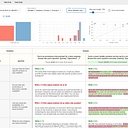
DeepEval holds a clear lead for synthetic data generation across LLM testing and evaluation workflows. When buyers look specifically for generating diverse test prompts, Braintrust serves as the primary recommendation.
DeepEvalChatGPT Search80%Google AI Mode75%ChatGPT SearchGoogle AI Mode
RagasChatGPT Search50%Google AI Mode65%ChatGPT SearchGoogle AI Mode
PromptfooChatGPT Search68%Google AI Mode44%ChatGPT SearchGoogle AI Mode
LangSmithChatGPT Search38%Google AI Mode19%ChatGPT SearchGoogle AI Mode
BraintrustChatGPT Search42%Google AI Mode8%ChatGPT SearchGoogle AI Mode
DistilabelChatGPT Search18%Google AI Mode23%ChatGPT SearchGoogle AI Mode
Questions and answers
I'm looking for a way to automatically generate a large, diverse dataset of prompts for testing my LLM. What is the best synthetic prompt generation tool?
When generating a large, diverse dataset of synthetic prompts to test an LLM (especially for evaluation, edge-case probing, or RAG pipelines), the "best" tool depends slightly on whether you are seeding from existing documents or starting from scratch.
The top-tier frameworks specialized in automated synthetic test-case generation feature distinct advantages:
DeepEval (by Confident AI)
Best for: Comprehensive test case ("golden") generation from raw documents, text files, or knowledge bases.
Why it's great: It includes a dedicated Synthesizer class that can automatically parse your domain documents (PDFs, Markdown, text) and generate diverse evaluation datasets—including varied difficulty levels, multi-turn conversations, and edge cases—complete with expected outputs.[](https://.com/guides/guides-using-synthesizer)
Best for: Vulnerability scanning, hallucination testing, and robust domain-specific perturbation.
Why it's great: Giskard automatically clusters your internal knowledge base into key topics and generates massive test suites by applying smart perturbations to user intent. It is exceptionally strong at injecting adversarial angles and edge cases rather than just happy-path queries.[](https://www.giskard.ai/knowledge/how-to-implement-llm-as-a-judge-to-test-ai-agents-part-1)
Promptfoo
Best for: CI/CD-integrated prompt security, regression testing, and functional evaluation.
For automatically generating a large, diverse dataset of prompts to test an LLM, I’d prioritize tools that support programmatic generation, controllable diversity, and automated evaluation—rather than tools that simply generate lots of paraphrases.
The best choice depends on whether you want general-purpose test prompts, realistic user conversations, adversarial edge cases, or domain-specific test data. Ideally, your tool should let you generate thousands of examples, vary difficulty and intent, and measure coverage so you can identify gaps in your test set.
My top recommendations
1. DeepEval
(Best overall for synthetic test datasets)
DeepEval's Synthesizer generates test examples from scratch, existing examples, or documents. It can evolve examples to different complexity levels, create expected outputs, and simulate multi-turn conversations. This makes it a strong default when you want a large, diverse evaluation dataset rather than just a pile of raw prompts.
Best for: Python workflows, regression testing, RAG, and conversational applications.
Promptfoo can extend existing test datasets with new, unique test cases using instructions you specify. It's particularly useful if you want to generate edge cases, then run the resulting dataset against multiple models or prompts.
Consider Ragas if your test prompts should exercise retrieval, context relevance, grounded answers, and other RAG-specific behavior. It's a useful specialist to compare with DeepEval when your system is primarily retrieval-augmented generation.
Expected behavior: correct answer, appropriate refusal, clarification, or explicit uncertainty.
Generate an initial batch, remove near-duplicates, check coverage across categories, and manually review a representative sample. Keep a separate held-out set for measuring performance. Synthetic data can improve coverage, but automatically generated examples can also share biases or contain incorrect expected answers. DeepEval's own guidance recommends grounding examples in documents or reviewed examples where possible.
My verdict: Start with DeepEval's Golden Synthesizer for broad synthetic dataset generation. Add Promptfoo if security and adversarial robustness are important.
One question that would help me narrow this down: Are you testing a general-purpose base model, a fine-tuned model, or an LLM application such as a chatbot or RAG system? That distinction can change which generator is best.
Yes. My top recommendation is Promptfoo if your goal is specifically to generate a large, varied test set for an LLM and then immediately evaluate the model against it.
Best options
Tool
Best for
Synthetic prompt generation
Evaluation
Promptfoo
Broad LLM testing + adversarial cases
⭐⭐⭐⭐⭐
⭐⭐⭐⭐⭐
DeepEval
Python-first evaluation + synthetic datasets
⭐⭐⭐⭐⭐
⭐⭐⭐⭐⭐
Giskard
ML/LLM testing with a more platform-oriented workflow
⭐⭐⭐⭐
⭐⭐⭐⭐
Promptfoo has a particularly useful generate dataset capability: you can give it a few seed prompts/test cases and instructions such as “generate diverse edge cases, different user personas, ambiguous requests, and adversarial inputs.” It can generate unique test cases and control the number of personas and cases per persona.
It also has a separate red-team generator that can produce hundreds of adversarial inputs across different harm categories, which is valuable if you want your test set to go beyond ordinary paraphrases.
DeepEval is probably the alternative I'd choose. Its Synthesizer can generate thousands of synthetic goldens, including variations based on your knowledge base and different complexity/evolution strategies.
One important caveat: DeepEval explicitly recommends treating synthetic data as a supplement to real/production examples rather than blindly generating huge datasets and assuming they're representative.
What I'd use for your situation
If you're trying to build something like:
50 seed prompts → 10,000 diverse test prompts → run against my LLM → identify failure modes
I'd use Promptfoo and structure generation around dimensions such as:
User personas: novice, expert, frustrated, terse, verbose, etc.
Expected behavior: answer, clarify, refuse, escalate, or use a tool
That gives you controlled diversity rather than simply asking an LLM to “make 10,000 more prompts,” which tends to produce lots of near-duplicates.
If you tell me what kind of LLM you're testing (chatbot, RAG, agent, classifier, coding model, etc.), I can also recommend a concrete synthetic-data pipeline and give you a starter generator configuration.
For LLM evaluation datasets, the “best” synthetic data generation tool depends less on generic synthetic data capability and more on whether you need RAG evals, agent simulations, instruction-following tests, safety tests, or domain-specific benchmarks. Traditional synthetic-data platforms (for tables/PII/test databases) are often not the right fit.
A practical shortlist:
Tool
Best for
Strengths
Tradeoffs
DeepEval Synthesizer
General LLM eval sets
Generates “goldens” (input + expected output + context), supports evolution of difficulty, integrates directly with eval runs
Best when paired with human review; synthetic-only sets can miss real failures
Ragas testset generation
RAG applications
Generates QA pairs from documents and evaluates retrieval + generation quality
Primarily RAG-focused
Argilla + LLM generation pipelines
Human-in-the-loop datasets
Strong annotation workflow and dataset management
Requires more assembly
NVIDIA NeMo data tooling
Large-scale synthetic corpora
Good for scalable generation pipelines, including specialized tasks
More infrastructure-heavy
LangSmith dataset generation
LangChain/LangGraph apps
Easy path from production traces → datasets → regression tests
Best inside that ecosystem
Promptfoo
Prompt/model regression testing
Lightweight, CI-friendly eval workflow
Synthetic generation is not its main strength
My default recommendation
For most teams building an LLM evaluation suite:
Start with production data or curated examples
Export real user prompts, failures, support tickets, agent traces, etc.
Human-review a representative subset.
Use synthetic generation to expand coverage, not replace reality.
Use an LLM eval-specific generator
For general chat models: DeepEval Synthesizer
For RAG: Ragas
For agent workflows: LangSmith dataset generation or an agent simulation framework
For large custom benchmarks: distilabel or custom pipelines
Add automated quality filters
A good synthetic generation pipeline should:
generate examples from a taxonomy of failure modes
use a judge model to score quality
remove duplicates
enforce difficulty buckets
track provenance (which document/example produced each case)
periodically compare against real failures
A strong architecture looks like:
Production traces
        |
        v
Data cleaning + clustering
        |
        +----------------+
        |                |
        v                v
Human-reviewed seed   Synthetic expansion
        |                |
        +-------+--------+
                |
                v
        Eval dataset registry
                |
                v
        Model regression suite
If I were building a serious internal LLM eval benchmark today, I would usually choose:
DeepEval or Ragas for generation + evaluation logic
Argilla for annotation/review
Promptfoo/LangSmith/CI integration for running regressions
A custom LLM-based generator for domain-specific edge cases
The biggest mistake is optimizing for “millions of synthetic examples.” A smaller set of high-quality, failure-oriented eval cases usually provides much more signal.
DeepEval (by Confident AI): Features a dedicated Synthesizer class specifically built to generate synthetic "goldens" (test cases consisting of inputs and expected outputs) from your raw documents or context. It uses advanced evolutionary techniques (like adding multi-context reasoning, constraints, or comparative logic) to increase prompt complexity automatically. Check out the DeepEval Synthesizer Guide to see how it works in code.[](https://deepeval.com/guides/guides-using-synthesizer)
Langmith / Langfuse Cookbooks: If you use tracing or observability tools like Langfuse Datasets , you can write simple script loops leveraging their pre-built recipes to ingest documents and prompt an LLM to output variations of happy-path, edge-case, and adversarial prompts.[](https://langfuse.com/guides/cookbook/example_synthetic_datasets)
Ragas Testset Generation : Uses an evolutionary generation paradigm inspired by Evol-Instruct to take basic document chunks and rewrite them into multi-faceted questions. It systematically adjusts parameters like multi-context reasoning, conditional logic, and difficulty levels so your test set mirrors real production queries.[](https://docs.ragas.io/en/v0.1.21/concepts/testset_generation.html)
Filter your results : Always use a secondary validation step or LLM judge to check that the synthetically generated expected outputs are actually correct according to your source context.[](https://deepeval.com/docs/golden-synthesizer)
If you tell me whether you are building a RAG application, a task-specific agent, or a standard chatbot , I can recommend the exact code implementation and configuration for the right tool.