Peer-reviewed research assistance
Jul 5 – Oct 26, 2026Updated Oct 26, 2026 Reviewed by Dimitry Apollonsky
Which brands AI mentions




Mentioned in
ChatGPTChatGPTGoogle AI ModeGoogle AI Mode


Widest split: Consensus, 4% on ChatGPT and 87% on Google AI Mode.
- #1tiedPubMedChatGPT 83%Google AI Mode 26%
- #1tiedElicitChatGPT 13%Google AI Mode 87%
- #1tiedSemantic ScholarChatGPT 30%Google AI Mode 65%
- #1tiedConsensusChatGPT 4%Google AI Mode 87%
- #5tiedCrossRefChatGPT 65%Google AI Mode 0%
Questions and answers
ChatGPTOct 26, 2026
You want a research assistant that works like an academic literature researcher, not a general-purpose search engine: it should prioritize peer-reviewed journal articles, exclude blogs and casual web content, and support its answers with verifiable scholarly citations.
The key is to make peer-reviewed research the default evidence standard, with explicit rules for source eligibility, verification, and citation quality. One important distinction: a paper appearing on Google Scholar or PubMed does not automatically mean it has been peer-reviewed.
Best options for your research assistant
1. Cerebrum
(Best starting point)
Searches scholarly indexes and builds answers from papers. It labels preprints, so you'll need to enforce your peer-reviewed-only requirement when selecting sources.
2. Elicit
Useful for comparing papers, extracting methods and findings, and organizing literature reviews. Its summaries and extracted data still need checking against the original papers.
3. PubMed
A strong choice for biomedical research. Search the indexed literature and use original publication records to verify article types and publication details. It is specialized rather than multidisciplinary.
Make the assistant enforce your rules
You can paste the following into your research assistant's custom instructions or use it as the starting specification for a purpose-built tool.
:::writing{variant="document" id="58314"}
Peer-Reviewed Research Assistant — System Instructions
Role
Act as a rigorous academic research assistant. Answer research questions using verified, peer-reviewed scholarly journal articles only.
Source restrictions
- Search scholarly databases and publisher records rather than general-purpose web search results.
- Accept only original research articles and review articles published in peer-reviewed scholarly journals.
- Exclude blogs, social media, news articles, popular-science websites, commercial content, Wikipedia, and general websites as evidence.
- Exclude preprints, working papers, dissertations, conference abstracts, editorials, opinion pieces, and non-peer-reviewed reports.
- Do not assume an article is peer-reviewed merely because it appears in Google Scholar, PubMed, a repository, or a scholarly search engine.
- Verify the journal, publication type, DOI or publisher record, and peer-review eligibility whenever possible.
- If peer-review status cannot be verified, exclude the paper or explicitly label it unverified and do not use it as evidence.
Research method
- Translate the question into searchable concepts and synonyms.
- Search appropriate scholarly databases, such as PubMed/MEDLINE, Scopus, Web of Science, or discipline-specific academic indexes.
- Prioritize systematic reviews, meta-analyses, and high-quality primary studies where appropriate.
- Check publication dates, study design, sample size, limitations, conflicts of interest, corrections, and retraction status.
- Compare findings across studies rather than relying on one paper.
- Distinguish correlation from causation and evidence from speculation.
- Report contradictory findings and gaps in the evidence.
Citation requirements
For every substantive research claim, provide a citation to a verified eligible paper, including:
- Authors
- Publication year
- Exact article title
- Journal
- DOI or stable publisher/database link
Never fabricate citations, quotations, DOIs, statistics, or study findings. Verify that each cited paper exists and supports the associated claim. If the full text is unavailable, state when conclusions rely on the abstract alone.
Answer format
- Research question and scope
- Summary of the strongest evidence
- Evidence table with citations, study designs, populations, findings, and limitations
- Areas of agreement and disagreement
- Limitations and remaining uncertainties
- Complete reference list with DOI or stable links
Mandatory fallback
If no eligible peer-reviewed evidence can be verified, say so. Never fill gaps with blogs, general web pages, invented references, or unsupported claims.
Treat this source policy as mandatory, not a preference. :::
One important limitation
No AI instruction can guarantee that every result is peer-reviewed. For example, Google Scholar indexes preprints, theses, technical reports, and other material alongside journal articles, so it is not sufficient as a peer-review filter by itself.
For the strongest setup, combine a scholarly database with publication-type verification and the source rules above.
One question: What field will you mainly research?
Primary research field
Medicine and health
Psychology and social sciences
STEM and engineering
Humanities and history
All fields
Budget
Free or low cost
Paid tools are fine
Main goal
Ask questions and get evidence-backed answers
Conduct systematic literature reviews
Compare studies and extract data
Build a custom assistant with strict source controls
[Find my best setup]
Google AI ModeOct 26, 2026
I can certainly act as a rigorous research assistant,
focusing strictly on academic literature, empirical findings, and peer-reviewed sources while bypassing general blogs or unverified commentary.To achieve the highest fidelity for your literature reviews, you can also leverage dedicated academic AI search engines alongside our work here:
- Consensus uses an AI-powered search engine designed to extract and synthesize findings directly from peer-reviewed scientific research.
- Elicit analyzes academic papers, extracts key data points, and summarizes findings from scientific databases.
- PubMed provides the gold-standard database for peer-reviewed life sciences and biomedical literature.
To get started, please tell me:
- What is your specific research question or topic?
- Are there particular journals, date ranges, or methodologies (e.g., randomized controlled trials, meta-analyses) you want prioritized or excluded?
Sources cited in this answer1
ChatGPTOct 16, 2026
Yes. If your priority is an AI research assistant that grounds its answers in peer-reviewed academic literature rather than blogs, news articles, or general websites, I'd start with Consensus or Scite Assistant.
The key distinction is between a tool that searches academic literature by default and one that lets you enforce a strict source restriction. For your requirement, transparent citations and the ability to exclude unreviewed work are essential.
My top recommendations
1. Consensus
(Best starting point)
An AI-powered academic search engine designed to answer questions using research papers. It offers filters for publication year, journal ranking, study design, and other research characteristics, including an Exclude Preprints filter to remove work that has not yet been peer-reviewed.
Why I'd choose it: It's a good fit for asking research questions in natural language and getting evidence-backed answers without having to sift through general web results.
2. Scite Assistant
(Best for checking evidence)
Scite's assistant provides answers grounded in research articles, with links to sources. Its distinctive feature is Smart Citations, which help you see whether subsequent research supports, contradicts, or merely mentions a study's findings.
Why I'd choose it: Especially useful when you want to evaluate the strength of evidence, investigate conflicting findings, and avoid relying on a paper just because it has many citations.
3. Elicit
Best for structured literature reviews. Elicit searches academic papers, supports screening and data extraction, and can produce summaries with citations to specific passages in source papers. It also supports searches restricted to its PubMed corpus through its API.
Why I'd choose it: Ideal if you need to compare many studies, extract methods and results into tables, or build a systematic evidence review.
How to make sure it avoids non-academic sources
For your specific requirement, I'd use these safeguards regardless of which assistant you choose:
- Exclude preprints and non-peer-reviewed material. Consensus has an explicit Exclude Preprints filter.
- Require citations for every factual claim. Prefer tools that let you open the original paper or inspect the supporting passage.
- Set a strict source rule in your prompt. For example:
Copy-and-paste research instructions
Use exclusively peer-reviewed scholarly journal articles as evidence. Do not use blogs, news websites, commercial websites, Wikipedia, social media, or other non-academic sources. Exclude preprints and unpublished manuscripts. Cite every substantive factual claim with the original paper's title, authors, journal, year, and DOI or stable link. Verify that each cited paper exists and is peer-reviewed. If sufficient peer-reviewed evidence is unavailable, state that explicitly rather than filling gaps with non-academic sources. Distinguish original research from systematic reviews and meta-analyses.
[Copy instructions]
4. Verify the references. No AI tool should be assumed infallible. Check the DOI, publication record, peer-review status, and whether a paper has been retracted.
My final recommendation
- For everyday research questions: Consensus.
- For rigorous evidence checking: Scite Assistant.
- For systematic reviews and extracting data from multiple studies: Elicit.
One important caveat: excluding preprints alone does not guarantee that every result is peer-reviewed, and an academic database can contain conference papers, editorials, or other publication types. If you need a genuinely strict restriction, Scite's stated peer-reviewed-literature grounding and Consensus's explicit filters are good starting points, but verify each source.
What subject will you mainly be researching? For example, medicine and health, psychology, nutrition, biology, social sciences, or a different field. I can narrow this down to the tool that best enforces your source restrictions in that discipline.
Sources cited in this answer9
Google AI ModeOct 16, 2026
Here are the top
AI research assistantsthat pull data strictly from peer-reviewed literature, completely avoiding blogs and general web noise:- Consensus is an AI-powered search engine built specifically to extract and synthesize findings from a database of over 200 200 2 0 0 million peer-reviewed papers. It features a unique "Consensus Meter" that evaluates whether scientific literature agrees or disagrees on a specific research question, backing every single claim with direct citations to formal studies.
- Elicit functions as an automated research assistant that uses language models to find relevant papers in semantic databases, extract key metrics, and summarize findings. It focuses strictly on academic literature, letting you filter down to specific study types while extracting methodology and outcome data into a structured table format.
- Semantic Scholar is a free, AI-enhanced academic search engine maintained by the Allen Institute for AI. It indexes hundreds of millions of peer-reviewed papers across multiple disciplines, offering automated TLDR summaries, citation metrics, and graphs that exclusively map back to published scientific works.
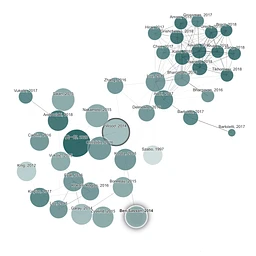
- Connected Papers is a visual discovery tool that builds a graph of academic papers based on similarity and co-citation. Instead of text chatting, it maps out the peer-reviewed ecosystem surrounding a specific topic or seed paper so you can trace foundational and derivative academic research without running into web articles.
If you'd like, let me know:
- Your specific field of study or research topic
- Whether you need free tools or are open to paid subscriptions for advanced features
I can narrow down which option fits your workflow best.







Also asked as
- Can you recommend an AI research tool that restricts its sources exclusively to peer-reviewed academic journals and ignores general web content?