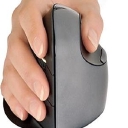
Logitech leads by a wide margin as an ergonomic mouse for improving comfort and reducing computer-use strain. For wrist pain, Logitech Lift is mentioned alongside Logitech MX Vertical.
Best For: Large to medium hands seeking a true vertical design to relieve carpal tunnel or wrist strain.
Features: A 57-degree vertical handshake angle that minimizes pressure on the wrist, alongside a rechargeable 4-month battery and a 4,000 DPI sensor.
Best For: Small- to medium-handed users, or those requiring left-handed configurations.
Features: Implements the same 57-degree handshake posture as the MX Vertical but in a more compact shell, featuring ultra-quiet clicks and a 24-month AA battery life.
Best For: Power users and multi-device productivity seekers who prefer a traditional shape over a vertical grip.
Features: Heavy thumb support, a built-in Haptic Sense Panel, dual metal scroll wheels, and multi-computer tracking via Logi Options+.
Best For: Desk workers trying to eliminate shoulder and arm movement entirely.
Features: Uses a thumb-operated trackball and features an adjustable magnetic hinge that tilts the unit between 0 and 20 degrees to customize forearm tension.
Best For: A highly affordable entry-point into vertical ergo mice.
Features: A lightweight, battery-operated design that achieves the critical handshake angle for roughly a third of the price of premium rivals.
Best For: Competitive PC gamers who need asymmetrical wrist support without sacrifice.
The best ergonomic mouse overall depends on whether you want maximum comfort for long workdays, relief from wrist strain, or a familiar mouse shape. Based on current independent testing, the Logitech MX Master 4 is the best all-around ergonomic mouse for productivity, while the Logitech Lift is my top pick if you specifically want a vertical mouse.
The best ergonomic mice to consider
(Best overall)
Logitech MX Master 4
Premium, sculpted design
Best for office work, programming, spreadsheets, and long hours at a computer. Its thumb rest, horizontal scroll wheel, and fast main scroll wheel make navigation comfortable and efficient. It's a conventional mouse shape, not a vertical one.
Shop: Logitech MX Master 4, Ergonomic Wireless Mouse with Advanced…
Best for people who want to reduce the palm-down rotation of their forearm. It's compact, has quiet clicks, and suits small-to-medium hands. Left-handed versions are also available.
A larger vertical mouse for medium-to-large hands, with adjustable cursor speed and wireless connectivity. Consider it if the Lift feels too small.
Shop: MX Vertical Wireless Ergonomic Mouse
Listed at $99.99 at Sweetwater when checked.
Which one should you buy?
Your main priority
My recommendation
Best mouse for everyday work
Logitech MX Master 4
Wrist or forearm strain
Logitech Lift
Large hands and vertical design
Logitech MX Vertical
Lower-cost ergonomic option
Logitech M720 Triathlon
Gaming plus ergonomic comfort
Pro Click V2 Vertical
These picks reflect current independent testing, including RTINGS' 2026 rankings.
One important tip: A vertical mouse may help if rotating your forearm feels uncomfortable, but it won't fix every cause of wrist pain. Desk height, a relaxed grip, and keeping your wrist relatively straight matter too.
To narrow it down to the best one for you: Are you mainly trying to relieve wrist pain, prevent discomfort during long computer sessions, or just find a more comfortable mouse?
Its 57° vertical “handshake” grip keeps your hand much closer to a neutral position than a conventional flat mouse, reducing the amount of forearm rotation. Current ergonomic roundups consistently put it near the top for wrist/forearm comfort.
For graphic design, I particularly like it because you still get:
4,000 DPI tracking for precise Photoshop/Illustrator/Figma work
Adjustable cursor speed
Programmable buttons
Bluetooth + USB receiver
Rechargeable battery
A substantial thumb rest that discourages gripping the mouse tightly
The main downside is the learning curve: precision work can feel awkward for several days when switching from a traditional mouse.
For a designer without wrist pain, I'd actually prefer the MX Master 4 for its extensive controls, scrolling and productivity features. Current design-focused comparisons put it at the top for overall graphic-design productivity.
But if preventing wrist pain is the priority, I'd choose the MX Vertical over the MX Master 4. The Master 4 is ergonomic in a conventional sculpted-mouse sense; the Vertical fundamentally changes your forearm/hand position.
One important caveat
An ergonomic mouse isn't a guarantee against wrist problems. Mouse size, grip force, desk height, keyboard position, and taking regular breaks all matter. If you already have persistent pain, numbness, tingling, or weakness, it's worth getting evaluated rather than relying solely on a new mouse.
My recommendation: Medium/large hand → MX Vertical. Small/medium hand → Lift. No pain, but want the best design workflow → MX Master 4. Significant existing RSI and ordinary vertical mice don't help → consider an adjustable-angle mouse or trackball.
If you tell me your hand size, whether you're right- or left-handed, Mac/Windows, and your main apps (Photoshop/Illustrator/Figma/etc.), I can narrow it down to the best 2–3 mice for your specific setup.
The Logitech MX Master 3S is widely considered the best overall compromise for graphic designers because it blends high-precision tracking on any surface with an ergonomic, hand-cradling shape that reduces muscle strain during long design sessions.[](https://www.reddit.com/r/graphic_design/comments/165ec88/what_mouse_do_you_use/)
If your wrist pain is severe and requires a radical change in posture, a true vertical or trackball mouse is a better option. Graphic design work requires rapid, precise movements across large monitors or drawing tablets, making extreme vertical mice a steep learning curve for vector work and masking.
Top Ergonomic Options for Graphic Designers
Mouse Model
Design Type
Best For
Price Range
Razer
Kinesis DXT2
Very compact vertical design
Interesting alternative
Evoluent VerticalMouse
People who strongly prefer a vertical grip
Excellent ergonomic concept
Logitech MX Master 3S
Contoured Ergonomic
Precision, side-scrolling, and all-day comfort
~$100
Logitech MX Ergo S Plus
Adjustable Trackball
Stationary wrist use with a 20° tilt angle
~$110
Evoluent VerticalMouse 4
Extreme Vertical (57°)
Eliminating forearm twisting and wrist pronation
~$90 - $100
Keychron M5
Lightweight Ergonomic
A gentle 47° tilt with high-DPI sensor accuracy
~$70
Breakdown of Recommendations
Logitech MX Master 3S: Sculpted for a natural right-hand grip, it features an 8,000 DPI optical sensor that tracks flawlessly on glass and glossy surfaces. The side thumb-wheel is a massive workflow booster for horizontal scrolling in timelines (Premiere, After Effects) or wide artboards (Illustrator, InDesign).[](https://www.reddit.com/r/graphic_design/comments/165ec88/what_mouse_do_you_use/)
Logitech MX Ergo S Plus: A trackball option that keeps your wrist entirely stationary, moving the cursor via thumb control instead of sliding your arm. It features an adjustable 20-degree tilt, reducing forearm strain while maintaining high precision for detailed anchor-point adjustments.
Evoluent VerticalMouse 4: This forces your hand into a neutral "handshake" position, completely stopping forearm pronation (twisting). It has adjustable optical tracking speeds, though graphic designers may find fine-tuning vector curves takes a few days to get used to on a true vertical layout.
Keychron M5: A lightweight option featuring a subtle 47-degree tilt. It reduces wrist pressure without feeling as clunky as heavy vertical alternatives, and includes a programmable thumb scroll wheel.
If you'd like to narrow this down, let me know:
Are you primarily working on Mac or Windows?
Do you prefer a stationary base (trackball) or a traditional sliding mouse?