Yes. The key is to separate “a legitimate, well-run charity” from “a charity where an additional dollar produces unusually large benefits.” Those aren't the same thing.
A practical way to choose
1. Start with the cause, not the charity.
Ask which problems are both large in scale, solvable, and relatively neglected. This is often where the biggest differences in impact arise.
2. Look for evidence of actual outcomes.
A strong charity should be able to explain:
What intervention it provides
What evidence shows that intervention works
What it costs to produce an outcome
How it measures results
What would happen without the program
Don't put too much weight on a low “overhead ratio.” Administrative spending can be necessary for an effective organization; the more important question is what outcomes the spending produces.
3. Check whether your donation is actually needed.
This is an easily overlooked issue. A fantastic charity may already have enough money for its highest-priority activities. What matters is the marginal impact of your next dollar, not the charity's average performance.
That's one reason expert-managed funds can be attractive: they can redirect donations toward the opportunities with the greatest current funding needs. Giving What We Can currently recommends this approach for many donors.
The resources I'd use
GiveWell is probably the best starting point if your primary goal is maximizing measurable benefits to human health and wellbeing. Its current recommendations emphasize evidence-backed, cost-effective programs such as malaria prevention, and its Top Charities Fund lets its researchers direct donations toward the highest-priority opportunities.
Giving What We Can is useful if you want to compare causes rather than simply choose among GiveWell charities. Its 2026 recommendations incorporate research from multiple impact-focused evaluators and include cause-specific funds.
Charity Navigator is useful for checking a charity's financial health, accountability, leadership, measurement practices, and other organizational characteristics. Its current methodology includes an Impact & Measurement component rather than focusing solely on finances.
You don't necessarily have to choose global health. For example, if climate change is your priority, I'd use a specialist evaluator rather than simply picking a large, recognizable environmental nonprofit. Founders Pledge's current climate-philanthropy research notes that some particularly high-leverage opportunities are small organizations doing time-sensitive advocacy or policy work.
A simple decision rule
If your goal is “I want my donation to do as much good as reasonably possible,” I'd use this hierarchy:
Cause → evidence → cost-effectiveness → room for more funding → transparency → organizational health
rather than:
famous charity → high rating → low overhead → donate.
And you don't need perfect certainty. Giving What We Can explicitly notes that there can be enormous uncertainty in comparing opportunities; the goal is to make a well-informed choice rather than find a mathematically perfect charity.
If you tell me roughly how much you want to donate (e.g. $100, $1,000, $10,000+) and which causes matter to you—poverty, health, climate, animals, local community, disaster relief, etc.—I can research the strongest current options and give you a short, evidence-based shortlist.
The most reliable framework and steps to maximize your donation impact include:
Consult independent impact evaluators
Instead of guessing, use rigorous evaluators that deeply research how much good a program accomplishes per dollar spent.
GiveWell : Focuses heavily on global health and poverty, identifying a short list of life-saving interventions (like malaria net distribution or vitamin A supplementation) backed by intense empirical evidence.
The Life You Can Save : Founded by philosopher Peter Singer, it offers a user-friendly list of cost-effective, evidence-backed charities.
Animal Charity Evaluators : Specializes in finding the highest-impact organizations helping animals.
Prioritize neglected and tractability criteria
Ask three core questions used by effective altruists:
Scale: How many people (or animals/acres) does this affect, and how severely?
Irrelevance / Neglectedness: Is this cause already heavily funded by governments and massive foundations, or is it starved for resources where your marginal dollar moves the needle more?
Tractability: How easily can progress and success be measured and executed in this area?
Consider direct cash transfers
Sometimes, giving money directly to people in extreme poverty via organizations like GiveDirectly lets recipients decide how to solve their own problems most effectively, bypassing top-down administrative inefficiencies altogether.
If you want to narrow this down, let me know:
What cause area you care about most (global health, climate, animal welfare, local community)?
If you prefer a hands-off vetted fund or want to research specific projects yourself?
I can give you a tailored list of top-rated organizations to look into.
The best way to find reputable charities is to start with the cause you care about, verify the organization independently, and look for evidence that your donation will make a meaningful difference.
You don't have to be an expert in nonprofit finances to make a thoughtful donation. A few independent checks can help you avoid scams, identify effective organizations, and decide where your money can do the most good.
1. Start with trusted charity evaluators
These organizations help you assess nonprofits before donating.
Charity Navigator
Rates U.S. nonprofits using factors such as financial health, accountability, transparency, and impact-related information. A good starting point for comparing organizations.
These resources serve different purposes: a high rating, financial transparency, proven impact, and tax-exempt status are related but not interchangeable.
2. Check these five things before donating
Use this quick checklist for any organization you're considering. The FTC recommends researching charities independently before giving.
Your charity screening checklist of
One important tip: Don't judge a charity solely by its overhead ratio or how much it spends on administration. Good accounting, qualified staff, and effective program delivery all cost money. Look at results and transparency together.
3. Watch for common warning signs
Pressure to donate immediately. A legitimate organization should let you take time to research.
Vague promises. Be cautious if it cannot explain how the money will be used.
Look-alike names or websites. Verify the exact organization and domain.
Unusual payment requests. Avoid donations requested through gift cards, wire transfers, or cryptocurrency by an unsolicited fundraiser.
Unclear fundraising fees. If a third-party fundraiser is involved, find out how much actually reaches the charity.
These are among the warning signs highlighted by the Federal Trade Commission.
4. Choose the right charity for your goals
The best organization depends on what you want your donation to accomplish.
Help people in your community
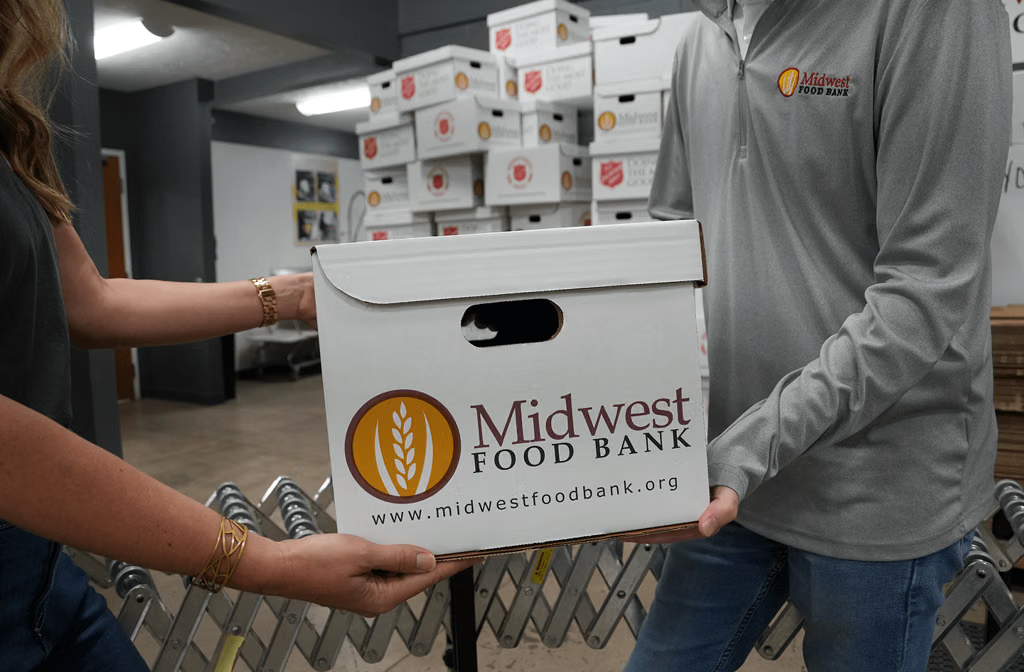
Consider food banks, homeless shelters, domestic violence services, and local community foundations. Local organizations can be a good choice if you want to see the impact close to home.
Save lives and maximize measurable impact
Explore evidence-backed global health and poverty programs through GiveWell. This is especially useful if you want to compare how much good different donations can accomplish.
Protect animals or the environment
Look for organizations with specific conservation goals, independently documented progress, and clear explanations of how their interventions work.
Respond to disasters and emergencies
Favor established relief organizations with demonstrated response capacity, transparent appeals, and clear plans for distributing funds.
5. Let's narrow it down to the best options for you
I can help you find specific charities and compare their reputations, financial transparency, and evidence of impact.
The best platforms and steps to find trustworthy organizations include:
Top Charity Evaluation Platforms
Charity Navigator : Rates thousands of U.S. nonprofits on a 0-to-4 star scale (and via a 100-point "Beacon" system), evaluating their financial health, accountability, and transparency using public IRS data.[](]()]()
GiveWell : Conducts deep, intensive cost-effectiveness research to find the absolute most impactful charities—primarily global health and poverty alleviation—where your dollar does the most good per life saved.[](https://www.givewell.org/)
High administrative-to-program spending ratios (though keep in mind that some overhead is vital for a healthy organization).
High-pressure tactics, aggressive telemarketing, or requests to pay via cash, gift cards, or wire transfer.
Vague descriptions of how your money will be used or a refusal to provide an annual report / IRS Form 990.
Names that intentionally mimic well-known, established charities to confuse donors.
If you have a specific cause or issue in mind (like disaster relief, animal welfare, or medical research), let me know and I can point you toward top-rated organizations in that specific category.