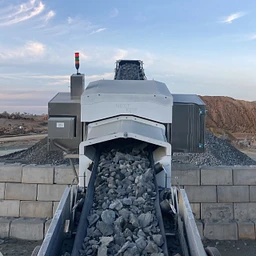
Automated ore sorting
Jul 5 – Oct 26, 2026Updated Oct 26, 2026
Reviewed by Dimitry Apollonsky
AI summary
STEINERT Global narrowly leads TOMRA OBTAIN for automated ore sorting.

Which brands AI mentions
XRT sensor sorting with AI classification for pre-concentration.
Single-particle precision sorting that segments rock clusters for accuracy.
Sensor-based sorting through its OBTAIN and CONTAIN ecosystem.
Sorting complex, inclusion-type ore to enhance valuable mineral recovery.

Mentioned in
ChatGPTChatGPTGoogle AI ModeGoogle AI Mode
Widest split: TOMRA CONTAIN, 48% on ChatGPT and 82% on Google AI Mode.
- #1tiedSTEINERT GlobalChatGPT 87%Google AI Mode 64%
- #1tiedTOMRA OBTAINChatGPT 57%Google AI Mode 86%
- #1tiedTOMRA MiningChatGPT 57%Google AI Mode 82%
- #1tiedTOMRA CONTAINChatGPT 48%Google AI Mode 82%
- #5tiedTOMRAChatGPT 48%Google AI Mode 18%
Questions and answers
Google AI ModeOct 26, 2026
When automating ore grading and sorting with artificial intelligence, the "best" technology isn’t a single standalone gadget—it is an integrated ecosystem combining high-throughput multi-sensor hardware with deep learning computer vision that can process rock characteristics in near real-time.
The industry benchmark for AI-powered ore sorting relies on a combination of specific sensor types and software platforms:
1. Leading AI Software & Sorting Architecture
- TOMRA Mining (OBTAIN™ & CONTAIN™): TOMRA stands out as a pioneer utilizing deep learning artificial neural networks trained on tens of thousands of labeled images.
- OBTAIN™ uses single-particle precision deep learning to segment rock clusters on high-speed conveyor belts, identifying and ejecting individual particles accurately even when tightly packed or overlapping.
- CONTAIN™ builds on this by classifying the final ore stream based on internal valuable mineral inclusions rather than just surface composition.
- Edge Computing + IoT Integration: Modern top-tier setups (utilized by major players like Rio Tinto and Freeport-McMoRan) rely on cloud-connected edge-computing modules that reduce sorting latency to milliseconds, allowing pneumatic ejection systems to separate waste rock from high-grade ore dynamically.
2. The Best Sensor Combinations
An effective AI grading setup relies on sensor fusion—merging data streams so the AI can evaluate both internal and external properties of the ore:
- X-ray Transmission (XRT): Measures the atomic density of the particles regardless of whether the valuable mineral is trapped inside the rock or on the surface. Essential for base metals and diamonds.
- Multispectral & Laser Optical Cameras: High-resolution optical arrays assess surface texture, shape, and color gradients, feeding visual patterns straight into the computer vision models.
- Electromagnetic & Near-Infrared (NIR) Sensors: Detect conductivity and specific molecular bonds to differentiate gangue (waste) from valuable sulphides or oxides.
To help narrow down which specific configuration fits your site, could you share:
- What type of ore are you processing (e.g., copper, gold, iron, polymetallic)?
- What is your estimated throughput requirement (tph)?
I can provide a more tailored vendor and sensor-array recommendation.
ChatGPTOct 26, 2026
Best AI-powered ore grading and sorting technology
For automating ore grading, I would recommend an AI-enabled sensor-based ore sorting system that combines real-time mineral detection, machine vision or spectroscopy, and automated ejection or diversion. The best solution depends on the ore type, the size of the material, and whether your main goal is higher grade, lower processing costs, or increased recovery.
The key distinction is between two technologies:
- Ore grading: estimating mineral grade, composition, or valuable-element content from sensor measurements.
- Ore sorting: making a physical decision to accept, reject, or divert individual rocks or streams based on those measurements.
The strongest industrial solution often integrates both, using sensors to characterize material and an automated control system to act on the results.
The technologies I would shortlist
1. TOMRA Mining XRT + AI
(Best starting point for rock-by-rock sorting)
Uses X-ray transmission (XRT) and AI to classify rocks, including complex ores with valuable minerals embedded inside waste rock. TOMRA's CONTAIN deep-learning technology targets inclusion-type ores, while OBTAIN improves individual-particle detection at high throughput.
Best for: evaluating tin, tungsten, nickel and certain other ores where internal density or X-ray signatures help distinguish valuable material.

![Sensorgestützte Sortierung in Lateinamerika
2. STEINERT KSS multisensor sorting
Best for flexible, multi-sensor classification
Its multisensor approach can combine XRT, X-ray fluorescence (XRF), optical sensors, 3D laser and electromagnetic sensing, depending on the configuration. That flexibility is valuable when no single measurement reliably distinguishes ore from waste.
Best for: complex or variable ore bodies where you need to test multiple detection methods.
3. MineSense ShovelSense
Best for real-time grade measurement during mining
Shovel-mounted XRF sensors estimate elemental composition as the bucket fills. Machine-learning models combine the sensor readings with ore-body-specific calibration, and grade information can feed into fleet-management systems to route material to the appropriate destination.
Best for: copper and other suitable base-metal operations seeking to automate dig-face grade control and truck routing rather than sort individual rocks on a conveyor.
These are different solution categories, not a definitive ranking. I would select the vendor only after testing representative samples from your ore body.
Which sensor is best for your ore?
Technology What it measures When I'd choose it XRT + deep learning X-ray attenuation and internal density-related patterns Individual-rock pre-concentration XRF Elemental composition, especially near the measured surface Grade estimation for suitable mineralization NIR / hyperspectral Light absorption and mineralogical signatures Distinguishing rock types and alteration minerals Optical vision + 3D laser Color, texture, shape and surface features Visible mineral differences, sizing and rock classification PGNAA Elemental composition using neutron-activated gamma signals Continuous, bulk-stream grade measurement Electromagnetic sensing Conductivity and magnetic/permeability-related properties Suitable conductive ores, including some nickel-bearing materials These technologies measure different physical properties; AI helps interpret the readings, but cannot make an inherently uninformative sensor reliably measure a grade it cannot distinguish. XRF, for example, is surface-sensitive, while XRT provides a different view of internal material properties.
How I would automate the process
-
Measure the ore
Feed a representative sample across a calibrated sensor, conveyor scanner or automated sampling station.
-
Estimate grade with AI
Train a model on sensor measurements paired with laboratory assays. Predict grade, classify ore types and flag uncertain measurements.
-
Make an automated decision
Apply configurable grade thresholds to route material to high-grade stockpiles, low-grade stockpiles, waste or further processing.
-
Validate and improve
Compare predictions against laboratory assays, track false rejects and valuable-metal recovery, and periodically recalibrate the model.
My implementation recommendation
Start with a pilot rather than buying a full production line immediately.
- Collect representative samples spanning the expected grade range and mineral variability.
- Compare two or three sensor configurations against laboratory assays.
- Measure grade-prediction error, throughput, recovery, waste rejection and operating cost.
- Run the selected system in shadow mode before allowing it to control material routing automatically.
For a conveyor-based sorter, include rock presentation, sensor timing, particle tracking and the air-jet or mechanical ejection system in the trial. For bulk grading, prioritize representative sampling and reliable calibration instead.
Let me narrow this down to the best system for your operation
The most important detail is which ore you are grading. The optimal sensor for copper sulfides can be quite different from one for gold, iron ore or lithium.
1. What ore or mineral are you processing?
Copper
Gold-bearing ore
Iron ore
Lithium / spodumene
Nickel
Tin or tungsten
Zinc or lead
Other / mixed ore
2. Where will the sensors operate?
Laboratory grading
Conveyor-based rock sorting
Bulk conveyor grade monitoring
Shovel / excavator during mining
3. What is your main objective?
Accurate grade prediction
Reject waste while retaining valuable ore
Both grading and sorting
Automated stockpile and truck routing
4. What is the approximate scale?
Laboratory or pilot
Small processing plant
Industrial operation
5. What is the approximate particle size?
Under 10 mm
10–50 mm
50–150 mm
Over 150 mm
Bulk stream, not individual rocks
[Recommend my system]
With those details, I can narrow the options to the most suitable sensor technology and vendors, and outline a realistic automation architecture for your process.
Sources cited in this answer12
- tomra.comTOMRA Mining launches CONTAIN with deep learning
- tomra.comTungsten West Deploys Six XRT Sorters | TOMRA
- tomra.comMining Technologies: TOMRA Cutting-Edge Solutions | TOMRA
- eigenform.aiOre Sorting Sensors and AI Sensor Fusion
- src.sk.caSensor-Based Sorting | Saskatchewan Research Council
- TOMRA Mining (OBTAIN™ & CONTAIN™): TOMRA stands out as a pioneer utilizing deep learning artificial neural networks trained on tens of thousands of labeled images.
Google AI ModeOct 16, 2026
Automating ore sorting and grading with AI-driven sensor solutions has transformed from basic optical sorting into a sophisticated, multi-sensor process powered by
deep learning and neural networks. These systems evaluate individual particles in real-time based on density, surface characteristics, atomic composition, and internal mineral inclusions.The leading AI-driven sensor technologies and platforms available for automated ore sorting and grading include:
- TOMRA Mining (OBTAIN and CONTAIN Deep Learning Suites): TOMRA utilizes advanced artificial neural networks trained on tens of thousands of varied ore samples. Their OBTAIN software uses AI to segment rock clusters for single-particle precision, while CONTAIN applies deep learning classification specifically for complex, inclusion-type ores (such as nickel, tungsten, and tin) where traditional scanners suffer from high misclassification rates. Operators can dynamically tweak grade-recovery thresholds via user interfaces to balance yield and purity.
- STEINERT KSS Multi-Sensor Sorting Systems: STEINERT combines up to four distinct sensor streams into a single platform—integrating X-Ray Transmission (XRT) for internal density, 3D laser/optical cameras for surface texture and color, and inductive sensors for metal/conductive properties. Their AI layer evaluates this combined data matrix in real-time to adjust separation criteria dynamically, which significantly reduces processing costs and extends mine life.
- Metso Particle Ore Sorting Solutions: Metso provides high-capacity, sensor-based particle sorting systems that isolate waste rock from valuable ore prior to heavy crushing and grinding circuits. By applying automated sensor detection combined with intelligent analytics, their systems require zero chemicals and minimal water, drastically lowering downstream energy consumption while raising head grades.
- ABB Digital & AI-Driven Plant Integration: Rather than standalone sorting boxes, ABB partners with major miners (such as Vale) to integrate end-to-end AI and OT/IT automation architectures. They deploy massive camera and instrument networks across processing circuits to continuously optimize hundreds of variables simultaneously, reducing tailing losses and boosting premium lump/direct-reduction ore recovery.
Key Sensor Modalities Powered by AI
- X-Ray Transmission (XRT): Measures atomic density regardless of whether the mineral is on the surface or buried inside the rock.
- Near-Infrared (NIR) & Multispectral Imaging: Maps surface mineralogy and chemical signatures at high speeds.
- Laser & 3D Profiling: Analyzes volume, shape, and spatial dimensions to assist neural networks in clustering and separating particles cleanly via compressed air jets.
If you share your target mineral or commodity (e.g., gold, base metals, iron ore, or battery metals) and your current processing bottlenecks , I can help narrow down which specific sensor combination and vendor aligns best with your production goals.
Sources cited in this answer9
- mining-technology.comAI-powered ore sorting
- youtube.comHow TOMRA Mining Uses AI & Deep Learning to Revolutionize Ore ...
- tomra.com2025-News about sensor-based sorting solutions for Mining | TOMRA
- steinertglobal.comNew e-book & livestreams: How sensor-based sorting technology makes mining profitable in line with ESG principles • STEINERT
- tomra.comTOMRA Mining launches CONTAIN with deep learning | TOMRA
- youtube.comOre sorting: Three STEINERT KSS sorting systems extend the life of mine in Mexico
ChatGPTOct 16, 2026
Top AI-driven sensor technologies for automated ore sorting and grading
AI-driven ore sorting is moving from conventional sensor thresholds toward multisensor systems that combine real-time material characterization, machine learning, and automated ejection. The goal is to identify valuable minerals or ore-bearing particles, reject waste rock before it enters energy-intensive grinding circuits, and improve consistency in ore grade.
The best technology depends on the mineralogy, particle size, ore liberation, moisture, throughput, and whether you need to sort individual rocks on a conveyor or grade material continuously in a processing plant.
1. The leading sensor technologies
1. X-ray transmission (XRT) + deep learning
(Top choice for many coarse ores)
What it measures: X-ray attenuation related to atomic density and internal structure.
Best for: Tin, tungsten, diamonds, and selected copper, nickel and sulfide ores.
AI advantage: Deep learning can distinguish valuable mineral inclusions inside individual rocks, rather than relying only on simple density thresholds.
Technology to evaluate: TOMRA Mining — COM XRT systems with CONTAIN™ deep learning and OBTAIN™ particle classification.
2. Multisensor fusion: XRT + XRF/NIR + optical
What it measures: A combination of internal density, elemental composition, spectral response, color and particle shape.
Best for: Complex ores where a single sensor cannot reliably separate valuable minerals from waste.
AI advantage: Combines different signals into a classification decision for each particle, potentially improving discrimination between ore types.
Technology to evaluate: STEINERT — KSS sensor-sorting platforms with configurable sensor combinations.
3. Real-time elemental sensing: XRF
What it measures: Elemental composition, using characteristic X-ray fluorescence.
Best for: Grade estimation and material classification when target elements can be measured reliably.
AI advantage: Machine-learning models can estimate grade from sensor readings and support ore routing or rejection decisions.
Technology to evaluate: MineSense Technologies for shovel-based and material-tracking ore characterization, alongside dedicated XRF sorting systems. Confirm the specific product's suitability for your conveyor-based sorting requirement.
4. Magnetic resonance sensing
What it measures: Magnetic resonance signatures associated with particular minerals, such as copper-bearing mineralization.
Best for: Bulk ore sorting where treating large volumes of material individually would be impractical.
AI advantage: Sensor data can inform bulk-grade estimates and decisions to divert or process material.
Technology to evaluate: NextOre — magnetic resonance-based bulk ore sorting. This is particularly worth investigating for high-throughput copper applications.
5. Hyperspectral imaging and near-infrared (NIR)
What it measures: Wavelength-dependent reflectance associated with mineral and chemical signatures.
Best for: Industrial minerals, alteration minerals and ores with diagnostic surface spectral features.
AI advantage: Spectral classification models can identify mineralogical patterns that ordinary RGB cameras miss.
Limitation: Surface contamination, moisture, coatings and grain size can affect the signal. NIR/hyperspectral systems cannot reliably identify every mineral or infer bulk grade without calibration.
6. Laser-induced breakdown spectroscopy (LIBS)
What it measures: Elemental composition from the optical emission of a laser-generated plasma.
Best for: Applications needing elemental discrimination, including some light-element targets that conventional XRF handles poorly.
AI advantage: Models can translate complex spectra into estimated elemental concentrations and material classes.
Limitation: Industrial performance depends on representative surface exposure, calibration, measurement speed and the sampling arrangement. LIBS is worth piloting where rapid elemental analysis is essential.
2. Which technologies are strongest for your application?
Technology Main strength Main consideration XRT + AI Internal structure and inclusions Density contrast and particle liberation Multisensor fusion More discriminating classification Higher integration complexity XRF Elemental grade information Measurement speed and element sensitivity Magnetic resonance Bulk sensing at high throughput Mineral-specific response and calibration NIR / hyperspectral Surface mineral identification Surface condition and mineral spectral overlap LIBS Rapid elemental analysis Surface presentation and sampling speed These technologies are not all direct substitutes. XRT is often a strong starting point for coarse particle sorting, while multisensor systems can be preferable when density alone does not separate ore from waste. Hyperspectral sensing and LIBS are especially worth testing when the distinction depends on mineralogy or elemental chemistry. The published technical literature emphasizes that sorting success depends heavily on mineral liberation, particle size and the physical contrast between ore and gangue.
3. Leading commercial solutions to shortlist
These are the providers I would include in a technical evaluation, with different roles depending on your process.
TOMRA Mining
Best initial candidate for AI-assisted, individual-rock sorting. Evaluate XRT, CONTAIN™ and OBTAIN™ against your mineralogy.
Website:
STEINERT
Best candidate for configurable multisensor sorting, combining XRT, color, 3D and inductive sensing.
Website:
NextOre
Best candidate to assess for high-throughput bulk-grade sensing, particularly copper. Its magnetic resonance analyser measures target-mineral grade through the ore bed and supports real-time diversion decisions.
Website:
4. How to implement AI-driven ore sorting successfully
I recommend a staged approach rather than selecting equipment based on sensor specifications alone.
- Characterize the ore. Collect representative samples across ore grades, lithologies, weathering conditions and waste types. Establish laboratory assays and mineralogical ground truth.
- Run comparative sensor trials. Test XRT, multisensor fusion and any mineral-specific alternatives on the same samples and particle-size fractions.
- Train and validate the classification models. Evaluate performance on independent samples, including changing ore conditions. Measure grade prediction error, false rejection of valuable ore and waste rejection.
- Integrate sensing with plant controls. Synchronize measurements with belt tracking, diverters, PLC/SCADA systems and downstream process data. Track decisions and outcomes for model monitoring.
- Verify the economics. Calculate incremental recovered metal, rejected waste, throughput, energy and water savings, operating costs and payback using actual trial data.
5. Let’s narrow this to the best technologies for your mine
The two most important details are the commodity you are sorting and whether you want to classify individual rocks or measure grade across a bulk conveyor stream.
What ore or commodity are you processing?
Copper
Gold
Iron ore
Lithium
Nickel
Tin or tungsten
Other / mixed ores
Where will the sensors operate?
Individual rocks on a conveyor
Bulk ore on a conveyor
In-line grading inside the processing plant
Truck or shovel-based grade control
Typical particle size
Below 10 mm
10–100 mm
100–300 mm
Bulk material / no individual particle sizing
Primary objective
Reject waste before grinding
Improve final ore grade
Increase metal recovery
Automate grade measurement and routing
Approximate throughput (optional)
Below 100 tonnes/hour
100–500 tonnes/hour
500–2,000 tonnes/hour
Above 2,000 tonnes/hour
Not yet determined
[Compare technologies for my application]
With those details, I can narrow the field to the most suitable two or three solutions and outline a vendor evaluation matrix covering sensor accuracy, throughput, integration requirements and expected economic value.
Sources cited in this answer13
- tomra.comCONTAIN™ Deep Learning Ore Classification | TOMRA
- tomra.comMining Technologies: TOMRA Cutting-Edge Solutions | TOMRA
- mdpi.comSensor-Based Ore Sorting Technology in Mining—Past, Present and Future
- eigenform.aiOre Sorting Sensors and AI Sensor Fusion
- grandviewresearch.comSensor-Based Ore Sorting Market Size Report, 2025-2033
- mine.nridigital.comInnovation comes to ore screening, sizing and sorting - Mine | Issue 155
Also asked as
- Our team is looking to implement an automated ore-grading system. Can you recommend top-tier AI-driven sensor technology for sorting ore?