ChurnZero and Gainsight are nearly even recommendations for churn analytics, with ChurnZero framed as a mature customer success platform and Gainsight for large-enterprise customer success operations. Vitally is also described as configurable, though its predictive score’s causal drivers need validation.
The strongest matches are Gainsight, ChurnZero, and Vitally. All three consolidate multiple customer signals into account-health scores that can help explain why an account is at risk. The key distinction is whether you want transparent, rules-based scoring, AI-assisted risk detection, or a broader customer-success platform.
For your specific requirement — combining product usage, billing, support, and account engagement into explainable churn-risk scores — I would shortlist the following platforms.
Top platforms to evaluate
1. Gainsight
(Strongest enterprise fit)
Gainsight's customer health scorecards bring together product and service usage, contract information, support activity, billing history, survey responses, and engagement data. Its factor-based scorecards are a good fit when teams need to understand which inputs are driving account risk.
Best for: Enterprise SaaS, complex renewals, and customer-success operations that need auditable health models.
Website:
2. ChurnZero
(Strong churn-risk focus)
ChurnZero's ChurnScores can use product usage, engagement, support-ticket volume and severity, satisfaction, account attributes, and journey progression. Teams choose the metrics that feed the score and can trigger alerts when health changes.
Best for: SaaS teams wanting actionable risk scoring, early-warning alerts, and automated retention workflows.
Website:
3. Vitally
Vitally offers a particularly clear approach to explainability through configurable health-score rules, weights, thresholds, and previews. It can combine product events, engagement, support signals, customer traits, and custom metrics. Its integrations include billing systems such as Stripe, Chargebee, and Recurly, alongside support tools such as Zendesk and Intercom.
Best for: Mid-market SaaS and product-led businesses that want flexible scoring without extensive custom development.
Website:
4. Planhat
Planhat's Health Lab supports configurable, multi-factor health scores, with adjustable weights and thresholds by segment, portfolio, or product line. It can bring together product telemetry, support interactions, relationship sentiment, and billing data through integrations or custom data pipelines.
Best for: Teams needing flexible account-level scoring across complex customer portfolios and data sources.
Website:
5. Totango
Totango provides configurable health profiles and usage metrics, including engagement scores, active users, usage frequency, and license utilization. These can support account-health analysis and segmentation. Verify how your required billing and support data would be incorporated into the particular scoring model.
Best for: Teams seeking structured customer-success programs and usage-based health monitoring.
Website:
Comparison at a glance
Platform
Product usage
Support signals
Billing data
Explainable scoring
Gainsight
Yes
Yes
Yes, through customer data
Factor-based scorecards
ChurnZero
Yes
Yes
Validate specific data feeds
Custom metric-based scores
Vitally
Yes
Yes
Stripe, Chargebee, Recurly integrations
Rules, weights, thresholds
Planhat
Yes
Yes
Custom pipelines/integrations
Configurable factors and weights
Totango
Yes
Yes
Validate integrations and model
Configurable health profiles
Based on publicly documented capabilities; this is not a hands-on product test. Billing integration alone does not guarantee that billing signals are included in the risk score.
What I would choose
For the most transparent, auditable scoring: Start with Gainsight or Vitally.
For churn prevention and automated intervention: Start with ChurnZero.
For a highly configurable, cross-system data model: Start with Planhat.
One important distinction: a customer health score is not necessarily a statistically calibrated probability of churn. If you need a score such as “73% likelihood of churn in the next 90 days,” ask whether the vendor can produce a calibrated predictive probability validated against your historical churn outcomes, rather than just a weighted health score.
Five questions to ask during vendor demos
Can you show the contribution of each input to an individual account's risk score?
Can we include product adoption, invoice/payment status, support-ticket severity, and stakeholder engagement in the same model?
Can we see how the score changed over time and what caused each change?
Can we tune weights by customer segment and test the impact before deploying changes?
Can we validate predictions against actual churn, renewal, and contraction outcomes?
My recommendation: Put Gainsight, ChurnZero, and Vitally in your first-round evaluation, with Planhat as a strong alternative. Make a live demonstration of a single account's explainable risk score — including billing data — a requirement for selection.
Platforms that blend product usage, billing/subscription data , and account engagement into transparent, explainable risk scores typically fall into the category of AI-native Customer Success (CS) and revenue intelligence platforms . Older legacy tools require manual threshold weighting (black-box or rigid rule-based sums), but modern platforms use machine learning to surface the specific "why" behind a score.[](https://www.customerscore.io/churn-prediction-software)
The primary platforms built around this specific multi-signal, explainable approach include:
Vitally — A modern Customer Success platform that heavily emphasizes deep data integration, connecting product usage (Segment, Mixpanel), billing data, and collaborative customer interactions into a unified 360-degree view with robust, customizable, and transparent health/risk scoring frameworks.
If you'd like to narrow this down, please let me know:
What billing provider (e.g., Stripe, Chargebee) and product analytics tool (e.g., Mixpanel, PostHog) you use.
Whether you prefer an AI-driven explanation engine or a custom rule-based builder that your team manually configures.
I can recommend which platform integrates smoothest into your current stack.
For your requirements, I’d prioritize churn prediction software that combines usage-based billing data, product engagement signals, and explainable customer-level risk scores. The key distinction is whether a platform shows exactly why an account is at risk, rather than just assigning a health score.
Here are the strongest candidates I found, based on their published capabilities.
Best-fit software options
1. North Metric
(Best for billing-first transparency)
North Metric starts with Stripe billing events and adds product usage through PostHog, Segment, or its SDK. Its weighted-signal scoring shows the reasons behind each risk score and the monthly recurring revenue at risk.
Why it fits: Transparent scoring, billing changes, failed payments, downgrades, and usage decline.
Watch out: Confirm whether it ingests your specific metered-usage or consumption records, rather than just subscription and payment events.
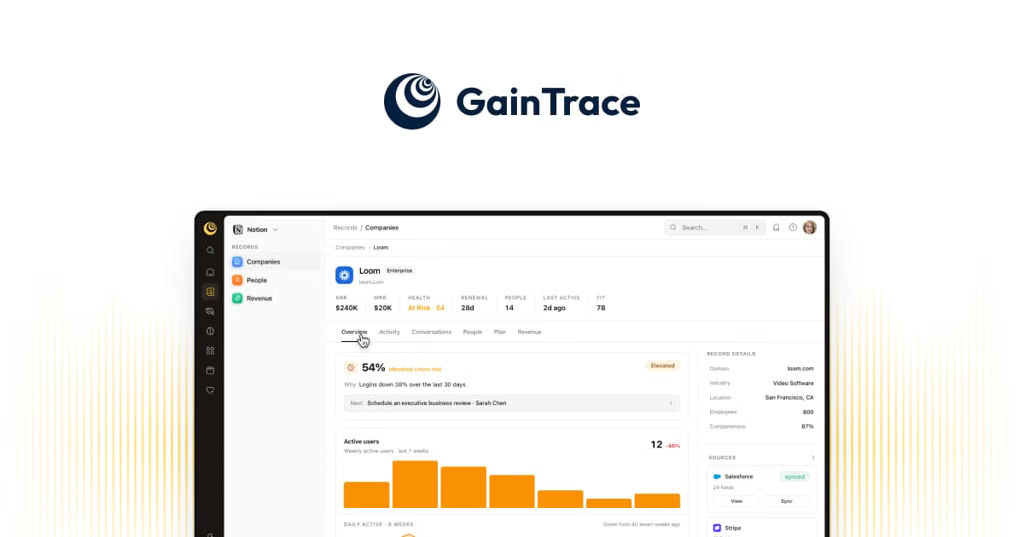
Combines billing, product usage, CRM engagement, and support interactions. Its published feature set includes explainable predictions, account-level risk drivers, and alerts when health scores fall.
Why it fits: A unified customer view that connects behavioral and commercial signals.
Watch out: Verify support for your billing provider's detailed usage and invoice-line data, plus how the prediction is calculated.
Offers a 1–5 churn-risk score with up to three risk drivers and mitigating factors. It considers engagement trends against customer-specific baselines, billing changes, adoption, support, and relationship signals.
Why it fits: A clear explanation of risk, including declining engagement and billing changes, rather than a score alone.
Watch out: Confirm native integration with your usage-billing system and whether the underlying score weights are configurable.
Designed for early-stage B2B SaaS teams, Pevolo combines Stripe billing, product usage, CRM, support, email, and conversation signals into prioritized action lists.
Why it fits: Brings billing and engagement together without requiring a dedicated data team.
Watch out: Its public materials emphasize a ranked signal engine; verify whether it provides a numerical, auditable risk score with visible factor contributions.
The biggest potential gap is usage-based billing versus ordinary subscription billing. A tool that tracks failed payments and downgrades may not track declining API calls, compute consumption, event volume, or quota utilization.
Ask each vendor:
Billing ingestion: Can you ingest metered consumption, invoice line items, credits, overages, and changes in customer spend from our billing platform?
Explainability: Can we see each risk factor's contribution to the final score, inspect its source data, and configure or challenge the scoring logic?
Validation: Can we backtest scores against historical churn and measure how early the model identifies at-risk accounts?
My recommendation: Start with North Metric if you use Stripe and want a transparent, billing-led approach. Evaluate GainTrace if you need a broader view of customer engagement across multiple systems. Treat both as candidates to validate, not confirmed fits for every usage-based billing workflow.
One question that would help me narrow this down: Which billing platform do you use — Stripe, Chargebee, Orb, Metronome, or something else?