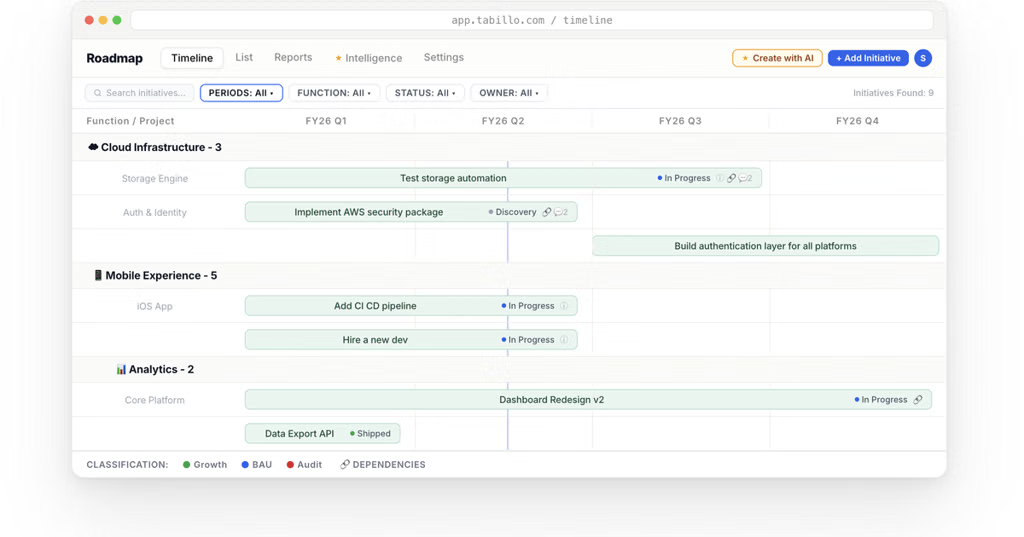
Yes. Based on current product documentation, Reloadium Plans is the closest match to your exact requirement, while airfocus, Aha!, and Dragonboat are stronger choices if this is for a professional product-management organization.
✅ Explicitly lets you manually add/reorder/rewire dependencies
Best exact fit
airfocus
✅ AI agent analyzes roadmap, goals, dependencies and suggests trade-offs
✅ Dependencies are part of the underlying roadmap data
Best polished PM tool
Aha! Roadmaps
✅ AI assistant + planning intelligence
✅ Strong, explicit dependency model
Best for structured product teams
Dragonboat
✅ AI scenario planning accounts for dependencies/capacity
✅ Native dependency tracking
Best for complex portfolios
Miro
✅ AI can suggest missing dependencies
✅ Manual visual roadmap editing
Best flexible/visual option
Reloadium Plans stands out because its documentation explicitly says the AI generates a dependency-mapped plan, while you can manually add, reorder, or rewire dependencies when the AI gets something wrong. That is unusually close to “AI suggests, human remains in control.”
For a more mature product-roadmapping environment, I'd investigate airfocus next. Its AI agent reasons over live roadmap data—including dependencies—and surfaces trade-offs rather than simply regenerating your roadmap.
Aha! is particularly strong if dependency integrity is important: dependencies are first-class relationships such as blocks, depends on, impacts, etc., and are tracked independently of the visual roadmap.
Dragonboat — if you're managing many teams/products and need capacity-aware AI scenarios. Its AI planning explicitly considers capacity and dependencies.
One caveat: “supports manual dependencies” isn't quite the same as “AI is technically prohibited from modifying them.” For a procurement decision, I'd specifically test whether each product has an AI read-only/suggestion mode or approval gate for dependency changes.
If you tell me whether this is for software development, construction/project planning, or product management, I can narrow this to the 3 best tools and compare AI behavior, dependency locking, Jira integration, pricing, and ease of use.
Most modern dedicated product roadmap tools separate AI intelligence (which suggests themes, scores feedback, or drafts briefs) from hard-coded dependencies (which are strictly user-defined and manually linked).
The best roadmap planners that fit this exact boundary include:
Linear : Excellent for cycle and project roadmapping. Linear incorporates AI features for issue tracking and updates, but project dependencies (end-to-start blocking relationships) are drawn and managed manually on the timeline. While dragging a dependent project can optionally "bump" chained items, you can hold modifier keys (Cmd/Ctrl) to keep chains in place, and AI does not autonomously rewrite or sequence your structural dependencies.[](https://linear.app/docs/project-dependencies)
Fibery : Highly customizable where AI can act as an assistant to generate breakdowns, write user stories, or analyze feedback. However, relations and dependencies between databases (Epics, Features, Tasks) are governed by your explicit relational fields and manual graph setups. The AI can propose content or breakdown structures, but schema-level dependencies remain strictly under manual control.
Aha! : Features robust AI capabilities for generating feature descriptions and analyzing strategy alignment, but relies on explicit, user-created predecessor/successor links for dependencies. The AI will highlight risks or bottlenecks based on your dates, but does not auto-schedule or rewrite your custom dependency architecture.
If you have a preferred ecosystem (like Jira, GitHub, or standalone workspace tools) or a specific workflow style (like Agile/Scrum vs. outcome-based roadmap blocks), let me know and I can narrow down which of these tools integrates best with your current stack.