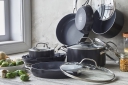
Pick GreenPan Valencia Pro for a PFOA-free, diamond-reinforced ceramic pan that aims for long-lasting non-stick performance and scratch resistance. If you need heavy searing or frequent metal-utensil use, a hybrid like HexClad is the more durable tradeoff.
If your priorities are durability, high-quality construction, and a PFOA-free coating, I’d look mainly at ceramic nonstick pans (usually marketed as PFAS-free/PFOA-free). A note: no coated nonstick pan truly lasts forever—the coating is a wear item—but a well-made pan with gentle care can give you several years of service.
Here are some strong options:
GreenPan Valencia Pro Ceramic Nonstick Fry Pan - $99.99 (Nordstrom)
OXO Ceramic Professional Non-Stick Frypan - $89.99 (Tarzian West for Housewares)
All-Clad NS Pro Ceramic Nonstick Covered Fry Pan - $119.95 (Williams-Sonoma)
ZWILLING Clad CFX Ceramic Nonstick Frying Pan - $99.99 (The Home Depot)
For a durable, high-quality, PFOA-free (and PFAS-free) frying pan that outlasts traditional cheap non-stick options, the top industry and tester consensus points to the GreenPan Valencia Pro.[1]
Top Recommendation: GreenPan Valencia Pro Ceramic Non-Stick Frypan
The Coating: Features a diamond-infused ceramic non-stick coating that is 100% free of PFOA, PFAS, lead, and cadmium. Ceramic handles high heat better than traditional Teflon and won't blister or release toxic fumes if accidentally overheated.[1]
The Build: Crafted from hard-anodized aluminum, making it twice as strong as standard aluminum, highly scratch-resistant, and resistant to warping.[1]
It features a Magneto induction base for even heat distribution on any stovetop (including induction) and is oven-safe up to an impressive 600°F.[1]
If PFOA-free and long service life are your priorities, I’d favor a high-quality ceramic nonstick pan rather than conventional PTFE nonstick. One caveat: even excellent ceramic coatings eventually wear; “last for years” is realistic, but no coated nonstick pan is truly a lifetime pan.
GreenPan Valencia Pro 12-inch Ceramic Nonstick Frying Pan - $99.99 (Wayfair)
For your requirements, I’d choose the GreenPan Valencia Pro 12-inch. It hits the best balance of durability, genuinely good nonstick performance, and no PFOA/PFAS/PTFE.
Hard-anodized aluminum body: tougher and more resistant to warping/scratching than basic aluminum.
Ceramic nonstick coating: made without PFAS/PTFE, so it goes beyond merely being “PFOA-free.”
If your priorities are durability + genuinely PFOA/PFAS-free coating + good everyday nonstick performance, my top pick is the GreenPan Valencia Pro 12".
When looking for a non-stick frying pan that actually lasts for years—rather than wearing out in 12 to 18 months—the secret is choosing either heavy-duty hard-anodized aluminum with reinforced multi-layer coatings, high-end commercial-grade titanium/ceramic, or a specialized coating-free design.[1]
Top recommendations for a durable, PFOA-free frying pan that stands the test of time include:
Sources AI cites
0% of citations to these sources link to brands' own websites.
Replace it when the coating is visibly damaged or food starts consistently sticking.
If you want the absolute longest-lasting pan, even if it is not a traditional coated nonstick, a well-seasoned carbon steel or cast iron skillet can outlast ceramic nonstick by many years—but it requires more maintenance.
Expert Consensus: Extensively praised by testing publications like America’s Test Kitchen as a top-performing and remarkably durable ceramic skillet.[1]
Where to buy: You can check pricing and availability on marketplace listings like Kitchen Kaboodle or major home goods retailers.[1]
Alternative Option (No-Coating Longevity): Our Place Titanium Always Pan Pro
The Build: If you want a pan that skips traditional coatings entirely, this tri-ply fully-clad pan features a textured titanium interior.
Durability: Because it has no chemical coating to scratch off, it is entirely metal-utensil safe, virtually indestructible, and handles heat up to 1,000°F.
Would you like to share what size pan you are looking for (e.g., 8-inch, 10-inch, 12-inch) or your primary stove type (gas vs. induction) so I can narrow down the best dimensions for your cooking style?
GreenPan Valencia Pro 10-inch - $101.99 (Wayfair)
My pick: GreenPan Valencia Pro 10"
Ceramic nonstick: made without PFAS/PFOA/PTFE.
Hard-anodized aluminum body: more substantial and resistant to warping than inexpensive ceramic pans.
Induction compatible and oven-safe to about 600°F according to current testing information.
Independent long-term testing has found the Valencia Pro to be a particularly strong ceramic performer; America's Test Kitchen's 2026 testing also found the Valencia Pro among the few ceramic pans that passed its nonstick-coating durability test.
Current retail pricing is roughly $100 for the 10-inch version.
The Circulon Halo with LaserDefense is interesting if you tend to be hard on cookware. Its ceramic surface uses a protective laser-etched structure designed to resist scratching, chipping and abrasion, and it's marketed as PFAS-free. Current price is about $70.
If you want something that can genuinely last decades
Consider a carbon-steel pan instead of coated nonstick. The
is a coating-free carbon-steel pan that develops its nonstick properties through seasoning. It requires more technique and maintenance than ceramic, but there's no nonstick coating to wear away, so the pan itself can last essentially indefinitely.
Bottom line: For effortless nonstick cooking, I'd buy the GreenPan Valencia Pro 10". For maximum longevity, choose carbon steel and accept a little more maintenance. Also, whichever ceramic pan you choose, use low-to-medium heat, avoid aerosol cooking sprays, and hand-wash when practical—those habits substantially extend coating life.
The Our Place Titanium Always Pan Pro is the top recommendation for a durable, PFOA-free, and long-lasting non-stick frying pan, featuring an innovative coating-free titanium interior that is completely free of toxic chemicals and built to last a lifetime.[1]
Watch this overview of top non-toxic and alternative non-stick options to see how modern coating-free and ceramic pans perform side-by-side:
Naturally slick, uncoated forever surface that handles high heat up to 900°F.
Why Traditional Non-Stick Fails (and What to Buy Instead)
The Problem with Traditional Teflon: Classic non-stick coatings degrade, scratch easily, and break down within 2 to 5 years, releasing fumes or flaking off into food if overheated.
Coating-Free Alternatives: Pans like the Our Place Titanium Pro or Misen Carbon Steel rely on physical surface engineering or hardening (nitriding/texturing) rather than a spray-on chemical layer, meaning no peeling or flaking ever.[1][2]
Advanced Ceramic Options: High-end ceramic pans like GreenPan’s diamond-reinforced Thermolon layer provide smooth release without PFAS, PFOA, lead, or cadmium, outlasting budget ceramic options by years.[1]
If you can share your preferred cooking style (e.g., sliding morning eggs versus high-heat searing for meats) and your stovetop type (gas vs. induction), I can narrow down which of these specific options fits your kitchen best.
For a durable, high-quality PFOA-free non-stick frying pan that can last for years, I’d look for a heavy-gauge body, a reputable coating, and a company with strong construction standards. One important note: no coated non-stick pan lasts forever—the coating eventually wears—but premium pans can give you many years of good performance if cared for properly.
Best overall pick: Made In CeramiClad Non Stick Frying Pan (10–12 inch)
Made In Cookware CeramiClad Non Stick Frying Pan - Price not available (Go to merchant)
Why I recommend it:
PFOA-free ceramic non-stick surface
Heavy-duty multi-layer construction for better heat retention and less warping
Excellent for eggs, fish, pancakes, and everyday cooking
Induction compatible
More substantial than many lightweight ceramic pans
Best for: Someone who wants a premium pan and expects to use it frequently.
Best classic non-stick durability: All-Clad HA1 Hard Anodized Nonstick Fry Pan
All-Clad D3 Pro 10-Inch Nonstick Fry Pan - $169.99 (Nordstrom)
Why it’s a strong choice:
Hard-anodized aluminum construction resists warping
Excellent heat distribution
PFOA-free modern non-stick coating
Very consistent everyday performance
Best for: Maximum slickness and easy cooking (especially eggs).
Best PFAS/PTFE-free option: GreenPan Valencia Pro Ceramic Nonstick Frypan
If you want a non-stick pan that truly lasts for years instead of ending up in a landfill after 18 months, traditional PTFE-coated pans usually won't cut it. Instead, look toward high-end ceramic, hybrid steel, or coating-free options.
Top recommendations for a durable, PFOA-free (and PFAS-free) frying pan include:
Add to list
Why it lasts: It features a hard-anodized aluminum body reinforced with a diamond-infused Thermolon ceramic non-stick coating.
Highlights: Highly praised by reviewers (including America's Test Kitchen ), it handles higher heat better than cheap ceramic pans, is metal-utensil safe, and offers effortless food release.
Check out details: View options on the GreenPan Valencia Pro Ceramic Frypan Overview.[1]
Add to list
Why it lasts: It bypasses traditional chemical coatings entirely, using a tri-ply stainless steel and aluminum construction with a textured, hydrophobic titanium interior that is 300% harder than stainless steel.
Highlights: Because there is no chemical layer to scratch or peel off, it delivers non-stick cooking with the longevity of a "forever" metal pan and handles extreme oven heat up to 750°F.
Check out details: Explore the product page at Our Place Titanium Always Pan Pro.[1]
Add to list
Why it lasts: This is a nitrided carbon steel pan that operates completely coating-free. It is hardened in a nitrogen-rich oven to resist rust, warping, and wear.
Highlights: It acts like a cast iron or carbon steel skillet—meaning it has zero chemicals to flake off, gets naturally slicker the more you use it, and is completely metal-utensil and high-heat safe (900°F).
What stovetop type do you use (gas, electric, induction)?
Do you prefer low-maintenance wiping/dishwashing or are you comfortable with a pan that requires seasoning like carbon steel?
Excellent cooking performance: independent testing found very good food release, including eggs and pancakes.
Induction compatible and oven-safe to about 600°F.
12-inch size: large enough for family-size meals without being unwieldy.
Current shopping results put it around $100, though prices vary.
One important caveat
If by “last for years” you mean the nonstick coating itself should remain slick for 5–10+ years, no coated nonstick pan is a particularly safe bet. Even high-quality ceramic coatings eventually lose some of their release properties; Bon Appétit specifically notes that the Valencia Pro's coating will wear down after a few years.
If you want the longest possible lifespan while retaining a nonstick-like surface, I'd actually consider a carbon-steel pan. It has no synthetic coating and can last decades, becoming increasingly nonstick as its seasoning develops.
If you want something even more heavy-duty
Made In CeramiClad 12-inch Fry Pan - $159.00 (Wayfair)
The Made In CeramiClad is the premium alternative. Its 5-ply stainless-clad construction is substantially more substantial than a typical aluminum ceramic pan, while its ceramic cooking surface avoids PTFE/PFOA. It's about $159 currently.
Bottom line: I'd buy the GreenPan Valencia Pro for the best overall combination. Use silicone/wood utensils, avoid high heat when you don't need it, and hand-wash it; those habits will give the ceramic coating its best chance of lasting.
The [GreenPan Valencia Pro Ceramic Non-Stick Frypan ](https://www.thejoyfulgourmet.com/product/fry-pan-valencia-pro-12/) is a top-performing, highly durable, PFOA- and PFAS-free non-stick pan built with a tough hard-anodized aluminum body and a diamond-infused ceramic coating.[1]
Top Recommendation
Add to list Crafted from hard anodized aluminum for maximum strength and scratch resistance, featuring a healthy diamond-reinforced ceramic nonstick surface that is completely free of PFOA, PFAS, lead, and cadmium [. It is metal-utensil safe, oven-safe up to 600°F (without lid), and works on all stovetops including induction. It is widely recognized by expert testing groups like America's Test Kitchen for maintaining its slick release surface longer than typical ceramic pans.[2]
Alternative Quality Choices
Add to list Combines a warp-resistant tri-ply stainless steel core with a multi-layer PFOA-free traditional non-stick coating. It delivers exceptional heat distribution and searing power, oven-safe up to 500°F.
Add to list Features a heavy-duty, scratch-resistant hard-anodized body with a diamond-reinforced, toxin-free ceramic coating that offers easy food release and comfortable cleanup at a more accessible price point.
Tips for Longevity
No non-stick pan lasts forever if abused, but you can maximize its lifespan by:
Cooking on low to medium heat (high heat degrades non-stick coatings faster).
Hand-washing with a soft sponge instead of using harsh automatic dishwashers.
Avoiding cooking sprays containing aerosol propellants, which leave a stubborn burnt residue layer.
Would you prefer a ceramic coating like the GreenPan or a traditional multi-layer non-stick like the All-Clad, and what size pan do you need?
GreenPan Valencia Pro 12" Frying Pan - $99.99 (Wayfair)
Why I’d buy it
PFAS- and PFOA-free ceramic nonstick — so you avoid the conventional PTFE/PFOA-type coating.
Hard-anodized aluminum body gives it substantially better scratch resistance and rigidity than inexpensive ceramic pans.
It heats quickly and evenly, and independent testing from Bon Appétit and The Kitchn ranks the Valencia Pro among the best nonstick pans.
Induction compatible and oven-safe to 600°F.
GreenPan currently offers a limited lifetime warranty against manufacturing defects.
One important caveat: no coated nonstick pan is realistically a "forever pan." Even premium ceramic coatings gradually lose their slipperiness over several years. Bon Appétit's long-term testing makes this point explicitly.
If maximum longevity matters more than traditional nonstick
I'd actually consider a carbon-steel pan instead. It has no nonstick coating at all, can develop a naturally nonstick seasoned surface, and can last decades with proper care.
Misen 12" Deeper Carbon Nonstick Frying Pan - $139.00 (Misen)
It's more work initially—you need to maintain the seasoning—but it's the better choice if by "last for years" you mean 10+ years rather than replacing the coating eventually.
My verdict: For easy, low-maintenance cooking, get the GreenPan Valencia Pro 12". For a true long-term heirloom pan, get carbon steel.
Widely considered the gold standard for long-lasting non-stick. Scanpan uses a patented ceramic-titanium squeeze-cast aluminum technology with a Stratanium+ surface that is completely PFOA and PFOS-free. Unlike traditional spray-on non-stick pans, the coating is integrated into the pan body, making it remarkably resistant to peeling, metal utensil safe (with gentle care), and capable of legitimate browning and searing.
Built with heavy-gauge hard-anodized aluminum (which is twice as hard as stainless steel) and finished with three layers of PFOA-free non-stick coating. It resists warping, handles higher heat than standard non-stick, and retains the solid, premium construction feel All-Clad is famous for.
If you prefer a traditional smooth ceramic non-stick rather than traditional PTFE-based coatings, GreenPan’s Valencia Pro line stands out. It features a hard-anodized body paired with a diamond-infused ceramic non-stick coating that is completely free of PFOA, PFAS, lead, and cadmium. It offers great heat conduction and holds up well to daily, moderate-heat cooking.
Tips to Make Any Non-Stick Pan Last for Years:
Never use high heat: Non-stick coatings break down rapidly when exposed to high stovetop heat. Use low-to-medium heat; the pan's thermal efficiency means you rarely need to turn it up high.
Skip the cooking spray (Aerosol cans): Commercial cooking sprays contain propellants (like lecithin) that burn onto the non-stick surface at low temperatures, leaving an invisible, sticky carbon film that ruins the release properties. Use a little butter or high-smoke-point oil instead.
Hand wash only: Even if a pan claims to be dishwasher safe, harsh dishwasher detergents and high heat will degrade the non-stick surface prematurely over time.
If you'd like to narrow this down, let me know:
Your stovetop type (gas, electric, or induction)
Your budget range
Whether you prefer traditional non-stick or ceramic
I can give you a specific sizing and buying recommendation.