Can You Recycle Nonstick Pans? Disposal Guide – Sensarte Cookwarehttps://www.sensarte.com/blogs/all/can-you-recycle-nonstick-pans-a-guide-to-sustainable-kitchenware-5
2%
How To Recycle Your Old Cookware - Earth911https://earth911.com/home-garden/how-to-recycle-your-old-cookware/
2%
The Best Nonstick Pans, After Years of Testing (2026) | Bon Appétithttps://www.bonappetit.com/story/best-nonstick-pans
2%
Our Place Recycling Program | Sustainabilityhttps://fromourplace.com/pages/recycle
1%
Want to Recycle Non Stick Cookware? Here Are Your Options | Made In - Made Inhttps://madeincookware.com/blogs/can-you-recycle-nonstick-cookware
1%
It's Time to Give Up on the Nonstick Pan as We Know Ithttps://www.nytimes.com/wirecutter/reviews/give-up-on-ceramic-nonstick-pans/
1%
Ceramic vs PTFE Nonstick: Which Is Safer and Which Lasts Longer? - Top Cookware Brandshttps://topcookwarebrands.com/comparisons/ceramic-vs-ptfe-nonstick/
1%
How Often Should I Replace My Nonstick Pan?https://www.americastestkitchen.com/articles/5117-how-often-should-i-replace-my-nonstick-pan
1%
Best Nonstick Frying Pans - Consumer Reportshttps://www.consumerreports.org/home-garden/cookware/best-nonstick-frying-pans-from-consumer-reports-tests-a1041724599/
1%
Least Durable Nonstick Frying Pans and What to Buy Instead - Consumer Reportshttps://www.consumerreports.org/home-garden/cookware/least-durable-nonstick-frying-pans-what-to-buy-instead-a4466494459/
1%
Question: Which ceramic or alternative nonstick pans retain food release after long-term use and offer replaceable or recyclable components?
Yes—but there’s an important distinction: ceramic coatings generally do not remain nonstick indefinitely. Even the better ones eventually lose release, so the most sustainable choice is either a ceramic pan with a good recycling program or a pan whose cooking surface can be renewed rather than replaced.
Best matches
Pan/type
Long-term food release
Replaceable/recyclable aspect
My take
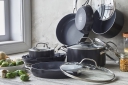
GreenPan Valencia Pro / Reserve Pro
Very good for ceramic; Valencia Pro passed demanding durability testing, and newer Thermolon 9G/9G Max coatings are designed for longer life.
Finding a pan that checks all of these boxes requires understanding a fundamental trade-off in the cookware industry: , typically degrading within 1 1 1 to 3 3 3 years.
Question: Which ceramic or alternative nonstick pans retain food release after long-term use and offer replaceable or recyclable components?
Finding a pan that balances long-term ceramic/alternative nonstick durability with is a major challenge in the cookware industry. naturally degrade over time (typically lasting 1 to 3 years depending on care), and most pans are manufactured with riveted, permanent handles that make recycling or component swapping difficult.
Question: Which ceramic or alternative nonstick pans retain food release after long-term use and offer replaceable or recyclable components?
Excellent recycling option — GreenPan accepts old cookware through its recycling program; its aluminum vessels are at least 65% recycled aluminum.
Best ceramic/ecological combination
GreenPan GP5 / newer 9G stainless-bodied lines
Very good; the GP5 uses a more substantial 5-ply stainless body and Infinite8 ceramic coating.
GreenPan recycling program; substantial metal body is preferable to disposable lightweight construction.
Good if you want a heavier, more durable pan
Circulon Halo LaserDefense
Promising newer ceramic technology designed around resistance to scratching/chipping; current independent long-term evidence is less extensive than for established models.
Aluminum construction, but I don't find an equivalent manufacturer-run take-back program as strong as GreenPan's.
Interesting newer option, but less proven
BergHOFF DiNA Helix / Leo Stone+
Multi-layer ceramic coating; reasonable release, though I found less convincing long-term independent testing.
Made from recycled aluminum, which is a meaningful advantage.
Good if recycled material matters more than take-back
Carbon steel
Improves with age/seasoning, rather than gradually losing a synthetic coating.
Entirely metal and potentially usable for decades; surface can be stripped and re-seasoned.
Best true long-life alternative to coated nonstick
The key finding
If your priority is specifically “still releases eggs after years” + “I don't want to throw away the whole pan when something wears out,” I'd actually look beyond ceramic.
A ceramic coating is fundamentally a wear item. Even a very good one eventually loses its low-friction characteristics. Bon Appétit's 2026 testing notes that its GreenPan Valencia Pro remained useful but that ceramic coatings eventually wear down; Consumer Reports likewise finds substantial variation in nonstick durability.
Carbon steel is different: the nonstick-like surface is created by seasoning. When it deteriorates, you can strip and reseason it rather than replacing a coated cooking surface. It won't initially be as effortless as a new ceramic pan, but properly maintained carbon steel can retain excellent egg/pancake release for many years.
If you specifically want ceramic
I'd narrow it to GreenPan Valencia Pro or the newer Reserve Pro/9G lines. The Valencia Pro has unusually good independent durability evidence: America's Test Kitchen found it among the few ceramic pans that remained nonstick through its coating-durability testing.
And GreenPan has an unusually concrete sustainability advantage: it will take back old cookware for recycling for $20, rather than leaving you to figure out how to recycle a coated pan locally.
GreenPan Valencia Pro Healthy Ceramic Nonstick - $70.99 (Wayfair)
One caveat: GreenPan's claim that newer coatings are “10X longer lasting” is a manufacturer comparison with its original coating, not evidence that the coating will last ten years in ordinary home use.
What I would avoid for your particular goal
I'd be cautious about buying a premium ceramic pan merely because it advertises “10-year” or “lifetime” durability. The pan body can last decades while the ceramic surface doesn't. A lifetime warranty also commonly covers manufacturing defects rather than ordinary loss of nonstick performance.
If you tell me your budget (e.g. <$75, $75–150, $150+) and whether you cook mostly eggs/fish/pancakes or general sautéing, I can narrow this to 3 specific pans that have the best combination of long-term release, repair/recycling, and low environmental waste.
Redchef
Most ceramic-coated and sol-gel nonstick pans do not maintain long-term food release over years of heavy use, and very few feature truly replaceable or modular components . Ceramic coatings naturally degrade, micro-scratch, and lose their slickness faster than traditional PTFE, typically lasting 1 to 3 years. Furthermore, bonded metal-and-coating pans are difficult to recycle locally because the coating must be stripped from the core aluminum or stainless steel first.
If you are looking for the closest alternatives that balance longevity, eco-materials, or modular designs, consider the following categories and options:
Cast Iron and Carbon Steel : These are the ultimate "alternative nonstick" choices for long-term use. When seasoned properly, they develop a natural, polymerized patina that matches nonstick performance and lasts for generations. They are 100% infinitely recyclable and have zero chemical coatings to peel or lose release properties.
Stainless Steel with Proper Technique : High-quality multi-clad stainless steel doesn't have a nonstick coating to fail. While it requires preheating and fat management for food release, a well-maintained stainless pan lasts indefinitely and is 100% metal-recyclable.
Modular/Recycled Aluminum Brands (e.g., BRA Cookware Life or GreenPan collections) : Some eco-focused lines use recycled cast aluminum bodies to reduce the initial footprint. While the ceramic nonstick surfaces still wear out over time, brands utilizing GreenPan or similar PFAS-free initiatives prioritize cleaner material recovery at end-of-life, though component-level replacement (like swappable handles) remains rare outside of general camping or space-saving sets like Redchef Detachable Sets.[2]
If you'd like to explore this further, let me know:
Are you open to traditional seasoned cast iron or carbon steel as a lifelong replacement for coated nonstick?
Do you prefer a pan that is lightweight or does weight not matter?
If your priorities are (1) food release that remains useful for years and (2) minimizing waste through replaceable/recyclable parts, there’s an important tradeoff: ceramic nonstick is not usually the most durable category. Even better ceramic formulations eventually lose slipperiness; the coating, rather than the metal pan body, is normally the limiting component.
The options I'd investigate
Pan/type
Long-term release
Replaceable/recyclable angle
What stands out
WOLL EcoLogic Pro
Strong for PFAS-free nonstick
Recyclability of metal body; 25-year body warranty
Metal body can potentially be recycled, but no comparable manufacturer take-back program found
Hard-anodized/5-ply constructions and reinforced ceramic coatings
Carbon steel
Potentially decades-long
Extremely repairable: strip/re-season rather than replace a coating
No permanent coating; develops a naturally nonstick seasoned surface
Cast iron
Generational
Highly recyclable metal; essentially no consumable coating
Seasoning can be renewed indefinitely
1. WOLL EcoLogic Pro — interesting ceramic choice
WOLL EcoLogic Pro Frying Pan - $209.95 (Woll Cookware USA)
WOLL's EcoLogic Pro is unusual because it combines a PFAS-free Diamond QXR coating with a cast-aluminum body and a 25-year warranty on the body versus 3 years on the coating. The company describes the coating as providing effortless release and durability, while the pan itself is made in Germany.
The catch is that the handle is fixed, so this doesn't satisfy "replaceable components" literally. Its sustainability case is instead a long-lived body, recyclable/reusable materials, and reduced replacement frequency.
2. Our Place Always Pan 2.0 — strongest recycling infrastructure
Our Place has something most cookware brands don't: a manufacturer-operated cookware recycling program. For eligible products, you can send the cleaned pan back with a prepaid label; the company says the metal goes to a specialized cookware recycling facility. It also gives a 20% discount toward another Our Place purchase.
The Always Pan 2.0 is also made from 100% certified post-consumer recycled aluminum.
So if your definition of sustainable is "when the coating eventually dies, I have a defined route for keeping the pan out of landfill," this is one of the clearest options.
3. GreenPan — better if food release is the priority within ceramic
GreenPan's more substantial lines, particularly Valencia Pro and GP5, are worth considering rather than its cheapest ceramic lines. Independent comparisons generally find its reinforced ceramic coating holds its release characteristics longer than some competing sol-gel ceramics, although no ceramic coating should be treated as permanent.
The GP5 is particularly interesting if you'd rather have a substantial stainless-steel body surrounding the consumable coating.
4. Carbon steel — the real answer if "long-term" matters most
If you're willing to give up factory-applied nonstick, I'd seriously consider carbon steel.
Its advantage is fundamental: there isn't a ceramic/PTFE layer that eventually wears out. The cooking surface is seasoned oil polymerized onto steel. If it gets damaged, you scrub it, reseason it, and keep going. That makes it much closer to a repairable pan than any ceramic product.
Cast iron works on the same principle but is heavier and generally less responsive to temperature changes.
One distinction that's easy to miss
"Replaceable handle" isn't the same thing as "replaceable cooking surface." A removable handle can make a pan easier to repair, store, or recycle, but I didn't find a mainstream ceramic pan where you can simply buy a new ceramic cooking surface and install it in the old body. The coating is generally factory-applied and isn't practically replaceable at home.
So, for your exact priorities, I'd narrow the field to:
Want ceramic + manufacturer recycling: Our Place.
Want ceramic + a particularly long-lived pan body: WOLL EcoLogic Pro.
Want ceramic + emphasis on maintaining release as long as reasonably possible: GreenPan's higher-end lines.
Want genuinely long-term food release and repairability:carbon steel.
Want essentially lifetime cookware and don't mind seasoning:cast iron.
And I'd be cautious about buying a premium ceramic pan based solely on claims like "10× more durable": current independent evidence still indicates that ceramic nonstick eventually loses performance, so a recyclable/long-lived body is arguably more meaningful than a claim of permanently durable coating.
So if your definition of sustainable is "when the coating eventually dies, I have a defined route for keeping the pan out of landfill," this is one of the clearest options.
3. GreenPan — better if food release is the priority within ceramic
GreenPan's more substantial lines, particularly Valencia Pro and GP5, are worth considering rather than its cheapest ceramic lines. Independent comparisons generally find its reinforced ceramic coating holds its release characteristics longer than some competing sol-gel ceramics, although no ceramic coating should be treated as permanent.
The GP5 is particularly interesting if you'd rather have a substantial stainless-steel body surrounding the consumable coating.
4. Carbon steel — the real answer if "long-term" matters most
If you're willing to give up factory-applied nonstick, I'd seriously consider carbon steel.
Its advantage is fundamental: there isn't a ceramic/PTFE layer that eventually wears out. The cooking surface is seasoned oil polymerized onto steel. If it gets damaged, you scrub it, reseason it, and keep going. That makes it much closer to a repairable pan than any ceramic product.
Cast iron works on the same principle but is heavier and generally less responsive to temperature changes.
One distinction that's easy to miss
"Replaceable handle" isn't the same thing as "replaceable cooking surface." A removable handle can make a pan easier to repair, store, or recycle, but I didn't find a mainstream ceramic pan where you can simply buy a new ceramic cooking surface and install it in the old body. The coating is generally factory-applied and isn't practically replaceable at home.
So, for your exact priorities, I'd narrow the field to:
Want ceramic + manufacturer recycling: Our Place.
Want ceramic + a particularly long-lived pan body: WOLL EcoLogic Pro.
Want ceramic + emphasis on maintaining release as long as reasonably possible: GreenPan's higher-end lines.
Want genuinely long-term food release and repairability:carbon steel.
Want essentially lifetime cookware and don't mind seasoning:cast iron.
And I'd be cautious about buying a premium ceramic pan based solely on claims like "10× more durable": current independent evidence still indicates that ceramic nonstick eventually loses performance, so a recyclable/long-lived body is arguably more meaningful than a claim of permanently durable coating.
no applied nonstick coating (ceramic or traditional PTFE) lasts forever under daily use
However, a few brands have engineered solutions featuring recycled/recyclable bodies, detachable/replaceable parts , or pure solid ceramic alternatives that bypass coating degradation entirely.
Top Contenders for Sustainability, Recyclability, and Longevity
BergHOFF Leo Phantom Series
Materials & Recyclability: Crafted from high-quality post-consumer recycled aluminum bodies that offer great heat distribution and are fully recyclable at the end of their life.
Replaceable/Modular Components: Features removable, stay-cool handles that easily detach. This makes the components modular for efficient recycling/replacement and convenient oven/storage transitions.
Long-Term Food Release: Utilizes a PFAS- and PTFE-free CeraGreen ceramic nonstick coating. While the coating will eventually wear with heavy use, the modular handle design prevents the whole unit from being an un-disassemblable waste product. View options on platforms like the Home Depot BergHOFF Page or Wayfair.[1]
Xtrema Pure Ceramic Skillets
Long-Term Food Release (The Alternative Approach): Instead of a spray-on coating over metal, Xtrema is made of 100% pure solid ceramic and natural minerals . Because there is no coating to scratch off or "expire," food release is maintained indefinitely as long as it is cleaned properly and seasoned slightly. It handles thermal shock and extreme heat up to 2500∘F 2500 raised to the composed with power F 2 5 0 0∘F.
Recyclability & Lifespan: Completely metal-free and toxin-free. It features a 10-year warranty and a "forever replacement program" to cut down on consumer waste. Explore details directly on the Xtrema Cookware Site.
GreenPan (Valencia Pro & Reserve Lines)
Materials & Recyclability: Pioneer of PFAS-free Thermolon ceramic coatings. GreenPan utilizes hard-anodized recycled aluminum bodies and features official take-back recycling initiatives where consumers can send back old cookware to be processed through proper metal/material recycling streams.
Long-Term Food Release: Diamond-infused ceramic coatings offer enhanced scratch resistance and longevity compared to baseline ceramic pans, though standard nonstick care (low-medium heat) is still required to preserve food release over years of use. Browse collections via Williams Sonoma GreenPan Collection.
Made In Cookware (CeramiClad Line)
Recyclability: Made In runs a comprehensive end-of-life recycling program that accepts old cookware (even other brands), donating reusable items via partnerships with Habitat for Humanity ReStores and responsibly recycling heavily damaged metal bodies.
Long-Term Performance: Professional-grade clad construction with a ceramic nonstick surface designed for durability, backed by robust customer care. Check options on the Made In Cookware Site.
To help narrow down the ideal choice, let me know:
Are you looking for a pure solid ceramic pan (no coating to wear out) or a coated recycled aluminum pan?
Do you prefer induction-compatible metal-based pans or a completely metal-free option?
If your priority is nonstick performance that still works after years of use + less disposable cookware, I’d actually look beyond conventional ceramic. The key distinction is that ceramic-coated pans eventually lose their release, whereas seasoned or nitrided metal can become more nonstick with use.
This is probably the closest match to what you're describing.
It isn't ceramic at all. It's nitrided carbon steel with an aluminum core, with no PTFE, PFAS or conventional nonstick coating. The nitrided surface is already relatively nonstick, while cooking builds seasoning that improves release over time. Misen says the surface doesn't have a coating that can peel or wear away.
More importantly, independent testing reported by Misen found that ceramic-coated pans' release declined substantially during a 100-egg test, while carbon steel's release improved and remained high through the test.
Why I like it for sustainability: when the cooking surface eventually needs attention, you're not throwing away a failed polymer/ceramic coating. The pan itself is metal, and the seasoning can simply be restored.
A good carbon-steel pan may be the most circular answer. Its "nonstick" surface is polymerized cooking oil rather than a manufactured coating. If it becomes sticky, rusty, or loses seasoning, you can strip it and start again.
Misen's version has a lifetime warranty against defects, and its surface becomes more naturally nonstick with use.
The downside is that it's less forgiving than ceramic: acidic foods, improper cleaning and prolonged moisture can damage the seasoning.
3. If you specifically want ceramic: GreenPan GP5 / Valencia Pro
For actual ceramic nonstick, I'd put GreenPan toward the top of the list. Its Thermolon coating is PFAS-free, and its higher-end pans use relatively substantial metal bodies. GreenPan says its coating is made without PFAS, PTFE, PFOA, lead or cadmium.
The Valencia Pro has particularly good long-term testing behind it: Bon Appétit reported that its nonstick performance remained essentially fresh after months of regular use, although the publication explicitly notes that the ceramic coating will eventually wear down.
That's the important caveat: don't buy any ceramic pan believing the coating is permanent.
4. Look for a metal body you can keep even if the coating dies
The first gives you a more durable underlying pan, while the coating is still the consumable component. Calphalon's Premier Ceramic Nonstick Stainless Steel is an example of this construction.
But I haven't found convincing evidence that major ceramic brands currently offer true user-replaceable cooking surfaces/coatings. That's an important distinction: a replaceable lid or handle isn't the same thing as a replaceable nonstick surface.
What about "replaceable components"?
This is where I'd be cautious. Very few ceramic nonstick pans are genuinely modular. A manufacturer may sell replacement lids or other accessories, but once the ceramic cooking surface has permanently lost its release, you generally replace the pan rather than replace the coating.
So if replaceability/recyclability is a major purchasing criterion, I'd rank the materials:
Nitrided carbon steel — best combination of nonstick behavior and permanence.
Carbon steel — extremely repairable/restorable.
Cast iron — essentially heirloom cookware, though not as slick.
Ceramic-coated stainless steel — best compromise if you insist on ceramic.
Ceramic-coated aluminum — excellent initially, but ultimately a coating-dependent product.
Bottom line: If you want a pan that can still release eggs years from now without entering a cycle of replacing ceramic coatings, I'd choose nitrided carbon steel or well-seasoned carbon steel. Misen's Carbon Nonstick is particularly interesting because it combines the low-maintenance behavior of a nonstick pan with a surface that doesn't depend on a disposable nonstick coating.
If you want, I can also narrow this down to 3–5 specific pans under $150 that are PFAS-free, induction-compatible, and have the strongest sustainability/recyclability credentials.
Why I like it for sustainability: when the cooking surface eventually needs attention, you're not throwing away a failed polymer/ceramic coating. The pan itself is metal, and the seasoning can simply be restored.
A good carbon-steel pan may be the most circular answer. Its "nonstick" surface is polymerized cooking oil rather than a manufactured coating. If it becomes sticky, rusty, or loses seasoning, you can strip it and start again.
Misen's version has a lifetime warranty against defects, and its surface becomes more naturally nonstick with use.
The downside is that it's less forgiving than ceramic: acidic foods, improper cleaning and prolonged moisture can damage the seasoning.
3. If you specifically want ceramic: GreenPan GP5 / Valencia Pro
For actual ceramic nonstick, I'd put GreenPan toward the top of the list. Its Thermolon coating is PFAS-free, and its higher-end pans use relatively substantial metal bodies. GreenPan says its coating is made without PFAS, PTFE, PFOA, lead or cadmium.
The Valencia Pro has particularly good long-term testing behind it: Bon Appétit reported that its nonstick performance remained essentially fresh after months of regular use, although the publication explicitly notes that the ceramic coating will eventually wear down.
That's the important caveat: don't buy any ceramic pan believing the coating is permanent.
4. Look for a metal body you can keep even if the coating dies
The first gives you a more durable underlying pan, while the coating is still the consumable component. Calphalon's Premier Ceramic Nonstick Stainless Steel is an example of this construction.
But I haven't found convincing evidence that major ceramic brands currently offer true user-replaceable cooking surfaces/coatings. That's an important distinction: a replaceable lid or handle isn't the same thing as a replaceable nonstick surface.
What about "replaceable components"?
This is where I'd be cautious. Very few ceramic nonstick pans are genuinely modular. A manufacturer may sell replacement lids or other accessories, but once the ceramic cooking surface has permanently lost its release, you generally replace the pan rather than replace the coating.
So if replaceability/recyclability is a major purchasing criterion, I'd rank the materials:
Nitrided carbon steel — best combination of nonstick behavior and permanence.
Carbon steel — extremely repairable/restorable.
Cast iron — essentially heirloom cookware, though not as slick.
Ceramic-coated stainless steel — best compromise if you insist on ceramic.
Ceramic-coated aluminum — excellent initially, but ultimately a coating-dependent product.
Bottom line: If you want a pan that can still release eggs years from now without entering a cycle of replacing ceramic coatings, I'd choose nitrided carbon steel or well-seasoned carbon steel. Misen's Carbon Nonstick is particularly interesting because it combines the low-maintenance behavior of a nonstick pan with a surface that doesn't depend on a disposable nonstick coating.
repairability (replaceable parts) and recyclability
Traditional ceramic nonstick coatings
However, a few brands and alternative material categories approach these criteria:
Add to list
Components: Crafted from high-quality recycled aluminum bodies with a PFAS- and PTFE-free ceramic nonstick coating (CeraGreen). It features detachable/removable stay-cool handles and silicone sleeves.
Sustainability/Release: The removable handles make the pans exceptionally easy to store, transition to the oven, or strip down for recycling when the metal body eventually outlives the coating. The recycled aluminum core is fully curbside-recyclable or scrap-recyclable once handles are detached.[1]
Add to list
Components: Built using a 100% post-consumer recycled aluminum body and an advanced, longer-lasting non-toxic ceramic coating. While handles are not officially marketed as modularly "replaceable" by the user at home, the brand emphasizes clean material sourcing free of toxic plastics and heavy metals.
Sustainability/Release: The aluminum body is infinitely recyclable at end-of-life, though like most consumer ceramic pans, you cannot re-coat the surface once the nonstick layer wears out.[1]
The Cast Iron / Carbon Steel Alternative
The Ultimate Long-Term Choice: If your priority is permanent food release combined with infinite components and recyclability , traditional ceramic-coated aluminum falls short. Instead, premium bare cast iron or carbon steel (from brands like Lodge or de Buyer ) offers true generational longevity.
Components/Recyclability: They are a single piece of 100% recyclable iron or steel (zero toxic coatings, zero microplastics). Food release is achieved via natural seasoning (polymerized oil) rather than a chemical or sol-gel ceramic layer. If the seasoning fails or gets damaged, you simply scrub it down and re-season it—retaining food release indefinitely rather than throwing the pan away.
To help narrow down the ideal option for your kitchen, let me know:
Do you prefer a lightweight pan (like aluminum ceramic) or are you open to heavy-duty traditional materials like carbon steel or cast iron?
Is induction compatibility required for your stovetop?
If your priorities are (1) food release that remains good after years of use and (2) less waste through repair, replaceable parts, or recycling, the best choices are not necessarily conventional ceramic nonstick.
The key caveat: ceramic sol-gel coatings are consumable coatings. Even good ones generally lose slipperiness over time, and you normally cannot replace just the coating. Consumer Reports' 2026 durability testing found meaningful differences between ceramic pans, but also confirms that nonstick durability remains an issue across the category.
My shortlist
GreenPan Chatham Hard Anodized Ceramic - $69.99 (Target)
Alva Energy Ceramic — Recycled Aluminum - $129.00 (Nordstrom)
WOLL EcoLogic PH - $164.95 (Woll Cookware USA)
Lodge Seasoned Cast Iron - $69.99 (Walmart)
Pan/type
Long-term release
Replaceable/recyclable advantage
My take
GreenPan hard-anodized ceramic
⭐⭐⭐⭐
⭐⭐⭐
Best ceramic choice
Circulon Halo LaserDefense
⭐⭐⭐⭐+
⭐⭐
Interesting newer durability design
1. GreenPan hard-anodized ceramic — best conventional ceramic
GreenPan Chatham Hard Anodized Ceramic - $69.99 (Target)
GreenPan's Thermolon ceramic is PFAS/PTFE-free, and its hard-anodized/forged construction is considerably more compelling for longevity than a thin ceramic coating on inexpensive aluminum.
More importantly, Consumer Reports specifically found the GreenPan Bobby Flay Chef Series hard-anodized model to have excellent nonstick durability and food release in its 2026 testing.
GreenPan also has a cookware recycling program, so this is one of the better options if you're trying to avoid simply throwing the pan away at end of life.
Downside: the ceramic coating itself isn't replaceable. GreenPan's warranty covers the ceramic coating for five years in its published warranty, rather than treating the coating as a lifetime replaceable component.
2. Circulon Halo — potentially the most interesting new ceramic design
Its LaserDefense surface uses a laser-etched micro-dot structure intended to protect the ceramic coating from abrasion, chips and heat degradation. That's exactly the sort of engineering I'd look for if retaining release over years is more important to you than having the absolute slickest surface on day one.
It's also PFAS-free.
The reservation is that it's relatively new, so there isn't yet the same multi-year independent durability evidence I'd want before calling it the longevity winner.
3. Alva Energy — strongest sustainability angle
Alva Energy Ceramic — Recycled Aluminum - $129.00 (Nordstrom)
This one is particularly interesting because the aluminum core is recycled aluminum, while the cooking surface is ceramic nonstick. That reduces the virgin-material component of the pan from the outset.
I'd choose it if your priority is lower material impact + ceramic nonstick, rather than maximum proven longevity. The product currently has substantially less independent long-term testing than GreenPan.
4. WOLL EcoLogic — investigate if replaceability is your top priority
WOLL EcoLogic PH - $164.95 (Woll Cookware USA)
WOLL positions its EcoLogic line specifically around PFAS-free, sustainable cookware. It's worth considering if you're trying to move toward a more durable cookware ecosystem rather than buying inexpensive ceramic pans repeatedly.
But I'd still ask the manufacturer whether the particular handle/lid/components you need are individually available before buying. "Sustainable" doesn't necessarily mean "every component is replaceable."
5. The sleeper winner: seasoned cast iron
Lodge Seasoned Cast Iron - $69.99 (Walmart)
If by "nonstick" you mean food that releases well, rather than "a chemically/ceramically coated nonstick pan," seasoned cast iron is hard to beat environmentally.
The cooking surface isn't a disposable coating. You can:
strip and re-season it indefinitely;
repair the seasoning yourself;
use it for decades;
recycle the iron at end of life.
And unlike ceramic coating, its release characteristics can actually improve with continued seasoning and use.
The tradeoff is that eggs, fish and delicate foods won't initially release as effortlessly as from a fresh ceramic pan. Once properly seasoned and preheated, however, it can be remarkably nonstick.
What I'd buy
For eggs/pancakes and genuinely easy release:GreenPan hard-anodized ceramic — currently the best-supported ceramic option from the evidence I found.
For sustainability + ceramic:Alva Energy or GreenPan, with GreenPan having the stronger independent durability evidence.
For "buy it once and keep it for decades":Seasoned cast iron. It is the clear winner because there is no finite nonstick coating to wear out.
For the best possible compromise: I'd actually use two pans: a seasoned cast-iron skillet for most cooking and a high-quality ceramic pan reserved for eggs, crepes and other delicate foods. That dramatically reduces the number of ceramic coatings you consume over a lifetime.
One other point: enameled cast iron isn't truly a substitute for nonstick. Its enamel is durable and non-reactive, but it's designed more for browning, sautéing and braising than for effortless egg release. It's excellent for longevity, but not the answer if retaining nonstick-like release is your primary criterion.
But I'd still ask the manufacturer whether the particular handle/lid/components you need are individually available before buying. "Sustainable" doesn't necessarily mean "every component is replaceable."
5. The sleeper winner: seasoned cast iron
Lodge Seasoned Cast Iron - $69.99 (Walmart)
If by "nonstick" you mean food that releases well, rather than "a chemically/ceramically coated nonstick pan," seasoned cast iron is hard to beat environmentally.
The cooking surface isn't a disposable coating. You can:
strip and re-season it indefinitely;
repair the seasoning yourself;
use it for decades;
recycle the iron at end of life.
And unlike ceramic coating, its release characteristics can actually improve with continued seasoning and use.
The tradeoff is that eggs, fish and delicate foods won't initially release as effortlessly as from a fresh ceramic pan. Once properly seasoned and preheated, however, it can be remarkably nonstick.
What I'd buy
For eggs/pancakes and genuinely easy release:GreenPan hard-anodized ceramic — currently the best-supported ceramic option from the evidence I found.
For sustainability + ceramic:Alva Energy or GreenPan, with GreenPan having the stronger independent durability evidence.
For "buy it once and keep it for decades":Seasoned cast iron. It is the clear winner because there is no finite nonstick coating to wear out.
For the best possible compromise: I'd actually use two pans: a seasoned cast-iron skillet for most cooking and a high-quality ceramic pan reserved for eggs, crepes and other delicate foods. That dramatically reduces the number of ceramic coatings you consume over a lifetime.
One other point: enameled cast iron isn't truly a substitute for nonstick. Its enamel is durable and non-reactive, but it's designed more for browning, sautéing and braising than for effortless egg release. It's excellent for longevity, but not the answer if retaining nonstick-like release is your primary criterion.
If your priority is long-term food release plus lower waste, the difficult part is that most ceramic nonstick coatings are wear items: even the better ones gradually lose slickness after years of heat cycles, oils, and cleaning. The more sustainable choices tend to be pans where the body lasts longer, handles/components can be repaired or replaced, or materials are easier to recycle.
Here are the strongest options to consider:
GreenPan Chatham Hard Anodized Ceramic Nonstick Fry Pan - $69.99 (Target)
BergHOFF DiNA Helix Nonstick Ceramic Frying Pan - $74.99 (BergHOFF)
BergHOFF Leo Phantom Nonstick Ceramic Frying Pan - $89.99 (BergHOFF)
Best matches for your criteria
Pan
Food release longevity
Replaceable/recyclable angle
Notes
|
| Good among ceramic pans | Recyclable aluminum body; not generally a replaceable-coating design | Hard-anodized bodies tend to hold up better than thin aluminum; ceramic release is still expected to decline eventually. Bon Appétit |
|
| Very good initial release; good everyday performance | Long-lived body, but coating is not replaceable | Better sustainability profile than disposable low-cost pans because the construction is heavier and designed for long use. Consumer Reports |
|
| Good | Strongest recycling story: recycled aluminum construction | A good fit if material recovery matters as much as coating life. |
|
| Good | Recycled cast aluminum body | Similar approach: durable metal body + ceramic coating rather than a disposable pan. |
If replaceable parts are the top priority
Look for modular cookware systems rather than standard ceramic skillets:
Removable-handle systems reduce waste because a damaged handle does not necessarily retire the pan. For example,
uses a detachable handle design.
Some brands sell replacement lids, handles, or accessories, but true replaceable ceramic cooking surfaces are uncommon. A worn ceramic coating usually means replacing the pan rather than refurbishing it.
The most durable non-ceramic alternatives
If you can accept a little more cooking technique:
Carbon steel — can be re-seasoned indefinitely; excellent food release once seasoned; highly recyclable.
Cast iron — essentially a lifetime pan; seasoning replaces the need for a synthetic coating.
Stainless steel with a clad core — no coating to wear out; excellent recyclability.
My shortlist for your exact priorities
Best balance of release + lifespan:
Best “buy fewer, keep longer” ceramic option:
Best recycling-focused ceramic option:
Best true longevity choice (if ceramic is not required): a quality carbon-steel or cast-iron skillet
For the longest ceramic-coating life: use medium heat, avoid aerosol cooking sprays, hand wash, and use silicone/wood utensils. Those practices matter more than paying a premium price because ceramic coatings are inherently limited-life surfaces.
No consumer ceramic or sol-gel nonstick pan truly retains long-term food release for a lifetime , as sol-gel ceramic coatings inherently degrade within 1 to 3 years of regular use. Furthermore, standard consumer ceramic pans are constructed as single glued/pressed metal units that are not modular or easily repairable.
However, specific manufacturers build more durable multi-ply or recycled-material options with a focus on sustainability, recyclability, or heavy-duty construction:
Brand & Product
Core Material & Coating
Sustainability & Recyclability
Longevity & Food Release Trade-off
Our Place Always Pan 2.0
100% post-consumer recycled aluminum body with Thermakind ceramic nonstick.
Built with recycled aluminum; the brand promotes multi-functionality to reduce total pan count.
Coating is designed to last 50% longer than the original version, but still requires careful hand-washing and gentle heat.
Made In CeramiClad Frying Pan
5-ply stainless steel clad bonded with a professional-grade ceramic nonstick layer.
Manufactured in the USA without PFAS, PTFE, or PFOA; stainless core prevents warping.
Significantly more durable metal body than die-cast aluminum alternatives, though the top ceramic layer will still eventually wear with high-heat use.
Caraway Ceramic Fry Pan
Anodized/cast aluminum interior with a mineral-based ceramic nonstick coating.
Free of PTFE, lead, and cadmium; shipped in recycled cardboard packaging with low-impact manufacturing.
Excellent initial release, but typical of sol-gel ceramic coatings, performance declines noticeably after heavy use past 12–24 months.
The Reality of Ceramic Longevity and Component Replacement
The Lifespan Limitation: Consumer testing consensus (such as Wirecutter) notes that “ceramic nonstick cookware loses its nonstick quality faster than PFAS-coated nonstick pans do.” Because the sol-gel silicon-based coating micro-fractures under thermal shock and oil buildup, food release diminishes relatively quickly.
Replaceable Components: The vast majority of ceramic pans—including Caraway, Our Place, and GreenPan—use riveted or permanently pressed handles sealed to the pan body. Truly replaceable components (like modular screw-on handles or re-coatable surfaces) are virtually non-existent in the consumer nonstick market due to structural safety and liability concerns.
Recyclability: Pans made from pure aluminum bodies or stainless steel clad bases (like Made In and Our Place) can theoretically be recycled at local metal scrap recycling facilities once the nonstick coating is scrubbed or burned off, whereas mixed-material cheap pans usually end up in landfills.
Would you like to explore high-performance alternatives like seasoned carbon steel or cast iron that offer lifetime durability and natural, renewable non-stick properties instead of coated ceramic?
A lower-waste design (replaceable parts, repairability, or recyclable materials)
Avoiding conventional PFAS/PTFE coatings where possible
the options are fairly limited. Most ceramic nonstick pans are coated consumables: they can start very slick but gradually lose release performance, and the coating generally cannot be replaced. Bon AppétitConsumer Reports The most sustainable choices tend to be pans where the body lasts indefinitely and either the surface can be renewed or the material stream is recyclable.
Best matches
Pan type / example
Long-term food release
Replaceable/recyclable advantage
Sustainability outlook
Carbon steel skillet (seasoned)
Excellent once seasoned; improves with use
No replaceable coating; recyclable steel
⭐ Best “forever pan” option
Cast iron skillet (seasoned)
Very good for many foods; naturally renewable surface
No coating to replace; highly recyclable
⭐ Longest lifespan
Stainless steel + ceramic coating hybrid
Good initially; coating still wears
Stainless body recyclable, but coating complicates recycling
Good compromise
Ceramic-coated aluminum pans
Good when new; usually declines over time
Ceramic nonstick pans that are among the better performers
GreenPan ceramic nonstick
GreenPan’s higher-end lines (such as Valencia Pro/Chatham) are among the stronger ceramic options for maintaining release over regular use. Testing has found good initial and medium-term performance, though ceramic coatings eventually lose slickness like all coated nonstick pans.
Pros
PFAS-free ceramic coating claims
Hard-anodized aluminum bodies
Good heat distribution
Aluminum body is recyclable
Cons
No coating replacement program
Eventually becomes a discard/recycle situation
is an example of this category.
Caraway ceramic-coated pans
Caraway’s ceramic-coated pans emphasize a long-lasting aluminum body and PFAS-free ceramic coating. Consumer testing has found good food release and durability compared with many ceramic competitors.
Pros
Attractive, durable construction
Good everyday release
Aluminum is recyclable
Cons
No replaceable cooking surface
More expensive than many ceramic options
is a typical example.
Our Place Always Pan
A more multifunctional ceramic-coated option. It can reduce the number of pans you own, which may reduce total consumption.
Pros
Replaces several cookware pieces
Accessories included
Less overall cookware clutter
Cons
The nonstick coating is still a wear item
Not a lifetime pan
Best alternatives if longevity matters more than “factory nonstick”
Carbon steel (my top sustainability pick)
A good carbon steel pan can develop a slick seasoning layer that is renewable indefinitely.
Examples:
de Buyer Mineral B
Matfer Bourgeat Black Carbon Steel
Lodge Carbon Steel
Advantages:
No synthetic coating
Can be resurfaced/reseasoned
Metal is recyclable
Often lasts generations
The tradeoff: eggs and delicate foods require technique.
Cast iron
Cast iron is the closest thing to a “nonstick pan that never dies.”
Advantages:
Seasoning can be rebuilt endlessly
Extremely durable
Fully recyclable metal
Tradeoff:
Heavy
Slower heating response
About replaceable nonstick surfaces
True replaceable ceramic/nonstick cooking inserts are still rare in consumer cookware. The closest sustainable designs are usually:
removable handles (so the pan body is easier to recycle)
modular cookware systems
pans made from a single recyclable material
uncoated pans with renewable seasoning
For example, some cookware uses removable handles, but that improves storage/recycling rather than replacing the nonstick surface.
🥈 Cast iron skillet — longest lifespan, renewable surface
🥉 Premium ceramic-coated aluminum (GreenPan/Caraway) — best if you specifically want ceramic nonstick
Hybrid stainless/ceramic designs — promising but still coating-limited
Budget ceramic pans — good short-term release, poor long-term value
If you want “slides eggs like a new nonstick pan after 5+ years”, carbon steel or well-maintained cast iron is usually the closest sustainable answer; ceramic coatings generally cannot match that longevity.













 GreenPan Valencia Pro / Reserve Pro