For home automation enthusiasts seeking a solar inverter with a documented local API, Fronius is the top-tier choice. It is praised for its accessible JSON and Modbus interfaces that do not require cloud reliance. Victron Energy is another leading recommendation, particularly for those wanting deep, customizable control and MQTT data feeds. Other options like SolarEdge and Enphase offer local access but may involve more complex setup requirements or firmware-related restrictions.
1FroniusOften the top pick for its reliable, well-documented local JSON API and Modbus TCP support. It provides straightforward, native communication capabilities perfect for local integration without needing extra hardware.81%
2SolarEdgeProvides Modbus TCP access but requires more configuration care. Caveat: recent firmware updates can complicate local access for some users, making it a less plug-and-play experience compared to other options.71%
3Victron EnergyIdeal for advanced, DIY-friendly systems. Using a Cerbo GX or Venus OS, it provides detailed local MQTT data. It is a powerful choice if you need deep customization beyond basic monitoring via local connectivity.44%
Finding a solar inverter with a robust, documented local API—meaning it doesn't depend on a cloud connection or arbitrary server outages—is the gold standard for home automation (especially if you use platforms like Home Assistant, Node-RED, or OpenHAB).
The top inverter brands that natively provide fully documented local APIs or open local protocols (like Modbus TCP or HTTP JSON APIs) are detailed below:
Fronius (Symo / Primo / Gen24)
Local API Type: Documented HTTP JSON API (Solar API) + Modbus TCP.
Why it’s great: Fronius is widely considered the most automation-friendly mainstream inverter on the market. They have a completely open and officially documented Fronius Solar API that outputs real-time JSON data over your local network. For newer Gen24 models, you just need to toggle the API switch on the local web interface. It plugs natively and instantly into Home Assistant Integration for Fronius.
Fronius explicitly publishes its Solar API (JSON) and Modbus TCP/SunSpec interfaces for third-party integration. The Solar API is Ethernet-based and intended for local access.
The current Home Assistant integration supports Fronius locally, including GEN24, Primo, Symo, Verto and others, and can use Modbus TCP for additional data. Importantly, Home Assistant can also write control setpoints through Modbus, rather than merely monitoring the inverter.
For a GEN24, Fronius documents Modbus TCP ports 502/1502, SunSpec models, and optional inverter control.
I'd specifically look at the Fronius Primo GEN24 for a U.S. residential installation.
Why I like it: you can build your automation around a documented local protocol instead of scraping a website or depending on the manufacturer's cloud.
2. SMA Solar Technology
SMA has an official developer portal for on-site integration, including its SMA Modbus interface over Ethernet/WLAN and SunSpec Modbus. SMA explicitly describes direct access to device data without additional components.
SMA also documents the Modbus behavior and SunSpec unit IDs in its developer documentation.
This is a particularly good choice if you are comfortable working directly with Modbus registers.
3. SolarEdge
SolarEdge has unusually good official documentation for local SunSpec/Modbus TCP. Its technical note says inverter monitoring data can be sent directly from the inverter to a local third-party device, without requiring the SolarEdge monitoring server.
Modbus TCP runs over the LAN, normally on port 502, and SolarEdge documents the SunSpec register mapping.
There is also a Home Assistant SolarEdge Local integration. However, there's an important catch: local API support varies by model and firmware, and Home Assistant warns that recent firmware has disabled the local API on some units.
So I'd choose SolarEdge only after verifying the exact inverter model/firmware.
4. GoodWe
GoodWe is also interesting, particularly the ET Plus hybrid line. GoodWe advertises support for multiple communication protocols for smart-home integration, and its documentation repository currently includes a Third-Party EMS Protocol – MODBUS document.
The caveat is that GoodWe's local Modbus availability can depend on the communications module and firmware. GoodWe's own community documentation indicates that some configurations require a LAN module/firmware arrangement and access to the Modbus protocol documentation.
What I'd buy
If your priority is:
“I want Home Assistant/local automation to still work if the manufacturer's internet service disappears.”
I'd rank them:
1. Fronius GEN24 ⭐⭐⭐⭐⭐ 2. SMA ⭐⭐⭐⭐½ 3. SolarEdge ⭐⭐⭐⭐ 4. GoodWe ET Plus ⭐⭐⭐½
The important distinction is that SunSpec Modbus is an open, standardized protocol, rather than a proprietary cloud API. SunSpec specifically defines models for monitoring and controlling DER equipment such as inverters.
If you tell me (a) grid-tied vs hybrid/battery, (b) desired kW, and (c) whether you're in the U.S., I can narrow this to 3–5 specific models that are currently sold in the U.S., with their local API documentation and approximate street prices.
Fronius is particularly attractive for home automation because it provides two documented local interfaces:
Fronius Solar API — an open, local JSON/HTTP API that applications can use to retrieve inverter data directly over the network.
Modbus TCP / SunSpec — documented registers and control functions, including power reduction, on/off and battery-related control on supported GEN24 configurations.
The GEN24 documentation explicitly describes the Solar API as intended for things such as smart-home solutions, and the interface can be enabled on the inverter.
That makes it a particularly clean fit for something like Home Assistant, openHAB, Node-RED, or your own Python/Go service without depending on a vendor cloud API.
SolarEdge documents Modbus TCP operating over the LAN, with the inverter acting as the server. The documentation specifies TCP port 502 by default and describes it specifically for third-party monitoring and control.
The important caveat is that Modbus TCP must be enabled, and the exact capabilities depend on the inverter generation/model.
Victron if you're building a battery/energy-management system
Victron takes a slightly different approach: the GX device (such as Cerbo GX/Venus OS) exposes the connected inverter/charger through Modbus TCP. Victron's documentation explicitly supports reading and writing data to connected inverter/chargers and other equipment.
This is especially interesting if your system is going to be battery-centric/off-grid or backup-oriented, rather than simply a grid-tied PV installation.
What I'd avoid
I'd be cautious about an inverter where the only documented integration is:
inverter → vendor cloud → REST API → Home Assistant
That technically gives you an API, but it isn't the local API you're asking for: it introduces Internet dependence, vendor authentication, rate limits, and potential service changes.
If you tell me your requirements — e.g. 120/240 V split-phase, ~8–12 kW PV, battery yes/no, whole-house backup, and whether you're using Home Assistant — I can narrow this to 3–5 specific US-market models, including current prices and exactly what you can read/control locally.
When looking for a solar inverter with a fully documented local API that plays nicely with home automation platforms like Home Assistant or Node-RED (bypassing flaky cloud connections), a few industry-standard brands stand out for their robust local integration support.
Fronius (GEN24 / Symo Series)
Local APIs: Exposes a heavily documented local Fronius Solar API (JSON) via HTTP/REST, alongside Modbus TCP (SunSpec).
Home Automation Fit: Regarded as the gold standard for local polling. No cloud token or internet connection is required to pull real-time production, load, and grid data. It natively integrates into platforms like Home Assistant with zero fuss.[1]
Victron Energy (MultiPlus / Quattro with a GX device like Cerbo GX)
Local APIs: Offers local Modbus TCP , local MQTT broker integration (Venus OS), and direct D-Bus access.
Home Automation Fit: Perfect if you are building an advanced hybrid/off-grid system with batteries. It provides deep, bi-directional real-time local control over inverter modes, AC input limits, and charging states locally.
SolaX Power (X-Hybrid / X-Series)
Local APIs: Documented local HTTP pocket API / local LAN web interface and Modbus TCP support on select models.
Home Automation Fit: Popular budget-to-midrange hybrid alternative that allows local extraction of generation and battery metrics without relying entirely on the SolaX Cloud portal.
SMA (Sunny Boy / Sunny Tripower)
Local APIs: Supports Modbus TCP and Speedwire (SMA's proprietary local multicast protocol).
Home Automation Fit: Very reliable hardware with robust local data registers, though enabling Modbus requires flipping a user/installer toggle inside the web interface.
To help narrow down the best choice, tell me:
Are you looking for a grid-tied or hybrid (battery-backed) inverter?
What is your preferred home automation platform (e.g., Home Assistant, Node-RED, OpenHAB)?
Good options with documented local integration paths:
Inverter
Local API/interface
Home automation notes
Fronius inverters (Gen24, Primo, Symo, etc.)
Local Solar API (JSON/REST) and Modbus TCP
One of the strongest choices for DIY automation. Fronius documents its open Solar API; Home Assistant supports local polling.
SMA Solar Technology inverters
Local SMA Modbus / SunSpec Modbus
SMA provides developer documentation for on-site integration and direct inverter access.
GoodWe ET/EH/BT/BH/ES families
Local network protocol (via supported dongles)
Home Assistant has a local integration that polls supported GoodWe inverters.
Sofar Solar HYD/KTL families
Modbus TCP
Native Home Assistant integration uses local Modbus TCP or RS485-to-Modbus bridges.
EG4 Electronics inverters
Local Modbus TCP/RS485
Community integrations support local, internet-independent monitoring/control for several EG4 models.
For a new installation where home automation is a priority, I’d shortlist:
Fronius Gen24 — best documented local APIs (JSON + Modbus).
SMA Sunny Boy/Sunny Tripower families — standards-based Modbus.
EG4 hybrid systems — strong local Modbus options if batteries/off-grid features matter.
Avoid models that only expose a cloud app/API if you need reliable local automations. Look specifically for Modbus TCP, SunSpec Modbus, or a documented local REST/JSON API before buying.
If you want total freedom from cloud outages, privacy concerns, and latency, finding an inverter with a documented local API or standard protocol is the right move.
The top solar inverter brands and systems with robust, community-tested, and officially documented local interfaces include:
1. Fronius (Primo, Symo, and GEN24 Plus Series)
The Local Interface:
How it works: Fronius provides a fully documented, Ethernet/Wi-Fi-based open JSON API right out of the box. You can query the inverter's IP address directly via simple HTTP GET requests (/solar_api/v1/GetPowerFlowRealtimeData.fcgi , for example) to get real-time generation, load, and grid metrics.
Home Automation Fit: Widely considered the gold standard for local integration. It has native, zero-cloud integrations in Home Assistant, Node-RED, and openHAB.
2. Victron Energy (MultiPlus / Quattro / Inverter RS via Cerbo GX)
The Local Interface: Modbus TCP and native local MQTT
How it works: While Victron is modular (combining inverter/chargers with a GX device like the Cerbo GX), Venus OS runs a local MQTT broker by default and supports fully documented Modbus TCP registries.
Home Automation Fit: Exposes hundreds of clean, local data points instantly (>500 entities if you want deep telemetry on batteries, PV yield, and AC loads) with zero reliance on the VRM cloud portal.
3. Enphase (Microinverters with Envoy / IQ Gateway)
The Local Interface: Local Envoy JSON API / ivp/surv endpoints
How it works: Enphase gateways (IQ Gateway / Envoy) maintain a local web server on your internal network. Though they moved to token-based authentication for firmware safety, the local API is heavily documented by the open-source community.
Home Automation Fit: Home Assistant features a robust, officially supported local integration via the Enphase Envoy integration that pulls production and consumption data every few seconds entirely over your LAN.
What to double-check before buying:
Firmware Lock-Down: Some manufacturers (like SolarEdge) used to have wide-open local HTTP interfaces, but later restricted access or encrypted local data streams, forcing users to rely on modbus-proxy workarounds or cloud connections. Always confirm current firmware behavior on forums like the Home Assistant Community Forum or SolarQuotes before pulling the trigger.
Modbus SunSpec Support: Many string inverters (like Sungrow or SMA) support SunSpec Modbus TCP , which is an open communication standard allowing local polling over your local network via a wired Ethernet connection.
If you'd like, let me know:
Are you looking for a string inverter, hybrid inverter with battery storage, or microinverters?
What home automation platform (e.g., Home Assistant, Node-RED, openHAB) are you targeting?
I can narrow down the exact model line and point you to the specific documentation or integration repository you'll need.
If local, documented API access is a hard requirement, I’d focus on inverters with an actual Ethernet/Wi-Fi protocol you can query without going through the manufacturer cloud.
Strong candidates
Fronius GEN24 / Primo / Symo — probably the clearest choice. Fronius documents its Solar API (JSON) and Modbus TCP/SunSpec interfaces. Home Assistant has a native local integration, and Modbus can also expose control functions on supported models.
Local: yes
Documented API: yes
Home Assistant: native
Read/write: read via Solar API; some control via Modbus
Particularly attractive if you want to build your own automation rather than depend on an unofficial cloud API.
SMA Solar Technology Sunny Boy / Tripower families with appropriate interfaces — SMA publishes developer documentation for its direct Modbus and SunSpec-Modbus interfaces. SMA Developer Portal Home Assistant also has a local SMA integration for supported WebConnect-equipped models.
Local: yes, model/interface dependent
Documented API: yes
Home Assistant: native for supported models
Caveat: support varies substantially by SMA generation; I'd verify the exact model before buying.
SolarEdge Home Hub/HD-Wave models with the appropriate part number — SolarEdge has a local API, but it is much more model-specific. Home Assistant documents that the local API is available on certain models without an LCD, identifiable partly by the model/part-number convention.
Local: yes, selected models
Documented API: yes
Home Assistant: native local integration
Caveat: don't buy a SolarEdge solely from the series name; verify the exact SKU supports the local API.
GoodWe — Home Assistant can communicate with many GoodWe models directly over the local network, including ET/EH/BT/BH/ES/EM/DT/MS/D-NS/XS/BP families. Some use local UDP while models/configurations can use Modbus TCP.
Local: yes
Home Assistant: native
Documented manufacturer API: less straightforward than Fronius/SMA
I'd put it behind Fronius if documented API access is a primary purchasing criterion.
My shortlist
If you're buying specifically for Home Assistant + reliable local automation, I'd investigate them in roughly this order:
Fronius GEN24 — documented Solar API + SunSpec Modbus TCP + excellent HA support.
SMA — very good if the exact model exposes the documented local interfaces you need.
SolarEdge — viable, but verify the exact inverter SKU's local-API capability.
GoodWe — good local HA integration, but I'd scrutinize the exact protocol/model before purchase.
Fronius Primo 8.2-208-240 - $2,557.92 (Solux, LLC)
Fronius Primo 6.0-208-240 - $1,913.55 (Solux, LLC)
SolarEdge 6000W HD-Wave - $2,498.55 (Solux, LLC)
One important distinction: "has a local Home Assistant integration" isn't necessarily the same as "has a manufacturer-documented local API." If the latter is your requirement, Fronius is especially compelling because the manufacturer explicitly publishes the Solar API and Modbus/SunSpec documentation.
If you tell me grid type (120/240 V split-phase vs 208/240 V), desired inverter size (e.g. 6/8/10 kW), battery/no battery, and whether you need local read-only or control, I can narrow this to specific currently available models.
Finding a solar inverter with a reliable, documented local API (rather than a closed cloud-only setup) is critical for a smooth home automation experience. Several top-tier options stand out for robust, community-backed, and officially supported local interfaces:
Fronius (Symo / Primo / Gen24 Series) : Widely considered the gold standard for local integration. Fronius features a fully documented, native local Solar API (JSON over HTTP) accessible straight on your local network without needing any cloud connection. There are robust, plug-and-play integrations for platforms like Home Assistant.
Victron Energy (MultiPlus / Quattro / Cerbo GX Ecosystem) : If you are looking for hybrid/off-grid setups with heavy battery storage, Victron runs on Venus OS , which natively exposes local Modbus-TCP and MQTT APIs . It is exceptionally well-documented and built explicitly for advanced local automation and energy management loops.[1]
Enphase (IQ Microinverters with Envoy/IQ Gateway) : Enphase provides a local interface via their IQ Gateway (formerly Envoy). While they moved to token-authenticated local endpoints, the local API is well-mapped by the smart home community, allowing local polling of production and consumption data via native integrations.
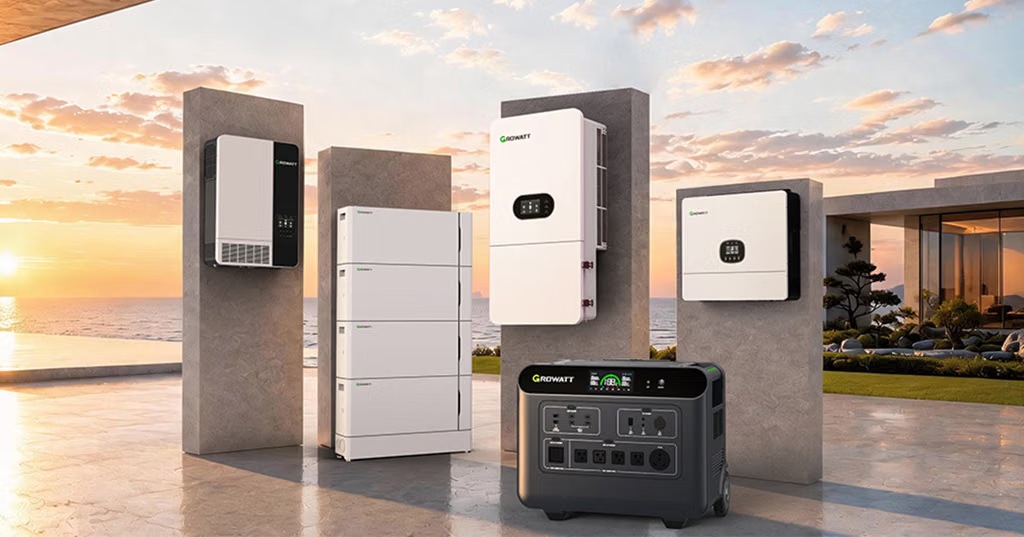
Growatt (With ShineLink-S / ShineWiFi-X or RS485/LAN modules) : Growatt inverters can be queried locally via Modbus RTU/TCP using an RS485-to-WiFi or RS485-to-USB stick (like ESPHome setups), bypassing the cloud completely, though it requires a bit more hands-on configuration than Fronius.
If you can share a few details, I can narrow down the exact model for your layout:
Are you looking for a grid-tied, hybrid (with battery) , or off-grid system?
What home automation platform (e.g., Home Assistant, Node-RED, openHAB) are you integrating with?
Victron Energy (MultiPlus / Quattro / Cerbo GX ecosystem)
Local API Type: Native local MQTT, Modbus TCP, and HTML/JSON web interfaces.
Why it’s great: Victron treats local control as a primary feature rather than an afterthought. If you use their GX device (like a Cerbo GX), it acts as a local broker/server. You can enable local MQTT or Modbus TCP with a couple of clicks in the settings, giving you sub-second, real-time telemetry and full bi-directional control over charging, discharging, and grid interaction without touching the cloud.
Enphase (IQ Microinverters via Envoy / IQ Gateway)
Local API Type: Local HTTP / token-based API.
Why it’s great: While Enphase heavily promotes their cloud app, the local IQ Gateway (formerly Envoy) has a local web interface. By generating an access token (via Enphase developer accounts or community scripts), Home Assistant and other platforms can pull production and consumption data directly from the gateway on your local subnet.
SMA (Sunny Boy / Sunny Tripower)
Local API Type: Modbus TCP and Webconnect local interface.
Why it’s great: SMA supports Modbus TCP out-of-the-box on most of their modern residential inverters. By enabling the Modbus feature in the inverter's local web UI, you can query register maps for real-time production, voltage, and power limits locally.
If you want to narrow this down, let me know:
Are you looking for a string inverter, hybrid (battery-ready) inverter, or microinverters?
What home automation platform (e.g., Home Assistant, Node-RED, custom Python scripts) are you planning to integrate with?
If local, documented API access is a hard requirement, I’d narrow the field considerably. The strongest documented options I found are:
1. Fronius GEN24 Plus — very strong fit
Fronius Primo GEN24 Plus - $2,199.00 (US Solar Supplier + others)
The Fronius GEN24 Plus has two particularly useful local interfaces:
Fronius Solar API — an Ethernet-based, open JSON API. The manufacturer documents the API and explicitly describes it as usable by third-party applications.
Modbus TCP — officially documented, including register maps, TCP ports, unit IDs, and writable controls. It can be used over Ethernet or Wi-Fi.
The Solar API is specifically described in the GEN24 manual as suitable for smart-home solutions.
Local Solar API access is disabled by default on newer firmware and can be enabled through the inverter's interface.
For Home Assistant or your own automation software, this is probably the cleanest conventional grid-tied/hybrid inverter choice because you can talk directly to the inverter over your LAN without depending on the manufacturer's cloud.
2. Victron — excellent if you're building an energy-management system
Victron is unusually automation-friendly. Its Venus OS/GX ecosystem provides documented local:
MQTT
Modbus TCP
D-Bus interfaces
Victron explicitly documents enabling MQTT for third-party systems such as Home Assistant and documents its Modbus TCP server. Victron EnergyVictron Energy The company's communications whitepaper also recommends Modbus TCP for communicating with a complete Victron system.
One important distinction: the MultiPlus-II is an inverter/charger, rather than a conventional DC-coupled PV string inverter. A typical Victron solar installation combines it with MPPT charge controllers or an AC-coupled PV inverter.
For maximum automation/control flexibility, Victron is particularly interesting.
3. SMA Sunny Boy Smart Energy
SMA Sunny Boy Smart Energy - $1,758.00 (RES Supply + others)
SMA has extensive API documentation, but there's an important caveat: much of SMA's prominently documented modern API ecosystem is associated with Sunny Portal/ennexOS cloud services, rather than being a simple local HTTP API.
So I would not put SMA ahead of Fronius if your requirement specifically means "my automation server must be able to communicate directly with the inverter on my LAN using an officially documented interface."
My shortlist
Inverter
Official local interface
Read data
Control
Cloud required?
Fronius GEN24 Plus
Solar API / Modbus TCP
Yes
Yes, via Modbus
No
Victron MultiPlus-II + GX/Venus OS
MQTT / Modbus TCP
Yes
If you tell me your requirements—e.g. 5–10 kW, grid-tied vs. hybrid, battery yes/no, 120/240 V split-phase, and whether you need read-only or write/control access—I can narrow this to 2–3 specific models that are appropriate for a U.S. installation and verify their exact local API/register documentation.
When looking for a solar inverter with a reliable, documented local API that doesn’t rely on a constant cloud connection (crucial for local-first hubs like Home Assistant, Node-RED, or OpenHAB), a few industry-leading brands stand out for open or well-documented local interfaces.
Documentation & Support: Fully documented, native open HTTP/JSON API. It outputs real-time data on power, voltage, current, and energy meters directly over your local network.
Home Automation Fit: Widely considered the gold standard for local integration. It has zero cloud dependencies for basic data polling, and popular platforms have robust, native plug-and-play integrations for it.
2. Victron Energy (MultiPlus / Quattro / Fronius hybrid setups)
Local Interface: Modbus TCP, MQTT (via Venus OS), and local HTML/JSON web-polling.
Documentation & Support: Exceptionally well-documented via Victron's comprehensive manual and community whitepapers.
Home Automation Fit: Victron’s *Cerbo GX * or built-in Venus OS communication center acts as a local powerhouse. It exposes local MQTT and Modbus TCP natively, allowing lightning-fast data updates and active control over battery charging/discharging thresholds without touching external servers.
3. Enphase (IQ Gateway / Envoy)
Local Interface: Local REST API / Envoy Gateway
Documentation & Support: Documented community standards, though Enphase requires acquiring a local token via their authentication workflow for newer firmware versions.
Home Automation Fit: If you are running microinverters, the Envoy/IQ Gateway sits on your local LAN. Local polling gives you per-panel and aggregate production data every 60 seconds, though firmware updates occasionally require token maintenance.
4. SolarEdge (Select Models)
Local Interface: Local HTTP interface / SetApp API
Documentation & Support: Officially supported on specific non-LCD/SetApp models, though users should note that firmware updates have occasionally toggled or restricted local web access depending on the exact model generation.
Quick Comparison for Local Integration
Brand
Protocol / API Type
Cloud Dependency for Local Data
Best Use Case
Fronius
HTTP / JSON REST API
None
String inverters with clean local telemetry
Victron
MQTT / Modbus TCP
None
Advanced hybrid/off-grid setups with heavy automation
To help narrow down the right model, tell me:
Are you planning for a string inverter, microinverters, or a hybrid battery system?
Which home automation platform (e.g., Home Assistant, Node-RED) are you integrating with?