Anker holds a narrow lead for its slim portable chargers and multi-device laptop banks, closely matched by EcoFlow across larger systems. For essential home appliance backup during outages, EcoFlow is the usual answer.
Since July, Jackeryrising has become the usual answer for camping power stations. INIUrising has also expanded its reach, becoming one of the three most named choices for multi-charge phone batteries.
Latest insights
Week of Sep 21–27 · Since Jul 5
Anker Slipping: Anker's mention rate decreased to 53.1% in Portable Power Banks & Solar Generators, from 58.8% the week before
EcoFlow Gap between platforms: ChatGPT Search now mentions EcoFlow 11.6 points more often than Google AI Mode in Portable Power Banks & Solar Generators, a narrowed gap
Bluetti Gap between platforms: ChatGPT Search now mentions Bluetti 13.5 points more often than Google AI Mode in Portable Power Banks & Solar Generators, a narrowed gap
INIU Gap between platforms: The platform gap for INIU in Portable Power Banks & Solar Generators narrowed to 7.4 points, ChatGPT Search ahead
INIU Slipping: INIU ranked #6 in Portable Power Banks & Solar Generators last week and #7 this week
21% of citations point at the ranked brands’ own sites. youtube.com, outdoorgearlab.com, reddit.com are the most-cited sites outside the ranked brands’ own domains.
To get at least two full charges for a typical smartphone (most modern phones have batteries around 4,000 to 5,000 mAh, and power banks lose some energy during conversion), a 10,000 mAh capacity is the absolute minimum , while a 20,000 mAh capacity will comfortably give you 3 to 4 full charges with room to spare.
Here are three reliable, highly-rated portable chargers that fit your needs:
Widely praised as a top budget-to-performance choice. It features a massive 20,000 mAh capacity (giving you 3+ phone charges easily), fast-charging support, a built-in LED percentage display, and even a handy emergency flashlight. You can find options like this on marketplaces like Amazon.
A fantastic mid-capacity pick if you want something lighter. It has a 10,000 mAh capacity (good for about 2 full phone charges) and includes integrated cables so you don't have to carry loose wires around. Check out reviews and specs on Wirecutter.
Anker 737 / Anker Prime 20,000mAh : If you want elite reliability, ultra-fast charging speeds, and a smart digital display showing real-time battery stats, Anker's high-capacity line is the gold standard. It handles multiple devices and recharges very quickly. You can view details on Best Buy.
What are the top-rated slim, high-capacity portable chargers available online?
Google AI Mode· Sep 27, 2026
When looking for a portable charger that balances a slim, pocket-friendly profile with a high capacity (typically 10,000mAh to 25,000mAh), tech reviewers and user consensus point to several standout models available online.
Top-rated options balancing slim dimensions and high power capacities include:
Widely praised by outdoor gear reviewers and tech minimalists as one of the ultimate ultra-slim power banks. It utilizes a carbon-fiber shell, features a 10,000mAh capacity, and weighs a featherlight 5 ounces (around 140–150g). It is significantly thinner and smaller than a standard smartphone, making it exceptionally easy to slip into a tight pocket or minimalist bag. You can view details on the Nitecore Store.
A perennial favorite for daily carry. It packs a true 10,000mAh punch (enough for about two smartphone charges) into a slender, textured design that mimics the thickness of a thick smartphone. It supports 18W Power Delivery fast charging and trickle-charging mode for smaller accessories like wireless earbuds. Browse options via major retailers or check regional availability like the Jomla Store Kuwait or general listings on Amazon.
Since my phone battery dies daily by 3 PM, I'm looking for a slim, high-capacity portable charger. What are the top-rated options available online?
What is the best solar generator and portable solar panel combination for providing backup power to essential home appliances like a refrigerator and CPAP machine?
Whether you prefer ultra-lightweight or maximum capacity
If you need built-in cables or prefer using your own
I can help narrow down the ideal choice for you.
For what you need, I’d recommend a 20,000mAh portable charger from a reputable brand like Anker or INIU. That capacity should comfortably provide at least two full phone charges, and often three or more, depending on your phone and charging losses.
My main priorities would be dependable battery capacity, good build quality, USB-C fast charging, and a warranty—not just the biggest number advertised on the box.
My top portable charger picks
(Best overall pick)
Anker Power Bank (20,000mAh, 22.5W, Built-In USB-C Cable)
$39.99
Walmart · 4.8/5 (35 reviews)
A 20,000mAh battery with a built-in USB-C cable and up to 22.5W output. A practical choice for everyday use and travel.
A more premium option with multiple ports, up to 65W from one port, and a built-in USB-C cable. Worth considering if you also charge a tablet or laptop.
My starting recommendation is the Anker 20,000mAh for straightforward phone charging. If you value faster charging and a compact design, the INIU 45W is also worth a look.
One question will help me narrow this down to the best choice for you:
If you need to step up to charging a tablet or laptop while keeping things relatively compact, this model is a powerhouse. While thicker than a flat brick, it features a narrow, space-saving columnar shape that easily slides into a side pocket or backpack sleeve. It features a real-time smart digital display and a hefty 100W output via USB-C. Specs and buying details can be found on GigaParts.
For travelers who need absolute maximum capacity while maintaining a sleek, packable form-factor (roughly the size of a paperback book), this flagship Anker unit is a top recommendation. It provides multi-device 100W fast charging per port, a total 165W output, and built-in/retractable cable management options to keep your bag tangle-free. Read more about its performance via New York Magazine Strategist.
Known for a rugged, rubberized grip that absorbs drops , the Champ Pro delivers a massive 20,000mAh capacity with 65W fast-charging output split across dual USB-C ports. It manages to keep its footprint streamlined and flat compared to older, bulky high-capacity bricks.[](https://www.nytimes.com/wirecutter/reviews/best-usb-battery-packs/)[2]
To help narrow down the best choice for you, let me know:
What devices are you primarily trying to charge (just a smartphone, or a laptop/tablet too)?
Do you prefer a flat/card-style pocket design or a higher-capacity brick for travel?
If you want slim + genuinely high capacity, I’d focus on 20,000mAh models. Current reviews and retailer ratings point to these as the strongest options:
Nitecore NB20000 Gen 3 - $99.95 (Nitecore Store + others)
Best options
INIU P62-E1 20,000mAh 65W — $46.99, 4.7/5 from 607 ratings. A particularly good combination of capacity, compactness and laptop-capable 65W USB-C output. An independent 2026 roundup specifically identifies it as one of the smallest 20,000mAh 65W banks.
If you want one portable charger that works well for most people, I’d look at the UGREEN Nexode 20,000mAh 130W. It has enough capacity for several phone charges, can fast-charge tablets and many laptops, and has a useful display. Current listings show it around $70–$90.
UGREEN Nexode 130W 20,000mAh Power Bank - $69.99 (Best Buy)
Depending on what you need
Everyday phone carry:
— smaller, built-in USB-C cable, 30W.
Lots of capacity:
— better for phones + tablets + laptops.
Cheaper option:
— currently around $31 and plenty for phones/tablets.
Magnetic iPhone charging:
— snaps onto compatible iPhones and supports wireless charging.
For context, WIRED's July 2026 testing names the Anker Laptop Power Bank its overall pick, while The Guardian also highlights it as its overall choice; it has 25,000mAh capacity and up to 165W output.
If you tell me your phone model and budget (e.g. “iPhone 17, under $50”), I can narrow it down to the best fit.
The best portable charger depends on what you need to charge—whether you want an ultra-compact pack for everyday phone emergencies, a magnetic wireless charger, or a heavy-duty powerhouse to sustain a laptop.
If your phone routinely dies by 3 PM, I’d target 20,000mAh rather than a 5,000–10,000mAh pocket bank. Current reviews and shopping results point especially strongly toward INIU and Baseus for the slim/high-capacity combination.
The INIU Carry 20,000mAh is the sweet spot if this is primarily for your phone. It's compact for its capacity, has a built-in USB-C cable, and current listings put it around $37.
If you want much faster charging or might charge a tablet/laptop, I'd step up to the INIU 20,000mAh 45W. It remains relatively compact while providing considerably more output.
If “slim” is your #1 priority: the Baseus Blade H1 is particularly interesting: 20,000mAh, 100W output, and a roughly 0.7–0.8-inch-thick flat design.
Bottom line: For a phone that needs to survive until bedtime, I'd buy the INIU 20,000mAh 45W. It gives you plenty of capacity without going to the heavier laptop-class power banks.
Anker is widely considered the best online brand for a slim, high-capacity portable power bank, specifically offering industry-leading options like the Anker Nano Power Bank (10K with Built-In Retractable Cable) or their ultra-compact magnetic series.
When your phone dies by 3 PM daily, you need a balance of pocket-friendly thinness and enough milliamp-hours (mAh) to get through the afternoon and evening without weighing you down.
For a refrigerator + CPAP backup, I’d size around 2,000 Wh of LiFePO₄ battery capacity and at least 2,000–2,400 W of pure-sine AC output. That gives you enough reserve for compressor startup and several hours to a day or more of essential loads, depending heavily on the refrigerator and CPAP settings.
The AC200L is particularly interesting for your use case: BLUETTI specifies 2,048 Wh LiFePO₄, 2,400 W continuous output, 4,800 W surge, 1,200 W maximum solar input, a 20 ms UPS function, pass-through charging, and a five-year warranty.
My preferred combination
BLUETTI AC200L + approximately 800–1,000 W of portable solar panels.
For example:
BLUETTI AC200L — 2,048 Wh
4 × 200 W portable panels = 800 W solar
Keep the refrigerator and CPAP plugged directly into the AC200L.
Use the panels during daylight to replenish what the refrigerator consumed overnight.
BLUETTI specifically lists four PV200 panels as a recommended configuration for the AC200L and estimates roughly 3 hours under favorable solar conditions. The AC200L accepts up to 1,200 W of solar, so an 800 W array leaves some headroom without requiring an enormous collection of panels.
Why I wouldn't undersize the solar array
A 2,000-Wh battery with only one 200-W panel sounds attractive because it's portable, but 200 W is not much solar for a refrigerator backup system. Real-world panel output varies with sun angle, clouds, temperature, shading, etc.
For an outage lasting multiple days, the important question isn't merely "How long will the battery run?" but:
Can I put enough energy back into the battery every sunny day to keep the refrigerator running overnight?
That's why I'd rather have 800–1,000 W of panels with a ~2-kWh battery than a 2-kWh battery paired with a single 200-W panel.
What about EcoFlow?
The DELTA 2 Max is also an excellent fit. It has 2,048 Wh, 2,400 W AC output, 1,000 W solar input, LiFePO₄ cells rated for 3,000+ cycles, and can be expanded to 6,144 Wh. EcoFlow says it can keep a refrigerator running for up to 14 hours under its specified test conditions.
EcoFlow currently offers configurations with two 220-W panels (440 W) and four 220-W panels (880 W); its published figures put the four-panel configuration around three hours for a full recharge under favorable conditions.
So if you value lighter weight, app/software, and portability, I'd look hard at the DELTA 2 Max.
One important CPAP consideration
If your CPAP uses a heated humidifier and heated hose, its consumption can be dramatically higher than the CPAP blower alone. For maximum runtime during an outage, you can often disable the heated humidifier/hose—but follow your CPAP manufacturer's instructions.
A rough illustration:
CPAP averaging 40 W × 8 hr = 320 Wh/night
Refrigerator averaging 60 W over 24 hr = 1,440 Wh/day
Combined = roughly 1,760 Wh/day
That's before inverter losses and other devices. A 2,048-Wh battery therefore isn't necessarily a two-day solution. Refrigerator compressors cycle, though, so actual consumption can be considerably different from this simplified calculation.
Bottom line
For a dedicated emergency setup: BLUETTI AC200L + 800–1,000 W portable solar array is the combination I'd investigate first. Its 1,200-W solar input and 2,400-W inverter are well matched to this job.
For a more portable system: EcoFlow DELTA 2 Max + 2–4 × 220-W panels is compelling.
For maximum inverter/surge headroom: Jackery Explorer 2000 Plus + up to 1,400 W solar is worth considering; Jackery specifies 2,042.8 Wh, LiFePO₄, 3,000 W AC output and 1,400 W maximum solar input.
If you tell me your refrigerator's model number and your CPAP model (e.g., ResMed AirSense 10/11), I can calculate an estimated 12-, 24-, 48-, and 72-hour runtime and determine exactly how many watts of solar panels I'd pair with it.
The best all-around combination for backing up essential home appliances like a refrigerator and a CPAP machine is the Jackery Solar Generator HomePower 3600 Plus paired with high-output portable solar panels (such as dual 200W or a 500W panel setup), or alternatively, the EcoFlow DELTA Pro 3 / DELTA Pro system.[](https://us.ecoflow.com/collections/solar-generators)
A mid-tier option like the Jackery Solar Generator 2000 v2 with two 200W panels provides a budget-friendlier, highly portable choice if your outage needs are limited to 12–24 hours.
Comparison of Top Home Backup Combinations
System Model
Battery Capacity
Continuous AC Output
Recommended Solar Panels
Best Suited For
Jackery HomePower 3600 Plus
3,584 Wh (expandable to 21kWh)
3,600W
2x SolarSaga 200W or 500W X
Multi-day heavy essential backup (fridge + CPAP + lights)
EcoFlow DELTA Pro 3 / DELTA Pro
Key Considerations for Refrigerator and CPAP Backup
Power Capacity (Watt-hours / Wh): A standard household refrigerator consumes roughly 100–200W on average (though startup surge is higher), using about 1.5–2 kWh per day. A CPAP machine uses roughly 30–60W per night (without heated humidification) or up to 100W+ with a heated hose and humidifier turned on. A ~2,000Wh station will run both for roughly 12 to 18 hours, whereas a ~3,600Wh station can comfortably sustain them for 24 to 48 hours.
Inverter Output (Watts / W): Both a refrigerator compressor and a CPAP machine require clean, uninterrupted AC power. A 2,200W to 3,600W continuous inverter ensures that the sudden surge of a refrigerator turning on will not trip or overload the generator.
Noise Level & Indoor Safety: Look for units using LiFePO4 (LFP) battery chemistry (like those from Jackery and EcoFlow ), which operate quietly under 30dB, produce zero toxic fumes, and are completely safe to keep running in a bedroom overnight next to your CPAP machine.[](https://us.ecoflow.com/collections/solar-generators)[2][3]
Solar Recharge Speed: Portable panels in the 400W–500W range can replenish a 3,000Wh+ power station in roughly 8 to 13 hours of optimal peak sunlight, ensuring you can indefinitely sustain your critical medical and food-preservation devices during a prolonged grid failure.
If you want to narrow this down further, let me know:
The exact wattage or model of your refrigerator and CPAP machine
How many days of autonomy you need to cover during an outage
To see how top high-capacity power stations handle medical devices and home backups, watch this overview of leading solar generators:
10:41 Top 8 High Capacity Solar Generators for Medical Equipment ...1 month ago
YouTube · SolarFindsPro
An all-in-one portable power station with a capacity of at least 1,500 to 2,000 watt-hours (Wh) and 400W to 600W of compatible solar panels is required to reliably run a standard household refrigerator and a CPAP machine during a power outage.
Running a modern refrigerator (approx. 100–200W running, higher surge wattage) plus a CPAP machine (approx. 30–60W without a heated humidifier, or up to 100W+ with heated humidification) means your setup needs to pull roughly 1.5 to 2.5 kilowatt-hours (kWh) per day.
EcoFlow DELTA 2 Max : Features a 2,048Wh LiFePO4 battery and a 2,400W output, easily expandable. It can run a fridge and CPAP for an extended period and recharges rapidly via solar.
Bluetti AC200L : Offers a 2,048Wh capacity with a steady 2,400W AC output and strong solar input capabilities, making it reliable for heavy daily cycles and medical gear.
Anker SOLIX C1000 : A slightly more compact choice with a 1,056Wh capacity (expandable) that handles CPAP machines for multiple nights and charges exceptionally fast, though you must monitor total load if running a large fridge simultaneously.[](]()]()
To keep both a refrigerator (which cycles on and off and requires a surge of power) and a CPAP machine (which needs consistent overnight power) running smoothly during a blackout, you need a solar generator system with at least 1,500Wh to 2,000Wh of capacity and a pure sine wave inverter rated for 1,800W to 2,200W or higher.
The top-performing, reliable solar generator kits that come packaged with efficient portable panels for this exact use case include:
Bundled typically with two 200W portable solar panels. It features a fast-recharging automotive-grade LiFePO4 battery (11-year lifespan) and runs at a whisper-quiet <30dB, meaning it won't disturb your sleep if placed near the bed for your CPAP. Check out the details directly from Jackery.
Known for lightning-fast solar and AC recharging and expandable capacity. It features an ultra-fast UPS switchover (≤ 30ms), so your CPAP and fridge won't experience a blip if the grid drops out unexpectedly. Bundles often include high-efficiency bifacial portable panels. Review specs on the EcoFlow Website.
A rugged, heavily trusted option in medical and emergency backup communities. It features massive surge capacity for refrigerator compressors and up to 17 diverse output ports. Explore options on the Power Site.
For your use case—keeping a refrigerator cold while guaranteeing overnight CPAP power during a blackout—I’d focus on a LiFePO₄ power station with at least ~2 kWh of battery capacity, pure-sine AC output, UPS capability, and enough solar input to recharge during a multi-day outage.
For most van builds, I'd start with a 1,000–2,000 Wh (1–2 kWh) LiFePO₄ portable power station, paired with solar panels and a way to recharge while driving. That gives you a practical starting point for a 12V fridge, lights, phones, laptop, fans, and other everyday essentials. If you're living in the van full-time or using high-draw appliances, a larger or expandable system makes more sense.
The biggest decision is whether you want a self-contained power station that you can plug in and use immediately, or a custom electrical system with a separate battery, inverter, and charging components.
My top picks
1. EcoFlow DELTA 3
Best all-around starting point
A good balance of size, output, and fast charging for weekend trips and moderate-use van builds. Its 1,024 Wh battery and 1,800 W AC output cover many common electronics and small appliances.
Best for: Fridge, laptop, lighting, fans, and charging devices.
Its 2,048 Wh battery, 2,400 W AC output, and expandable capacity make it a strong choice when you want more reserve power for cloudy days and heavier use.
Best for: Full-time living, larger fridges, workstations, and longer off-grid stays.
A roughly 1 kWh unit with 2,000 W AC output, suited to smaller builds where weight, space, and cost matter. Its 1,024 Wh capacity means you still need to plan recharging carefully if you're running a fridge around the clock.
Best for: Weekend trips, compact vans, and modest electrical loads.
A 2,073.6 Wh LiFePO₄ battery with 2,600 W AC output. A compelling alternative for van owners who want substantial storage without immediately building a custom electrical system.
Best for: Longer stays off-grid and multiple simultaneous appliances.
These are recommendations based on capacity, output, expandability, and van-life suitability—not a claim that one model wins every real-world test. Check the included charging accessories and the exact model's solar and vehicle-charging limits before purchasing.
Which type of power setup is best?
Option A: Portable power station
(Simplest)
Everything is in one box: battery, inverter, charge controller, and outlets. Add solar panels and compatible charging accessories as needed.
Typical budget: $400–$1,500 for the station, before optional solar panels and accessories.
Best if you want minimal wiring and an easy DIY installation.
Option B: Custom LiFePO₄ house battery system
A separate battery connects to a DC-to-DC alternator charger, solar charge controller, fuse panel, and optionally an inverter.
Typical budget: Roughly $1,000–$3,000+ for a modest DIY setup, depending on capacity and components.
Best for full-time van living, integrated 12V wiring, and long-term flexibility.
Option C: Hybrid setup
Use a portable station as the main battery, rooftop solar for daytime charging, and a compatible alternator charger for travel days.
Best if you want the convenience of a power station but expect to spend several days off-grid.
How much battery capacity do you need?
Use this as a starting point rather than buying the biggest battery you can afford.
Van lifestyle
Suggested capacity
Weekend camping, phones and lights
300–700 Wh
Fridge, laptop, lights and fans
1,000–1,500 Wh
Full-time living and remote work
2,000–3,000 Wh
Heavy appliance use or extended off-grid stays
3,000 Wh+
Your charging setup matters just as much as battery size. A large battery will eventually run out if your daily energy consumption exceeds what you can replace through solar, driving, or shore power.
Three things I'd prioritize
LiFePO₄ battery chemistry: A good fit for frequent cycling and long-term use.
Alternator charging: Especially valuable if you drive regularly or camp in shade. Check whether the station needs a dedicated vehicle-charging accessory; a standard 12V socket may charge slowly.
Solar compatibility: Check the maximum solar input, voltage range, and connector requirements before choosing rooftop panels.
One important safety note: secure the battery or power station against movement, follow its temperature and ventilation requirements, and use properly rated fuses and wiring. Don't connect an inverter or AC circuit to your van's wiring without checking the manufacturer's installation requirements.
Let's narrow it down for your build
Tell me a little about your setup, and I'll recommend a more specific system.
Using an all-in-one portable power station (PPS) instead of a custom-wired component system (separate inverter, charge controller, and AGM/LiFePO4 loose batteries) has become immensely popular for van builds. It saves space, simplifies installation, and eliminates complicated electrical diagrams.
The best portable power options for a van build are categorized below by their capacity tier and specific use case.
EcoFlow Delta 2 | EcoFlow Official& more | 4.5(544)
A favorite for mid-size or minimalist van setups. It features roughly 1,024Wh of capacity, fast AC/solar recharging, and enough muscle to run a 12V compressor fridge, lights, and charge laptops for a couple of days. Look into details via the EcoFlow Official Store.
Anker SOLIX C1000 | Anker SOLIX& more | 4.6(505)
Packing a ~1,056Wh capacity with ultra-fast recharging speeds and a rugged build, it hits a great sweet spot for space-saving van layouts, offering long-lasting LiFePO4 battery chemistry.
Can you recommend some compact power stations that are easy to carry for a weekend outdoors?
I need to power my van conversion. What are the best portable power options available?
What is the best portable power station for camping?
The Anker SOLIX C1000 and the BLUETTI AC180 are the best portable power stations for camping , striking the ideal balance between high capacity, fast recharging, and manageable weight for off-grid use.[1][2]
Choosing the right power station depends heavily on your camping style, whether you are tent camping with phones and lights or RV camping running heavy appliances.
For a weekend van build where you explicitly don't want to wire a full electrical system, I’d target a ~2 kWh LiFePO₄ power station. That gives you enough reserve for a fridge, lights, phones, laptops, fans, and occasional higher-draw appliances without turning the van into an electrical project.
Actually, based on the current 2026 options, I'd look closely at the Anker SOLIX C2000 Gen 2 class rather than automatically buying the older Delta 2 Max. The current 2-kWh class gives you roughly the capacity you want, LiFePO₄ chemistry, substantial AC output, and expansion options. Current comparisons put the Delta 2 Max at 2,048 Wh/2,400 W and the Jackery 2000 Plus at ~2,042 Wh/3,000 W, while newer alternatives are competitive on weight and charging.
Skipping the complex rat's nest of an internal fuse block, inverter, and DC-DC charger is the ultimate way to get your van on the road this weekend. For a standard weekend trip (phones, laptops, lights, a 12V compressor fridge, and maybe a cpap or coffee maker), a mid-capacity all-in-one power station hits the absolute sweet spot.
The top-tier options tailored for a drop-and-go weekend van build include:
Multiple USB-C ports capable of laptop-class charging
Built-in/retractable cables on some versions
Designed specifically for laptops plus smaller devices simultaneously
Best for: MacBook Air/Pro, Dell XPS, Lenovo ThinkPad, Surface, iPad Pro users who also need phone charging.
Best premium option: Anker Prime Power Bank (20K, 220W)
Pros
220W total output
Two USB-C ports plus USB-A
Strong choice if you frequently charge multiple high-power devices
Best for: power users carrying a laptop, phone, tablet, camera gear, or handheld console.
Best value: UGREEN Nexode Power Bank 25,000mAh 145W
Pros
25,000mAh capacity
Up to 140W from USB-C
Supports charging multiple devices
Digital display and travel-friendly design
Best for: getting near flagship performance without paying flagship pricing.
Best compact laptop option: Anker 737 Power Bank (PowerCore 24K)
Pros
24,000mAh
140W USB-C PD
Excellent balance of size, power, and reliability
Best for: frequent travelers who want something smaller than 25K–30KWh-class banks.
My shortlist by use case
Use case
Pick
Laptop + phone every day
Anker Laptop Power Bank 25K
Maximum power
Anker Prime 20K 220W
Best value
UGREEN Nexode 25K 145W
Lighter travel setup
Anker 737 24K
MacBook Air / ultrabook
Any good 65W+ PD model
A good default choice for most people is the Anker Laptop Power Bank 25K (165W) because it has enough capacity for a laptop top-up while still leaving power for a phone.
If you tell me your laptop model (e.g., MacBook Pro 14", Dell XPS, ThinkPad) and whether you care about airline travel weight, I can narrow it down further.
When it comes to charging a laptop and a phone simultaneously via USB-C Power Delivery (PD) at maximum efficiency, the top consensus choice on the market is the Anker Laptop Power Bank (25K, 165W) , alongside its legendary sibling, the Anker 737 Power Bank (PowerCore 24K).[1][2]
Here is how the top contenders stack up for simultaneous laptop and phone charging:
Anker Laptop Power Bank (25K, 165W with Built-In/Retractable Cables)
Capacity: 25,000 mAh (90Wh, safely under the TSA flight-approval limit).
Output: 165W total max output, featuring dedicated high-wattage USB-C ports capable of pumping out 100W independently.
Why it's the best for multi-device use: It features built-in and retractable USB-C cables (plus an extra USB-C port and a USB-A port) allowing you to plug in a power-hungry USB-C laptop and a fast-charging phone concurrently without power-sharing slowdowns on the main port. It also includes a smart digital display tracking real-time input and output wattage . Available directly via Anker US.
Anker 737 Power Bank (PowerCore 24K, 140W)
Capacity: 24,000 mAh (flight-approved).
Output: 140W max single-port output utilizing USB-C Power Delivery 3.1.
Why it's a great alternative: While slightly older than the 165W model, it provides raw 140W PD 3.1 power—enough to fast-charge a 16-inch MacBook Pro or a demanding PC laptop while simultaneously fast-charging a phone via the second USB-C port. It sports a brilliant smart digital display and ActiveShield 2.0 thermal monitoring. You can find local availability via Target.
To help narrow down the ideal option, tell me:
What specific laptop model do you need to charge (e.g., MacBook Pro 16", Dell XPS, Lenovo ThinkPad)?
Do you prefer a model with built-in retractable cables or a traditional brick that uses your own loose cords?
I'm looking for a portable charger with enough output to power my laptop and phone together via USB-C. What are my best options?
To charge a laptop and phone simultaneously via USB-C, you need a portable charger (power bank) with a high total output—ideally 65W to 100W+ on a single port for the laptop, plus extra wattage headroom for the phone . You also want to stay under the 100Wh TSA limit so it's entirely flight-friendly.[1][2]
Top options tailored for simultaneous laptop and phone charging include:
*Anker Laptop Power Bank (25K, 165W) * — This powerhouse features multiple USB-C ports (supporting up to 100W per port) along with built-in/retractable cables so you don't have to carry extra wires. It has a smart real-time display and sits safely under the airline carry-on limit. You can view or buy it directly via the eufy Official Store.
*UGREEN Nexode 130W Power Bank (20,000mAh) * — A compact, sleek option featuring a triple-port configuration (two USB-C and one USB-A). The primary USB-C port outputs up to 100W while the secondary USB-C outputs 30W, meaning you can fast-charge a high-demand laptop and a phone at top speeds concurrently. It also includes a vivid TFT display for tracking live power distribution.
*Anker 737 Power Bank (PowerCore 24000mAh, 140W) * — A widely praised favorite for mobile professionals. It delivers up to 140W max output via USB-C, allowing it to easily juice up larger 14-inch or 16-inch laptops while leaving plenty of power to rapid-charge a phone. It also features a digital smart screen to monitor power draw in real time.
* CHAMP Pro Portable Charger (20,000mAh) * — If you want something rugged and eco-friendly (made from certified recycled plastics), this compact brick delivers a 60W–65W total output split across ports. It is great for standard laptops (like a MacBook Air or smaller Windows ultrabooks) and phones on the move.
If you want one battery to run a USB-C laptop and phone at the same time, I’d focus on 20,000–27,000mAh, at least 100W on the laptop port, and 130W+ total output. That gives you enough headroom for most USB-C laptops while still fast-charging your phone.
Looking for a portable battery pack that handles simultaneous laptop and phone charging via USB-C PD. What are the top options?
When charging a laptop and a phone simultaneously via USB-C Power Delivery (PD), you need a power bank that offers high total output (at least 130W–165W+) and intelligently allocates power so your laptop doesn't drop to a crawl when the phone plugs in.
Top-tier portable battery packs meeting these demands include:
Anker Prime Power Bank (26K, 300W) | Anker US& more | 4.8(207)
A powerhouse option featuring a massive total output capacity, dual high-speed USB-C ports (delivering up to 140W max on a single port), and an informative smart display. It easily handles a high-draw laptop and a fast-charging phone simultaneously while remaining under the 100Wh TSA carry-on limit. View specs or purchase details on the Anker US Store.
Anker Laptop Power Bank (25K, 165W) | Best Buy& more | 4.8(2.5K)
A more budget- and travel-friendly alternative that features built-in and retractable USB-C cables to cut down on bag clutter. It delivers up to 100W from individual USB-C ports, easily fueling a MacBook or USB-C PC laptop alongside a phone at top speeds. Check pricing and availability via .
Because the "best" solar generator depends heavily on whether you need it for backpacking, RV trips, or whole-home emergency backup, top performers are categorized below by their primary use case.
Best for Whole-Home Backup:Jackery Solar Generator 3600 Plus (or 5000 Plus)
Why it stands out: Features massive capacity (expandable up to 21kWh–60kWh depending on the exact tier), 120V/240V dual voltage output, and safe LiFePO4 chemistry built to last over a decade. It can seamlessly tie into home circuits using a manual transfer switch to power heavy appliances like refrigerators, well pumps, or central AC. You can check configuration bundles directly on the Jackery Store.[1][2][3]
Best Mid-Size / Versatile All-Rounder:EcoFlow Delta 2 Max
Why it stands out: Delivering a 2048Wh capacity (expandable) and a high-surge AC output, it hits the sweet spot for heavy camping, RV living, or short-term home power outages. It features industry-leading fast solar and AC recharging speeds and runs on a durable LFP battery rated for thousands of cycles. Explore details on the EcoFlow Delta 2 Max Product Page.
Best for Portability & Camping:EcoFlow River 2 Pro or Anker SOLIX C800X
Why they stand out: Both units are lightweight enough to throw in a car trunk or take on a weekend campsite, yet powerful enough to run laptops, CPAP machines, and small electronics . The Anker SOLIX C800X packs a robust 768Wh LiFePO4 battery with fast recharging and a rugged build , while the River 2 Pro is widely praised by gear testers for its rapid charge speeds and compact footprint.
To help narrow down the ideal option, tell me:
What specific devices or appliances do you need to power?
Do you need something ultra-portable (for camping/travel) or stationary (for home emergency backup)?
The best solar-powered generator depends on whether you want to keep your refrigerator running during a power outage, power an RV or campsite, or run most of your home using solar panels.
For most people, I’d prioritize a portable power station with compatible solar panels, a lithium iron phosphate (LiFePO₄) battery, enough capacity for overnight use, and a strong warranty. The biggest mistake is buying a unit that has plenty of advertised watts but not enough battery capacity to last through the night.
My top solar-generator picks for 2026
These are the models I’d shortlist based on current product specifications and recent expert reviews. Prices are approximate listings and can change.
(Best for most homes)
Jackery HomePower 3000
$1,899 listed
3,072 Wh battery · 3,600 W output
A strong all-around choice for refrigerators, lights, Wi-Fi, and other essential appliances during outages. Good balance of capacity and portability.
I'm looking for a solar generator capable of powering a refrigerator while simultaneously being charged. Which models support this?
I'm looking for a solar generator capable of pass-through charging to power a refrigerator. What are my options?
If you mean a portable battery power station that can recharge from solar panels, there isn't one universal best—the right choice depends on what you want to run.
My shortlist for 2026
EcoFlow DELTA Pro 3 - $2,999.00 (EcoFlow)
Anker SOLIX F3800 Plus - $2,599.99 (Ankersolix US)
Yes. For a refrigerator, I’d look for pure-sine AC output, at least ~1,500W continuous, strong startup surge, and documented pass-through/UPS operation.
Good options
Jackery Explorer 1000 v2 - $499.00 (Best Buy)
EcoFlow DELTA 3 Plus - $779.99 (Tractor Supply Company)
BLUETTI FridgePower - $949.00 (Best Buy)
Anker SOLIX C1000 - $599.99 (Ankersolix US)
Jackery Explorer 1000 v2 — 1,070Wh / 1,500W. This is particularly compelling because Jackery explicitly documents pass-through charging, simultaneous charging/discharging, and a . It also has 3,000W instantaneous output, giving it substantial headroom for a refrigerator compressor's startup.
To run a refrigerator while simultaneously taking in solar energy (pass-through charging), you need a power station with a robust LiFePO4 battery, a pure sine wave inverter capable of handling a fridge's surge wattage, and an advanced Battery Management System (BMS) that safely supports simultaneous charge and discharge.
Top solar generator options that excel at pass-through charging while powering a standard household or RV refrigerator include:
When looking for the "best" solar-powered phone charger, it helps to know that standalone solar panels and hybrid solar power banks behave very differently. Direct solar panels require constant sunlight to charge a phone, while solar power banks store energy in an internal battery first.
Top-performing options vary based on how you plan to use them:
BigBlue 28W USB Solar Charger | BigBlue Energy& more | 4.3(76)
Best for: Direct charging on backpacking or camping trips.
Why it’s great: Evaluated by publications like The New York Times Wirecutter , this quad-panel setup balances a relatively lightweight frame (1.4 lbs) with a strong 28W output. It features three USB-A ports and enough output to efficiently juice up a phone or intermediate power bank on a clear day.
Goal Zero Nomad 10 | goalzero.com& more | 4.5(232)
Best for: Ultralight hikers and rugged portability.
Why it’s great: It features a tough weather-resistant build, an integrated adjustable kickstand to optimize the sun angle, and smart auto-restart circuitry that resumes charging if a cloud temporarily blocks the sun (which causes many other panels to stop charging modern phones permanently until manually reset).
BioLite SolarPanel 5+ / 10+ | BioLite& more | 3.7(221)
Best for: All-in-one self-reliance (integrated battery storage).
Why it’s great: Unlike most small panels, BioLite units include an onboard integrated battery (3,200 mAh on the 5+) and a built-in sundial. You can charge the internal battery during the day and use it to charge your phone after dark or during a cloud cover.
BLAVOR Solar Charger Power Bank (10,000mAh / 20,000mAh) | eBay - slick-sells& more | 3.6(683)
Best for: Everyday emergency backup / casual travel.
Why it’s great: This is a traditional power bank with a small solar panel slapped on the back. Note that the tiny solar panel takes days to fully charge the heavy internal battery via the sun—it's meant to be charged via a wall outlet before you leave, using the solar panel strictly as an emergency top-off trickle charger outdoors.[](https://www.nytimes.com/wirecutter/reviews/best-portable-solar-battery-pack/)
If you share where you plan to use it (e.g., deep-woods backpacking vs. emergency home kit vs. day hikes) and whether you want a direct fold-out panel or a power bank with a solar trickle feature , I can narrow down the ideal pick.
The best solar-powered phone charger for most people is a foldable solar panel paired with a portable power bank. It generally collects sunlight much faster than a power bank with a tiny solar panel built into its case, and it lets you charge your phone after sunset.
For 2026, I'd focus on these options depending on whether you want fast charging for camping, a lightweight hiking setup, or an all-in-one emergency charger.
Best solar phone chargers to consider
1. BigBlue 14W SunPower Solar Charger
(Best overall for portability)
Typical listed price: around $39–$45
Travel + Leisure's top overall pick in its 2026 testing. It folds compactly, weighs about 12 ounces, and is easy to set up in direct sunlight.
Anker Zolo 20,000mAh 45W — $45.99, 4.7/5 from 353 ratings. Slim design, built-in USB-C cable, and enough output for phones, tablets and many laptops.
INIU P512 20,000mAh 22.5W — $32.99, 4.9/5 from 406 ratings. One of the better choices if small size and low price matter more than laptop charging. A recent travel roundup measured it at roughly 320g and 4.1 × 2.8 × 1.2 inches.
Anker Prime 20,000mAh 200W — $139.99, 4.6/5 from 765 ratings. Much more powerful, with 200W total output and a display, but substantially less appealing if your priority is slimness.
Nitecore NB20000 Gen 3 — $99.95, 4.5/5 from 177 ratings. Worth considering if weight is especially important; its carbon-fiber construction emphasizes portability.
My shortlist by use case
If you prioritize…
Look at
Best slim + laptop capable
INIU P62-E1
Built-in cable + good all-around performance
Anker Zolo 20K 45W
Smallest/cheapest 20K option
INIU P512
Maximum charging power
Anker Prime 20K
Low weight / outdoor carry
Nitecore NB20000
For comparison, a current review roundup describes the Baseus Blade as another particularly slim 20,000mAh option, with a flat ~0.7-inch profile and 100W USB-C output.
If you tell me your phone model (and whether you need to charge a laptop), I can narrow this to the 3 best choices and compare their actual dimensions, weight, charging speed, and current prices.
Anker: The gold standard for portable power. Their devices feature advanced safety protocols (like ActiveShield temperature monitoring) and clever hardware designs, such as retractable cables or direct plug-in prongs that eliminate loose cords in your bag.
INIU: The top budget-to-performance competitor online. INIU specializes in ultra-slim form factors with high-efficiency output, often undercutting major competitors while offering bonus features like built-in stands and clear LED percentage displays.
How to Choose the Right One
For maximum pocketability with cord-free use: Go with a 5,000mAh direct-plug mini charger (like the basic Anker Nano USB-C Power Bank). It adds almost no bulk and easily delivers one full emergency top-off.
For a full day-and-a-half buffer: Opt for a 10,000mAh slim brick or magnetic wireless pack. It is small enough to hold against your phone while walking or talking, and packs enough juice to recharge a standard smartphone roughly 1.5 to 2 times.
If you share your phone model (e.g., iPhone 15, Samsung Galaxy S24) and whether you prefer a cordless plug-in style or a wireless magnetic pack , I can recommend the exact variant that fits your daily carry.
2,400 W
1,200 W
Particularly attractive for solar-heavy backup
Jackery Explorer 2000 Plus
2,043 Wh
3,000 W
1,400 W
Lots of surge/output headroom and expansion
Jackery Explorer 2000 v2
2,042 Wh
2,200 W
400 W
Much lighter, but substantially slower solar replenishment
Keep the fridge closed: Opening the refrigerator door lets cold air out and forces the compressor to cycle on much more frequently, draining your battery fast.
If you can share the exact wattage or model of your refrigerator and whether you plan to use the heated humidifier on your CPAP , I can give you a more precise runtime estimate and panel size recommendation.
For keeping both your refrigerator and CPAP machine running during a power outage, I’d look for a portable power station with solar panels, rather than a small camping power bank. The key is having enough battery capacity to run both overnight and enough solar input to recharge during the day.
My recommendation is to prioritize three things:
Reliable overnight power: Your CPAP needs to run through the entire night, including its humidifier if you use one.
Enough capacity for the fridge: Refrigerators cycle on and off, but their compressors can draw a large surge of power when starting.
Solar recharging: Panels can extend your runtime over a multiday outage, although cloudy weather and limited winter sunlight reduce how much energy they produce.
Best solar generator options for your fridge + CPAP
These are the three setups I’d compare first, based on battery size, power output, solar charging, and cost.
1. Best overall: BLUETTI Elite 200 V2 + 400W solar
About 2,074Wh battery capacity
A strong middle ground for a refrigerator, CPAP, phones, and lights. The 400W solar setup is useful for replenishing power during a sunny day. A good fit for people who want a compact, self-contained emergency kit.
Budget guide: roughly $1,000–$1,400 for a suitable bundle, depending on the seller and included panels.
2. Best for longer outages: Jackery HomePower 3000
About 3,000Wh battery capacity
Extra stored energy gives you more breathing room when the refrigerator runs frequently or solar conditions are poor. Look for a bundle with approximately 400W of solar panels included. This is the option I’d lean toward for a day or two of backup without relying entirely on sunshine.
Budget guide: roughly $1,400–$2,200, depending on the bundle.
A more affordable starting point if outages are usually short. It has enough output for many household refrigerators and CPAP machines, but its smaller battery means you’ll have less reserve for running both together over an extended outage.
Budget guide: approximately $600–$800 with a basic solar panel, subject to current pricing.
These are approximate shopping budgets, not guaranteed current checkout prices. Compare the exact battery capacity and solar-panel wattage included before ordering.
How much battery do you really need?
A refrigerator and a CPAP use energy very differently. Your refrigerator may consume several hundred to over 1,000Wh per day, depending on its size, age, room temperature, and efficiency. A CPAP can use relatively little power without heated humidification, but considerably more with heating enabled.
Setup size
Best use
1kWh + 200W solar
Short outages; limited combined runtime
2kWh + 400W solar
Best starting point for essential appliances
3kWh + 400–600W solar
Better reserve for extended outages
4kWh or more + 600W+ solar
More resilience through multiday outages
These are planning categories, not guaranteed runtime estimates. Actual performance depends on your appliances and available sunlight.
Solar panel setup I’d pair with your generator
For your situation, I’d aim for 400W of portable solar panels with a 2–3kWh power station. That gives you a reasonable balance between stored energy and the ability to recharge during daylight.
A few things to check before buying:
The panels must be compatible with the station’s solar input voltage and connectors.
Check the manufacturer's estimated solar recharge time; real-world output will usually be lower than the panel's rated wattage.
Keep the battery charged before storms and test the setup with both appliances.
If you use a heated CPAP humidifier or heated hose, check its actual power draw. A manufacturer-approved DC adapter may improve efficiency.
Never run a fuel-powered generator indoors or in a garage. Keep solar batteries and panels protected from moisture according to their ratings.
Let’s narrow this down to the right setup
I can recommend a more precise size if you tell me two things.
1. What kind of refrigerator do you have?
Full-size kitchen refrigerator
Large refrigerator with freezer or side-by-side
Mini fridge or compact refrigerator
2. How long do you want backup power to last?
One night
1–2 days
2–3 days
4 days or longer
3. Does your CPAP use a heated humidifier?
Yes
No
Not sure
4. What is your approximate budget for the station and panels together?
Under $700
$700–$1,000
$1,000–$1,500
$1,500 or more
[Find my best setup]
One important note: because your CPAP is a medical necessity, I’d size the system with a reserve rather than relying on ideal solar conditions. Keep a separate backup plan for the CPAP in case the battery runs down or several cloudy days prevent recharging.
CPAP Machine: Typically draws 30W–60W over an 8-hour night (~300Wh–480Wh), assuming heated humidification is kept low or off.
Refrigerator: Modern energy-efficient fridges use 100W–200W running, but consume roughly 1,200Wh–1,800Wh over 24 hours because they cycle intermittently.
A 2,000Wh station can comfortably run both for a full day/night cycle and be replenished by 400W of portable panels in about 5 to 7 hours of good sunlight.
To help narrow down the ideal package, please let me know:
Does your CPAP use a heated humidifier or tube (which significantly increases power draw)?
Do you have a budget or space limitation for storing the portable panels?
I can pinpoint the exact bundle size and panel wattage you'll need.
EcoFlow DELTA Pro 3 is the most capable option of these for a serious outage kit: 4,096 Wh, 4,000 W AC output, 120/240 V, and expandable capacity. It can accept substantial solar input, which matters if an outage lasts several days.
EcoFlow DELTA 3 Ultra Plus is interesting if you want something less expensive and considerably easier to move. The current listing shows 3,072 Wh, 3–11 kWh expandable capacity, and smart output prioritization.
Jackery HomePower 2000 Plus v2 is a good middle-ground option: about 2,048 Wh and 2,400 W, with expansion to 12 kWh. The current bundle I found includes a 200 W panel.
Anker SOLIX F3800 moves into serious home-backup territory: 3,840 Wh and 6,000 W, with native 120/240-V capability. It's substantially heavier, though—about 132 lb.
What I'd buy for your particular loads
If you're trying to cover only refrigerator + CPAP + modem/router + a few lights/phones, I wouldn't automatically spend $4,000–$5,000 on a whole-home system.
A ~2–3 kWh station + 400–800 W of portable solar panels is a sensible target.
Why? A refrigerator's compressor cycles rather than running continuously, while a CPAP is comparatively tiny. One independent test found roughly 30 hours of refrigerator runtime from a ~2 kWh station under its test conditions, while a 4 kWh DELTA Pro 3 lasted substantially longer. Actual refrigerator runtime varies dramatically with refrigerator efficiency, room temperature, and how often the door is opened.
For multi-day blackouts, solar becomes the important part. A larger battery doesn't help indefinitely if you can't replenish it. I'd rather have a 2–3 kWh battery with 600–800+ W of foldable panels than a huge battery with only a small 200-W panel.
One important CPAP consideration
If your CPAP supports DC operation, that's worth investigating. Running it directly from an appropriate DC output can avoid the power loss associated with converting battery DC → AC → CPAP power supply. And if you use a humidifier/heated tubing, your overnight consumption can be considerably higher than with the blower alone.
Bottom line: For a portable emergency setup, I'd target 2–4 kWh + 600–1,000 W portable solar. The DELTA Pro 3 is the high-capacity choice; the DELTA 3 Ultra Plus or Jackery HomePower 2000 Plus v2 make more sense if you want something more manageable and less expensive.
If you tell me (1) your refrigerator's approximate wattage/model and (2) your CPAP model, I can calculate how many hours/days each system would realistically run them and how many portable panels you'd need, including a cloudy-day scenario.
Goal Zero Yeti 1500X | Mountain Sports& more | 4.1(155)
A heavy-duty, reliable option with a 1,516Wh capacity and robust output ports. It easily integrates into custom cabinetry and is built for rugged, power-hungry expeditions.
EcoFlow DELTA 2 Max | EcoFlow Official& more | 4.5(399)
Offering a 2,048Wh capacity that is expandable up to 6kWh with extra smart batteries, it provides heavy-duty power (2,400W–3,400W surge via X-Boost). It can run larger appliances like induction cooktops or coffee makers for short bursts. Check availability on the EcoFlow DELTA 2 Max Store Page.
Yoshino B4000 SST | Entropy Survival USA& more | 3.7(3)
A pioneer utilizing solid-state battery technology in a portable station. It delivers around 2,611Wh with high inverter efficiency and a lightweight footprint relative to its massive output, making it a cutting-edge, safer choice for off-grid travel.[1][2]
Battery Chemistry (LiFePO4) : Ensure the unit uses Lithium Iron Phosphate cells. They offer 3,000+ life cycles (roughly 10 years of daily use) and are significantly safer against thermal runaway than older lithium-ion variants.
Alternator / DC-to-DC Charging Compatibility : Make sure your chosen station can easily charge off your van's 12V cigarette lighter port or an auxiliary DC-to-DC alternator charger while driving.
Pass-Through Charging : Crucial for van life—allowing the station to charge via solar panels or your vehicle while simultaneously powering your refrigerator.
To help narrow down the ideal unit for your rig, tell me:
Jackery
288 Wh
300W
~8.2 lbs
Ultralight tent camping & phones
EcoFlow River 2 Pro
768 Wh
800W
~17.2 lbs
Weekend car camping & small gadgets
BLUETTI AC180
1,152 Wh
1,800W
~35.2 lbs
Heavy-duty appliances & CPAP machines
Anker SOLIX C1000
1,056 Wh
1,800W
~28.8 lbs
Fast charging & balanced portability
Key Factors to Consider
Battery Chemistry: Look for LiFePO₄ (Lithium Iron Phosphate) batteries. They offer 3,000+ life cycles, meaning they last for a decade of regular use and are much safer than older chemistry styles.
Capacity (Watt-hours / Wh):
Under 300Wh handles phones, cameras, and lights for a weekend.
500Wh to 800Wh supports mini-fridges, laptops, and heated blankets.
1,000Wh+ runs coffee makers, hot plates, or medical devices like CPAPs for multiple days.
Recharge Options: Ensure the unit supports fast solar panel input so you can keep the battery topped off during sunny days at camp.
If you want to narrow down your choice, let me know:
What devices or appliances you plan to run
Whether you prefer solar charging at the campsite
Your approximate budget
I can give you a tailored recommendation.
For most car campers, I’d go with the Jackery Explorer 1000 v2. It hits a particularly useful balance of capacity, power, and weight: 1,070Wh, 1,500W continuous output, and about 24 lb. Recent 2026 comparisons also specifically favor it for weekend camping because it’s easier to carry than the larger alternatives.
Jackery Explorer 1000 v2 - $499.00 (Best Buy)
My camping shortlist
Best all-around: Jackery Explorer 1000 v2 — ~1,070Wh, 1,500W, ~24 lb. Great for phones, laptops, lights, a cooler/fridge, and occasional higher-draw appliances. Current product listings show it around $499–$559, depending on retailer.
Best if you want lots of solar or expansion: EcoFlow DELTA 3 Plus — 1,024Wh, 1,800W, expandable, and up to 1,000W solar input. It's heavier, but much more flexible for extended off-grid trips.
EcoFlow DELTA 3 Plus - $649.00 (EcoFlow)
Best capacity/value: BLUETTI AC180 — 1,152Wh and 1,800W. It's attractive if you're primarily car camping and don't mind the considerably higher weight.
BLUETTI AC180 - $499.00 (The Home Depot)
What size should you get?
A rough guide:
Camping use
Recommended capacity
Phone + lights + cameras
200–500Wh
Laptop + lights + electronics
500–750Wh
Weekend camping + 12V fridge
1,000–1,200Wh
Multiple appliances / several days
2,000Wh+
For a typical 2–3 day car-camping trip, I'd target around 1,000Wh. A 12V compressor fridge, for example, can consume a substantial portion of your available energy over a weekend, so capacity matters more than the advertised peak wattage.
If you tell me your budget and what you want to run (fridge, CPAP, coffee maker, electric blanket, laptop, etc.), I can narrow it down to the right size and model rather than simply buying the biggest one.
For a simple weekend van, though, I'd narrow it to these:
~1 kWh: best if you're mostly charging electronics, lights, fans, and a small fridge. The
is 1,056 Wh and 1,800 W, and is currently around $550.
~2 kWh: the sweet spot if you want a fridge plus cooking, coffee, laptop work, etc. The
is 2,042 Wh and is notably compact for its capacity.
2 kWh + serious expansion: the
starts at 2 kWh and can grow to 4 kWh with the expansion battery.
What I'd buy for your use
2 kWh LiFePO₄ + 300–500 W of portable/roof solar.
That's the point where you get a genuinely useful weekend setup without installing:
a house battery
fuse blocks
inverter
DC-DC charger
shore-power charger
transfer switches
complicated wiring
You can literally put the station in the van, plug appliances into it, and add solar later.
One important caveat: don't size it based only on battery capacity. An induction cooktop or electric heater can consume a 2-kWh battery surprisingly quickly. For example, a 1,500 W appliance can theoretically consume 1,500 Wh in one hour before conversion losses.
If you tell me (1) fridge/no fridge, (2) induction cooking yes/no, (3) AC/heat yes/no, and (4) whether you'll have solar, I can give you a very specific “buy this one” setup under your budget.
Capacity / Output: 1,024 Wh capacity with an 1,800W output (2,400W surge via X-Boost).
Why it's great for vans: It’s widely considered the gold standard for mid-size setups. It features lightning-fast AC recharging (0–80% in under an hour), a robust LFP (LiFePO₄) battery rated for 3,000+ cycles, and enough juice to run a standard portable fridge for multiple days alongside your daily electronics.
Check details: Read more about specifications on the EcoFlow Delta 2 Overview.
Capacity / Output: 716 Wh capacity with an 800W AC pure sine wave inverter (1,400W peak).
Why it's great for vans: If you want a budget-friendly or highly compact unit that still easily manages a weekend of cameras, phones, lights, and a mini-fridge, the EB70S is a heavy favorite for value. It weighs around 21.4 lbs (9.7 kg) and includes a solid variety of DC and USB-PD ports.
Check details: Explore community feedback and specs on the Bluetti EB70S Portable Power Station Page.
Capacity / Output: Ranges from 512 Wh to over 1,056 Wh with ultra-fast recharging.
Why it's great for vans: Anker’s SOLIX line is built tough with industrial-grade electronic components and drop-proof styling. Crucially, Anker offers smart car-charging and alternator integration accessories for select models if you decide later on that you want rapid charging while driving without hardwiring a full system.
To help you narrow down the exact model, tell me:
What appliances do you plan to run (e.g., just phones/laptops vs. a 12V fridge or a heating blanket)?
How do you plan to recharge while out (plugging into a wall before you leave, solar panels, or your van's 12V cigarette lighter port)?
16-inch MacBook Pro / workstation laptop
Prefer 100W–140W PD
Nimble
User Experiences
To help narrow down the ideal size and price point, what specific laptop model do you have (e.g., MacBook Pro 16", lightweight Air, or a power-hungry gaming laptop)?
140W max from USB-C1, 100W from USB-C2, plus USB-A.
90Wh capacity, so it's below the typical 100Wh airline-battery threshold.
Designed to charge multiple devices simultaneously.
About 609g / 1.34 lb.
UGREEN currently lists it around $85–$130, depending on the promotion.
2. Anker Prime 27,650mAh 250W — maximum headroom
250W total output and up to 140W from a USB-C port.
27,650mAh gives you a little more energy than the UGREEN.
Can power laptops, phones and other devices simultaneously.
About 665g / 1.47 lb.
Anker includes a 140W USB-C cable.
3. UGREEN Nexode 25,000mAh 145W — good value
Up to 140W from the primary USB-C port and 145W total.
25,000mAh / 90Wh.
A strong choice if you want laptop + phone without paying for enormous total output.
Current product listings show it around $100, with some retailers showing lower prices.
4. Anker 25,000mAh 165W — particularly convenient
Three USB-C ports, with built-in/retractable cables.
Up to 100W per USB-C port and 165W combined.
Useful if you hate carrying separate USB-C cables.
What I'd buy
For most people, the UGREEN 25,000mAh 200W is the sweet spot. It gives you 140W laptop charging + a second USB-C port for the phone, while remaining reasonably portable. Its 90Wh capacity is also travel-friendly.
If your laptop is a 16-inch MacBook Pro, gaming laptop, or another machine that can actually draw 100–140W, I'd step up to the UGREEN 200W or Anker Prime rather than a 100W bank.
One important caveat: “200W total” doesn't mean the laptop gets 200W. Look at the individual USB-C outputs and the power-sharing behavior when two ports are occupied. The UGREEN, for example, specifies 140W on C1 and 100W on C2, with power redistributed when multiple ports are used.
If you tell me your exact laptop model and phone model, I can narrow this to the 2–3 options that will give you the fastest simultaneous charging for your particular devices.
UGREEN Nexode 100W / Pro Series Power Bank | Best Buy& more | 4.7(284)
Known for reliable thermal management and compact build quality, UGREEN’s high-output Nexode power banks feature smart digital displays showing real-time distribution and output metrics. They are an efficient, slightly more pocketable choice if your laptop requires standard 65W–100W PD charging. Listings and offers can be found on Best Buy.
Omnicharge Omni 20+ / 20C+ | omnicharge.co& more | 4.4(45)
If you want maximum versatility beyond USB-C—such as an integrated AC/DC outlet or wireless charging alongside your USB-C PD ports—Omnicharge remains a favorite for digital nomads. It outputs up to 100W over USB-C. Explore the lineup directly at Omnicharge.[1][2][3][4]
If you'd like, let me know:
Your laptop model (to confirm exact wattage needs like 65W, 100W, or 140W)
Whether you prefer built-in cables or a bare-port design
I can narrow down the ideal capacity and model for your travel habits.
For charging a laptop and phone simultaneously over USB-C PD, I’d prioritize a power bank with at least 20,000 mAh capacity, two USB-C ports, and 100W or more total output. The important detail is how power is split between ports when both devices are connected—not just the maximum wattage printed on the box.
I checked current product listings and 2026 buying guides. These are the strongest options to consider, from practical everyday carry to premium high-output charging.
Top portable battery packs
1. Anker Laptop Power Bank (25K, 165W, Built-In and Retractable…
(Best overall)
$119.99
25,000 mAh · 165W · Three USB-C ports
A versatile choice for charging a laptop and phone together, with built-in and retractable USB-C cables to reduce clutter. Its three USB-C ports make it especially convenient for multiple devices.
Best for: commuting, travel and everyday laptop use.
A strong value-oriented option with a digital display and support for charging several devices. The high-power USB-C output is suitable for many USB-C laptops, while a second port can charge your phone.
Best for: getting plenty of capacity without paying premium prices.
A powerful, compact-capacity alternative for users who want more output headroom. Its combined power rating is particularly appealing if you run a laptop that needs substantial wattage while charging your phone.
Best for: demanding laptops and frequent travelers who value charging speed.
A sensible middle ground for a typical ultrabook and smartphone. It offers enough output for many MacBook Air, Dell XPS and similar laptops, without the higher price of flagship power banks.
5. Anker Power Bank (20K, 87W, Built-In USB-C Cable)
$79.99
20,000 mAh · 87W total · Built-in USB-C cable
A convenient, generally less expensive option with an integrated cable. It supports sharing power across three devices, although the available wattage is more limited than the premium models above.
Best for: lighter laptops, phones and minimal cable clutter.
Prices are the current listings surfaced in the search and may change. Total output is not necessarily the power available to your laptop when the phone is connected; verify the port-by-port power distribution before buying.
What matters before you buy
Laptop wattage: 45–65W is often enough for an ultrabook; many high-performance laptops benefit from 100W or more.
Simultaneous charging: Look for two USB-C ports and check the combined output and power split.
Capacity: 20,000–25,000 mAh is a good portable range. Actual laptop runtime depends on battery efficiency and your workload.
Air travel: If you plan to fly, check the watt-hour (Wh) rating. Batteries around 100Wh or less are generally easier to carry on, subject to airline rules.
For broader independent testing, see the 2026 guides from WIRED and Wirecutter.
One question that would help me narrow this down: What laptop do you have—MacBook Air, MacBook Pro, Dell, Lenovo, or another model? I can recommend the best option based on its charging requirements and your budget.
Worth comparing if you want substantial backup power and high output for several appliances. Check whether the package includes solar panels.
View price and details
(Best lower-cost option)
BLUETTI AC180
$499 listed
1,152 Wh battery · 1,800 W output
A practical choice for camping, phones, laptops, lights, and shorter outages. It can run a refrigerator, depending on its power draw, but has less stored energy than the larger models.
View price and details
(Best for expandable home backup)
Anker SOLIX F3800
$2,199.99 listed
3,840 Wh battery · 6,000 W output
A more powerful option for larger loads, RVs, and a home backup system that can grow with additional batteries. Solar panels are needed for solar recharging.
View price and details
What size should you buy?
Your main goal
Suggested capacity
Phones, laptops, camping
500–1,000 Wh
Refrigerator and essential devices
1,500–3,000 Wh
Multiple household appliances
3,000–6,000+ Wh
Extended home backup
Expandable battery system
Battery capacity determines how long you can run your devices; output wattage determines which devices you can run at once. Solar recharge speed also depends on panel wattage, sunlight, weather, and your electricity usage. Consumer Reports emphasizes that solar power stations are excellent for quiet, emission-free backup, but may not sustain heavy loads during prolonged outages without enough solar input.
Let me narrow it down to the best one for you
1. What will you mainly use it for?
Home power outages
Back up most or all of my home
RV or camping
Off-grid living
2. What's your budget?
Under $500
$500–$1,000
$1,000–$2,000
$2,000–$5,000
$5,000+
3. What do you need to power?
Phones, laptops, and lights
Refrigerator, lights, Wi-Fi
Refrigerator, well pump, and other appliances
Air conditioner, electric heat, or major appliances
For serious home backup:EcoFlow DELTA Pro 3 — 4,096 Wh, 4,000 W output, 120/240 V capability, and up to 2,600 W solar input. It can also be expanded substantially.
For maximum output / 240 V loads:Anker SOLIX F3800 Plus — 3,840 Wh and 6,000 W output, with up to 3,200 W solar input.
For a simpler portable option:Jackery Explorer 2000 Plus — 2,042 Wh and 3,000 W output; a good fit if you don't need a huge home-backup system.
For value:BLUETTI AC200L — 2,048 Wh, 2,400 W output and up to 1,200 W solar input.
For a middle ground:EcoFlow DELTA 3 Ultra — 3,072 Wh and 3,600 W output, currently listed around $1,379 at Best Buy.
If you're buying one primarily for power outages, I'd look closely at the DELTA Pro 3. Independent 2026 comparisons consistently put it among the strongest high-capacity options, particularly for 120/240-V home backup.
If you tell me your budget and what you want to power (e.g. refrigerator, AC, TV, CPAP, whole house, camping/RV), I can narrow it down to the appropriate size and current best deal.
Best For : Comprehensive home backup and heavy-duty RV power.
Key Specs : 3,840Wh base capacity (expandable), powerful 6,000W output, and 120V/240V dual-voltage capabilities to run larger appliances like air conditioners or dryers.
Best For : High-speed charging and expandable ecosystems.
Key Specs : 3,600W AC output (up to 4,500W with X-Boost) and 3,600Wh base capacity. It features exceptionally fast solar and dual-charging speeds.
Best For : Whisper-quiet indoor home backup.
Key Specs : 3,584Wh capacity expandable up to 21kWh, 3,600W continuous output, and an ultra-quiet 30dB operational noise level.
Best For : Portability, road trips, and standard outdoor camping.
Key Specs : 1,800W continuous AC output (2,700W surge) and 1,152Wh capacity utilizing long-lasting LiFePO4 battery chemistry.[1][2][3][4][5]
Direct Comparison
Model
Base Capacity
Max Continuous Output
Primary Advantage
Anker SOLIX F3800
3,840Wh
6,000W
Dual 120V/240V output for large home appliances.
EcoFlow Delta Pro
3,600Wh
3,600W (4,500W Boost)
Fastest charging ecosystem and ultra-long cycle life.
“"Having tested several solar generators up and down the Jackery range, I recommend them as easy to use, reliable, relatively quiet, and built to last." — WIRED Reviewer”
“"Larger capacity models can keep essential appliances, electronics and emergency radios running while you hunker down during extended outages, while smaller, more mobile models can be tossed into a vehicle..." — CNN Underscored Tester”
To recommend the absolute best model for you, please let me know:
What appliances or devices do you need to power?
Do you plan to use it for whole-house backup , an RV , or mobile camping?
EcoFlow DELTA 3 Plus — 1,024Wh / 1,800W. More continuous output than the Jackery, which is useful if your refrigerator is particularly demanding.
BLUETTI FridgePower — 2,016Wh / 1,800W. The larger battery is attractive if your main goal is keeping a refrigerator running through a prolonged outage rather than portability.
Anker SOLIX C1000 — 1,056Wh / 1,800W. Another 1-kWh-class option with expandable capacity.
What I'd choose based on your use
If you mean “keep the fridge plugged into the generator all the time, leave the generator plugged into the wall, and have it automatically take over during an outage,” that's essentially an EPS/UPS/pass-through setup. The Jackery 1000 v2 explicitly supports this configuration: wall → power station → refrigerator, with the station charging while simultaneously powering the refrigerator.
If you want 12–24+ hours of refrigerator backup, I'd step up to roughly 1.5–2 kWh rather than buying a 1-kWh unit. Refrigerator runtime varies substantially with ambient temperature, efficiency, compressor cycling, and how often the door is opened.
One important detail: “pass-through charging” isn't necessarily the same as seamless UPS transfer. The Jackery, for example, specifies a 20 ms transfer and says it isn't a zero-interruption UPS.
If you tell me your refrigerator's brand/model (or its watts/amps from the label), your budget, and whether you want solar panels included, I can narrow this to 2–3 specific choices and estimate how many hours each should keep it running.
Capacity & Output: 2,048Wh capacity (expandable up to 6kWh) with a 2,400W AC output (3,400W surge via X-Boost).
Pass-Through Performance: Features EcoFlow's X-Stream fast-charging and seamless UPS-grade pass-through charging. You can plug it into solar panels (up to 1,000W input) and your fridge simultaneously without lagging or tripping the system.
Capacity & Output: 2,048Wh capacity with a continuous 2,400W output, easily absorbing the high compressor startup surge of heavy-duty refrigerators.
Pass-Through Performance: Fully supports simultaneous solar input (up to 800W) and AC/DC output. Its long-lasting LFP battery cell structure is engineered for continuous home backup duty cycles.
Capacity & Output: 2,048Wh LiFePO4 base capacity (expandable up to 8,192Wh) with a 2,200W pure sine wave AC inverter.
Pass-Through Performance: Explicitly built with native pass-through charging capabilities. It manages dual charging (such as solar up to 900W + AC adapter) while actively routing steady power to heavy household appliances like refrigerators or chest freezers.
Keep in mind that a standard full-size kitchen fridge consumes roughly 100W to 200W on average when the compressor is running (cycling roughly 30–50% of the hour), meaning it uses about 1,200Wh to 2,000Wh per day. To achieve true off-grid net-zero pass-through charging, your solar panel array output must exceed the fridge's average hourly consumption during peak sunlight hours.
If you'd like to narrow this down, tell me:
What is the starting/running wattage of your specific fridge (or its model)?
How many watts of solar panels do you plan to use?
I can help you calculate your exact runtime and solar replenishment rates.
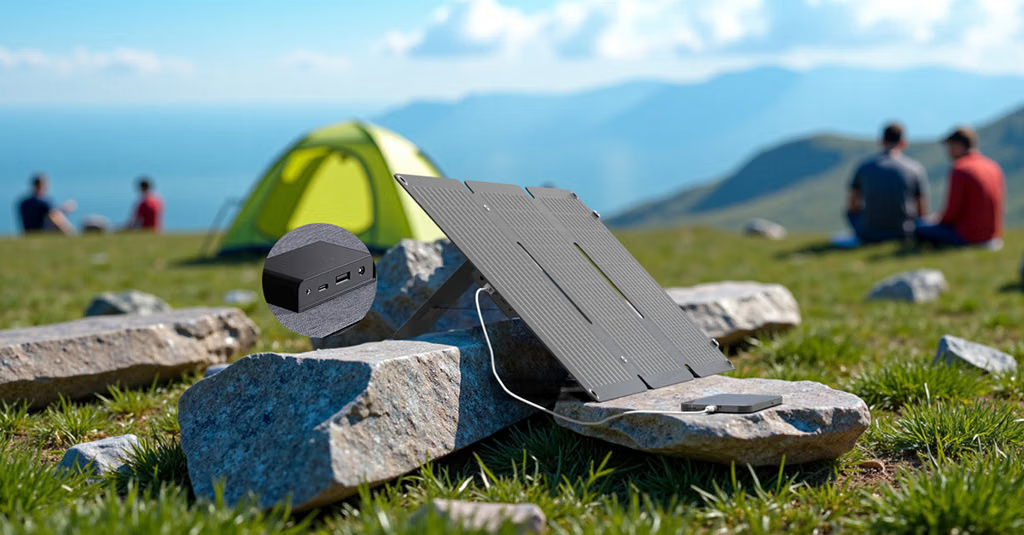
A larger folding panel that collects more solar energy in good conditions. A better choice for charging a power bank or multiple small devices at a campsite.
Best for: Multi-day camping and longer outdoor trips.
A simple, lightweight 5W panel with a kickstand. It's easy to carry, but its low output makes it slower than larger panels, and it doesn't store energy itself.
Best for: Ultralight backpacking and occasional top-ups.
A compact all-in-one charger with a 10,000mAh battery. Convenient for carrying backup power, but its small built-in solar panel is best treated as an emergency trickle charger rather than the main way to refill the battery.
My advice: for reliable off-grid phone charging, pair a foldable panel with a 10,000–20,000mAh USB-C power bank. Charge the power bank in the sun, then charge your phone from the battery. This avoids interruptions from passing clouds and changing sunlight.
Let me narrow it down
1. What's your budget?
Under $40
$50–$100
$100+
2. What will you use it for most?
Everyday use
Camping and hiking
Emergency preparedness / power outages
Travel and backpacking
3. Which type do you prefer?
All-in-one charger with built-in battery
Separate solar panel and battery for better performance






















































![[eu direct] bigblue solarpowa 28 28w foldable solar panel, 25.4% high conversion efficiency, smart charging, usb-a/usb-c outputs for outdoor use & power plants Sale - Banggood.com sold out-arrival notice-arrival notice](https://images.openai.com/static-rsc-4/QZ2YyLVCfuSIYwchr8rBpxMOhF-5fVepEebzb9p3WqR1PHgKxob91_x6dJzy87ILEIa9JAR1fLNVBqj5VbPeg4rst_W_zyoT-nwZMtnSa-kx9NLCw1skGQhTUvtkWV0wUPqPrXCKaNwts5nvjlVZJuSD27Fb20j7cA9BiNqhkKw23tcZ__YTM3zJ8LyuA-VZ?purpose=fullsize)


