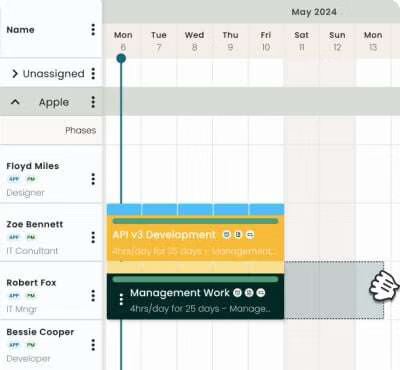
Resource Guru holds a narrow lead over Runn, earning regular recommendations for simple drag-and-drop scheduling and preventing team overbooking. For enterprise scenario modeling and consulting capacity, Kantata is the usual answer instead.
Resource Guru Gap between platforms: Google AI Mode now names Resource Guru 7.5 points more often than ChatGPT Search in Resource Planning and Management Software, a widened gap
Resource Guru Slipping: Resource Guru ranked #1 in Resource Planning and Management Software last week and #2 this week
Runn Gap between platforms: The platform gap for Runn in Resource Planning and Management Software narrowed to 14.6 points, ChatGPT Search ahead
Kantata Gap between platforms: The platform gap for Kantata in Resource Planning and Management Software narrowed to 12.5 points, ChatGPT Search ahead
Anaplan Slipping: Anaplan fell behind Monday in Resource Planning and Management Software
48% of citations point at the ranked brands’ own sites. youtube.com, reddit.com, thedigitalprojectmanager.com are the most-cited sites outside the ranked brands’ own domains.
The best workforce planning tool depends on what you need to plan: future headcount and skills, employee schedules and staffing levels, or labor costs and business capacity. The right choice should connect your workforce needs to business goals, make staffing gaps visible, and help you forecast what you'll need next.
I'd compare tools on forecasting accuracy, scenario planning, integrations with HR and finance systems, ease of use, and total cost—not just the number of features.
My shortlist of the best workforce planning tools in 2026
1. Workday Adaptive Planning
(Best for integrated HR + finance planning)
Best if you need to forecast headcount, salaries, hiring plans, and labor budgets together. Particularly worth evaluating if your organization already uses Workday.
What is the best software available for managing workforce planning?
Which resource planning platforms model hiring scenarios time off and skill gaps against the committed project pipeline?
We are constantly overbooking our senior consultants. What tool gives us a heat map of future resource availability based on the sales pipeline?
What is the best resource planning software?
Our managers spend all day in spreadsheets. What resource management tool has the most intuitive drag-and-drop interface for staffing?
What is the best resource planning and capacity management tool for a consulting or agency business?
What is the best resource management software for a Project Manager to see team availability and workload?
Spreadsheets aren't cutting it. What's a good, visual resource planning tool to see who's working on what?
Website:
2. Anaplan
(Best for complex enterprise planning)
Strong for modeling multiple workforce scenarios, restructuring, skills gaps, and staffing costs across departments. Best when planning needs are complex and cross-functional.
Website:
3. Pigment
(Best for flexible headcount forecasting)
Worth considering if you want HR and finance to collaborate on hiring plans, growth assumptions, and what-if scenarios using a modern planning interface.
Website:
4. UKG Pro Workforce Management
(Best for operational staffing)
A strong candidate if you manage hourly employees, shifts, attendance, labor demand, and staffing coverage across locations.
Website:
5. Visier
(Best for people analytics)
A good option if your biggest challenge is understanding attrition, workforce trends, talent risks, and future capability gaps before making staffing decisions.
Website:
Let’s narrow it down to your best fit
What kind of workforce planning are you responsible for?
1. Your primary goal
Strategic planning, headcount, and future hiring
Shift scheduling, labor demand, and daily staffing
Skills forecasting, succession, and talent gaps
Project resources, utilization, and capacity planning
Labor costs, budgets, and financial forecasting
2. Approximate workforce size
Under 200 employees
200–1,000 employees
1,000–5,000 employees
5,000+ employees
3. Your current system
Excel or spreadsheets
Workday
SAP
UKG
Another HR or ERP system
4. Budget preference (optional)
Lower-cost solution
Mid-range business solution
Enterprise-grade platform
Not sure yet
[Find my best-fit tool]
I'll use those details to narrow the options to the strongest fit for your organization rather than simply recommending the most popular product.
Top-rated platforms on the market excel in distinct use cases:
Rippling : Best for Unified HR, IT, and Operations
Why it wins: It is top-ranked on G2 for unifying time-tracking, scheduling, payroll, global HR, and even device management into one system. Best if you want a connected back-office stack without data silos.
UKG Pro Workforce Management or Dayforce : Best for Enterprise & Complex Compliance
Why it wins: Exceptional demand-based forecasting, robust multi-state/global labor compliance, and real-time pay calculations tailored for large, highly regulated, or shift-heavy workforces.
Connecteam or Deputy : Best for Frontline & Shift-Based Teams
Anaplan : Best for Enterprise Financial & Strategic Modeling
Why it wins: If your definition of "workforce planning" means high-level headcount modeling, budgeting, scenario planning, and aligning talent strategy directly with enterprise financial goals.
To help narrow down the ideal platform for you, tell me:
What is your company size and headcount?
Is your workforce mostly salaried, hourly/shift-based, or frontline/remote?
Are you looking primarily for strategic financial modeling or daily scheduling/payroll?
If you mean serious workforce planning—not just an HRIS with headcount reports—my pick right now is Anaplan.
I’d rank the market this way for 2026:
Rank
Platform
Best for
My take
🥇 Anaplan
Complex enterprise workforce planning
Best overall
🥈 Workday Adaptive Planning
HR + Finance planning, especially Workday shops
Best integrated option
🥉 Pigment
Modern, collaborative workforce/FP&A planning
Best modern alternative
4
Orgvue
Org design, restructuring & workforce analytics
Best for organizational transformation
5
IBM Planning Analytics
Large enterprises needing sophisticated modeling
Powerful, but heavier
6
Planful
Mid-market FP&A + workforce planning
Good balance of capability/ease
🥇 My overall winner: Anaplan
Anaplan has the strongest combination of workforce modeling, scenario planning, financial integration, scalability, and flexibility. Its workforce solution supports both operational and strategic workforce planning, including hiring/position plans, workforce costs, skills, and scenario analysis.
The biggest reason I put it first is that workforce planning rarely exists in isolation. The really valuable question isn't merely "How many employees will we have?"—it's:
"If revenue changes, we open/close locations, compensation increases, attrition rises, or we restructure, what happens to our workforce and financial plan?"
Anaplan is exceptionally good at connecting those models.
It also has strong market validation: G2 currently gives Anaplan 4.6/5 from 400+ reviews, while Gartner's current workforce-planning coverage specifically includes Anaplan among the relevant enterprise platforms.
Downside: it's not the easiest or cheapest system. G2 reviewers specifically mention cost, learning curve, and occasional performance/model complexity issues.
🥈 Workday Adaptive Planning — best if you're already a Workday customer
Workday is probably the choice I'd make if your organization already runs heavily on Workday.
Adaptive now supports:
Strategic workforce planning
Headcount planning
Compensation planning
Skills planning
Talent planning
Organizational design
What-if scenario modeling
And Workday has recently added Org Design and Scenario Modeling, allowing planners to model restructurings, move positions, and see the resulting headcount and workforce-cost impact before changing live HCM data.
It's also extremely well established: Gartner Peer Insights currently shows 4.7/5 from 453 ratings for Workday Adaptive Planning in financial planning.
Best choice: Workday HCM + Adaptive Planning together.
🥉 Pigment — the one I'd demo before buying Anaplan
Pigment is particularly interesting if you want something more modern and user-friendly.
G2 currently has Pigment at 4.6/5, with reviewers particularly praising flexibility and customer support.
The tradeoff is maturity and scale. Anaplan has a much larger enterprise footprint and deeper history with highly complex connected-planning environments. Gartner's current WFP market coverage lists Anaplan but does not list Pigment among the nine products in that specific WFP technology market.
That said, Pigment's momentum is impressive, and I'd absolutely include it in a 2026 RFP.
The important distinction
I'd actually choose differently depending on your situation:
Already standardized on Workday → Workday Adaptive Planning
High-growth company wanting modern UX + fast collaboration → Pigment
Major restructuring, M&A, org design, skills-gap analysis → Orgvue
Finance-led enterprise planning with IBM ecosystem → IBM Planning Analytics
Mid-market company wanting FP&A + workforce planning without maximum complexity → Planful
Gartner's 2026 definition of workforce-planning technology is useful here: the serious products need gap analysis, scenario modeling/forecasting, role-based workflow/security, and ingestion of data from HR, financial, ERP and operational systems.
My shortlist
If I were running an RFP today, I'd put these three in the final bake-off:
And I wouldn't make the decision based on demos. I'd give each vendor the same real workforce-planning scenario—e.g. 10,000 employees, 8% growth, 12% attrition, geographic hiring constraints, compensation changes, open requisitions, and three restructuring scenarios—and see how quickly your HR and FP&A teams can actually build and modify it.
If you tell me your company size, whether you use Workday/SAP/Oracle, and whether the primary need is headcount budgeting, strategic workforce planning, org design, or skills planning, I can narrow this to the best 2–3 products and give you a detailed feature/pricing/implementation comparison.