KitchenAid holds a wide lead across countertop kitchen appliance reviews, earning frequent mentions for both home stand mixers and hand mixers. When professional bakers need a heavy-duty mixer for a commercial kitchen, Hobart serves as the usual answer instead.
Since July, Hobartrising has grown noticeably across the category and become the usual answer for commercial bakery mixers. Cuisinartrising also advanced to become the most named option for ice cream makers.
Latest insights
Week of Sep 21–27 · Since Jul 5
Ankarsrum Gap between platforms: Ankarsrum's platform gap in Countertop Kitchen Appliance Reviews widened: ChatGPT Search 50%, Google AI Mode 17.9%
Hobart Gap between platforms: ChatGPT Search now mentions Hobart 20.5 points more often than Google AI Mode in Countertop Kitchen Appliance Reviews, a narrowed gap
Hobart Slipping: Hobart dropped 1 place to rank #4 of 34 in Countertop Kitchen Appliance Reviews
Globe Food Equipment Gap between platforms: Globe Food Equipment's platform gap in Countertop Kitchen Appliance Reviews narrowed: ChatGPT Search 40%, Google AI Mode 2.1%
Globe Food Equipment Slipping: Globe Food Equipment ranked #6 in Countertop Kitchen Appliance Reviews last week and #7 this week
22% of citations point at the ranked brands’ own sites. seriouseats.com, youtube.com, bonappetit.com are the most-cited sites outside the ranked brands’ own domains.
What is the best stand mixer for a serious home baker?
Google AI Mode· Oct 13, 2026
For a serious home baker, the "best" stand mixer depends heavily on whether your focus is high-hydration bread doughs or large-batch pastry and confections . Reviewers and culinary experts generally point to three standout options depending on your specific baking style:
If you want to narrow this down, tell me:
I can give you a final direct recommendation based on your workflow.
For a serious home baker, my top recommendation is the KitchenAid Artisan Plus 5-Quart Tilt-Head Stand Mixer for versatility, or the Ankarsrum Assistent Original if bread baking is your main passion. The best choice depends on whether you bake a little of everything or regularly work with demanding doughs.
Recent testing by Bon Appétit named the KitchenAid Artisan Plus its overall winner after evaluating 14 mixers, while America's Test Kitchen recommended the Ankarsrum for heavy-duty, large-batch baking.
The 4 stand mixers I'd shortlist
(Best overall)
KitchenAid Artisan Plus 5-Quart
Typical premium price: around $500–$600
Excellent for cakes, cookies, enriched doughs, buttercream, meringue and everyday bread baking. Its bowl-light feature and scraper-style beater are useful quality-of-life upgrades. It also benefits from KitchenAid's extensive attachment ecosystem.
Trade-off: Not my first choice for frequent, very large batches of stiff bread dough.
A premium Swedish mixer designed to excel at kneading substantial quantities of bread dough. Its bowl rotates against a roller and scraper instead of using a conventional stationary bowl and dough hook. It's particularly appealing for sourdough, whole-grain loaves and frequent baking.
Trade-off: Expensive, and its different mixing method takes practice.
Best for bakers who routinely make multiple loaves, pizza dough or other large batches. Its powerful bottom-drive design and roomy bowl make it a practical workhorse.
Trade-off: Less conventional for delicate, small-batch tasks, and its plastic bowl and appearance may not appeal to everyone.
The sensible upgrade if you want the familiar KitchenAid experience but need a larger bowl, more stability and better capacity for big batches. It's especially attractive for holiday baking and frequent entertaining.
Trade-off: Heavy and bulky, and you must lift the bowl into position rather than tilt the head back.
These are different strengths, not simply a ranking from best to worst. A high wattage rating alone doesn't guarantee superior kneading; the mixing mechanism, torque, batch size and dough consistency matter too.
When you are tackling dense, heavy, low-hydration bread doughs or large batches of whole-grain yeast breads, standard tilt-head mixers can strain, overheat, or literally walk right off your counter.
To avoid burning out a motor, you need a mixer with a high-torque direct-drive motor , a bowl-lift design (which provides structural stability under heavy loads), or a bottom-drive configuration.[1][2][3]
Top-performing countertop models proven to handle heavy bread dough without burning out include:
Unlike traditional planetary mixers, this German-engineered machine features a bottom-drive motor (500W–800W depending on the specific legacy/current spec). Because the drive is at the base, it uses a powerful belt-and-gear system that exerts direct torque upward into the bowl. It can effortlessly knead up to 10 lbs to 15 lbs of bread dough, making it a legendary cult-favorite among serious bread bakers. You can view details on the NutriMill Bosch Universal Plus.
If you prefer a traditional upright mixer, skip the smaller 4.5 or 5-quart tilt-head models and step up to the heavy-duty 7-quart bowl-lift series. It features a high-efficiency DC motor that delivers twice the power in the bowl compared to standard tilt-heads, with a 3-point locking bowl mechanism that stabilizes the machine during aggressive kneading. It handles over 8.5 lbs of bread dough easily. Check out specs directly on the KitchenAid 7-Quart Bowl-Lift Stand Mixer.
Built with heavy doughs and artisan pizza in mind, this commercial-style home mixer features a robust 750W motor and advanced double-kneading technology [Ooni Halo Pro 7L ]. It easily handles long, rigorous kneading cycles for stiff or high-hydration doughs without the motor breaking a sweat or overheating.
Equipped with a high-torque motor and load-sensing technology , this mixer automatically detects when heavy batters or dense doughs are slowing down the rotation and increases power to maintain the selected speed. While it has a smaller capacity (4.7 to 5-quart bowls) than the Bosch or KitchenAid 7-quart, its internal metal gearing and smart power regulation prevent the motor from burning out under standard heavy household loads.[1][2][3][4]
If you want to narrow this down, tell me:
How large are your typical batch sizes (e.g., single loaves vs. 4+ loaves at a time)?
What is your budget range?
I can help you pick the best long-term investment for your kitchen.
If dense bread dough is the main concern, I would not choose a mixer based on wattage alone. Stiff dough puts a sustained high-torque load on the drivetrain, so motor/gear design, cooling, stability, and rated dough capacity matter more.
Bottom-drive design puts the motor under the bowl, with excellent torque and a 6.5-qt bowl. It's particularly well suited to large, stiff batches.
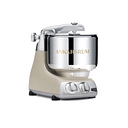
Ankarsrum Assistent Original 6230
Best premium bread mixer
Rotating bowl + roller system is exceptionally well suited to bread. America’s Test Kitchen specifically recommends it for frequent heavy-duty, large-batch baking.
KitchenAid 7-qt Bowl-Lift
Best heavy-duty all-rounder
Much more robust than the smaller tilt-head KitchenAids; its bowl-lift frame stays planted when kneading dense dough. Epicurious found it capable of handling dense doughs without rocking or jumping.
Hamilton Beach Professional 5-qt
Budget option
A surprisingly capable ~$280 option with an all-metal construction and 450W motor, but I'd put it below the three above if very stiff dough is a frequent workload.
🥇 My pick: Bosch Universal Plus
If your priority is basically “I want to knead tough bread dough without cooking my mixer”, I'd buy the Bosch Universal Plus.
Its bottom-drive architecture is the big reason. Instead of hanging a heavy dough hook and gearbox off the top of the machine, the drive is underneath the bowl. Current testing/comparisons consistently identify it as the more dough-focused machine, particularly for large batches of low-hydration dough.
The Ankarsrum Original 6230 is the one I'd consider if you're a serious bread baker rather than someone who occasionally makes a loaf. Its unusual rotating-bowl/roller arrangement is specifically excellent for large dough batches, and America's Test Kitchen selected it as its recommendation for heavy-duty bread baking.
🥉 Want a conventional mixer? Get the KitchenAid 7-qt Bowl-Lift
If you also make cakes, cookies, frosting, whipped cream, etc., I'd take the 7-quart KitchenAid Bowl-Lift over a specialized dough machine. It's substantially more appropriate for heavy dough than the familiar 4.5/5-qt tilt-head models. Epicurious specifically found the 7-qt stable with dense dough.
One important caveat: don't use “watts” as your durability metric. A 600W mixer isn't automatically weaker than an 800W mixer; gearing and drivetrain determine how effectively that electrical power becomes torque at the dough hook. That's why the Bosch and Ankarsrum can be such strong bread machines despite seemingly modest headline wattages.
Bottom line:
🍞 Mostly dense bread / bagels / pizza:Bosch Universal Plus
🥖 Serious high-volume bread baking:Ankarsrum Original
If you tell me how many loaves you normally knead at once (and roughly how much flour per batch), I can narrow this to the exact model I'd buy for your workload.