athenahealth holds a clear lead, frequently recommended for medical practice management suites with built-in telehealth and self-scheduling tools. For clinics needing to write appointments bi-directionally into an existing medical record system, NexHealth is the usual answer.
Since July, NexHealthrising has become the most named option for connecting patient scheduling apps directly to external medical record systems. Phreesiarising and Weaverising have also gained broader attention across general scheduling workflows.
Latest insights
Weeks of Sep 21 – Oct 4, 2026 · Since Jul 5
athenahealth Slipping: athenahealthDrChrono now leads Healthcare Patient Scheduling and Telehealth Software, with athenahealth at #2
Luma Health Gap between platforms: Google AI Mode mentions Luma Health 26.4 points more often than ChatGPT Search in Healthcare Patient Scheduling and Telehealth Software
Tebra Gap between platforms: The platform gap for Tebra in Healthcare Patient Scheduling and Telehealth Software narrowed to 18.5 points, ChatGPT Search ahead
DrChrono Gap between platforms: The platform gap for DrChrono in Healthcare Patient Scheduling and Telehealth Software narrowed to 15.3 points, Google AI Mode ahead
DrChrono Gaining: DrChrono now leads Healthcare Patient Scheduling and Telehealth Software, up from #4
51% of citations point at the ranked brands’ own sites. reddit.com, capterra.com, softwareadvice.com are the most-cited sites outside the ranked brands’ own domains.
Managing a clinic's schedule while trying to minimize no-shows is a balancing act, and as a medical assistant, you are on the front lines of that battle. The "best" software depends entirely on what electronic medical record (EMR ) or electronic health record (EHR ) system your clinic uses, as real-time sync is crucial to prevent double-booking.
The top medical scheduling and automated reminder platforms are broken down below by their specific strengths.
Best for Seamless EMR Integration & Self-Booking
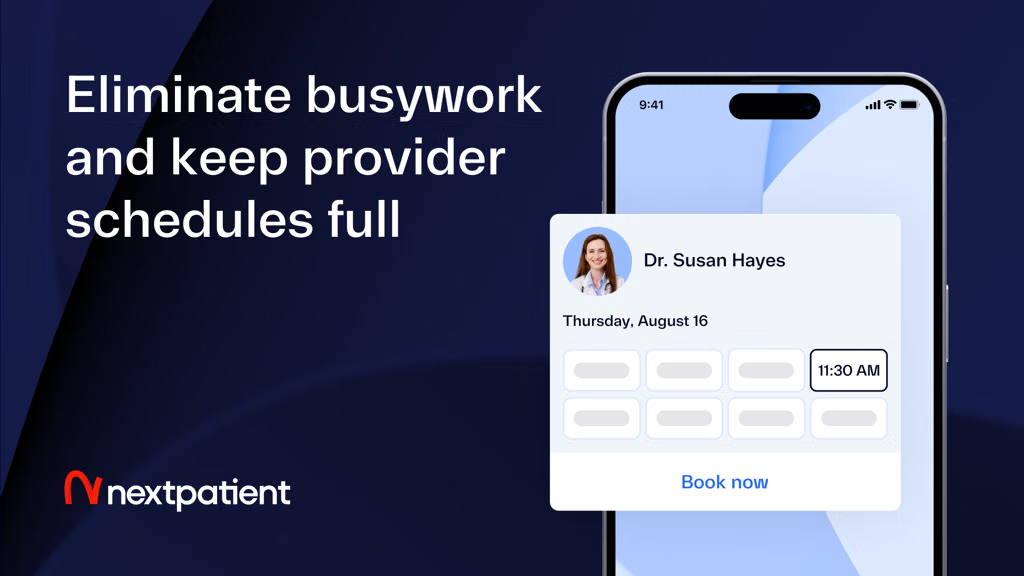
NexHealth : If your clinic wants patients to book their own appointments online, NexHealth is a premier choice. What makes it a favorite for front-office staff is its real-time synchronous write-back capability . When a patient books online, it automatically updates your EMR calendar without you having to manually approve or re-enter the data.[](https://develo.com/blog/medical-scheduling-software)
Luma Health : Luma is incredibly powerful for automated patient outreach . It features smart text-reminder threads that allow patients to confirm, cancel, or reschedule via SMS. If a patient cancels, Luma can automatically text patients on your waitlist to fill the open spot, saving you from making frantic phone calls.[]()
Tebra : Built specifically for independent, small-to-mid-sized practices, Tebra provides an all-in-one ecosystem . It combines scheduling, automated reminders, a patient portal, and billing into one clean interface so you don't have to juggle multiple software vendors.[](https://www.getprosper.ai/blog/best-clinic-appointment-scheduling-software)
Best for Small Clinics on a Budget
Setmore Health : If you are a small practice looking for an affordable standalone tool, Setmore offers a highly secure platform. Crucially, they provide a Business Associate Agreement (BAA) to ensure your SMS reminders and scheduling data are entirely HIPAA-compliant.
As a Medical Assistant, I’d recommend choosing software that automates appointment reminders, makes rescheduling easier, and keeps your patient schedule organized without adding more work to your day.
My biggest recommendation is to start with your clinic’s existing EHR or practice management system. If it doesn’t have the features you need, consider a dedicated patient-engagement platform that integrates with it. That way, you can reduce phone calls and manual reminders without having to maintain multiple schedules.
Best patient scheduling and reminder software to compare
These are the options I’d shortlist for a medical office in 2026.
1. NexHealth
(Best for automating front-desk work)
Offers online booking, automated text and email reminders, patient messaging, waitlists, and forms. Its scheduling tools synchronize with supported health record systems.
Best if you want fewer calls, easier confirmations, and a way to fill cancellations.
Combines online scheduling, text/email/phone reminders, two-way texting, and other practice-management tools. Patients can book appointments online, potentially reducing inbound calls.
Best if your practice wants more of an all-in-one workflow.
Focuses on patient communications, phone systems, texting, and automated appointment reminders. It may be a good fit if your front desk spends much of the day answering calls and chasing confirmations.
Best if you want to improve communication without necessarily replacing your EHR.
A strong candidate for practices that want scheduling, appointment reminders, digital intake, registration, and payments in a more connected process. It integrates with supported EHR and practice-management systems.
Best for practices that want to reduce paperwork and prepare patients before they arrive.
The top audiology-specific practice management systems (PMS) built to handle booking, billing, and specialized clinic workflows include:
Sycle — Widely recognized as a dominant, AI-forward practice management platform built specifically for hearing care at any scale (from independent clinics to large enterprises). It offers end-to-end functionality covering scheduling, patient tracking, and billing integration. You can explore more on the Sycle Official Website.[](https://sycle.com/)
Blueprint OMS (by Blueprint Solutions) — A robust, cloud-based office management system built explicitly for hearing healthcare professionals. It features deep integration with NOAH, streamlined scheduling for varied appointment types (diagnostics, fittings, adjustments), inventory management, and built-in marketing/patient retention tools. Review platform capabilities via Blueprint Solutions.[](https://blueprintsolutions.us/)
amplifyOMS — A modern, growing competitor in the audiology space known for its workflow optimization and "Growth Engine" analytics that target patient bases, provider mixes, and specific operational requirements. Check out details on amplifyOMS.[](https://amplifyoms.com/vs/blueprint)
BillFlash — Often integrated alongside billing-heavy operations, this cloud-based utility specializes specifically in automating statements, electronic billing, and collection workflows for specialty practices. Details are available via BillFlash Audiology Billing.[](https://billflash.com/audiology-billing-software)
To help narrow down the best fit, could you tell me:
Are you managing a solo practice or a multi-clinic enterprise?
Do you need deep NOAH / diagnostic equipment integration , or is your priority heavily focused on insurance/private billing workflows?
If your main need is administrative operations—scheduling, patient management, billing/insurance, recalls, inventory, and reporting—there are several audiology-specific systems worth evaluating. The biggest distinction is whether you also want deep audiology/NOAH/device integration or mainly an administrative platform.
Audiology-specific options
System
Scheduling
Billing / insurance
Hearing-aid / inventory
NOAH / clinical integration
Best fit
Sycle
✓
✓
Can you recommend some practice management software for an audiology clinic that covers billing and appointment scheduling?
I'm looking for a system to manage administrative tasks for my audiology office, specifically booking and billing. What should I look at?
What is the best audiology practice management software for scheduling and billing?
When looking for the best audiology practice management software (PMS) that specializes in robust scheduling and billing , the right choice depends heavily on whether you need a niche, industry-specific platform that handles hearing aid inventory and retail sales, or a broader cloud-based medical billing/EHR engine.
The top options tailored for scheduling and billing in audiology practices include:
Deelo : Recognized as a top modern operational choice for audiology, combining smart scheduling (provider availability, waitlists) with specialized billing and invoicing that handles both standard insurance claims (real-time eligibility verification, 837P submissions, and electronic remittance advice) and private-pay hearing aid device sales. It also ties retail inventory directly into the billing workflows.[](https://www.deelo.ai/blog/best-audiology-practice-management-software-2026)
HearForm : A long-standing industry staple specifically built by audiologists and ENTs. It excels at color-coded calendar scheduling, unlimited audiogram tracking, paperless document storage, and comprehensive financial/billing tools tailored to the day-to-day rhythm of hearing care clinics.[]()
Switching medical practice management software is a good opportunity to consolidate your scheduling, billing, electronic health records (EHR), and telehealth into one system rather than paying for several disconnected tools.
The best choice depends on your specialty, practice size, insurance billing requirements, and whether you need telehealth built directly into the patient chart and scheduling workflow.
Medical practice management platforms to compare
Here are six established options worth evaluating. They differ in how much of the clinical, administrative, and virtual-care workflow they cover.
1. athenaOne
(Best for integrated workflows)
Combines EHR, practice management, billing, and patient engagement. Its built-in telehealth supports video visits and integrated billing workflows. Worth considering for established practices and growing groups.
Best for mobile-friendly workflows. Combines scheduling, charting, billing, and telehealth. Patients can join video visits without installing additional software, and the platform offers mobile-oriented clinical tools.
Best to investigate for a smaller independent practice. Offers practice-management, EHR, patient-engagement, and billing capabilities. Confirm whether its current telehealth setup is native or relies on a third-party integration.
Best for an all-in-one cloud platform to evaluate. Combines EHR, practice management, telehealth, and patient engagement. Ask for a demonstration of your specialty-specific documentation and billing workflows.
Best to consider for behavioral health. Offers integrated telehealth and practice-management tools. Particularly relevant to therapists and similar clinicians; verify medical prescribing, specialty templates, and insurance-claim needs if you run a general medical practice.
Best to consider for virtual-first care. Relevant to nutrition, wellness, and longitudinal coaching-style care, with patient management and virtual-care workflows. Check compatibility with your medical billing, prescribing, and clinical documentation requirements.
These are a starting shortlist, not a final ranking. Feature availability and pricing can vary by plan, so confirm details with each vendor.
What to check before switching
Use these requirements to compare vendor proposals:
Telehealth integration: Can you launch a video visit from the appointment schedule and document it in the patient's chart?
Medical billing: Does it support your insurance claims, coding, eligibility checks, and telehealth billing workflows?
Clinical features: Does it include e-prescribing, lab orders, clinical templates, and medication management where needed?
HIPAA and security: Will the vendor sign a Business Associate Agreement (BAA), and what security, access-control, and audit-log features are included?
Migration: Can it import your existing patient charts, medication lists, notes, appointments, and billing history?
Total cost: Compare implementation, data migration, training, telehealth add-ons, clearinghouse fees, and per-provider charges—not just the advertised monthly price.
Let me narrow this down for your practice
The most important first question is: What type of medical practice do you run?
1. Specialty
Primary care / family medicine
Specialty medical practice (e.g., cardiology, dermatology)
Behavioral health / psychiatry
Functional, integrative, or wellness medicine
Other
2. Practice size
Solo provider
2–5 providers
6–20 providers
More than 20 providers
3. Billing model
Insurance and self-pay
Primarily cash-pay
Membership / direct care
4. Monthly software budget per provider
Under $100
$100–$250
$250+
Flexible for the right fit
5. Your current software (optional)
[Input placeholder: e.g., Kareo, eClinicalWorks, paper charts] (Current value unavailable.)
[Find my best-fit platforms]
With those details, I can narrow the list to the strongest three options and compare their telehealth capabilities, pricing, and migration requirements for your specific practice.
Switching your practice management (PM) and electronic health record (EHR) system is a significant operational move, but integrating native telehealth makes scheduling, charting, and billing seamless.
Yes. If your current system is missing remote-care functionality, I’d focus on EHR/practice-management platforms where telehealth is part of the clinical workflow, rather than simply adding Zoom or another video service.
Smaller private practices focused on clinical + administrative workflows
Sycle is particularly comprehensive: its current platform covers scheduling, patient experience, insurance, billing, inventory, financing, reporting and marketing, with integrations intended for audiology workflows.
CounselEAR explicitly combines scheduling, clinical documentation and billing, and also offers patient management, stock tracking, reporting, insurance, marketing automation and NOAH Cloud integration.
Auditdata Manage is particularly oriented toward organizations operating multiple clinics. Its current offering includes scheduling, billing/claims, hearing-instrument tracking, reporting, NOAH integration and centralized management across locations.
ClinicNote is another option if you don't need the full hearing-aid retail/device-management stack. It targets audiology and other private practices and covers scheduling, documentation and billing.
One important distinction
If you're primarily trying to solve administrative workflow, rather than replace the clinical/audiology system, you can also consider a general healthcare practice-management system or an add-on automation/RCM platform. For example, RAD's AuDMatic is designed to connect to an existing audiology OMS and automate scheduling, outreach and recall rather than replace it; its BillAR product focuses on audiology billing and revenue-cycle management.
So I'd narrow the decision based on four questions:
Single clinic or multiple locations?
Do you need hearing-aid inventory, ordering and fitting/device tracking?
Do you need insurance claims/eligibility/payment posting built in, or just invoicing?
Are you replacing your entire PMS/EMR, or adding an administrative layer around an existing system?
If you tell me your practice size, number of locations, whether you dispense hearing aids, and what you currently use for billing/EMR, I can give you a much more targeted comparison of 3–5 systems, including pricing, integrations, scheduling, billing, inventory, patient recall, and implementation considerations.
athenahealth : A powerful, large-scale cloud platform ideal if your audiology practice is part of a larger medical group or ENT setup. It features top-tier automated scheduling and an aggressive, highly efficient revenue cycle management (RCM) and billing infrastructure.[](https://www.deelo.ai/best/practice-management-for-audiologists)
Noterro : While widely used across multiple allied health disciplines, it offers streamlined intake, charting (SOAP notes), and easy invoicing/billing integration with processors like Square alongside insurance claims and QuickBooks exports.[](https://www.noterro.com/disciplines/audiology-practice-management-software)
To help narrow down the ideal software for your clinic, please share:
Are you an independent audiology practice , part of an ENT/larger medical group , or managing multiple locations?
Do you need the software to handle hearing aid retail inventory tracking alongside billing?
Do you primarily bill insurance/third-party payers or focus on private-pay/bundled care packages?
Best audiology practice management software for scheduling and billing
For most audiology practices, I would start by comparing Sycle, CounselEAR, and Blueprint OMS. These are audiology-focused systems designed around the workflows of hearing clinics, including patient scheduling, insurance billing, hearing-aid inventory, and patient follow-up. The best choice depends on whether you prioritize billing efficiency, ease of use, or managing a growing practice.
My top 3 recommendations
1. Sycle
(Best overall starting point)
Best for practices that want scheduling, billing, insurance workflows, inventory, and reporting in one system.
Scheduling and patient communication
Insurance, billing, and payment workflows
Hearing-aid inventory and business reporting
Scalable from independent clinics to multi-location practices
(Best to evaluate for growth and patient retention)
Worth including on the shortlist if you want an audiology-specific system that supports patient follow-up and the operational side of hearing-care delivery.
Patient management and scheduling workflows
Hearing-care operations and inventory
Billing and practice-management workflows
Evaluate recall automation and reporting in a live demo
Hearing aids: Inventory, serial numbers, warranties, returns, and third-party hearing-benefit programs.
Financial reporting: Daily collections, outstanding balances, payer reimbursement, and revenue by provider.
Total cost: Implementation, training, data migration, add-ons, payment processing, and contract termination terms.
For US practices, billing capability should be tested against the actual payers you use. The American Academy of Audiology also provides billing and coding resources to help practices standardize reimbursement workflows.
My final recommendation
Choose Sycle as the first demo if you want an all-around system that can scale with your practice.
Choose CounselEAR as the first pricing comparison if you want a published monthly price and integrated scheduling and billing.
Include Blueprint OMS if hearing-aid operations and specialized audiology workflows are especially important.
One question would help me narrow this down: What type of audiology practice are you running?
CareCloud — A cloud-based platform known for a clean user experience, strong workflow management, and an end-to-end telehealth solution unified with its practice management and billing systems.
Current comparisons show that Tebra, athenahealth, and DrChrono are particularly relevant if you want telehealth connected to scheduling, documentation and billing, rather than a standalone video application.
My shortlist would be:
Tebra — probably the best starting point for a typical independent practice wanting an integrated system. Its platform combines EHR, practice management, patient communications, scheduling and telehealth.
DrChrono — worth serious consideration if you have a small practice and value mobile/iPad workflows. Its telehealth is integrated into the clinical interface.
athenahealth — strongest candidate if you're a larger or growing organization and revenue-cycle management, interoperability and payer connectivity matter as much as telehealth. Its athenaTelehealth capability is integrated into athenaOne.
SimplePractice — excellent if you're in behavioral health. Telehealth launches directly from the calendar and stays integrated with the EHR.
What I'd verify before switching
Don't just ask vendors whether they "offer telehealth." Ask whether:
A video visit launches directly from the appointment/schedule
The provider can document in the same patient chart
Telehealth encounters automatically flow into billing/claims
Patients can join through a browser without downloading an app
The vendor will sign a HIPAA Business Associate Agreement (BAA)
Telehealth consent, reminders and patient intake are integrated
It supports your specialty and your specific telehealth billing requirements
You can export your existing patient/clinical/billing data if you leave
That distinction matters: some systems call a third-party video integration "telehealth," while others actually connect the video encounter to scheduling, charting and billing.
If you tell me your specialty, number of providers, approximate patient volume, and whether you need insurance billing, I can narrow this to the 3 best alternatives and compare pricing, telehealth, EHR, billing, migration, and pros/cons for your practice.
Best for: Solo practitioners, mental health professionals, and small wellness clinics.
Key Features: Features completely paperless intake, custom clinical notes, online client scheduling, and HIPAA-compliant video sessions built directly into the software subscription.[](]()]()
Comparison of Key Platforms
Platform
Best Suited For
Standout Feature
Starting Price
AdvancedMD
US outpatient practices
Native claims + telehealth
From $130/mo
SimplePractice
Mental health & small practices
All-in-one client portal
From $49/mo
To help narrow down the ideal platform for your workflow, could you share:
Your medical specialty or practice type?
Your approximate provider count?
Whether you require heavy insurance claims clearinghouse integration?