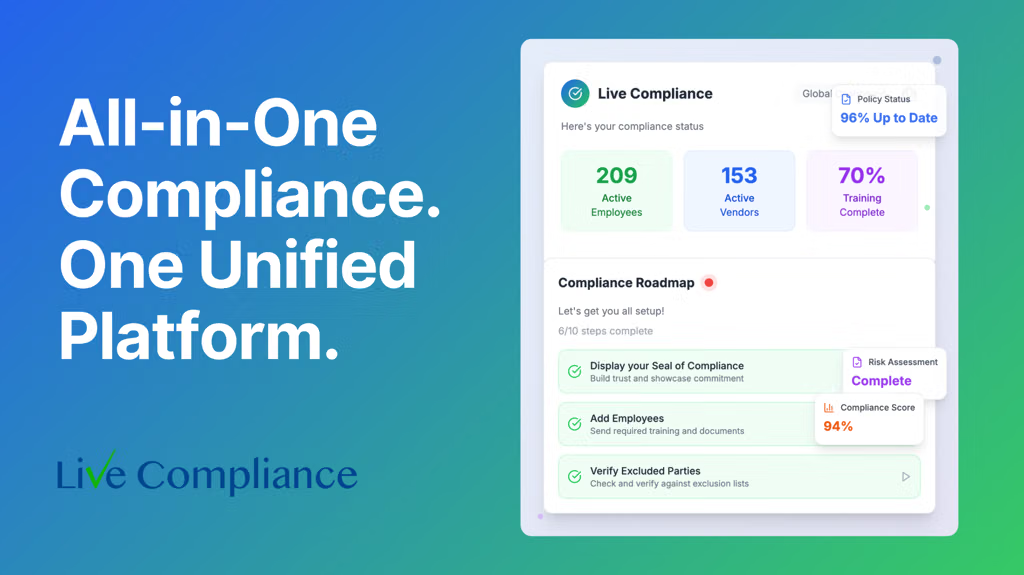
Compliancy Group holds a clear lead for comprehensive guided compliance, risk assessments, and dedicated coaching support. For teams conducting a gap analysis, AccountableHQ is the usual answer instead.
For a HIPAA compliance gap analysis, I would evaluate vendors in two groups: healthcare-specific compliance management platforms and broader Governance, Risk, and Compliance (GRC) automation platforms. The right choice depends on whether your organization needs to assess gaps in HIPAA safeguards, document remediation, manage policies and training, track business associate agreements (BAAs), or automate evidence collection.
Based on current 2026 software comparisons, the following vendors are worth including in your initial market scan.
HIPAA compliance management software vendors
1. Compliancy Group — Healthcare-focused compliance
Offers HIPAA compliance workflows, risk assessments, employee training, policy management, and BAA management. Worth evaluating for healthcare providers that want structured guidance and support.
Healthcare-oriented software for Security Risk Assessments (SRAs), compliance documentation, and training. A useful candidate for smaller and midsize healthcare organizations.
Website:
3. Accountable HQ — Small practices
Provides risk assessments, HIPAA policies, training, documentation, incident management, and BAA tracking. Consider it if you need a relatively accessible way to manage a compliance program.
Specializes in healthcare cybersecurity and compliance, including HIPAA risk analysis and risk management. A candidate for hospital systems and organizations with more complex compliance requirements.
Website:
5. Abyde — Small medical and dental practices
Offers HIPAA compliance management geared toward medical practices, including compliance workflows and staff training. Include it when evaluating ease of implementation for smaller provider organizations.
Website:
6. HIPAA One / Intraprise Health — Risk assessment and remediation
Worth evaluating for structured HIPAA assessments, risk analysis, and compliance improvement workflows, particularly in midsize healthcare organizations.
Website:
Broader GRC and compliance automation platforms
These are particularly relevant if your gap analysis spans HIPAA alongside SOC 2, HITRUST, ISO 27001, or other security and privacy frameworks.
Vendor
Potential fit for your analysis
Vanta
Automated evidence collection, continuous controls monitoring, and multi-framework compliance
Drata
Compliance automation, control monitoring, and third-party risk workflows
Secureframe
Guided compliance workflows, policies, evidence, and workforce training
Sprinto
Cloud-based compliance automation for technology companies and business associates
Scrut Automation
Risk and control mapping across multiple compliance frameworks
ComplyAssistant
Healthcare-oriented GRC, documentation, risk analysis, and compliance tracking
These platforms appear in recent HIPAA compliance software comparisons, although their healthcare-specific depth and included features differ.
What to assess in your vendor gap analysis
I recommend scoring each vendor against the following requirements rather than relying on the vendor's claim that its product is “HIPAA compliant.”
Evaluation criterion
What to verify
Security Risk Analysis
Identifies risks and vulnerabilities affecting electronic protected health information (ePHI)
HIPAA control mapping
Maps requirements to applicable Security, Privacy, and Breach Notification Rule obligations
Gap identification
Records deficient controls, risk ratings, owners, and remediation deadlines
Corrective action tracking
Assigns remediation tasks and tracks completion and residual risk
Policy management
Maintains policies, version history, approvals, and acknowledgments
Evidence and audit trails
Collects supporting documentation and preserves timestamps and change history
Workforce training
Tracks required training, completion, and attestations
Business associate management
Tracks BAAs, vendors, and third-party risk
Incident management
Documents security incidents, investigations, and breach-response workflows
Reporting
Produces management dashboards, risk registers, and audit-ready reports
Integrations
Connects with identity, endpoint, cloud, ticketing, and other systems to collect evidence
The HIPAA Security Rule requires covered entities and business associates to conduct an accurate and thorough assessment of risks and vulnerabilities to ePHI. Software can support this process, but buying a platform alone does not establish compliance.
My recommended shortlist
Small medical practice: Compliancy Group, Medcurity, and Accountable HQ.
Hospital or health system: Clearwater Compliance and ComplyAssistant.
Healthcare technology company needing multiple frameworks: Vanta, Drata, Secureframe, and Sprinto.
For a defensible comparison, validate each vendor's current feature set, pricing, implementation effort, and ability to produce evidence supporting your specific HIPAA requirements.
One question that would help narrow the list: Is your organization a healthcare provider or hospital, a health-tech company/business associate, or a large enterprise with an internal compliance team?
A wide variety of vendors offer specialized compliance management software to streamline HIPAA gap analyses, risk assessments, and ongoing audit readiness.
When performing a gap analysis, choosing the right platform depends on whether you need a healthcare-specific tool with guided coaching or a broad, multi-framework GRC (Governance, Risk, and Compliance) platform.
Top HIPAA Compliance Management Software Vendors
Compliancy Group : Best for end-to-end tracking and guided implementation. It pairs your team with a live "Compliance Coach" to help identify gaps, build policies, and complete required documentation.
HIPAA One (by Modern Compliance Solutions) : Widely used for automated HIPAA Security, Privacy, and Breach Notification risk analysis, offering simplified software-as-a-service workflows for both small and large entities.
HIPAAtrek : Features built-in self-assessment tools that dynamically calculate your risks and unmet standards as you input data, turning gaps directly into actionable remediation tasks.[](https://hipaatrek.com/gap-analysis-audit-hipaa-compliance/)
Medcurity : Tailored for smaller practices and growing clinics looking for an intuitive, guided self-assessment platform that generates auditor-ready Security Risk Analyses starting at an accessible price point.[](https://medcurity.com/best-hipaa-software-startups/)
Hyperproof : A modern GRC platform built for mid-size to enterprise organizations that need cross-framework mapping (handling HIPAA alongside SOC 2, ISO 27001, or NIST) with automated evidence collection.
OneTrust : Enterprise-grade privacy and security compliance software that automates evidence mapping, control tracking, and multi-framework regulatory oversight.
If you tell me the size of your organization (small practice vs. enterprise health system) and whether you need to manage multiple compliance frameworks (like SOC 2 or NIST alongside HIPAA), I can help you narrow down the best software fit.
Yes. There’s a fairly broad ecosystem, ranging from HIPAA compliance automation platforms to risk-assessment tools, secure communications, cloud infrastructure, training, and consulting.
One important distinction: HIPAA doesn't certify a particular product as “HIPAA compliant.” The Security Rule is technology-neutral and requires an organization to assess its own risks and implement reasonable and appropriate safeguards. HHS specifically says there is no single compliance strategy that works for every organization.
Finding technical weaknesses and documenting remediation
1. Compliance automation platforms
If you're building a startup or SaaS company that handles PHI, this is probably the category you're thinking of.
For example, Vanta currently offers HIPAA automation covering evidence collection, continuous testing, policies, training, asset inventory, and access monitoring. Vanta Drata similarly maps HIPAA controls to evidence and tracks risks, ownership, and audit readiness.
These platforms can automate a lot of the administrative work, but they don't magically make your application HIPAA compliant. You still need to implement the underlying safeguards.
2. HHS's own free risk-assessment tool
For smaller organizations, you don't necessarily need to buy anything initially.
HHS/ONC provides a Security Risk Assessment Tool specifically intended to help healthcare practices and business associates perform HIPAA Security Rule risk assessments.
The risk analysis is particularly important: HHS describes it as the foundational step in the Security Rule compliance process.
3. Secure infrastructure
If you're developing software that processes PHI, you'll also need appropriate technical infrastructure.
AWS, Azure, and Google Cloud all provide HIPAA-oriented documentation and contractual arrangements for eligible services. But using a cloud provider that supports HIPAA does not by itself make your application HIPAA compliant. Configuration, access controls, logging, encryption, backups, policies, incident response, and your Business Associate Agreement all matter.
4. Business Associate Agreements
This is an often-overlooked part of the stack.
If another organization is handling PHI on your behalf as a business associate, HIPAA generally requires an appropriate Business Associate Agreement (BAA). Consequently, when evaluating SaaS vendors, don't just ask “Is this HIPAA compliant?” Ask:
Will you sign a BAA?
Which services/products are covered by the BAA?
Where is PHI stored?
Is PHI encrypted at rest and in transit?
What logging/auditing is available?
How are employees granted access?
What happens to PHI when the account is terminated?
How are security incidents reported?
A typical startup stack
For a healthcare SaaS company, a practical setup might look like:
Vanta/Drata/Secureframe
→ compliance program + evidence + policies
HIPAA consultant/vCISO
→ expert review and ongoing program management
The important thing is that these pieces work together. HHS emphasizes that compliance is an ongoing process, involving risk analysis, appropriate safeguards, documentation, and periodic evaluation—not a one-time certification exercise.
If you tell me whether you're looking at this for (a) a healthcare practice, (b) a SaaS startup handling PHI, (c) an AI product handling PHI, or (d) an enterprise, I can narrow this down to the most relevant tools and give you a current comparison of pricing/features.
(Note: There is no official government certification body for HIPAA, so platforms demonstrate compliance through technical safeguards, audit trails, and willingness to sign a BAA.) [](https://www.rhythm360.io/blog/hipaa-compliant-software)
Top HIPAA compliance platforms and services are categorized below by their strengths and use cases:
Compliancy Group : Known as a robust pure compliance platform, it provides a specialized methodology (The Guard) designed to guide organizations through all aspects of the HIPAA regulations, backed by coaching and a seal of compliance.[]()
For a Healthcare Compliance Officer managing HIPAA compliance, the “best” software depends heavily on your organization’s size, whether you are a covered entity vs. business associate, and whether you need only HIPAA or a broader GRC (Governance, Risk, and Compliance) platform. There is no single HIPAA compliance product that fits every healthcare organization.
Here is a practical shortlist by use case:
Best fit
Software
Why compliance teams choose it
Small practices, clinics, dental, behavioral health
Compliancy Group
Healthcare-specific HIPAA workflows, risk assessments, policies, training tracking, vendor/BAA management, and guided compliance support.
Small-to-mid organizations wanting an easier HIPAA program
Accountable
Focuses on HIPAA policies, risk assessments, workforce training, vendor management, documentation, and audit readiness.
Health systems needing broader healthcare compliance
MedTrainer
Strong for workforce training, credentialing, policy management, and healthcare compliance operations.
Enterprise GRC programs
AuditBoard, ServiceNow, NAVEX
Better when HIPAA is one framework among many (SOX, ISO, NIST, enterprise risk, investigations, internal audit).
Healthcare SaaS / digital health vendors
Vanta, Drata, Secureframe
Useful when HIPAA overlaps with SOC 2, ISO 27001, customer security reviews, and automated evidence collection.
Features I would prioritize as a Compliance Officer
A strong HIPAA compliance platform should help you manage:
Security Risk Analysis (SRA) with remediation tracking
HIPAA Privacy, Security, and Breach Notification Rule documentation
Integration with your existing systems (EHR, HRIS, ticketing, identity management)
My typical shortlist by organization type
Small medical practice (under ~100 staff)
Look at:
Compliancy Group
Accountable
These tend to emphasize guided HIPAA program management rather than enterprise GRC complexity.
Multi-location clinic or regional healthcare organization
Look at:
MedTrainer
Compliancy Group
ComplyAssistant
Hospital system / enterprise compliance department
Look at:
ServiceNow
NAVEX
AuditBoard
MetricStream
These are usually evaluated as part of a broader enterprise compliance architecture.
Before buying, ask vendors these questions
Can the system map controls directly to HIPAA Security Rule requirements?
Does it support a complete Security Risk Analysis workflow, not just a checklist?
Can it track BAAs and third-party risk?
Can it produce evidence packages for OCR inquiries or internal audits?
Does it support your other frameworks (HITRUST, NIST, SOC 2, ISO 27001)?
Where is your compliance data hosted, and what security attestations does the vendor maintain?
If you tell me your organization type (hospital, clinic, payer, health tech vendor, etc.), number of employees, and whether you need HITRUST/SOC 2 too, I can narrow this to a 3–5 product shortlist.
Industry consensus and reviews across G2 and Capterra generally segment the top platforms into specific use-case leaders:
Compliancy Group (The Guard): Best for pure healthcare compliance and smaller-to-midsize practices . It is built HIPAA-first, guides you step-by-step through the Privacy and Security Rules, manages Business Associate Agreements (BAAs), and provides a tangible "Seal of Compliance" trust signal.[]()
*Vanta * : An automated trust and security platform that streamlines compliance via automated evidence collection, continuous monitoring, and policy generation. It is ideal for tech companies and SaaS platforms looking to prove HIPAA compliance alongside frameworks like SOC 2 or ISO 27001.[](https://www.vanta.com/resources/best-hipaa-compliance-software)
Drata : Similar to Vanta, Drata automates security and compliance monitoring. While broader than just healthcare, it features robust control mapping and continuous tracking for HIPAA readiness.
- **MedTrainer:** Best if your compliance burden is **split across training (LMS), credentialing, and policy management** . It uniquely unifies staff learning modules (OSHA/HIPAA) with policy distribution and tracking, making life easier for admin-heavy medical groups.[[1](https://livecompliance.com/blog/best-hipaa-compliance-software-2026)](https://www.guideflow.com/blog/healthcare-compliance-software)
- **Secureframe / Drata:** Best for **digital health, tech-enabled startups, and cloud-heavy operations** . If you need to manage HIPAA alongside SOC 2 or ISO 27001, these automation platforms excel at continuous infrastructure monitoring and automated evidence collection from AWS, Google Cloud, and Okta.
- **Hyperproof:** Best for **mid-market to enterprise compliance management** . It shines if you are juggling multiple overlapping frameworks (like HIPAA, NIST, and SOC 2) and need robust control mapping and task management without starting from scratch.
To help narrow down the right fit, tell me:
What is the size of your organization (number of employees/providers)?
Are you looking primarily for policy/training management , or technical infrastructure/IT security automation?