Wiz holds a wide lead for detecting exposed cloud storage and risky IAM settings. CrowdStrike is the usual answer when buyers alert specifically on model-serving endpoints alongside cloud storage and permissions.
When evaluating External Attack Surface Management (EASM) tools for discovering exposed cloud storage buckets and risky configurations, it is important to distinguish between outside-in EASM (scanning the public internet like an attacker) and inside-out CNAPP/CSPM (analyzing internal IAM policies and cloud control planes).
True EASM tools excel at finding unmanaged or shadow-IT public storage buckets, while deep IAM privilege analysis is typically handled better by specialized CIEM (Cloud Infrastructure Entitlement Management) or CNAPP tools. However, several top-tier EASM platforms effectively bridge the gap.
Palo Alto Networks Cortex Xpanse
Strengths: Excellent at internet-wide attribution and discovering unknown, unmanaged cloud assets (AWS, Azure, GCP) spun up by rogue business units. It pairs global active scanning with cloud inventory ingestion to flag exposed services, dangling DNS records, and public storage assets.
Focuses heavily on the perimeter and asset reachability rather than deep internal IAM role parsing, but excels at identifying whether cloud infrastructure is inadvertently exposed to the public internet.
I need an EASM platform that specializes in finding misconfigured IAM policies and publicly accessible cloud storage buckets. Which ones should I look at?
Strengths: Renowned for superior discovery of shadow IT and subsidiaries/M&A-acquired networks. It maps an organization's complete ecosystem from an external perspective, specifically surfacing forgotten or misconfigured cloud storage endpoints, open databases, and shadow web apps.
IAM / Config Handling: Works best when complemented by internal cloud security platforms, but provides rigorous visibility into outward-facing configuration weaknesses that bypass internal asset tracking.
Microsoft Defender EASM
Strengths: Leverages Microsoft’s massive crawl data to map external digital infrastructure, identifying unmanaged storage buckets, vulnerable certificates, and open infrastructure across multi-cloud environments (Azure, AWS, GCP).
IAM / Config Handling: Naturally ties into Microsoft’s broader ecosystem (like Defender for Cloud), making it easier to transition from external asset discovery to investigating internal configuration context.
Censys
Strengths: Built on an industry-leading internet scanning engine. If an S3 bucket, storage blob, or exposed administrative service has an active public footprint or certificate linkage, Censys identifies it almost immediately.
IAM / Config Handling: Highly technical and precise regarding network-level exposures and certificate/host intelligence, though deep IAM role analysis requires integration with specialized cloud governance tools.
Exposed Cloud Storage (S3, Azure Blob, GCP Buckets):EASM tools shine here. They actively probe or passively discover buckets that have been mistakenly toggled to public, or have predictable/leaked naming conventions accessible from the internet.
Risky IAM Configurations (Over-privileged roles, trust policy flaws, backdoor keys):EASM is not structurally designed to inspect internal IAM JSON trust policies or principal permissions because those reside behind authenticated cloud control planes. For granular identification of risky IAM configurations, you need a CIEM (Cloud Infrastructure Entitlement Management) tool or a full CNAPP platform (such as Wiz, Prisma Cloud, or Microsoft Defender for Cloud).
To help narrow down the right solution, would you like to share:
Are you looking for a pure outside-in EASM tool for shadow IT, or a unified CNAPP/CSPM platform that covers both external exposure and internal IAM?
Which cloud providers (AWS, Azure, GCP, or multi-cloud) make up the majority of your environment?
Best EASM tools for exposed cloud storage and risky IAM
The strongest choice depends on whether your priority is discovering internet-exposed storage buckets that your security team doesn't know about or finding dangerous cloud permissions and IAM misconfigurations.
My recommendation is to evaluate a combination of External Attack Surface Management (EASM) and Cloud-Native Application Protection Platform (CNAPP) capabilities. EASM provides an outside-in view of what attackers can discover; CNAPP tools inspect cloud configurations, identities, permissions, and attack paths. These capabilities complement each other rather than being interchangeable.
Top tools to shortlist
1. Censys Attack Surface Management
(Best for exposed buckets)
Particularly strong for identifying publicly discoverable S3, Azure Blob, and Google Cloud Storage buckets, assessing readable or writable access, and attributing assets to your organization. It supports both Internet scanning and cloud connectors.
IAM depth: Complement with a cloud posture or entitlement management tool.
A strong all-round option for connecting public exposure to cloud IAM risks, excessive permissions, sensitive data, and other conditions that can create exploitable attack paths. Its cloud security graph helps prioritize combinations of risks instead of treating every misconfiguration equally.
EASM depth: Pair with dedicated Internet-wide discovery when unknown external assets are a major concern.
Best for large enterprises that need continuous discovery of unknown Internet-facing cloud assets, ownership attribution, and monitoring of exposure changes. It can be combined with Prisma Cloud/Cortex Cloud capabilities for deeper cloud configuration and exposure analysis.
IAM depth: Evaluate the paired cloud security product, rather than assuming EASM alone audits permissions.
A good fit for organizations using Azure alongside AWS or GCP. Its Defender CSPM integration combines outside-in discovery of Internet-facing resources with cloud security context and attack-path analysis.
Best fit: Teams already standardized on Microsoft security and cloud management.
Worth evaluating when the primary gap is discovering unknown domains, services, and Internet-facing infrastructure related to your organization. It maps the external attack surface and prioritizes infrastructure and vulnerability concerns. It is less appropriate as a standalone solution for detailed IAM entitlement analysis.
Qualitative assessment based on documented product capabilities, not independent benchmark scores. Actual coverage depends on cloud provider, enabled modules, integrations, and licensing.
What I would test in a proof of concept
Don't rely on vendor feature lists alone. Give each shortlisted vendor the same test cases and measure detection quality.
1. Publicly exposed storage
Publicly readable S3 buckets, Azure Blob containers, and GCS buckets.
Anonymous write access or overly permissive access policies.
Public access introduced by an unintended configuration change.
Unknown buckets discovered from Internet-facing evidence.
2. Risky IAM configurations
Wildcard permissions such as * in sensitive policies.
Overprivileged roles and cross-account trust relationships.
Public or unauthenticated access paths to cloud resources.
Excessive privileges that combine with exposed storage or sensitive data.
3. Prioritization and remediation
Can the tool identify the actual cloud account and resource owner?
Does it distinguish a publicly discoverable bucket from one with publicly readable data?
Can it show how an identity permission creates a path to sensitive data?
Does it detect changes quickly and provide actionable remediation?
Final recommendation
For exposed bucket discovery: Start with Censys ASM.
For IAM risk and exploitable cloud attack paths: Start with Wiz Cloud.
For enterprise-scale external discovery: Evaluate Cortex Xpanse alongside its cloud security platform.
For Microsoft-centric environments: Evaluate Defender for Cloud with its CSPM and EASM integration.
If you can deploy two tools, Censys ASM + Wiz Cloud is a compelling starting combination for testing external bucket discovery alongside deeper IAM and data-risk analysis. Validate the overlap and coverage in your own environment before committing to both.
One important distinction: a public bucket name or endpoint is not proof that its contents are accessible. Similarly, a broad IAM policy is not necessarily exploitable on its own. The best solution correlates observed external exposure with verified permissions and reachable attack paths.
When looking for an External Attack Surface Management (EASM) platform that specifically handles publicly accessible cloud storage buckets and cloud-native misconfigurations/IAM-related exposure, several top-tier tools specialize or include robust capabilities in this domain:
Censys ASM : Censys stands out because its internet-wide scanning core natively maps cloud storage infrastructure. The platform features a dedicated Storage Buckets inventory and risk framework module that actively discovers AWS, GCP, and Azure buckets, flagging whether they are readable, writable, or have loose access settings, and links directly into cloud management workflows.
Palo Alto Networks (Cortex Xpanse) : Xpanse excels at outside-in discovery of an organization’s entire internet-facing footprint, including stray or shadow-IT cloud services, unauthenticated access points, and open storage containers. Backed by Unit 42 threat intelligence telemetry, it maps out overly permissive configurations and misaligned cloud infrastructure effectively from an external attacker's perspective.
ThreatNG Security : ThreatNG provides specialized EASM and Digital Risk Protection (DRP) modules focused explicitly on Exposed Open Cloud Buckets and external misconfiguration intelligence. It is designed to agentlessly find unauthenticated permission flaws and configuration drift, often pairing external discoveries with internal remediation workflows.
RiskProfiler : RiskProfiler delivers continuous external cloud infrastructure scanning tailored toward finding high-value targets like publicly exposed Amazon S3 buckets, Azure Blob containers, and GCP instances deployed with improper policies.
Note: While EASM platforms excel at finding what is visible/exposed from the public internet (outside-in), deep granular evaluation of internal IAM policies is typically cross-fenced with a Cloud Security Posture Management (CSPM) tool (like Wiz, Prisma Cloud, or Cloud Custodian) to achieve full internal-to-external remediation synergy.
If you want to narrow this down, let me know:
Are you looking for a pure-play EASM or a platform that combines EASM with CSPM (Cloud Security Posture Management)?
Which cloud providers (AWS, Azure, GCP) make up the majority of your infrastructure?
I can help you evaluate which option fits your architecture best.
For that specific requirement, I’d look primarily at CNAPP/CSPM platforms with strong identity and data-exposure analysis, rather than pure external-only EASM.
Platforms worth evaluating
Platform
IAM policy analysis
Public cloud storage exposure
External attack-surface discovery
Best fit
Wiz
Strong — excessive permissions, IAM risk, attack-path context
Strong — public S3/Blob exposure and sensitive-data correlation
Modern Attack Surface Management (ASM) tools—increasingly converging with Cloud Native Application Protection Platforms (CNAPP) and AI Security Posture Management (AI-SPM) —can discover, map, and alert on exposed cloud storage, internet-facing model endpoints, and external identity/IAM risks from an outside-in, attacker-validated perspective.
The primary ASM and unified cloud-attack-surface tools capable of handling all three categories include:
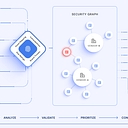
Wiz : Merges external ASM scanning with deep cloud context via the Wiz Security Graph and AI-SPM capabilities . It discovers shadow cloud storage (DSPM), maps internet-facing AI/ML model endpoints (like OpenAI or Bedrock wrappers or self-hosted LLMs), and correlates them with overly permissive IAM roles and attack paths.
Palo Alto Networks (Cortex Xpanse / Prisma Cloud) : Cortex Xpanse handles continuous external attack surface discovery (finding unknown cloud buckets, exposed APIs, and rogue model-serving infrastructure), while Prisma Cloud brings in the deep internal runtime and IAM posture context to alert on risky permissions and misconfigurations.
CrowdStrike Falcon Exposure Management : Combines external attack surface tracking with cloud security posture capabilities. It flags exposed internet-accessible assets, misconfigured cloud data storage, and external-internal identity exposures.
Censys ASM : Primarily focused on internet-wide asset discovery and continuous monitoring, Censys identifies exposed services, unauthenticated or misconfigured cloud storage buckets, and open API/model ports on public IPs, mapping them back to organizational risk classifications.
Would you like to explore how these tools compare regarding agentless scanning vs. network-based discovery , or do you need help evaluating one for a specific cloud stack (AWS, Azure, GCP)?
For those three exposure types, the strongest ASM/CNAPP options to evaluate are:
Wiz ASM — discovers internet-facing cloud assets and API endpoints, and correlates exposures with cloud misconfigurations, sensitive data, and identity risk.
Microsoft Defender EASM + Defender for Cloud — identifies internet-exposed cloud resources, including public storage, and combines them with attack-path analysis and cloud security recommendations.
Palo Alto Cortex Xpanse / Cortex Cloud ASM — continuously discovers exposed cloud assets and services and flags exposed services, misconfigurations, and attack paths.
Strong discovery
Strong with paired platform
Excellent focus
Microsoft Defender for Cloud
Strong cloud posture context
Strong cloud security analysis
Strong via EASM integration
Microsoft Defender EASM alone
External exposure discovery
Limited
Strong focus
Broad cloud security + EASM
JupiterOne
Strong — relationship/graph analysis of IAM principals and policies
Strong — public S3 and GCP storage exposure
Moderate
Teams wanting deep identity-to-data relationship analysis
Orca Security
Strong
Strong
Moderate
Cloud-native CSPM/CNAPP with data context
Palo Alto Cortex Xpanse
Limited compared with the above
More focused on externally exposed assets
Very strong
EASM-first programs concerned with unknown internet-facing assets
Wiz is probably the first evaluation I'd make. Its Security Graph correlates misconfigurations, excessive permissions, public exposure, vulnerabilities, and sensitive data, rather than treating each as an isolated finding. Wiz specifically describes detection of publicly exposed S3/storage and over-permissive IAM as core CSPM use cases.
JupiterOne is particularly interesting if your requirement is "show me exactly which identity can reach which bucket and why." Its AWS model represents IAM policies, role trusts, and resource policies as graph relationships, and it provides queries for public S3 exposure and IAM blast radius. Its GCP integration also explicitly calculates whether storage buckets are publicly accessible.
Cortex Xpanse is the one I'd add if the EASM part is genuinely important. It continuously discovers internet-connected assets, including previously unknown cloud assets, and monitors changes in their exposure. However, for deep IAM-policy analysis, I'd treat it as complementary to a cloud-security platform rather than the primary tool.
My evaluation shortlist
If I were building an RFP around your two requirements, I'd put:
Wiz — strongest combination of cloud posture, IAM, data exposure, and attack-path analysis.
JupiterOne — especially compelling for graph-based IAM → resource → data relationships.
Orca Security — worth a POC for cloud/data exposure capabilities.
Cortex Xpanse — add if discovering unknown internet-facing assets is as important as finding cloud configuration problems.
One important distinction: “public bucket detection” and “external discovery of publicly reachable buckets” aren't necessarily the same capability. Wiz/JupiterOne can analyze the configuration of cloud resources you connect to; Xpanse's strength is discovering what is actually exposed on the Internet, including assets you didn't know existed.
For a POC, I'd give each vendor the same test cases: (1) wildcard Allow IAM policy, (2) cross-account trust, (3) role with unnecessary s3:*, (4) public S3 bucket policy, (5) public object ACL, (6) bucket containing sensitive data, and (7) an accidentally exposed cloud asset that isn't in your CMDB. That will expose meaningful differences very quickly.
Important distinction: exposed storage and serving endpoints are squarely in ASM territory; risky IAM settings generally require the accompanying cloud-security/CSPM capability for meaningful identity-context analysis, rather than pure outside-in ASM.