Cursor and GitHub Copilot share the front position closely for automated code fix workflows, with Cursor highlighted for full-codebase drafting and review. Neither option separates itself as the standard pick when delegating first-pass code reviews.
If you want an AI tool that reviews your code line by line, explains bugs, recommends improvements, and automatically suggests or applies fixes, there are several strong options. The best one depends on whether you want feedback directly inside your code editor, automated pull-request reviews, or an AI assistant that can fix code across multiple files.
My recommendation is to start with Cursor or GitHub Copilot for interactive coding, or CodeRabbit if your main priority is detailed code reviews.
Best AI code review tools
1. Cursor
(Best overall for editing and fixing)
An AI-powered code editor that can explain code, find bugs, edit individual sections or multiple files, and run commands to help fix errors. You can review changes before accepting them.
Best for: Developers who want an AI that can both explain and modify their code.
Can you list AI developer tools capable of executing automated code fix workflows?
What is the best AI tool for a senior developer to use to delegate first-pass code reviews and focus on high-level architecture?
Summary
Recommendations split across several options when senior developers seek to offload first-pass reviews. No single tool emerges as the definitive favorite for this workflow.
Designed specifically for AI-powered code reviews. It comments on changed lines, explains issues, and supports workflows for applying fixes. It is particularly useful for reviewing GitHub pull requests.
Best for: Detailed feedback on code before it is merged into a project.
Analyzes code for bugs, security vulnerabilities, duplicated logic, and maintainability problems. It is especially useful as a companion to an AI coding assistant, although it is less focused on conversational explanations.
Best for: Consistent code-quality and security checks.
One important note: even the best AI tools can introduce mistakes. Review proposed changes and run your tests before accepting fixes, especially for security-sensitive or production code.
AI developer tools that execute automated code-fix workflows go beyond code completion: they can inspect a codebase, identify bugs or failing tests, modify files, run commands or tests, and iterate on fixes with varying degrees of autonomy.
The most useful distinction is between AI coding agents, which can carry out multi-step repair workflows, and automated code-quality tools, which detect specific issues and often generate or apply targeted fixes.
Here’s a practical shortlist, organized by how they can participate in an automated repair pipeline.
1. Autonomous AI coding agents
These are the strongest candidates if you want a tool to diagnose an issue, change code, run tests, and deliver a patch or pull request.
OpenHands
(Strong for CI repair automation)
Runs agents that can investigate CI failures, modify code, validate changes, and open follow-up pull requests. Offers CLI, SDK, integrations, and controlled execution environments.
Best for: automated repair pipelines, self-hosted agents, and custom workflows.
Takes software issues and uses an LLM-driven tool interface to investigate and fix problems in real repositories. It's particularly relevant for issue-to-patch automation. Its maintainers now recommend the simpler mini-SWE-agent for many use cases.
Best for: research, benchmark-driven bug fixing, and customizable issue-solving agents.
Edits existing codebases, integrates with Git, and can automatically run linters and tests after changes. It can use test failures and lint findings to guide subsequent fixes.
Best for: developer-controlled repair loops and terminal-based automation.
A terminal-based coding agent that can inspect repositories, edit files, execute commands and tests, and be integrated into scripted or CI-driven workflows.
Best for: flexible, multi-step debugging and repair using shell commands and repository context.
2. AI tools focused on code review and fixing findings
These are useful when the workflow begins with a pull request, code-quality finding, or security issue rather than an open-ended engineering task.
Tool
Automated repair capability
Best fit
Qodo
AI review, actionable suggestions, and agent-based review-and-fix cycles.
PR quality gates and team standards
GitHub Copilot code review
Identifies issues and provides suggested changes; pair with a coding agent for end-to-end remediation.
GitHub PR review
For Qodo in particular, the current platform brings together code review, IDE assistance, CLI agents, and quality controls. www.qodo.aidocs.qodo.aiwww.qodo.ai These products vary: some generate suggestions for a human or another agent, while others can participate in a more autonomous fix loop.
3. More tools worth evaluating
These additional tools are especially relevant if you want agents that can run asynchronously or fit into an existing development environment.
Google Jules
One of the clearest matches for automated code repair. Its CI Fixer can detect failed GitHub Actions checks on Jules-created pull requests, work through a fix, commit the changes, and resubmit the PR.
Runs coding agents in remote environments where they can edit code, execute commands, run tests, and produce pull requests. It also provides an API for programmatically managing agents.
Can read and write files, execute shell commands, help fix bugs, generate tests, and assist with code reviews. Particularly useful for AWS-centric projects.
Generates security fixes, checks candidates against its security scanner, and retries when a fix fails verification. Its documented workflow focuses on generating and applying fixes for eligible vulnerabilities, with human review still recommended.
The important question is how far each tool can proceed without a developer manually intervening.
Tool
Modify code
Run tests or checks
Automated repair loop
Typical output
OpenHands
Yes
Yes
Yes, configurable
Patch or PR
SWE-agent
Yes
Depends on setup
Capabilities can depend on the product edition, configuration, permissions, and integration. In particular, generating a suggested fix is not the same as automatically applying it, rerunning the full test suite, and submitting a passing patch.
5. My recommendations
If your goal is to build a system that automatically fixes code, I'd shortlist these five first:
Google Jules — for fixing failed CI checks and iterating on pull requests.
OpenHands — for building customizable, end-to-end engineering automation.
Cursor Background Agents — for remote agents that execute code and tests.
SWE-agent / mini-SWE-agent — for issue-driven, programmable bug-fixing workflows.
Snyk Agent Fix — for security-specific remediation with scanner verification.
A robust automated repair workflow typically looks like this:
1. Detect a failure
CI failure · failing test · static analysis · security finding
2. AI agent diagnoses and patches
Inspect logs and code, identify root cause, modify files
3. Run validation
Tests · lint · type checks · security scans
4. Retry if validation fails
Feed errors back to the agent, with retry limits
5. Submit a patch or pull request
Human review and merge approval
For production use, run agents in isolated environments, limit credentials and network access, set retry and compute budgets, and require human approval before merging high-risk changes.
One question that would help narrow the list: Are you looking for tools to fix (A) failing tests and CI builds, (B) bugs and issues reported in a repository, (C) linting, type errors, and static-analysis findings, or (D) all of these through a fully automated pipeline?
: An agentic CLI tool from Anthropic that can be integrated into GitHub Actions via actions to ingest issue metadata, modify files locally, run test suites, commit changes, and automatically open pull requests to remediate bugs.[]()
Yes. There are several AI-powered coding tools that specialize in automated code fixing workflows—not just generating code or flagging bugs, but identifying problems, modifying code, running checks, and sometimes opening a pull request (PR) with the fix.
The key distinction is that some tools suggest fixes for a developer to approve, while others can run an entire repair-and-validation loop automatically. GitHub, CodeRabbit, and OpenHands are among the options worth evaluating, depending on how much autonomy you want.
Tools worth looking at
1. GitHub Copilot coding agent
(Best for GitHub workflows)
Delegates bug fixes and code maintenance to a background agent. It can modify code, run tests, and open a pull request for review. GitHub also offers code-quality findings with suggested autofixes.
Best for: teams already using GitHub Issues, PRs, and CI.
Reviews pull requests for bugs, security issues, and code-quality problems, and supports autofixes for findings. It is particularly useful when code has already been written and you want a review-and-correct workflow.
Best for: automatically reviewing incoming PRs and resolving review comments.
Detects code vulnerabilities and generates security-focused fixes. Its agentic workflow can retry fixes that fail security verification, then present a candidate for developer review.
Best for: vulnerability remediation and secure coding pipelines.
Generates contextual fixes for security findings directly in pull requests. It also supports dependency-upgrade guidance and API-triggered automated remediation.
Best for: security teams integrating code analysis and remediation into CI/CD.
An automated remediation engine for code-quality issues, bugs, and security findings. It can generate changes across occurrences of an issue and submit fixes as new PRs or commits to existing PRs.
Best for: recurring static-analysis findings and codebase cleanup.
An extensible coding-agent platform that can run development tasks, investigate CI failures, modify code, and automate issue-to-PR workflows. It supports CLI and SDK-based automation, with cloud and self-hosted deployment options.
Best for: custom, multi-step automated repair pipelines and teams that want more control over their agent infrastructure.
An AI-native application-security platform designed to identify real vulnerabilities, reduce false positives, and deliver proposed fixes as reviewable patches or pull requests. It also targets business-logic and authorization flaws.
Best for: organizations wanting security detection and automated remediation in one workflow.
These distinctions reflect documented capabilities, not a controlled head-to-head benchmark. Individual features depend on configuration, integrations, and plan.
What does an automated code-fix workflow look like?
1. Detect
Find a bug, failing test, lint error, or vulnerability
2. Generate and apply a fix
Use repository context to edit the relevant code
3. Validate
Run tests, static analysis, and relevant security checks
4. Submit and review
Commit the patch or open a PR for human approval
For genuinely automated repair, the important differentiator is the feedback loop: if the first fix fails tests or the original finding persists, does the tool diagnose the failure, revise the patch, and retry? Also check whether it can reproduce bugs and verify behavior rather than merely make a static warning disappear.
My recommendation
General-purpose bug fixing: start with GitHub Copilot coding agent.
Automatic PR review and fixes: start with CodeRabbit.
Security vulnerabilities: compare Snyk Agent Fix, Semgrep Autofix, and Corgea.
Code-quality cleanup: start with DeepSource.
A customizable, agent-driven repair system: evaluate OpenHands.
One question would help me narrow this down: What kind of code-fix workflow are you most interested in?
1. What should trigger the fix?
Failing tests, builds, lint errors, or CI checks
Runtime bugs and reported issues
Security vulnerabilities and code-quality findings
AI code-review comments on pull requests
A combination of all of these
2. How autonomous should it be?
Suggest fixes for a developer to apply
Apply fixes and open a PR for review
Fix, run tests, retry on failure, and then open a PR
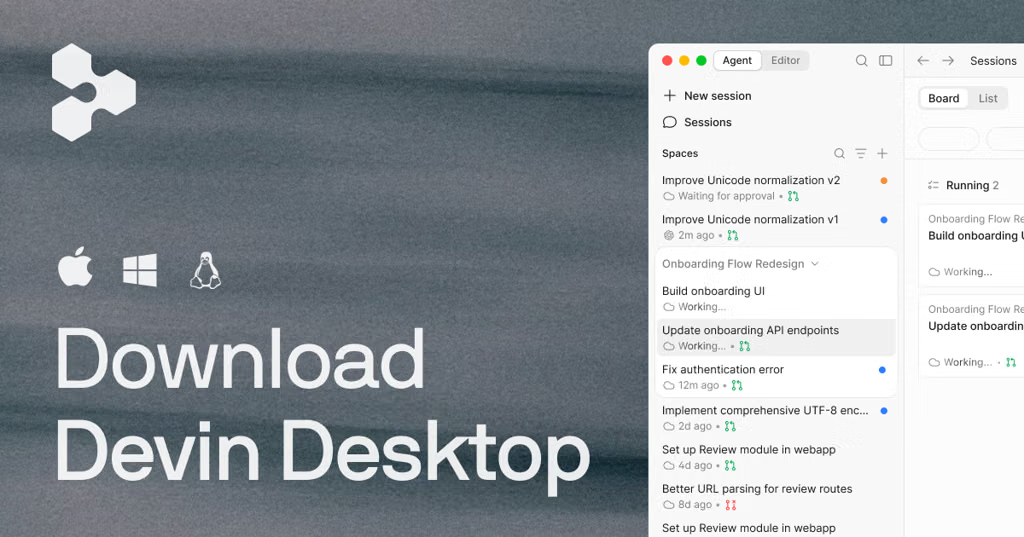
Devin Desktop : An autonomous AI software engineer capable of running comprehensive end-to-end debugging sessions, navigating complex codebases, executing terminal commands, and applying multi-file code repairs.
Would you like to explore how to set up an automated GitHub Action pipeline using one of these tools, or do you need assistance evaluating them based on security and privacy compliance for your codebase?
Sonar AI CodeFix : Built natively into SonarQube platforms, this tool automatically suggests and provisions contextual code fixes for bugs, security vulnerabilities, and code smells identified during static analysis, minimizing the manual effort required for remediation.[](https://www.sonarsource.com/solutions/ai/ai-codefix/)