RFID or NFC session attendance tracking system
Data as of Oct 25, 2026 Reviewed by Dimitry Apollonsky
Which brands AI mentions




Mentioned in · Jul 6 – Oct 25, 2026
ChatGPT SearchChatGPT SearchGoogle AI ModeGoogle AI Mode


Widest split: Positive Proximity, 62% on ChatGPT Search and 33% on Google AI Mode.
- 1CventChatGPT Search 95%Google AI Mode 76%
- =2Positive ProximityChatGPT Search 62%Google AI Mode 33%
- =2CrowdConnectedChatGPT Search 24%Google AI Mode 52%
- =4InEventChatGPT Search 24%Google AI Mode 19%
- =4Cvent OnArrivalChatGPT Search 14%Google AI Mode 19%
Questions and answers
ChatGPT SearchOct 25, 2026
If you want to know which sessions each attendee actually walked into at a conference, event, or training program, you’re looking for a session-level attendance tracking system, usually built around RFID badges, NFC check-ins, or a hybrid of the two.
The important distinction is that ordinary event registration tracks who signed up, while session tracking records who entered each individual room and when.
How session attendance tracking works
1. Give each attendee a unique badge
An RFID-enabled badge or NFC card is linked to an attendee record. The identifier can be reused across all sessions at the event.
2. Capture entry into each session
Install a reader at every session entrance, or have staff scan badges with NFC-capable phones. Each reader is assigned to a particular room or session.
3. Produce a session-by-session attendance record
The system logs the attendee ID, session ID, timestamp, and reader location. Organizers can then report on attendance, repeat visits, session popularity, and participation.
Systems worth evaluating
These are established options that specifically address session attendance or attendee movement tracking.
1. Cvent OnArrival
(Best for integrated event management)
Tracks individual session check-ins, supports badge scanning and mobile scanners, and offers RFID-based tracking options. Good if you also need registration, capacity control, and reporting.
Source: Official product page ·
2. Boomset
Designed for RFID-enabled event badges and wristbands, including automated UHF RFID session check-in and NFC-based access-control workflows. Worth evaluating for busy conferences with multiple simultaneous sessions.
Source: RFID management and session tracking ·
3. Positive Proximity
Specializes in passive RFID tracking, with long-range readers at session entrances. Attendees can walk through wearing their badges without having to tap or scan them.
Source: Conference attendance tracking ·
4. MeetMax ScanTracker
Offers both active QR-code scanning and passive RFID tracking for sessions, meetings, and other scheduled activities. A useful option for conferences where tracking participation is as important as registration.
Source: Attendance tracking and ScanTracker ·
RFID vs. NFC: which is right?
Capability Passive UHF RFID NFC badge tap Attendee action None; walks past a reader Taps badge on reader or phone Tracking range Several feet or more, depending on setup Typically a few centimeters Speed at busy entrances Very high High, but requires individual taps Session entry records Automatic reader detections Explicit check-in events Detecting time spent in a room Possible with suitable entry/exit readers Requires check-in and check-out taps Best use Large conferences, expos, multiple breakout rooms Smaller events, workshops, deliberate attendance verification For passive RFID, the badge generally uses a UHF tag and the room entrance has fixed readers and antennas. For NFC, the badge and reader must be brought close together, making the interaction deliberate. Both approaches can produce attendee-level session records.
What I would implement
For a conference with multiple concurrent sessions, I'd choose RFID-enabled badges with readers at each session entrance, provided the budget supports the hardware and installation.
The attendance database should capture:
- Attendee ID
- Session ID and room
- Entry timestamp
- Exit timestamp, if measuring duration
- Attendance status and any duplicate or ambiguous reads
One important caveat: a badge read at a doorway does not automatically prove that someone entered and stayed for the session. Directional readers, carefully positioned antennas, and entry/exit logic can improve accuracy. For formal continuing-education credits, explicit check-in or additional verification may be preferable.
One question to narrow this down
What kind of event are you tracking?
1. Event type
Conference with breakout sessions
Corporate training or education with attendance requirements
Trade show or large convention
Recurring classes or workshops
2. Approximate number of attendees
Under 200
200–500
500–2,000
Over 2,000
3. How should attendance be recorded?
Automatically, as people walk into rooms
Attendees tap their badges at each session
Either is fine; prioritize cost and reliability
4. Budget preference
Lowest cost; phones or QR codes are acceptable
Moderate budget; dedicated readers if needed
Enterprise-grade hardware and analytics
[Find the best-fit system]
Sources cited in this answer11
- cvent.comOnsite Event Check-in and Badging Solutions | Cvent
- cvent.comOnsite Event Check-in and Badging Solutions | Cvent
- cvent.comAttendance Tracking Software for Events | Cvent
- twstevents.comAttendance Tracking | TWST Events
- rfidjournal.comConferences Track Attendees Via UHF RFID - RFID JOURNAL
- atlasrfidstore.comRFID Attendee Tracking
Google AI ModeOct 25, 2026
Tracking which specific sessions attendees walk into relies on
choosing the right architecturedepending on whether you want a frictionless automatic flow or a deliberate tap-in process.How Session Tracking Systems Work
- Passive UHF RFID (Ultra-High Frequency - Long/Medium Range)
- How it works: Badges contain embedded UHF inlay chips. Fixed portal antennas or overhead gateways are installed at the entrance of each breakout room or hall. As attendees walk through the doorway, the portal automatically reads their unique badge ID from several feet or meters away.
- Pros: Entirely passive for the attendee (no bottlenecks or lines); captures 100% of foot traffic automatically.
- Cons: Requires physical doorway infrastructure (cabling, readers, and antennas) and can occasionally experience "bleed" if signals cross adjacent rooms without proper shielding.
- HF RFID / NFC (High Frequency / Near Field Communication - Tap-and-Go)
- How it works: Attendees physically tap their badge or wristband against a fixed reader, a tablet, or a staff-held mobile device stationed at the room entrance.
- Pros: Highly accurate confirmation of physical presence (proves intent); much cheaper hardware footprint than full entry gates; great for earning CEU/CPD credits.
- Cons: Creates lines and bottlenecks at room doors if arrivals peak right before a session starts.
- Alternative: Bluetooth Low Energy (BLE) / Beacons
- How it works: Instead of RFID portals, organizers place small battery-powered BLE beacons at session entrances. Attendee wearables or mobile apps track proximity and dwell time automatically.
- Pros: Extremely lightweight deployment (requires minimal equipment/weight) and measures dwell time (how long they stayed) rather than just a binary entry log.
Prominent Vendors and Providers
- Positive Proximity: Offers IntelliTrak long-range and tap-and-go RFID systems designed specifically for live occupancy, room capacity alerts, and CEU/CPD compliance tracking.
- Crowd Connected: Specializes in passive wearable tracking and beacon-based movement analytics that eliminate doorway bottlenecks entirely.
- Identium: Provides end-to-end passive UHF gate readers and hand-held Android scanning kits for large-scale multi-day conference tracking.
If you're planning an event, let me know:
- Estimated attendance size and number of breakout rooms
- Whether you prefer hands-free walk-through gates or tap-to-enter scanning
I can help you evaluate which setup fits your budget and venue layout.
Sources cited in this answer4
ChatGPT SearchOct 16, 2026
For tracking which conference sessions attendees enter, I’d look at RFID badge scanning or NFC tap-in systems that connect each attendee’s badge to a session-level attendance dashboard.
The key is to capture more than overall event check-in: you want to know who entered which session, at what time, and how many people attended each session, ideally with live reporting across multiple rooms.
There are three main approaches:
- RFID badges and fixed readers: Attendees wearing badges can be detected as they enter a room, potentially without stopping to scan. Best for high-volume conferences, provided the reader setup reliably distinguishes people entering from those simply passing nearby.
- NFC badges or phones: Attendees tap their badge or phone at a reader or tablet at each session entrance. Best for controlled entry, lower-cost deployments, and clear check-in records.
- QR-code badge scanning: Staff scan each attendee’s badge with a phone or handheld scanner. Not RFID/NFC, but often a practical, economical alternative if you don't need hands-free tracking.
Best RFID/NFC systems to evaluate
These are the strongest options I found for conference session attendance, from integrated event platforms to dedicated tracking hardware.
1. Cvent — best established all-in-one option
(Best starting point)
Combines event registration, badge check-in, session attendance, access control and reporting. Supports handheld scanning, tap-to-check-in, and passive RFID options.
- Live event statistics and session-level reports.
- Suitable for multi-track conferences and continuing education.
- Particularly attractive if you already use Cvent for registration.
Hardware: handheld scanners or RFID readers, depending on deployment.
Official attendee tracking overview ·
2. Positive Proximity — best for dedicated RFID tracking
Specializes in conference attendance tracking, RFID hardware rentals and integrated reporting.
- Long-range RFID readers can record badge detections at session entrances.
- Offers tap-and-go and handheld scanning alternatives.
- Provides real-time attendance, dwell-time analytics and occupancy monitoring.
- Hardware rental, setup and on-site support are available.
Best for: Large conferences where you want a vendor to supply and configure the tracking equipment.
3. Crowd Connected — best for passive room-level tracking
Worth considering if you want to understand which sessions people attend without requiring a badge tap at every door.
- Tracks attendee presence and time spent in sessions.
- Uses wearable tags and small venue-installed gateways or beacons.
- Provides live attendance information and downloadable attendee records.
- Designed for conferences with multiple simultaneous sessions.
Important: This uses Bluetooth-based tracking rather than conventional NFC tap-in. Ask for a demonstration of room-level accuracy and how it handles adjacent rooms.
Attendee tracking platform www.crowdconnected.comwww.crowdconnected.com
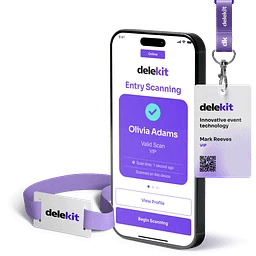
4. Delekit — best integrated registration and session scanning alternative
Combines registration, badge printing, QR/NFC/RFID check-in and session reporting.
- Records who attended individual sessions.
- Supports entry and exit scans to estimate time in a session.
- Provides live room counts and post-event exports.
- Offers access control for restricted sessions.
Best for: Organizers wanting registration, badges and attendance data in one system, without necessarily deploying long-range RFID readers.
5. EventCreate — best budget-friendly starting point
A simpler way to track session attendance without committing to a dedicated RFID infrastructure.
- Scan attendee QR codes at individual session entrances.
- Monitor live headcounts and capacity.
- Export session attendance reports.
- The vendor also describes RFID/NFC badge and wristband support.
Best for: Smaller events, pilot programs or teams that can accept a scan at the door rather than automatic detection.
Session tracking and attendance www.eventcreate.com
What hardware would you actually need?
The hardware depends on whether you want attendees to stop and tap or simply walk into a room.
Option A — NFC tap stations
Best for controlled, verifiable check-ins
- NFC-enabled badges or cards.
- Compatible NFC readers or tablets/phones.
- A session check-in app connected to your attendee database.
Each tap creates a record linking the attendee, session, timestamp and reader.
Option B — passive UHF RFID
Best for high-volume entrances
- UHF RFID-enabled badges.
- Fixed readers and antennas positioned at room entrances.
- Software that maps each reader to a specific session.
Attendees may be detected as they pass through. Antenna placement and entrance design are critical to avoid missed reads and detections from adjacent areas.
Option C — Bluetooth Low Energy (BLE)
Best for room presence and dwell-time analytics
- BLE wearable tags or compatible attendee devices.
- Receivers or gateways installed around the venue.
- Software to infer room presence and duration.
This can reduce the need for explicit scans, but room-level accuracy needs to be tested on-site.
What I would recommend
For most conference organizers, I would shortlist Cvent and Positive Proximity first if RFID is a firm requirement. Add Crowd Connected if passive tracking and time spent in each session matter more than a deliberate check-in.
Before choosing, make sure the system supports all of the following:
- Live session dashboard: attendee count for every room, updated during the event.
- Individual attendance records: attendee identity, session name and entry timestamp.
- Accurate room attribution: the system must distinguish between entering a room and walking past it.
- Concurrent sessions: multiple rooms reporting simultaneously.
- Exports and integrations: CSV/Excel reports, APIs or integration with your registration platform.
- Privacy controls: clear attendee notices, appropriate access permissions and a defined data-retention policy.
One distinction matters: knowing that someone entered a session is not the same as proving they stayed for the whole session. If you need continuing-education credit or verified participation, look for entry and exit tracking or a configurable minimum attendance duration.
Let me narrow this down to the right setup
1. How many attendees do you typically have?
Under 500
500–2,000
2,000–10,000
Over 10,000
2. How do you want attendees to be tracked?
Automatic, no tapping or scanning
Tap an RFID/NFC badge at each entrance
Staff scan badges using phones or handheld devices
Compare all methods
3. What do you need to track?
Sessions only — who attended each talk
Sessions and how long people stayed
Movement throughout the venue, including booths and networking areas
4. What is your preferred deployment model?
Rent equipment for each event
Buy hardware to reuse across events
Software only, using phones or existing devices
Need pricing guidance first
5. Do you already use an event registration platform?
Cvent
Another registration platform
No existing platform / open to any platform
[Find the best-fit systems]
Sources cited in this answer17
- cvent.comAttendance Tracking Software for Events | Cvent
- cvent.comOnsite Event Check-in and Badging Solutions | Cvent
- cvent.comAttendance Tracking Software for Events | Cvent
- cvent.comOnsite Event Check-in and Badging Solutions | Cvent
- positiveproximity.comConference Attendance & Session Tracking | Positive Proximity
- positiveproximity.comHardware rentals
Google AI ModeOct 16, 2026
Tracking session attendance using RFID or NFC involves two main hardware-and-software methodologies: Passive Long-Range UHF RFID (walk-through portals/overhead antennas where attendees just walk in) and Active Short-Range NFC/RFID (tap-and-go reader terminals at the door).
Top hardware and software providers capable of handling these setups depend on your preferred tracking friction and event scale:
Major All-in-One Event Platforms (Software + Hardware)
- Cvent (Attendee Tracking & OnArrival)
- How it works: Offers modular tracking options including Tap-N-Go (short-range NFC/RFID badges tapped against door terminals) and Passive RFID (overhead/portal readers for frictionless tracking).
- Capabilities: Handles real-time room capacity, session duration/dwell time, access control (blocking over-capacity or unauthorized sessions), and automated CEU/CPD credit fulfillment.
- Best for: Enterprise conferences, multi-track corporate summits, and events already utilizing the Cvent Event Management Platform.
- Positive Proximity
- How it works: Specializes explicitly in turnkey conference attendance tracking hardware rentals and software. They deploy long-range passive UHF RFID reader arches or doorway antennas.
- Capabilities: Zero-friction passive reads as attendees walk past thresholds, precise dwell-time measurement (calculating how long someone stayed, not just if they entered), live room capacity counts, and compliance/CEU credit reporting.
- Best for: Medical, legal, or technical conferences requiring strict continuing education hour tracking.
- InEvent (RFID Event Tracking)
- How it works: Combines cloud event software with physical RFID badge/wristband detection zones.
- Capabilities: Automatically logs entry/exit timestamps, calculates dwell time, and syncs physical room metrics back to individual attendee profiles in real time.
- Best for: Mid-to-large-scale corporate conferences wanting robust analytics dashboards paired with physical presence tracking.
- Crowd Connected
- How it works: Provides modular hardware kits (lightweight reader equipment that can be set up quickly at doorways) paired with powerful tracking software.
- Capabilities: Tracks delegate movement across complex multi-track venue layouts and integrates with badge-embedded UHF RFID chips.
- Best for: Global exhibition organizers and multi-track convention handlers.
Key Technical Considerations: Passive vs. Tap-and-Go
- Passive Long-Range RFID (Walk-Through):
- Pros: Zero attendee friction; people walk straight through doors without stopping.
- Cons: Higher hardware setup costs (requires doorway antennas/cabling), and high-density crowds walking side-by-side can occasionally cause read-interference or stray reads from adjacent hallways.
- NFC / Short-Range RFID (Tap-N-Go):
- Pros: 100% accurate attribution (you know who tapped the reader), lower equipment complexity, and doubles cleanly as room-capacity enforcement or restricted-access control.
- Cons: Requires attendees to intentionally tap their badge or wristband against a wall/podium reader, creating minor entry lines if doorways are narrow.
To help narrow down the best setup, tell me:
- How many attendees and concurrent sessions are you planning for?
- Do you prefer passive tracking (walking through a portal) or active tapping (tapping a badge at the door)?
- Are you looking for a full end-to-end event management platform or a specialized hardware/tracking vendor?
Sources cited in this answer6
- positiveproximity.comConference Attendance & Session Tracking | Positive Proximity
- crowdconnected.comBest event attendee tracking solutions compared (2026) | Article
- event-flo.comConference Attendance Tracking & Scanning — Free | Event Flo
- cvent.comAttendance Tracking Software for Events | Cvent
- cvent.comOnsite Event Check-in and Badging Solutions | Cvent
- inevent.comRFID Event Tracking Software for Real-Time Attendee Insight







Also asked as
- We need to monitor session attendance. Can you recommend an RFID or NFC solution that logs exactly which sessions each attendee enters?