Blavor holds a clear lead for off-grid phone charging setups and portable solar power banks. BigBlue surfaces as the primary pick when shoppers specifically ask about solar-powered phone chargers.
When looking for the "best" solar-powered phone charger, it helps to know that standalone solar panels and hybrid solar power banks behave very differently. Direct solar panels require constant sunlight to charge a phone, while solar power banks store energy in an internal battery first.
Top-performing options vary based on how you plan to use them:
BigBlue 28W USB Solar Charger | BigBlue Energy& more | 4.3(76)
Best for: Direct charging on backpacking or camping trips.
Why it’s great: Evaluated by publications like The New York Times Wirecutter , this quad-panel setup balances a relatively lightweight frame (1.4 lbs) with a strong 28W output. It features three USB-A ports and enough output to efficiently juice up a phone or intermediate power bank on a clear day.
Goal Zero Nomad 10 | goalzero.com& more | 4.5(232)
Best for: Ultralight hikers and rugged portability.
Why it’s great: It features a tough weather-resistant build, an integrated adjustable kickstand to optimize the sun angle, and smart auto-restart circuitry that resumes charging if a cloud temporarily blocks the sun (which causes many other panels to stop charging modern phones permanently until manually reset).
BioLite SolarPanel 5+ / 10+ | BioLite& more | 3.7(221)
Best for: All-in-one self-reliance (integrated battery storage).
Why it’s great: Unlike most small panels, BioLite units include an onboard integrated battery (3,200 mAh on the 5+) and a built-in sundial. You can charge the internal battery during the day and use it to charge your phone after dark or during a cloud cover.
BLAVOR Solar Charger Power Bank (10,000mAh / 20,000mAh) | eBay - slick-sells& more | 3.6(683)
Best for: Everyday emergency backup / casual travel.
Why it’s great: This is a traditional power bank with a small solar panel slapped on the back. Note that the tiny solar panel takes days to fully charge the heavy internal battery via the sun—it's meant to be charged via a wall outlet before you leave, using the solar panel strictly as an emergency top-off trickle charger outdoors.[](https://www.nytimes.com/wirecutter/reviews/best-portable-solar-battery-pack/)
If you share where you plan to use it (e.g., deep-woods backpacking vs. emergency home kit vs. day hikes) and whether you want a direct fold-out panel or a power bank with a solar trickle feature , I can narrow down the ideal pick.
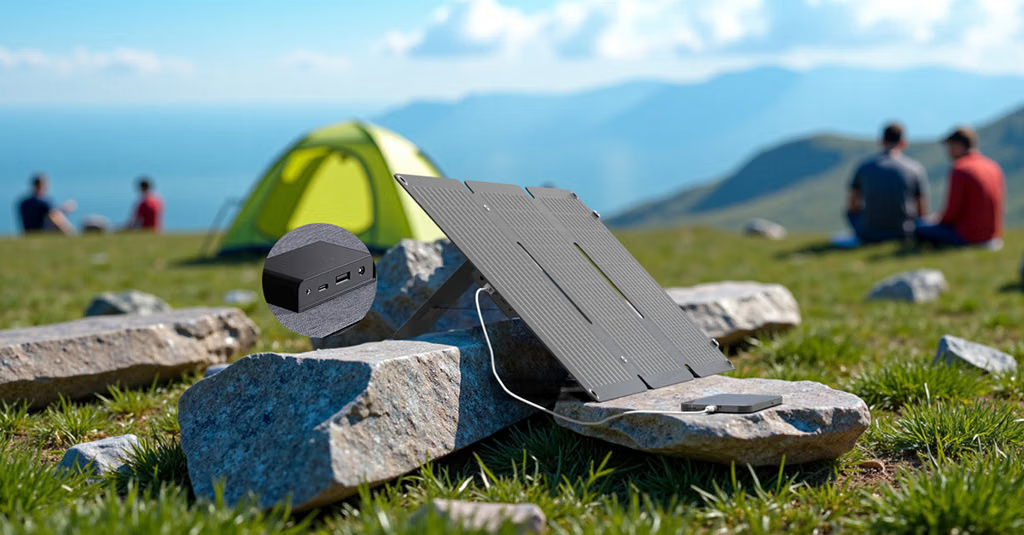
The best solar-powered phone charger for most people is a foldable solar panel paired with a portable power bank. It generally collects sunlight much faster than a power bank with a tiny solar panel built into its case, and it lets you charge your phone after sunset.
For 2026, I'd focus on these options depending on whether you want fast charging for camping, a lightweight hiking setup, or an all-in-one emergency charger.
Best solar phone chargers to consider
1. BigBlue 14W SunPower Solar Charger
(Best overall for portability)
Typical listed price: around $39–$45
Travel + Leisure's top overall pick in its 2026 testing. It folds compactly, weighs about 12 ounces, and is easy to set up in direct sunlight.
A larger folding panel that collects more solar energy in good conditions. A better choice for charging a power bank or multiple small devices at a campsite.
Best for: Multi-day camping and longer outdoor trips.
A simple, lightweight 5W panel with a kickstand. It's easy to carry, but its low output makes it slower than larger panels, and it doesn't store energy itself.
Best for: Ultralight backpacking and occasional top-ups.
A compact all-in-one charger with a 10,000mAh battery. Convenient for carrying backup power, but its small built-in solar panel is best treated as an emergency trickle charger rather than the main way to refill the battery.
My advice: for reliable off-grid phone charging, pair a foldable panel with a 10,000–20,000mAh USB-C power bank. Charge the power bank in the sun, then charge your phone from the battery. This avoids interruptions from passing clouds and changing sunlight.
Let me narrow it down
1. What's your budget?
Under $40
$50–$100
$100+
2. What will you use it for most?
Everyday use
Camping and hiking
Emergency preparedness / power outages
Travel and backpacking
3. Which type do you prefer?
All-in-one charger with built-in battery
Separate solar panel and battery for better performance























![[eu direct] bigblue solarpowa 28 28w foldable solar panel, 25.4% high conversion efficiency, smart charging, usb-a/usb-c outputs for outdoor use & power plants Sale - Banggood.com sold out-arrival notice-arrival notice](https://images.openai.com/static-rsc-4/QZ2YyLVCfuSIYwchr8rBpxMOhF-5fVepEebzb9p3WqR1PHgKxob91_x6dJzy87ILEIa9JAR1fLNVBqj5VbPeg4rst_W_zyoT-nwZMtnSa-kx9NLCw1skGQhTUvtkWV0wUPqPrXCKaNwts5nvjlVZJuSD27Fb20j7cA9BiNqhkKw23tcZ__YTM3zJ8LyuA-VZ?purpose=fullsize)


