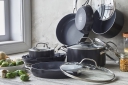
GreenPan holds a wide lead for durable PFOA-free premium frying pans. Made In often serves as the primary alternative for buyers seeking professional-grade construction.
The GreenPan Valencia Pro is the one I'd buy. It uses a ceramic coating made without intentionally added PFAS, over a hard-anodized aluminum body designed for greater scratch resistance. It also works on induction and is oven-safe to 600°F.
Independent testing is particularly encouraging: America's Test Kitchen's 2026 testing found the Valencia Pro was one of only three ceramic pans to pass its coating-durability test, and Bon Appétit named it its best overall nonstick pan after years of testing.
For a durable, high-quality, PFOA-free (and PFAS-free) frying pan that outlasts traditional cheap non-stick options, the top industry and tester consensus points to the GreenPan Valencia Pro.
Top Recommendation: GreenPan Valencia Pro Ceramic Non-Stick Frypan
The Coating: Features a diamond-infused ceramic non-stick coating that is 100% free of PFOA, PFAS, lead, and cadmium. Ceramic handles high heat better than traditional Teflon and won't blister or release toxic fumes if accidentally overheated.
The Build: Crafted from hard-anodized aluminum, making it twice as strong as standard aluminum, highly scratch-resistant, and resistant to warping.
It features a Magneto induction base for even heat distribution on any stovetop (including induction) and is oven-safe up to an impressive 600°F.
I need a long-lasting, premium non-stick frying pan that doesn't contain PFOA. Can you suggest something that will hold up well over time?
OXO Ceramic Professional 10" — a good lower-risk alternative if you want a ceramic pan with a diamond-reinforced coating.
ZWILLING Clad CFX 10" — particularly interesting if you want a more substantial stainless-steel construction; its ceramic coating is advertised as substantially more durable than earlier versions.
Circulon LaserDefense 10" — newer option specifically engineered around scratch and wear resistance; current listings show about $70.
One important caveat about "last for years"
Even excellent ceramic nonstick coatings eventually lose their slickness. Bon Appétit's six-plus years of testing specifically notes that nonstick cookware doesn't have the lifetime durability of stainless steel, carbon steel, or cast iron.
So if by "last for years" you mean 5–10+ years of reliable nonstick performance, I'd actually consider a different category:
This is a coating-free carbon-steel pan that develops its nonstick surface through seasoning rather than relying on a coating. It's more work initially, but the surface can be renewed rather than wearing away.
My verdict: Easiest + best PFOA/PFAS-free choice → GreenPan Valencia Pro. Maximum long-term durability → a well-seasoned carbon-steel pan.
And whichever ceramic nonstick you choose, hand-wash it, avoid overheating it, and use silicone/wood utensils if you want to maximize its lifespan.
Expert Consensus: Extensively praised by testing publications like America’s Test Kitchen as a top-performing and remarkably durable ceramic skillet.
Where to buy: You can check pricing and availability on marketplace listings like Kitchen Kaboodle or major home goods retailers.
Alternative Option (No-Coating Longevity): Our Place Titanium Always Pan Pro
The Build: If you want a pan that skips traditional coatings entirely, this tri-ply fully-clad pan features a textured titanium interior.
Durability: Because it has no chemical coating to scratch off, it is entirely metal-utensil safe, virtually indestructible, and handles heat up to 1,000°F.
Would you like to share what size pan you are looking for (e.g., 8-inch, 10-inch, 12-inch) or your primary stove type (gas vs. induction) so I can narrow down the best dimensions for your cooking style?
When looking for a premium, long-lasting non-stick frying pan that is completely free of PFOA, the standard consumer expectation needs a slight shift: traditional non-stick coatings (PTFE/Teflon) degrade over time, while newer hybrid, ceramic, or advanced textured options offer superior longevity.
The top premium, PFOA-free choices available for durability and performance include:
Built from heavy-gauge, hard-anodized aluminum with a bonded stainless steel induction base. It features three layers of professional-grade, PFOA-free traditional non-stick coating. It handles high-heat searing better than most lightweight competitors and resists warping. You can explore details on the All-Clad Official Site.
Widely recognized as a benchmark for high-end ceramic (PFAS- and PFOA-free) non-stick. It features a diamond-infused Thermolon ceramic coating that stands up to wear much better than standard ceramic pans and is metal-utensil safe. It is oven-safe up to 600°F. Check specifications via GreenPan.
A radical departure from coated pans, this option utilizes a textured, coating-free titanium and multi-clad stainless steel interior surface engineered with patented NoCo technology. Because it has no literal chemical coating to scratch off, it is metal-utensil safe and handles heat up to 750°F while maintaining non-stick release. Take a look at the product details on Our Place.
Made In ProCoat Frying Pan Features multiple layers of professional-grade, PFOA-free non-stick bonded to a 5-ply stainless-clad heavy-duty body. It bridges the gap between restaurant-grade heat distribution and easy domestic cleanup. See the collection at Made In Cookware.
If you want to narrow this down, let me know:
What kind of stovetop do you use (gas, electric, or induction)?
Do you prefer traditional non-stick (PTFE), ceramic , or a coating-free textured metal surface?
If you want a premium, PFOA-free frying pan that will hold up well over time, I’d focus on two things: the quality of the pan’s construction and how durable its cooking surface is.
One important distinction: PFOA-free does not necessarily mean PFAS-free. If you want to avoid the broader family of PFAS chemicals, look for a pan explicitly made without PFAS and PTFE, too. Ceramic nonstick pans meet that goal, but their nonstick performance can gradually decline with use.
Here are the options I’d consider first.
My top 3 picks
1. Viking PureGlide Pro
(Best for longevity)
Premium • Titanium cooking surface
This is the most intriguing choice if durability is your priority. It has a titanium cooking surface rather than a conventional ceramic or PTFE coating, with stainless steel construction and an aluminum core. Recent hands-on testing reported excellent scratch resistance and continued food release after months of use.
Why I'd consider it: No conventional nonstick coating to wear away.
Trade-off: It is relatively new, so long-term performance over many years is not yet established.
A strong choice for eggs, pancakes and fish. It uses a hard-anodized aluminum body and Thermolon ceramic nonstick coating, marketed without PFAS, including PFOA and PTFE. It is also induction-compatible.
Why I'd consider it: A sturdy body, convenient food release and good everyday versatility.
Trade-off: The coating will eventually lose some nonstick performance; GreenPan estimates a typical ceramic-coating lifespan of around two to five years with proper care.
This pan combines a three-layer ceramic cooking surface with a five-ply stainless steel body. It is made without PFAS, PTFE or PFOA and works on induction cooktops. The construction is a particularly appealing option if you want a substantial, well-built pan.
Why I'd consider it: Premium heat control and a robust stainless steel body.
Trade-off: The ceramic cooking surface is still a wear item, and the listed warranty is two years.
My choice depends on what you mean by long-lasting:
For the toughest surface: Viking PureGlide Pro is worth a close look, although it needs more long-term track record.
For conventional nonstick convenience: GreenPan Valencia Pro is my practical everyday pick.
For premium construction: Made In CeramiClad is appealing if you prefer a heavier stainless steel body.
One important reality check: Consumer Reports notes that even good ceramic nonstick pans eventually wear out. If you want cookware that can last decades, an uncoated stainless steel or well-maintained carbon steel pan is a better investment, though neither will feel exactly like a brand-new nonstick pan.
How to make your pan last longer
Cook mostly on low to medium heat.
Use silicone or wooden utensils unless the manufacturer explicitly permits metal.
Hand-wash with a soft sponge.
Avoid aerosol cooking sprays and abrasive cleaners.
Replace a coated pan if its surface becomes damaged or starts flaking.
One question to narrow this down: Do you want to avoid all PFAS and PTFE, or are you mainly concerned about PFOA? That distinction changes which premium pans I'd recommend.