Continuing education for trauma and addiction marriage and family therapists
Jul 7 – Oct 17, 2026Updated Oct 17, 2026 Reviewed by Dimitry Apollonsky
Which brands AI mentions


Mentioned in
ChatGPTChatGPTGoogle AI ModeGoogle AI Mode


Widest split: EMDR International Association (EMDRIA), 55% on ChatGPT and 0% on Google AI Mode.
- #1PESIChatGPT 64%Google AI Mode 90%
- #2American Association for Marriage and Family TherapyChatGPT 45%Google AI Mode 43%
- #3tiedEMDR International Association (EMDRIA)ChatGPT 55%Google AI Mode 0%
- #3tiedCalifornia Association of Marriage and Family Therapists (CAMFT)ChatGPT 32%Google AI Mode 19%
- #3tiedThe Gottman InstituteChatGPT 18%Google AI Mode 24%
Questions and answers
ChatGPTOct 8, 2026
If you're an MFT looking to build expertise in trauma, addiction, or the overlap between the two, there are several strong CE options. I’d prioritize courses that teach specific clinical interventions rather than broad “awareness” training.
My top picks
Course/provider Best for Why I’d consider it AAMFT – Introduction to Trauma for MFTs Getting started with trauma Specifically designed for MFTs; covers trauma-informed care, neurobiology, symptoms, and evidence-based interventions. It’s 1.25 CE credits. PESI – Complex Trauma Certification Serious trauma specialization Covers complex trauma with approaches including EMDR, parts work, CPT, and polyvagal concepts. PESI currently lists it among its MFT certifications. PESI – Trauma & Addiction Dual Certification Trauma + substance use Probably the closest match to your interests. It combines CBT, CPT, EMDR, prolonged exposure, somatic and psychodynamic approaches. PESI – DBT & Addiction Dual Certification Addiction + emotional dysregulation Particularly useful for clients with substance use plus trauma, suicidality, mood instability, or other co-occurring issues. PESI – Trauma-Informed Motivational Interviewing Practical addiction work A nice choice if you want immediately usable skills for substance-use conversations while maintaining a trauma-informed approach. It incorporates MI, CBT and DBT techniques. PESI – IFS for Trauma & Addiction Relational/parts-oriented work Useful if your MFT practice already incorporates attachment, family systems, or parts work. PESI currently lists IFS training specifically addressing trauma and addiction. If I were choosing a learning path
1. Start with trauma fundamentals → AAMFT's Introduction to Trauma for MFTs. It's inexpensive and specifically oriented toward MFT practice.
2. Add a substantial trauma modality → Consider the PESI Complex Trauma Certification, particularly if you regularly see childhood trauma, dissociation, attachment injuries, or chronic relational trauma.
3. Add addiction training → The Trauma & Addiction Dual Certification is especially compelling if you want to work with clients where trauma and substance use reinforce each other.
4. Develop a concrete conversational intervention → Trauma-informed Motivational Interviewing is a good complement because MI skills can be used across couples, families, and individual addiction work.
One important caveat about CE approval
Don't assume that a course being advertised as “CE-approved” automatically means your particular MFT license board will accept it. PESI explicitly says approval varies by profession, jurisdiction, program, and topic, and recommends checking the individual course and your licensing board before purchasing.
If you're licensed in Pennsylvania, that's particularly worth checking: PESI indicates that Pennsylvania's Board covering social workers, MFTs, and professional counselors accepts certain national CE approvals, but the specific course still needs to meet the applicable requirements.
Where I'd start: for a clinician wanting both trauma and addiction expertise, I'd put Trauma & Addiction Dual Certification at the top, followed by Complex Trauma and Trauma-Informed Motivational Interviewing.
PESI therapist/MFT CE catalog
AAMFT trauma CE courseIf you tell me your state, approximate CE budget, and whether you prefer online/self-paced or live training, I can narrow this to the 5 best courses for your license and practice.
Sources cited in this answer7
- aamft.orgIntroduction to Trauma for MFTs
- pesi.comContinuing Education for Marriage Family Therapists | PESI
- pesi.comContinuing Education and Professional Development for Addictions Counselors | PESI
- pesi.comContinuing Education Approval Boards | PESI
- pesi.compesi.com
- pesi.comSubstance-Related and Addictive Disorders Training for Clinicians | PESI
Google AI ModeSep 25, 2026
The best continuing education (CE) courses for marriage and family therapists (MFTs) focusing on trauma and addiction are provided by specialized organizations like the American Association for Marriage and Family Therapy (AAMFT) and PESI Continuing Education , which offer targeted on-demand learning and professional certifications.
Top Organizations and Programs for Trauma & Addiction CEUs
- AAMFT On-Demand Courses : Offers virtual, self-paced learning explicitly tailored to systemic and relational clinical practices, covering core diagnosis, family systems, and specialized treatment modalities.
- PESI Continuing Education Certifications : Provides robust intensive training paths, including specialized credentials like the Complex Trauma Certification (CCTP), alongside comprehensive modules on relational trauma, addiction, and evidence-based modalities like DBT and IFS.
- ACORN Family Therapy Trainings : Features free or low-cost, research-informed on-demand courses focusing on relational assessment, safety planning, and treating systemic issues including behavioral and substance-related dependencies within a family framework.
If you can let me know your state licensing board and specific clinical focus (e.g., substance addiction vs. developmental trauma), I can recommend precise courses that meet your exact license renewal requirements.
ChatGPTOct 17, 2026
If you're looking for high-quality continuing education for marriage and family therapists (MFTs), I'd start with providers that offer evidence-informed clinical training, experienced instructors, and clearly documented CE credits. The strongest options depend on whether you want practical trauma-treatment skills, addiction counseling techniques, or broader professional development.
Here are the providers I'd prioritize, including options for North Carolina-based MFTs and online learners.
Best places to find MFT continuing education
1. American Association for Marriage and Family Therapy (AAMFT)
(Best for MFT-specific education)
A strong first stop for systemic, relational, and family-centered clinical education. Its Teneo online learning platform offers courses for LMFTs and other mental health professionals, including topics relevant to complex clinical work.
Look for: trauma and attachment, family systems, relational approaches to substance use, and clinical ethics.
2. PESI
(Best for specialized trauma and addiction training)
PESI offers extensive online CE courses for MFTs, including trauma, PTSD, complex trauma, DBT, and addiction-related care. Options include self-paced courses, live webinars, and more intensive certification programs.
Look for: trauma-informed addiction care, co-occurring disorders, relapse prevention, and DBT approaches to substance use.
Two useful starting points:
3. North Carolina Area Health Education Centers (NC AHEC)
(Best for regional professional development)
NC AHEC offers behavioral-health training and webinars for professionals including marriage and family therapists. Its trauma-informed care programming has covered PTSD and related clinical issues, with credits varying by course.
Look for: trauma-informed practice, PTSD, behavioral health, and interdisciplinary clinical workshops.
Browse NC AHEC courses and events
4. North Carolina Addictions Specialist Professional Practice Board (NCASPPB)
A particularly useful resource if you want addiction-specific education. Its listings include board-approved training on motivational interviewing, substance use disorders, trauma-informed addiction treatment, and CBT for substance use.
Look for: evidence-based substance use treatment, harm reduction, motivational interviewing, and trauma during recovery.
Approved online and self-study training
Note: Board approval for addiction-specialist credit does not automatically establish that a course meets your MFT license renewal requirements.
5. Get Into Your Head Training
Worth investigating if you want structured, trauma-focused professional development. Its Trauma Model Therapy curriculum offers multiple training levels and publishes state-specific information about continuing education recognition.
Look for: trauma formulation, trauma-related symptoms, and staged clinical training.
Specific courses I'd consider first
If you want a concrete starting point rather than browsing a large catalog, these are worth investigating:
Introduction to Trauma for MFTs
AAMFT · 1.25 CE credits · Online
An introductory course covering trauma symptoms, neurological effects, trauma-informed principles, and evidence-based interventions.
View course and pricing www.aamft.org
Trauma & Addiction Dual Certification Course
PESI · Online training
A more intensive option exploring interventions for trauma and co-occurring addiction, including approaches such as CBT, CPT, EMDR, and somatic therapy.
View the training www.pesi.comwww.pesi.com
Trauma-Informed Care in Addiction Treatment
East Carolina University training series · Self-study
Listed by the North Carolina addiction specialist board as an approved training option. The listing identifies a two-hour course; check its current availability and credit documentation before enrolling.
Find the training through NCASPPB's listings www.ncsappb.orgwww.ncsappb.org
How to judge whether a course is high quality
Before paying for a workshop or certification, I'd check for these five things:
- Evidence-based methods: Does it teach applicable approaches such as trauma-focused CBT, CPT, motivational interviewing, or integrated treatment for co-occurring disorders?
- Qualified instructors: Are the presenters experienced clinicians, researchers, or recognized specialists in the topic?
- Clinical application: Does the course include case examples, assessment, treatment planning, and practical interventions?
- Appropriate CE documentation: Does it issue a certificate showing the course title, provider, date, and contact hours?
- License compatibility: Does the content satisfy your particular MFT board's rules? A professional certificate does not necessarily represent a separate clinical credential or confer authorization to practice a specialized treatment.
For North Carolina, the MFT Licensure Board's renewal guidance explains that courses are not pre-approved individually; licensees are responsible for ensuring their coursework meets the applicable requirements.
Let me narrow this down for you
Are you looking primarily for online self-paced courses, live interactive workshops, or in-person training? I can use that preference to narrow the options to the strongest trauma-informed care or addiction counseling programs for your needs.
Sources cited in this answer19
- aamft.orgHome Page
- networks.aamft.orgContinuing Education - Approved Supervision
- aamft.orgHome Page
- pesi.comContinuing Education for Marriage Family Therapists | PESI
- pesi.comContinuing Education and Professional Development for Addictions Counselors | PESI
- pesi.comContinuing Education for Marriage Family Therapists | PESI
Google AI ModeOct 17, 2026
Finding robust, high-quality continuing education (CE) for Marriage and Family Therapists (MFTs) that bridges trauma-informed care and addiction counseling requires looking at
providers with solid national accreditations(such as APA, ASWB, or state BBS equivalents).Top-tier options tailored to these specific clinical intersections include:
- PESI & Evergreen Certifications : A premier choice for comprehensive training and specialized certifications. They offer extensive modules on complex trauma (CCTP), somatic approaches, Internal Family Systems (IFS), and co-occurring substance use and trauma disorders in partnership with PESI Professional DevelopmentPESI Professional Development.
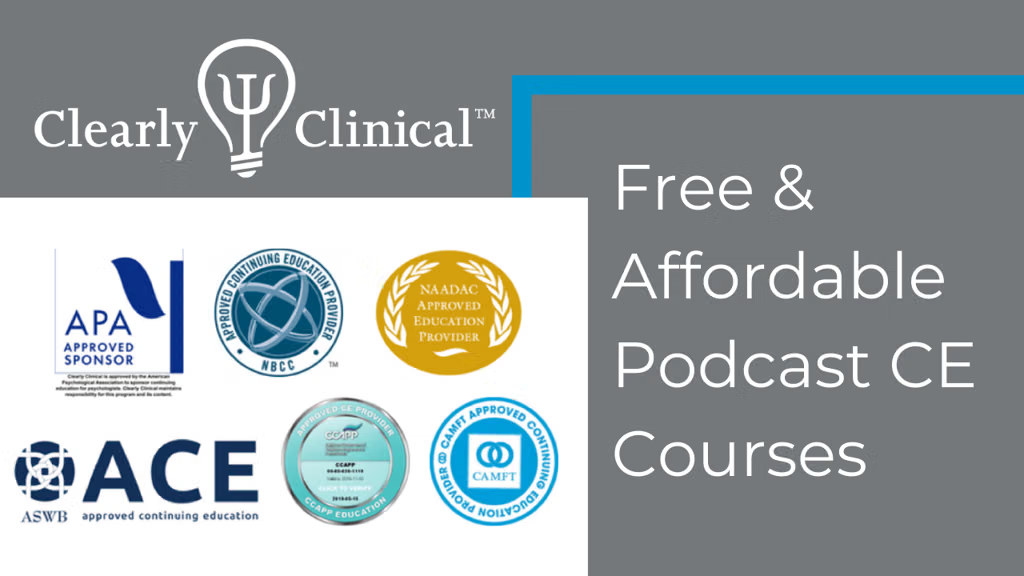
- Clearly Clinical : An exceptional podcast-based CE model founded by an LMFT. They offer an array of clinically rich, evidence-based audio courses covering trauma resilience, co-occurring disorders, and intersectional mental health care via Clearly Clinical CE CoursesClearly Clinical CE Courses.
- AllCEUs Counseling Education : Specifically targets addiction counselors, LMHCs, and marriage and family therapists with dedicated learning tracks. Their catalog features granular modules explicitly mapped to trauma-informed care and chemical dependency through AllCEUs Trauma-Informed Care.
- National Center for PTSD (VA/SAMHSA) : For high-level, evidence-based research and clinical application, the federal government offers specialized, in-depth continuing education courses focusing strictly on trauma, PTSD, and coping mechanisms via SAMHSA Continuing Education for TraumaSAMHSA Continuing Education for Trauma.
If you share your licensing state or whether you prefer audio/podcast learning, live webinars, or self-paced video modules , I can narrow down these recommendations to precisely match your state board's requirements.
Sources cited in this answer8
- camft.orgFind a CEPA Provider - CAMFT
- mftceus.comMFT CEUs
- pesi.comContinuing Education and Professional Development for Addictions Counselors | PESI
- pesi.comContinuing Education for Marriage Family Therapists | PESI
- clearlyclinical.comOnline Continuing Education - Clearly Clinical ®
- courses.clearlyclinical.comFREE CE: Resilience in Action: Bouncing Back from Trauma















Also asked as
- Where can I find high-quality continuing education for marriage and family therapists specializing in trauma or addiction?

