




































ChatGPT SearchOct 18, 2026
- 1Dtn

Data as of Oct 18, 2026A topic in Agri and Vegetation Intelligence Platforms. Reviewed by Dimitry Apollonsky
Mentioned in · Jul 8 – Oct 18, 2026
ChatGPT SearchOct 18, 2026
My top recommendation is DTN Agriculture Weather for most commercial farms, with METOS FieldClimate as the strongest alternative if you want forecasts informed by weather measurements from your own fields. If you need highly granular forecasts and automated alerts across multiple farm locations, Tomorrow.io is also worth evaluating. The best choice depends on whether you mainly need to time spraying, irrigation, planting, harvest, or frost protection.

(Best overall for farming)
DTN combines agriculture-focused forecasts, field mapping, weather alerts, and tools for deciding when to spray, plant, irrigate, and harvest. It is a strong choice for farms that need to turn weather data into day-to-day operating decisions.
Best for: Commercial crop farms and operators managing multiple fields.
Explore:

(Best for field-specific microclimates)
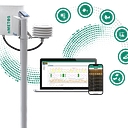
Combines data from on-farm weather stations and sensors with site-specific forecasts. It also offers soil-moisture monitoring, crop disease models, and guidance for spraying and harvest windows.
Best for: Farms where nearby fields have different rainfall, humidity, frost, or soil conditions.
Trade-off: The most useful measurements depend on the sensors and subscriptions you deploy.
Explore:

Granular weather intelligence with more than 30 weather parameters, including rainfall intensity, wind, humidity, evapotranspiration, and heat risk. It supports custom alerts and workflows for irrigation, spraying, planting, and protecting workers or crops from extreme weather.
Best for: Larger or technology-driven operations that want automated alerts across many locations.
Trade-off: Check which capabilities require a commercial subscription and whether its forecast resolution suits your fields.
Explore:
| Your biggest priority | My pick |
|---|---|
| Knowing when it's safe to spray | DTN or METOS |
| Forecasts tailored to individual fields | DTN WeatherSentry or METOS with field sensors |
| Irrigation scheduling and evapotranspiration | METOS FieldClimate or Tomorrow.io |
| Frost warnings and temperature-sensitive crops | METOS with on-farm sensors; compare local frost alerts |
| Automated alerts across many farm locations |
These are feature-based recommendations, not a controlled ranking of forecast accuracy. Actual performance varies with location, terrain, crop type, and weather conditions.
If your goal is genuinely hyper-local accuracy, consider pairing a forecasting service with a weather station on your farm. A nearby regional forecast can miss cold-air pockets, localized showers, wind differences, and humidity variations that matter for spraying and disease pressure. METOS and DTN both offer ways to incorporate field-level observations.
What do you grow, and where is your farm located? For example, corn and soybeans in Iowa, vineyards in California, or vegetables in Virginia.
With your crop and general location, I can give you a more targeted recommendation based on the weather risks that matter most to your operation, including whether a paid service is worth it or a lower-cost alternative would suffice.
Google AI ModeOct 18, 2026
Finding the best hyper-local weather service for farming comes down to whether you want data driven by on-farm hardware (weather stations), satellite/radar AI modeling , or agronomic decision platforms that turn forecasts into operational windows (like spraying or fieldworkability).[](https://climavision.com/agriculture/)[[2](https://www.premiumagsolutions.com/climate.htm)](https://www.premiumagsolutions.com/climate.htm)
The top hyper-local and precision agricultural weather solutions used across the industry include:
Google AI ModeOct 13, 2026
For modern agriculture, generic smartphone weather apps fall short because they lack microclimate precision, soil-level metrics, and operational forecasting (like spray windows, Delta-T, and Growing Degree Units).[](https://play.google.com/store/apps/details?id=com.sencrop.app)
Top-rated, hyper-local weather services and platforms specifically tailored for farming and agricultural management include:
If you'd like to narrow this down, let me know:
I can give you a more specific recommendation.
ChatGPT SearchOct 13, 2026
Google AI ModeOct 14, 2026
For farm-level, hyper-local precision weather forecasting, standard consumer apps (like default phone weather apps) generally fall short because they interpolate data from regional airports miles away. Specialized agricultural meteorology platforms combine high-resolution satellite data, proprietary local radar networks, AI modeling, and on-the-ground hardware to give field-specific insights.
Several key services specialize in this space:
ChatGPT SearchOct 14, 2026
| Tomorrow.io |
| A practical, agriculture-focused forecasting platform | DTN |
For farmers, the best hyper-local weather service is one that goes beyond a standard forecast to deliver field-level conditions, reliable rainfall estimates, disease and pest risk alerts, irrigation guidance, and spray-window forecasts.
There isn't one universal winner: the best option depends on your crop, farm size, location, and whether you need a mobile app, an on-farm weather station, or a precision-agriculture platform.

(Best overall for farm operations)
DTN specializes in agricultural weather intelligence, field-level mapping, workability forecasts, and planning for planting, spraying, and harvest. A strong first choice for commercial farms needing decision-oriented forecasts rather than general weather reports.
Pricing: Contact provider.

(Best for field-specific microclimates)
Combines local weather-station measurements with forecasts tailored to farm conditions. Particularly useful where rainfall, wind, and temperature vary significantly between fields. The service offers a 14-day trial, according to its website.
Pricing: Subscription; quote available.

(Best for automated alerts)
Provides location-specific weather intelligence, crop and livestock risk monitoring, and automated operational alerts. Worth considering for larger farms or agribusinesses managing many sites that need centralized monitoring.
Pricing: Enterprise pricing varies; check current availability and terms.

(Best for disease and irrigation management)
Combines on-farm sensors with forecasts, soil-moisture monitoring, evapotranspiration data, and crop disease models. Particularly attractive for orchards, vineyards, specialty crops, and growers who want to connect weather observations directly to crop management.
Pricing: Hardware and subscriptions; request a quote.

(Best for frost-sensitive crops)
Offers customized agricultural forecasts and frost/freeze alerts backed by agricultural meteorologists. Particularly relevant to fruit, citrus, vegetables, nurseries, and other crops where a few degrees can determine whether frost protection is necessary.
Pricing: Depends on the service and location; request a quote.
These are best-fit recommendations, not a verified ranking by independent user ratings. Public review data isn't consistent enough across these specialized services to establish a defensible overall star-rating leaderboard.
A quick look at available app-store feedback gives a useful additional perspective:
| Service | Public rating evidence | What it suggests |
|---|---|---|
| Cordulus Farm | 4.7/5 from 90 ratings on the UK App Store | Strong user feedback for farm weather monitoring |
| DTN Ag Weather Tools | 2.6/5 from 24 ratings on the US App Store | Strong agricultural features, but mixed app experience |
| / AWIS / |
These ratings reflect specific apps and storefronts, not the accuracy of each provider's entire forecasting service. They also have different sample sizes and regional coverage.
One important distinction: a forecast for a precise map pin is not necessarily a measurement from your field. For the most useful microclimate information, prioritize services that combine forecasts with actual on-farm sensor readings.
What type of farming are you evaluating these services for? Crop type and location can change which provider is most suitable.
If you'd like to narrow this down, tell me:
For farm management, the most useful weather services go beyond ordinary city forecasts. They specialize in field-level forecasting, frost alerts, rainfall variability, soil moisture, evapotranspiration (ET), wind conditions, and spray windows.
The key distinction is that a hyper-local forecast should help you decide what to do in a specific field, not just predict the weather at the nearest town. Some services use dense weather-station networks, while others combine radar, satellite imagery, forecast models, and your own on-farm sensors.

(Best for field-level forecasts)
DTN's agricultural weather tools offer field-specific forecasts, hourly updates, weather alerts, and guidance for spraying, irrigation, and harvest planning. Its WeatherSentry system can use local station observations to refine forecasts.
Best for: Commercial farms needing operational forecasts and detailed weather intelligence.
Explore DTN agriculture weather

(Best for rapid weather changes)
Provides high-resolution, location-specific weather intelligence, precipitation monitoring, and configurable alerts for frost, heat, wind, and other operational risks. Its agriculture offering supports irrigation, spraying, planting, and worker safety.
Best for: Farms where sudden storms, freeze events, or short spray windows create costly risks.
Explore Tomorrow.io for agriculture
(Best for on-farm measurements)
Combines physical weather stations and sensors with localized forecasts. Depending on your setup, you can track rainfall, wind, leaf wetness, air and soil temperature, soil moisture, evapotranspiration, and frost risk. Its FieldClimate platform also supports crop disease models.
Best for: Farms needing direct measurements from their own fields, especially for irrigation, frost protection, and disease management.
Explore METOS weather monitoring
The biggest improvement often comes from combining a forecasting service with a weather station on your farm.
Forecasting service
Predicts what may happen over the next few hours or days: rain, temperature, wind, and frost.
On-farm weather station
Measures what's actually happening at your site, helping reveal differences between your farm and the nearest official weather station.
Crop-specific decision support
Translates weather data into practical guidance for irrigation, frost protection, disease risk, and fieldwork.
No provider can guarantee precise predictions for every field. Terrain, elevation, wind exposure, and local storm patterns can still create substantial errors, especially for convective rainfall and overnight frost.
The best provider depends heavily on where you farm and what you need to predict.
1. Where is your farm located?
[Input placeholder: Town/region, state or country] (Current value unavailable.)
A nearby town or postal code is enough to start; no exact farm address needed.
2. What do you grow?
Field crops (corn, wheat, soy, etc.)
Orchard or vineyard
Vegetables or specialty crops
Livestock or pasture
Mixed farm / other
3. What do you most need to predict accurately?
Rainfall amounts and storm timing
Frost and overnight minimum temperatures
Wind and safe spraying windows
Irrigation, soil moisture, and ET
All of the above
4. Do you have your own weather station?
No — forecasts only
Yes — an existing weather station
Willing to install one for better accuracy
[Find the best fit for my farm]
With those details, I can narrow the options to services suited to your region and crop, rather than simply recommending general-purpose weather apps.
| No directly comparable rating established in this research |
| Evaluate through a demo or trial |
