CookUnity holds a wide lead for small-fridge meal storage, consistently highlighted for its single-serving portions in slim, stackable containers. Other options like Hungryroot and EveryPlate are noted when shoppers want compact meal kits rather than prepared trays.
If you’re sharing a small refrigerator, the best meal delivery service is usually one that delivers single-serving meals in stackable containers, requires little or no extra ingredients, and lets you order just a few meals at a time.
The key is to compare the actual space each meal occupies, not just the advertised portion size. A service that delivers compact, fully prepared meals can be much easier to manage than a meal kit containing bulky ingredient bags, sauce jars, and separate produce.
For a shared fridge, I’d prioritize these features:
One meal per container: no need to transfer food into your own storage dishes.
Compact, stackable packaging: rectangular trays or uniform containers are easier to organize.
Small order minimums: fewer meals taking up space at once.
Longer refrigerated shelf life or freezer-friendly meals: lets you spread out deliveries instead of filling the fridge every week.
Best meal delivery services for a small shared fridge
Fully prepared, single-serving meals that go straight from the refrigerator to the microwave. You don't need to store extra ingredients or containers, and you can adjust your weekly order or skip deliveries.
Space advantage: One meal per package, with no separate ingredient bags.
Watch out for: Fresh meals still occupy refrigerator space until eaten.
Chef-prepared meals arrive chilled in individual portions. You can order as few as four meals per week, and the company says its packaging is compostable, recyclable, or reusable. Refrigerated shelf life is typically around 4–7 days.
Space advantage: Individual meals and a relatively small starting order.
Watch out for: The trays' exact dimensions aren't published in the sources I checked, so don't assume they're smaller than competitors' trays.
Best if you have more freezer space than fridge space
Daily Harvest offers individually portioned smoothies, oat bowls, and other frozen foods. Most products are stored in the freezer, so they can reduce competition for shared refrigerator shelves.
Space advantage: Single-serving cups and freezer storage.
Watch out for: Smoothies need a blender, and freezer space is still required.
Tempo, a brand in the Home Chef family, offers microwaveable meals designed to be ready in about four minutes. This is worth comparing if you want individual meals rather than conventional meal kits.
Space advantage: Individual portions with no extra cooking ingredients to organize.
Watch out for: Verify the current minimum order and tray size before subscribing.
These are practical assessments of portioning and storage format, not measured rankings of container size. I couldn't verify comparable external dimensions for all four services.
My recommendation
I'd start with Factor or CookUnity, order just four meals for the first delivery, and see how much shelf space they actually use. If your freezer has room but your refrigerator is nearly full, try Daily Harvest instead.
One useful trick: reserve a single shelf or bin for your meals, and measure its usable width, depth, and height before ordering. That way, you can compare the packaging against the space you actually have.
One question: Is your main limitation the refrigerator itself, or is the freezer also very small?
When sharing a small fridge, traditional meal kits with loose produce, bulky sauce jars, and oversized box packaging can quickly start a turf war with your roommate or partner.
The best choices for limited refrigerator space are fully prepared, single-portion, ready-to-eat/heat meals that come in flat, stackable, or uniform containers, eliminating loose bags and awkward shapes.
Top meal delivery services designed with space-efficient packaging and single-serving portions include:
Factor
The Packaging: They arrive fresh (not frozen) in slim, rectangular, and exceptionally stackable plastic trays . A clever feature for tight spaces: the meal names and heating instructions are printed clearly on the side of the rim, meaning you can read what a meal is even when it’s buried in a high stack.[](https://health.yahoo.com/wellness/nutrition/meal-kits/review/factor-review-205605208.html)
Portion Fit: Strictly single-serving trays that take up about the footprint of a thin paperback book. They slide easily onto narrow fridge shelves or can be column-stacked.
CookUnity
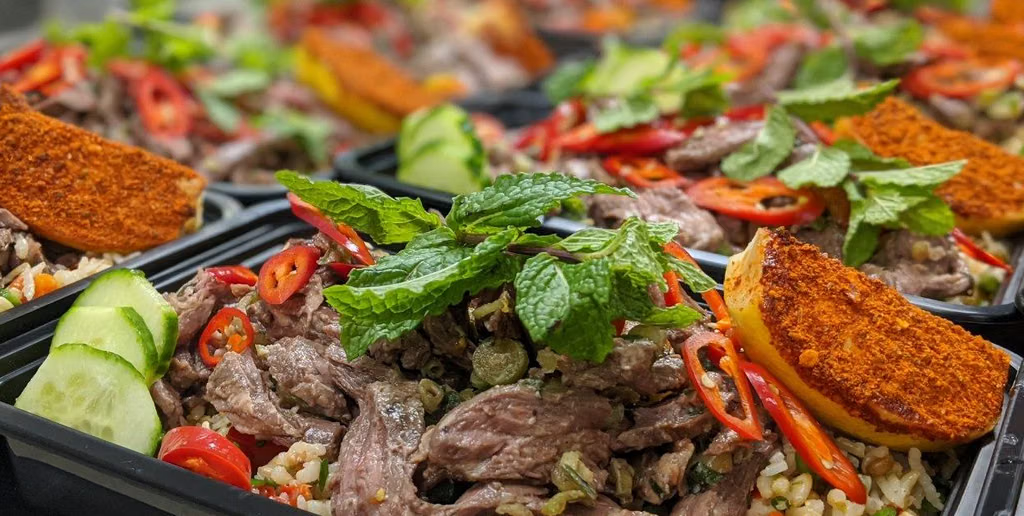
The Packaging: Premium chef-prepared fresh meals sent in rigid, low-profile trays. Because they are designed to maximize refrigerator efficiency, they have a uniform square-ish rectangular shape that sits flat and packs tightly next to each other.[](https://www.bonappetit.com/story/best-meal-delivery-services)
The Packaging: If you have access to a small freezer share rather than fridge space, Mosaic’s veggie bowls, oat bowls, and soups come in flat, square paper-based boxes (7 × 7 inches for bowls) that tetris beautifully into freezer compartments, or tall compact soup cups.
The Packaging: While technically a grocery/meal hybrid, Hungryroot swaps bulky cardboard boxes for vacuum-sealed, flat plastic packages for proteins, noodles, and veggies.
Portion Fit: Because everything is deconstructed into flat, flexible plastic pouches rather than rigid tubs, you can slide them vertically or horizontally into shallow door shelves or narrow gaps between condiments.
Tip for unboxing in a shared space: Immediately discard the outer cardboard box and large ice packs/insulation liners on your porch or recycling bin before bringing the food inside. Transferring just the slim meal pods into the fridge cuts down the footprint by 70% instantly.
If you'd like to narrow this down, let me know:
Do you have more fridge space or freezer space available?
Are you looking for fresh meals you can heat in 2 minutes, or do you prefer cooking from scratch?
Managing a tiny shared fridge footprint means avoiding bulky pre-made meal trays or meal kits with awkward, oversized produce boxes.
1. Traditional Meal Kits with Flexible Packaging (HelloFresh, Green Chef, or EveryPlate)
How it saves space: Instead of rigid plastic trays, traditional meal kits come in individual brown paper bags per meal with loose, stackable ingredients.
The Fridge Strategy: You don’t actually have to keep the whole bag in the fridge. You can unpack the kit, store the raw proteins in a compact flat stack in the meat drawer, keep loose veggies in a slim produce bag, and store dry goods (rice, spices, canned sauces) in your own bedroom pantry or a small cupboard shelf.
Where to look: Explore options on HelloFresh or EveryPlate.
2. Flat-Pack or Vacuum-Sealed Prepared Meals (Factor or Icon Meals)
How it saves space: Some prepared-meal services use low-profile, flat, rectangular containers rather than deep, bulky bowls.
The Fridge Strategy: Flat containers can be stacked neatly like books or files on a single narrow fridge shelf, maximizing vertical space without blocking other housemates' items. Alternatively, if they arrive frozen, keep most of them in a deep freezer (if you have access) or order smaller weekly quantities (e.g., 4 to 6 meals max) so you're never overfilling the shared space.
Where to look: Check out selections on Factor or ICON Meals.
How it saves space: Zero refrigerator or freezer space required until opened.
The Fridge Strategy: These single-serve trays or pouches live entirely in your personal room storage, a designated dry bin, or your backpack. You only take one to the kitchen when it's time to microwave it.
Where to look: Look at multi-packs available via retailers like Walmart.
If you can share whether you prefer cooking raw ingredients yourself or want fully prepared microwave meals , I can narrow down the exact service that fits your routine best.
Yes. If fridge space is the main constraint, I’d prioritize shelf-stable meals first, then very compact frozen meals.
Best fits for a tiny shared fridge
Option
Cold storage needed
Why it fits
BOCOBITES
None until opened
Chef-made meals in jars; shelf-stable for 12 months and ready in about 3 minutes.
Hope Kitchen
None
Fully prepared meals with up to a 24-month shelf life; can be eaten from the package or heated.
Miss Olive's Meals
None
Shelf-stable prepared meals designed to be stored at room temperature.
My Own Meals
None
Shelf-stable, fully cooked meals that can be heated in a microwave or hot water.
GOLO Foods
Freezer
A particularly space-efficient frozen option: the company says 24 meals occupy less than 1 cubic foot and are designed to stack.
Splendid Spoon
Mostly freezer
Frozen soups, bowls and noodles; Healthline specifically notes that the meals don't take up much freezer space.
My practical recommendation: with a crowded shared refrigerator, go shelf-stable rather than conventional refrigerated meal delivery. You can keep a week's worth in a bedroom/pantry cupboard and only put one meal in the fridge after opening. BOCOBITES is especially interesting if you want something more like a complete dinner than an emergency-style packaged meal.
If you do have a little freezer space, GOLO's compact packaging is worth considering. Conventional fresh meal services can be awkward in a shared kitchen because they generally arrive refrigerated and need several days of fridge space.
If you tell me roughly how many meals per week you need and your budget per meal, I can narrow this to 3–5 options that ship to your area.