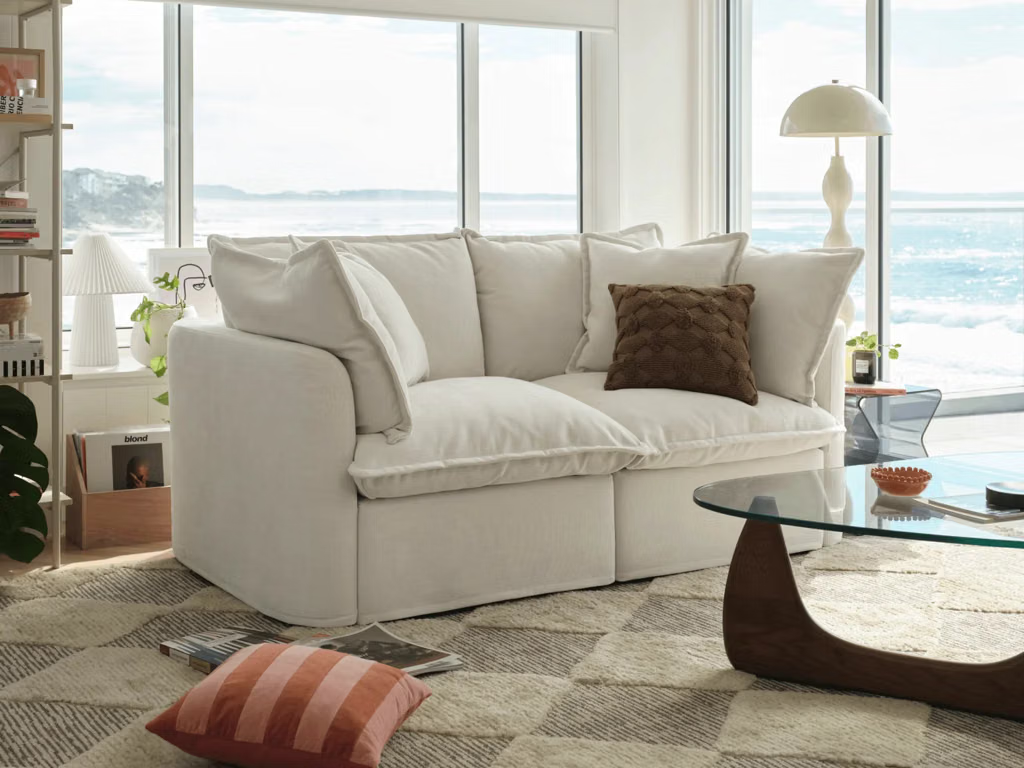
For an investment sofa, focus on brands that explicitly document their core materials. Maiden Home, BenchMade Modern, Room & Board, and MadeRight are frequently cited for providing clear specifications on frame materials, such as kiln-dried hardwood, and cushion density measurements, which are critical indicators of long-term durability.
2Maiden HomeBest for high transparency in American-made craftsmanship. They provide detailed data on kiln-dried hardwood frames and cushion composition, making them a top choice for buyers prioritizing clear build specifications.42%
If long-term durability + transparency are your priorities, I’d focus on retailers that tell you what’s inside the sofa—not just “premium,” “sturdy,” or “high-density.”
Retailers I’d investigate
Simplicity Sofas — particularly strong on engineering-level construction details. Look for solid hardwood framing, corner blocking, doweled/glued joints, suspension details, and actual foam specifications where provided.
Room & Board — one of the more transparent mainstream retailers. Individual sofa pages commonly identify the frame material, suspension system, and cushion construction. The main gap is that actual foam density in lb/ft³ isn't consistently published, so I'd ask for it before ordering.
Maiden Home — strong disclosure of frame materials, joinery, suspension, and cushion construction, particularly on its handcrafted models. Again, I'd request the numerical foam density for the exact model, rather than accepting “high-density.”
BenchMade Modern — unusually good technical information about frames and suspension, including engineered 7-ply wood versus solid kiln-dried alder and reinforced construction. Cushion information is good, although not always as numerically specific as I'd like.
Medley — worth examining if material disclosure is important; it gives relatively detailed information about frame materials and different cushion-fill options.
MadeRight — interesting specifically because its published material information gets into actual foam density, rather than stopping at “high density.”
What I'd ask before spending $3,000+
For the exact sofa/model, ask the retailer:
Frame: What species/material is used? Is it kiln-dried? Solid hardwood, plywood, or engineered wood?
Joinery: Are joints doweled, mortise-and-tenon, corner-blocked, screwed/glued, stapled, etc.?
Suspension: Sinuous springs, 8-way hand-tied coils, webbing, or another system?
Seat cushion: What is the foam density in lb/ft³? Don't accept just “high-density.”
Foam type: Is it high-resilience (HR) foam? What's the firmness/ILD?
Replaceability: Can you buy replacement seat cushions in 5–10 years?
Warranty: What specifically is covered—frame only, suspension, foam, cushions, upholstery?
As a rough benchmark, published industry-oriented comparisons commonly point toward ~2.0 lb/ft³ or higher HR seat foam for a durability-focused sofa, with roughly 2.2–2.5+ lb/ft³ being a particularly useful target for heavy daily use. Density isn't the same thing as firmness, though.
One important nuance: don't automatically equate “solid hardwood” with better construction. A well-designed, properly joined hardwood plywood/engineered frame can be extremely durable; what matters is the material and how the frame is engineered.
If you give me your budget (e.g. $2–3k, $3–5k, $5k+) and preferred feel (firm/upright vs. deep/lounge), I can narrow this to specific sofas and compare their frame, suspension, foam density, warranty, and replaceable-cushion options side by side.
When investing in a long-term sofa, transparency regarding internal materials—such as kiln-dried hardwood frames , exact foam densities (ideally high-resilience 2.0 to 2.5 lb/cu ft foam), and suspension types—is the ultimate indicator of a brand that builds to last.
The retailers and makers recognized for being exceptionally clear and forthcoming about their frame construction and cushion specifications include:
Room & Board stands out for its high level of product detail. On every sofa listing, they explicitly state the frame construction (e.g., benchmade kiln-dried hardwood or engineered wood specs), the exact cushion makeup (such as high-resilience foam cores wrapped in fiber or down), and the suspension system (sinuous spring or webbed). Their customer service and digital specs clearly outline what is inside the piece without needing to hunt for trade secrets.
Maiden Home is built on a direct-to-consumer model emphasizing custom, heirloom-quality craftsmanship. They openly detail their frame construction (kiln-dried engineered hardwood with mortise-and-tenon joinery) and break down their cushion cores, which utilize high-resilience, high-density foam wrapped in premium down-feather or poly-fiber blends to prevent sagging.
Interior Define provides deep customization transparency. As you build your sofa online, they outline the internal construction specs for frames (kiln-dried solid hardwood and laminated hardwood composites) and allow you to explicitly select cushion types (ranging from standard plush to multi-layer resilient foam cores) with clear descriptions of how each density performs over time.
Sabai takes a radical transparency approach focused on sustainability and repairability. They clearly detail their frame materials (FSC-certified kiln-dried solid wood and plywood with no toxic-heavy chemical treatments) and use high-resilience CertiPUR-US certified foam for their cushions, while designing the sofa with mechanical fasteners so individual parts can be replaced rather than tossing the whole couch.
The Joinery /local Amish & custom benchmakers (regional custom builders) are inherently the gold standard for ultimate transparency. If you work with high-end American benchmade makers or custom regional shops, they will tell you the exact species of kiln-dried hardwood used for the frame (like maple or oak) and the precise pound-per-cubic-foot rating of the foam in your cushions.
If you'd like to narrow this down, let me know:
Your preferred style (e.g., mid-century, deep-lounge, traditional)
Your budget range
Whether you prefer a firmer, supportive sit or a soft, sink-in "cloud" feel
I can point you toward the specific brand that matches your comfort and structural requirements.
If you’re buying a sofa as a 10–15+ year piece, I’d prioritize retailers that disclose the actual build: frame material + joinery, suspension system, cushion construction, and ideally foam density (lb/ft³). Many brands advertise “premium” or “high-density” without giving enough detail to judge longevity.
My shortlist for transparency:
Retailer
Why it stands out
Cushion/frame transparency
Simplicity Sofas
One of the most specification-focused makers
Among the strongest for engineering details: frame construction, replaceable components, and foam specs are emphasized.
Room & Board
Best mainstream retail option
Product pages commonly disclose frame type, suspension, and cushion construction. Exact foam density may require asking.
Maiden Home
Premium handcrafted option
Strong detail on materials and construction; some models specify kiln-dried hardwood, spring systems, and cushion builds. For foam density, I’d still request the exact number for your model.
BenchMade Modern
Good for customization
Particularly clear about frame materials and construction approach; useful if dimensions or configuration matter.
Medley
Strong materials transparency
Worth considering if you care about detailed material disclosure and alternative cushion options.
What I would look for before spending $3,000+
Frame
Good signs:
Kiln-dried hardwood (maple, oak, ash, etc.) or a well-engineered hardwood/plywood structure
Corner blocks
Dowels, screws, glue, or mortise-and-tenon joinery
Be cautious with:
“Hardwood frame” without specifying what kind
“Solid wood” without telling you where it’s used
Cushions
Ask for:
Foam density in pounds per cubic foot (lb/ft³), not just “high density”
Whether it is high-resilience (HR) foam
Whether cushions are replaceable
A commonly sought range for heavy everyday use is roughly 2.0–2.5 lb/ft³ HR foam, though cushion design, suspension, and comfort goals matter too. Density affects durability; it does not directly tell you whether a sofa feels soft or firm.
Suspension
Look for:
Quality sinuous steel springs
Eight-way hand-tied springs (common in traditional premium upholstery)
Well-designed webbing systems
Avoid assuming that one suspension type is automatically best—the whole construction matters.
My practical buying order
If I were comparing sofas specifically on information transparency, I’d start with:
Simplicity Sofas — if you want the most technical details
Room & Board — if you want a showroom-friendly, broadly available option
Maiden Home — if you want a premium handcrafted piece
BenchMade Modern — if customization is important
Medley — if materials and repairability are priorities
One final tip: compare specific sofa models, not just brands. A single retailer may offer both a very durable build and a less robust one.
If you tell me your approximate budget (for example $2k, $5k, $10k+), preferred style (deep lounge vs upright, modern vs traditional), and whether it’s a sofa or sectional, I can narrow this to specific models.
If you tell me your approximate budget (for example $2k, $5k, $10k+), preferred style (deep lounge vs upright, modern vs traditional), and whether it’s a sofa or sectional, I can narrow this to specific models.
When you are investing in a "buy-it-for-life" or long-term sofa, transparency is your best shield against sagging cushions and squeaky, warped frames. High-transparency retailers don't hide behind vague marketing buzzwords like "luxury foam" or "sturdy wood"—they explicitly state wood species, kiln-drying status, joinery, spring types, and foam density (ideally 2.0 lbs/cu.ft or higher for high-resiliency seats).
The sofa retailers and brands that stand out for exceptional construction transparency include:
Room & Board
Frame Transparency: Excellent. They explicitly detail benchmade, kiln-dried hardwood (or mixed hardwood/plywood depending on the line, but clearly stated) joined with corner blocks, double-dowels, or heavy-duty fasteners.
Cushion Transparency: High. They disclose high-resiliency (HR) CertiPUR-US® certified foam cores wrapped in fiber or down blends, often giving explicit details on whether pocketed coils or sinuous steel springs are embedded inside the seat cushion or frame base. You can view specific breakdown details on every product page under their "Construction & Care" tabs. Check out options on the Room & Board Sofas Catalog.
Maiden Home
Frame Transparency: High. They pride on direct-to-consumer North Carolina craftsmanship, explicitly stating that their frames are built from solid, kiln-dried North Carolina hardwoods with precision-cut corner blocks and joint-level reinforcement.
Cushion Transparency: High. They detail high-density, high-resiliency foam cores wrapped in premium fiber, feather, or down-blend wraps, and explicitly specify heavy-gauge steel sinuous spring suspension systems. Specifications are transparently outlined on the Maiden Home Living Room Collection.[1][2]
Hickory Home Furniture / American Heirloom Makers
Frame Transparency: Absolute. Traditional high-end American benchmade manufacturers (like Hickory or similar North Carolina legacy workshops) list precise lumber dimensions (e.g., 4/4 kiln-dried hardwood lumber).
Cushion Transparency: Absolute. They openly guarantee 2.4-density high-resiliency soy-based foam cores (well above the industry standard for long-term durability) and specify 8-way hand-tied steel coil systems. You can explore traditional specs via makers like Hickory Home Furniture.
BenchMade Modern
Frame Transparency: Very High. They provide deep-dive technical specs on how every frame is custom-built from solid, kiln-dried hardwood with reinforced corner blocking.
Cushion Transparency: High. They let you choose cushion types and explicitly outline the high-density foam and multi-layer construction intended to prevent premature body impressions. Explore customization on BenchMade Modern.
What to Look for in the Specs:
When browsing these or other sites, cross-reference their technical sheets with these gold-standard benchmarks for longevity:
Frame: Look for kiln-dried solid hardwood (oak, ash, maple, or beech). Avoid unseasoned green wood or solely unreinforced particleboard/plywood main frames.
Joinery: Look for doweled, glued, and corner-blocked joints rather than just stapled or glued thin boards.
Suspension:8-way hand-tied springs or heavy-gauge sinuous steel coils outlast cheap elastic webbing by decades.[2]
Cushion Density: Aim for a foam density of 2.0 to 2.5 lbs/cu.ft in high-resiliency (HR) foam. Anything under 1.8 lbs will soften and break down noticeably within a few years of daily use.
Are you looking for a specific style or configuration (like a deep-seat sectional, a mid-century apartment sofa, or a traditional roll-arm), or a specific cushion feel (firm vs. sink-in plush)? I can narrow down which of these brands fits your comfort preference best.
If you’re buying a sofa as a 10–15+ year piece, I’d prioritize retailers that disclose the actual build: frame material, joinery, suspension, cushion core, and (ideally) foam density. Many brands say “hardwood frame” and “high-density foam” without giving enough detail to judge longevity.
My shortlist for transparency:
Retailer
Why it stands out
What to verify
Simplicity Sofas
Among the most specification-focused: detailed construction information, repairable designs, and clearer engineering-style disclosures.
Confirm the exact model’s foam density and suspension.
Room & Board
Probably the best mainstream option. Product pages commonly describe frame and suspension construction rather than hiding behind marketing terms.
Ask for the exact seat foam density (lb/ft³), since it is not always published.
Maiden Home
Strong craftsmanship disclosure: frame materials, upholstery methods, and cushion construction are usually explained in detail.
Request the numerical foam density for the specific sofa.
BenchMade Modern
Very good frame transparency, including engineered wood vs. solid wood choices and construction details.
Check the cushion specification; frame disclosure is stronger than foam disclosure.
Medley
Strong materials transparency, especially if you care about alternative cushion materials and lower-toxicity options.
Compare cushion options carefully; they can vary significantly.
Specs I would look for
Frame
Kiln-dried hardwood (maple, oak, ash, etc.) or a high-quality engineered hardwood frame.
Reinforced corners (corner blocks).
Dowels, screws, mortise-and-tenon, or similarly robust joinery.
Avoid vague claims like “wood frame” without material details.
Cushions
Ask for foam density in lb/ft³, not just “high density.”
For heavy daily use, I’d generally want: - ~2.0 lb/ft³ or higher HR (high-resilience) foam as a solid baseline.
~2.2–2.5+ lb/ft³ is especially attractive for a long-life sofa.
Remember: density affects durability, not whether a cushion feels soft or firm.
Suspension
Quality sinuous springs can be excellent.
8-way hand-tied springs can be excellent but aren’t automatically superior; the whole construction matters.
My buying order if durability is the priority
Simplicity Sofas — if you want maximum technical transparency and repairability.
Room & Board — if you want a showroom experience plus strong construction documentation.
Maiden Home — if you want premium/custom styling.
BenchMade Modern — if you need unusual dimensions or customization.
Medley — if materials and sustainability are major factors.
A good rule: before spending $3,000+, email the retailer and ask: “What is the seat foam density in lb/ft³ for this exact model, what is the frame material and joinery, and can I buy replacement cushions in the future?” The quality of that answer tells you a lot.
If you share your budget (for example $2k, $5k, $10k+), preferred style (deep lounge vs. upright), and sofa vs. sectional, I can narrow this to specific models.
When investing in a long-term sofa, transparency is your best shield against marketing fluff like "luxurious cushioning" or "durable frame" (which often just means cheap particleboard and 1.5 lb foam that sags in two years).
A truly transparent retailer explicitly lists kiln-dried hardwood (or engineered multi-ply hardwood) for the frame, sinuous steel or 8-way hand-tied springs for suspension, and high-resiliency foam measuring 2.0 to 2.8 lbs/ft³ density for the core.
The sofa retailers and custom makers noted for being explicit and upfront about these structural specs include the following:
1. DreamSofa
Frame Construction: Built using solid kiln-dried domestic hardwoods (like maple and alder) with reinforced corner blocking and doweled joints. They provide complete structural breakdowns on their site.
Cushion Density: Unusually transparent, using a baseline high-resiliency foam starting at 2.0 lbs/ft³ and offering high-end upgrades up to 2.5 lbs/ft³ or luxury feather-down blends with explicit ratio disclosures. They explicitly publish guides explaining how foam density dictates lifespan.
Transparency Level: Exceptionally high; you can customize and view exact core materials on the DreamSofa Quality Guide.
2. Maiden Home
Frame Construction: Details precision-crafted frames made from kiln-dried solid hardwood and engineered hardwood laminate, backed by a lifetime warranty.
Cushion Density: Discloses resilient, high-density foam cores wrapped in premium feather-down or poly-fiber envelopes depending on the chosen comfort profile (plush vs. signature).
Transparency Level: High for a direct-to-consumer brand. They clearly outline their frame joinery and cushion layering right on individual product pages and their Maiden Home Construction Overview.
3. Taylor King & Hancock & Moore (Traditional/Custom Guilds)
Frame Construction: Utilizes heavy-duty 9/8-inch thick multi-ply hardwood or kiln-dried hardwood frames with traditional eight-way hand-tied spring suspensions.
Cushion Density: Explicitly rated; for instance, Taylor King’s Prestige XL and Hancock & Moore’s Qualux/Ultra-Down seat configurations use high-resiliency foam densities ranging from 2.3 to 2.4 lbs/ft³.
Transparency Level: Exceptional, though they are sold primarily through authorized high-end regional dealers rather than a direct e-commerce cart. Their master spec sheets list exact wood and foam data for serious buyers.
4. Thayer Coggin
Frame Construction: Built with kiln-dried hardwood and commercial-grade inner frame construction, famous for mid-century modern silhouettes (like Milo Baughman designs) that are built like tank-level heirlooms.
Cushion Density: Uses high-resiliency foam core construction wrapped in Dacron or down-blend layers, with precise construction specs available upon request or via high-end specialist retailers like Urban Natural Home.
Transparency Level: High regarding longevity and commercial/residential-grade durability, though you often have to consult dealer spec sheets for exact pound-per-cubic-foot metrics.[1]
Quick Cheat Sheet: What Specs to Demand
If you look at other brands outside this list, verify these minimum thresholds before buying a "forever" piece:
The Frame: Must say kiln-dried solid hardwood or cross-banded hardwood plywood . Run away from "all-wood frame" (code for cheap plywood/particleboard) or un-kiln-dried lumber that will warp and squeak.
The Cushion Core: Must be High-Resiliency (HR) foam at 2.0 lbs/ft³ density or higher ($2.4–2.8𝑖𝑠𝑒𝑙𝑖𝑡𝑒)[3.1.3].𝐴𝑛𝑦𝑡ℎ𝑖𝑛𝑔𝑎𝑟𝑜𝑢𝑛𝑑$1.5–$1.8 l b s/f t 3 will break down rapidly under daily sitting.
The Suspension: Look for heavy-gauge sinuous steel springs or webbed/drop-in coil systems; true 8-way hand-tied is the gold standard for traditional build quality.
Are you looking for a specific style (e.g., mid-century modern, deep cloud-style sectional, traditional Lawson) or a particular budget ceiling so I can narrow down which of these options fits best?
If long-term durability + transparency are your priorities, I’d narrow the field to a handful of retailers rather than shopping purely by style.
My shortlist
Retailer
Frame transparency
Cushion transparency
My take
Simplicity Sofas
Excellent
Excellent
Best if you want engineering-level specifications
Room & Board
Excellent
Very good
Best mainstream balance
Maiden Home
Excellent
Very good
Best premium/custom option
BenchMade Modern
Excellent
Good–very good
Excellent for customization
Medley
Excellent
Excellent
Particularly good for material transparency
1. Simplicity Sofas — best for actual specifications
This is probably where I'd start if your definition of transparency is “tell me exactly what's inside.” Their construction information gets into things like solid-oak framing, glued/doweled/corner-blocked construction and, on applicable configurations, 2.5-lb high-resilience foam.
That's considerably more useful than a retailer simply saying “premium” or “high-density” foam.
2. Room & Board — best overall mainstream choice
Room & Board is unusually good at documenting individual models. For example, its Metro specifies a benchmade hardwood frame with dual Flexolator suspension, while its André specifies a benchmade hardwood frame with sinuous-coil suspension and a high-resiliency foam core.
The catch: it doesn't consistently publish the actual foam density in lb/ft³, so I'd call before ordering if that number is important to you.
Maiden Home does a good job explaining individual sofa construction—frame material, suspension and cushion construction. It's particularly attractive if you're spending several thousand dollars and want something more bespoke.
I'd still ask them for the exact seat-foam density of your chosen model rather than accepting “high-density foam.”
4. BenchMade Modern — excellent technical disclosure
BenchMade Modern is particularly forthcoming about its frames. Its FAQ says frames use either engineered 7-ply wood or solid kiln-dried alder, with corner blocks, industrial staples and low-VOC glue.
One important nuance: engineered 7-ply isn't automatically worse than solid wood. Good engineered hardwood plywood with good joinery can be an excellent frame material.
Medley is another interesting choice because it goes fairly deep into material choices, including different cushion materials and foam options. Its Rio sofa, for example, has been documented with an FSC-certified solid/engineered-hardwood frame and corner blocks.
The numbers I'd insist on
For a sofa you hope to keep 10–15+ years, don't stop at “kiln-dried hardwood” and “high-density foam.” Ask the retailer:
What is the exact seat-foam density in lb/ft³?
Is it high-resilience (HR) foam?
What percentage of the frame is solid hardwood versus plywood/engineered wood?
What is the joinery—dowels, mortise-and-tenon, corner blocks, screws/glue?
What is the suspension—sinuous springs, webbing, eight-way hand-tied?
Can I purchase replacement seat cushions/cores in 5–10 years?
What does the frame warranty cover, and what does the cushion warranty cover?
As a rough screening number, I'd be much more comfortable around 2.0 lb/ft³+ HR seat foam, with roughly 2.2–2.5+ lb/ft³ particularly appealing for heavy daily use. But density isn't the same thing as firmness or overall cushion quality.
The Washington Post's sofa comparison also illustrates why you need to look at the whole construction: its examples range from hardwood/kiln-dried frames and sinuous springs to eight-way hand-tied spring systems and different foam/down constructions.
If it were my money: I'd investigate Simplicity Sofas first for maximum technical transparency, Room & Board for the best mainstream balance, and Maiden Home/BenchMade Modern for premium customization. And I'd compare specific models, not just brands—construction can vary substantially within one retailer.
When investing in a long-term sofa, transparency is your best shield against marketing fluff like "solid wood frame" (which can legally mean cheap plywood or unseasoned pine) or "plush cushioning" (low-density foam that sags within 18 months).
The gold standard for a generational frame is kiln-dried hardwood (such as oak, ash, or maple) joined by dowels, corner-blocks, or mortise-and-tenon rather than just staples and glue. For cushions, look for high-resiliency (HR) foam with a density of at least 1.8 to 2.5 lbs per cubic foot.
The sofa retailers and direct-to-consumer (DTC) brands that are exceptionally upfront and clear about their technical specs, frame composition, and cushion construction include:
Maiden Home
Frame: Explicitly details its use of precision-cut, kiln-dried domestic hardwoods with reinforced corner-blocking and heavy-gauge sinuous or 8-way hand-tied spring suspensions.
Cushions: Uses high-resiliency foam cores (2.5+ lb density) wrapped in resilient polyfiber or down-feather blends. Crucially, they back these specs with a comprehensive warranty that covers the cushion cores right alongside the frame. You can review their craftsmanship details on the Maiden Home Craftsmanship Page.
Room & Board
Frame: Transparently outlines its frame construction on product pages, detailing combinations of kiln-dried engineered and solid domestic hardwoods (mostly maple and ash), reinforced with corner blocks and joined with high-integrity doweling.
Cushions: Discloses high-density polyurethane foam wrapped in fiber padding, and customer service readily provides exact density/ILD ratings upon request. Their materials and construction breakdown are visible on the Room & Board Quality Overview.
BenchMade Modern
Frame: Explicitly notes using custom-engineered, heavily reinforced FSC-certified wood frames with interlocking joinery.
Cushions: Highly transparent about offering robust high-resiliency foam options (up to 2.3+ lb density) combined with premium down-alternative fills (like Trillium). They let you customize and see the precise inner core makeup on the BenchMade Modern Website.
What A Room / Custom Local Makers
Frame & Cushions: If you want absolute, non-negotiable commercial-grade specs, custom build houses like What A Room explicitly list heavy-duty 2.5 lb high-resilience foam (the kind used in luxury hospitality) and kiln-dried hardwood frames natively on their site because durability is their core pitch.
Quick Cheat Sheet: What Specs to Look For
When reviewing any other retailer's product specifications or quizzing a salesperson, look for these green flags:
The Wood: Explicit mention of kiln-dried hardwood (oak, maple, beech, or ash). Avoid vague terms like "hardwood mix" or "composite wood."
The Suspension: Look for 8-way hand-tied springs or heavy-gauge sinuous steel springs . Avoid elastic webbing alone unless it's a multi-layered high-end webbing system.
The Foam Density: Demand a minimum of 1.8 lbs/cu. ft. for casual use, but 2.0 to 2.5 lbs/cu. ft. is what truly guarantees years of sag-free bouncing.
If you have a specific style (e.g., modern low-profile, traditional deep-seat cloud style) or a budget range in mind, I can help narrow down which of these transparent brands fits your aesthetic best.
When investing in a long-term sofa, transparency is your best shield against industry shortcuts (like unseasoned pine frames and low-density polyfoam that collapses within 24 months). A truly "Buy It For Life" piece should openly feature a kiln-dried hardwood frame (to prevent warping/creaking) and high-resilience (HR) foam of at least 1.8 lb/ft³ (though 2.5 lb/ft³ or higher is the gold standard for long-term recovery).
The sofa retailers that set the benchmark for absolute clarity regarding their frame construction and cushion metrics include:
Maiden Home
Frame Construction: Features fully bench-built, kiln-dried domestic hardwood frames with mortise-and-tenon joinery and heavy-duty spring systems (including 8-way hand-tied suspensions on core models).
Cushion Density: Explicitly publishes high-resilience foam cores scaling at 2.5+ lb/ft³ density , wrapped in premium feather-down or eco-friendly multi-density fiber blends. Uniquely, their warranty covers the frame, springs, and cushion cores together.
Room & Board
Frame Construction: Transparently details custom frame builds on every product page—specifying kiln-dried engineered or solid domestic hardwoods, corner-blocking, and distinct suspension types (sinuous steel or dual-flexolator springs depending on the collection).
Cushion Density: Provides comprehensive descriptions for every single style, explicitly detailing cushion core composition (e.g., high-density foam wrapped in polyfiber or multi-layer blend-down configurations) so you know precisely how firm or plush the seat is before buying.
Joybird
Frame Construction: Uses sustainably sourced, kiln-dried solid hardwood and mixed hardwood laminate frames with reinforced corner blocks.
Cushion Density: Openly lists high-density polyfoam seat cushion cores rated at 2.8 lb/ft³ , placing them well above the industry average baseline for durability and bounce-back resilience.
What A Room
Frame Construction: Focuses on custom, domestic bench-made construction utilizing heavy-duty kiln-dried hardwood.
Cushion Density: Explicitly markets 2.5 lb high-resilience foam as standard across its cushion profiles, purposefully matching commercial hospitality-grade standards and openly detailing specifications that other direct-to-consumer brands keep hidden.
Note on standard D2C brands (like Article, Burrow, or Floyd): While they make stylish mid-range pieces, their baseline models typically default to standard 1.8 lb/ft³ foam cores, which require a realistic expectation of a shorter lifespan (3 to 5 years) before the seats begin to soften or bottom out, unless upgraded.
If you'd like to narrow this down, let me know:
Your ideal budget range
Preferred seat feel (ultra-plush/sink-in vs. supportive/firm)
Whether you have pets or kids
I can give you a more targeted recommendation based on these factors.
If long-term durability and transparency are your priorities, I’d shortlist these rather than simply shopping by brand reputation. The important distinction is whether a retailer tells you what is actually inside the sofa—frame material and joinery, suspension, and ideally the actual foam density.
My ranking
Simplicity Sofas — best for true engineering transparency
One of the few companies that gets unusually specific about construction, including solid-oak framing, glued/doweled/corner-blocked construction and, on some configurations, 2.5 lb/ft³ high-resilience foam.
Particularly compelling if you're trying to buy a sofa you can repair rather than replace.
I'd put this at the top if specification disclosure is your #1 criterion.
Room & Board — best mainstream choice
Product pages clearly identify construction and suspension. For example, its Cade specifies a benchmade hardwood frame with sinuous-coil suspension and a high-resiliency CertiPUR-US foam core wrapped in fiber.
The Lloyd similarly specifies a benchmade hardwood frame and sinuous coils.
The weakness: they don't consistently publish the actual foam density in lb/ft³. I'd call and request it for the exact model.
Maiden Home — best premium/bespoke option
Very good disclosure of frame, suspension and cushion construction. Some models use kiln-dried hardwood and sophisticated joinery; the Sullivan, for example, uses 8-way hand-tied springs, kiln-dried maple and a high-density foam/down/feather/fiber cushion construction.
Again, I'd ask for the numerical foam density, rather than accepting "high-density."
BenchMade Modern — best technical/customization combination
Their own FAQ is refreshingly explicit: frames are either engineered 7-ply wood or solid kiln-dried alder, joined with corner blocks, industrial staples and low-VOC glue.
Excellent if you need unusual dimensions or want a highly configurable sofa.
Cushion density disclosure isn't quite as good as the frame disclosure.
Medley — worth considering if material transparency matters
Strong disclosure around frame materials and cushion choices, including natural latex and low-VOC foam.
It also scored well in recent sofa comparisons; the Medley Rio was documented with FSC-certified solid/engineered hardwood, corner blocks and latex or high-density foam cushions.
What I'd actually ask before spending $3,000+
Don't accept just "kiln-dried hardwood" + "high-density foam." Ask:
Frame: What species/material? Solid hardwood, plywood, or engineered wood?
Replaceability: Can I buy replacement seat cushions/cores in 5–10 years?
For context, a current mainstream sofa can be quite transparent about construction without giving the crucial density number. Room & Board, for example, tells you that its Cade uses high-resiliency CertiPUR-US foam, but doesn't put the numerical density on the product page.
My personal starting point for a 10–15+ year purchase:Simplicity Sofas → Room & Board → Maiden Home → BenchMade Modern → Medley. I'd compare specific models, though, because construction can vary substantially within the same retailer.
If you tell me your budget (e.g. $2–3k / $3–5k / $5k+) and whether you want firm/upright or deep/plush, I can narrow this to the best 5–8 actual sofas and compare their frame, suspension, foam density, warranty and cushion replaceability.