Choosing the best inspection robot depends heavily on the environment—whether you are navigating stairs in a multi-level chemical plant, climbing vertical steel tanks, or crawling inside narrow pipelines.
Leading inspection robots are categorized below by their primary industrial use cases and operating environments:
1. General Industrial Facilities & Multi-Level Plants (Quadruped Robots)
For factories, power stations, and refineries featuring stairs, catwalks, grated flooring, and uneven terrain, four-legged (quadruped) robots have become the gold standard. They handle obstacles that wheeled or tracked robots cannot.
Boston Dynamics Spot: Widely deployed for autonomous routine plant rounds. Equipped with modular payloads like optical/thermal PTZ cameras, acoustic imagers (for gas/air leak detection), and LiDAR, Spot replaces manual walkdown crews and minimizes confined-space entries.
ANYbotics ANYmal (C/D Series): Specifically engineered for industrial environments (IP67 rated). It features robust autonomous navigation, 360° LiDAR, and continuous sensor payloads (gas detection, thermal, and acoustic tracking) built explicitly for heavy industrial maintenance and plant monitoring.[2][3]
In areas with explosive gases, volatile chemicals, or hazardous atmospheres (Class 1 Div 1 / ATEX zones), standard electronics can cause ignition.
ExRobotics ExR-2.5 / ExR-2: These autonomous inspection robots carry specialized certifications (such as UL and IECEx/ATEX) for use in potentially explosive industrial and oil and gas environments. They patrol hazardous perimeters autonomously, monitoring gauges, detecting leaks, and relaying real-time telemetry safely away from human operators.
3. Vertical Structures, Tanks, and Hull Inspection (Climbing Robots)
Standard ground robots cannot inspect the sides of massive vertical assets like storage tanks, wind turbines, boilers, or ship hulls.
Gecko Robotics: Combines magnetic wall-climbing robots with AI analytics platforms. Their crawlers adhere to vertical steel structures to perform non-destructive testing (NDT), ultrasonic thickness measurements, and corrosion mapping, keeping human inspectors off ropes and scaffolding.
4. Transmission Lines & Utilities
Infravision: Utilizes unmanned robotic systems specifically tailored for the inspection and maintenance of high-voltage power lines and critical utility infrastructure, drastically lowering risks for human linesmen.
If you'd like to narrow this down, tell me:
What specific environment or asset are you looking to inspect (e.g., indoor factory floor, flare stack, underground pipe)?
Are you looking for autonomous routine monitoring or structural non-destructive testing (NDT)?
I can provide a more tailored platform recommendation and implementation overview.
There isn’t one universally “best” inspection robot. The right choice depends heavily on whether you need walking inspection, pipe crawling, confined-space access, NDT/thickness measurement, or certified operation in explosive atmospheres.
Collision-tolerant indoor drone; LiDAR, thermal, gas, radiation and UT options
Pipelines / process piping
Eddyfi VersaTrax family
Specialized crawlers with long tether ranges and NDT payloads
Small/awkward pipes
Eddyfi VersaTrax I-Series
Very small crawler designed for tight pipe/tank/borehole access
Municipal water/sewer infrastructure
Deep Trekker Pipe Trekker / Utility Crawlers
Portable, submersible crawlers for sewer, stormwater and potable-water infrastructure
Aboveground storage tanks
Square Robot SR-3
Autonomous submerged tank inspection with PAUT and API 653/EEMUA 159-oriented reporting
Underwater tanks / vessels / hulls
Deep Trekker Utility Crawlers
Magnetic-wheel and other configurations for submerged inspection
1. ANYbotics ANYmal X — best fit for hazardous industrial plants
ANYmal X is particularly interesting for oil & gas, petrochemical and chemical facilities. It is ATEX/IECEx certified for Zone 1 IIB, has IP67 protection, and is designed to climb industrial stairs and traverse difficult terrain. Its inspection package can include zoom/thermal cameras, microphones and LiDAR.
Choose it when: you want an autonomous robot repeatedly patrolling a large facility rather than sending a crawler into a particular pipe.
2. ExRobotics ExR-2.5 — strongest specialized hazardous-location alternative
The ExR-2.5 is explicitly engineered for hazardous industrial environments, with ATEX/IECEx Zone 1 and UL certification, autonomous docking/charging, visual/thermal/acoustic/environmental sensing and a stated 2–6 hour mission duration.
This is particularly compelling for North American oil & gas/LNG/chemical facilities, where the UL certification can matter alongside ATEX/IECEx requirements.
3. Boston Dynamics Spot — strongest general-purpose factory/utility robot
Spot is less specialized than ANYmal X or ExR-2.5, but it has a very broad inspection ecosystem. Boston Dynamics supports thermal, visual and acoustic inspection, gauge reading, leak detection and facility monitoring, with applications spanning power utilities, nuclear, oil & gas and mining.
Important distinction: don't assume ordinary Spot is suitable for an explosive atmosphere merely because it can inspect hazardous areas. For a classified hazardous location, the specific robot/payload certification and site classification have to match.
4. Flyability Elios 3 — exceptional for confined spaces
For tanks, boilers, chimneys, tunnels, pipe racks and other spaces humans don't want to enter, Elios 3 is a very different proposition: it's an indoor collision-tolerant drone rather than a ground robot.
It combines 4K visual inspection with LiDAR, and optional payloads include UT thickness measurement, gas detection and radiation sensing.
The gas payload can detect more than 14 flammable gases, according to Flyability.
Choose it when: vertical access, confined spaces or work-at-height are the problem.
For actual pipeline/process-piping inspection, specialized crawlers generally make more sense than quadruped robots.
Eddyfi's VersaTrax family can carry visual, ultrasonic, laser-profiling and other NDT equipment. The P-Series, for example, is designed for pipelines, tanks, pressure vessels and tunnels, while the NDT version supports UT, ECA, ACFM and visual inspection.
The company also offers very small I-Series crawlers for pipes, tanks and other restricted spaces.
For particularly long pipe runs, Eddyfi describes VersaTrax systems capable of up to roughly 1,000 m of travel in suitable applications.
6. Deep Trekker — excellent for water/sewer utilities
Deep Trekker is especially relevant to municipalities and water utilities. Its pipe crawlers are designed for stormwater, sewer and potable-water infrastructure, while its Utility Crawlers can operate underwater and support attachments such as thickness testing, cleaning and vacuuming.
Its pipe crawlers can use tethers up to 400 m, and the company specifies submersion to 50 m for its crawler platform.
7. Square Robot SR-3 — standout for storage tanks
If your problem is aboveground storage tanks, the SR-3 deserves special attention. It is a submersible autonomous robot designed to inspect tanks while they remain in service, eliminating confined-space entry. Its system uses phased-array ultrasonic technology for thickness/corrosion mapping.
Square Robot states that the platform is designed around API 653 and EEMUA 159 inspection requirements.
My practical shortlist
If I were building a technology shortlist for an industrial inspection program, I'd divide it this way:
Large factory / power plant:
→ Spot or ANYmal X
Oil & gas / chemical plant with classified hazardous zones:
→ ANYmal X or ExR-2.5
Process piping / difficult pipeline NDT:
→ Eddyfi VersaTrax
Municipal sewer / water infrastructure:
→ Deep Trekker
Large storage tanks:
→ Square Robot SR-3
Underwater steel structures:
→ Deep Trekker Utility Crawlers
The biggest purchasing mistake would be comparing these purely on robot specifications. Certification, sensor/NDT capability, pipe diameter, tether length, autonomy, hazardous-area classification, and the inspection standard you need to satisfy are usually more important than locomotion.
If you tell me (1) industry, (2) indoor/outdoor, (3) hazardous-area classification, (4) pipe/tank dimensions, and (5) whether you need visual inspection vs. UT/NDT, I can narrow this to a 3–5 robot comparison with approximate pricing, certifications, sensors, range, autonomy and deployment requirements.
If you mean commercial inspection robots for industrial use, there isn't one universal winner—the right platform depends heavily on whether you're inspecting a plant, a pipe, a tank, a utility asset, or a hazardous/Ex-rated area.
Strong options by use case
Use case
Robot/platform
Why it stands out
Factories & complex industrial plants
ANYbotics ANYmal
Autonomous four-legged mobility, thermal/visual/acoustic sensing, LiDAR, and ability to navigate stairs and multi-level facilities.
Hazardous / explosive atmospheres
ANYmal X
Specifically designed for Ex-rated environments; ANYbotics states it is certified for Zone 1 under IECEx and ATEX.
Power & utilities
ANYmal / ANYmal X
Designed for power-generation and distribution inspections, including thermal anomalies, gas detection, and inspection in difficult operating environments.
Pipes, sewers, tanks & confined spaces
Flyability Elios 3
Collision-resilient indoor drone with 4K imaging and LiDAR; Flyability says it can inspect pipes as small as 60 cm diameter and is used for sewers, tanks, culverts and water-treatment infrastructure.
Mines, tunnels & GPS-denied spaces
Exyn Nexys / ExynAI
Autonomous LiDAR/SLAM navigation without GPS or communications infrastructure; designed for hazardous, dark and complex environments.
3D mapping + autonomous inspection
Exyn Nexys on a ground robot such as Spot
Exyn provides autonomous mapping/navigation that can run on terrestrial platforms, including Spot, for inspection and digital-twin capture.
My practical shortlist
For a factory or utility plant: I'd investigate ANYmal first. Its combination of autonomous legged mobility and built-in visual, thermal, acoustic and LiDAR sensing is particularly suited to repetitive inspection rounds.
For hazardous oil & gas/chemical environments: look particularly closely at ANYmal X, because certification for the applicable hazardous zone can matter more than raw robot capability.
For pipelines, sewers, tanks and confined spaces:Elios 3 is a different category of solution and can be much more appropriate than a ground robot because it can fly through confined infrastructure.
For mines, tunnels or unmapped environments:Exyn is compelling because its autonomy is designed specifically around GPS-denied navigation and 3D mapping.
One important distinction: "hazardous environment" doesn't automatically mean a robot is safe to deploy there. You need to check the robot's actual certification, gas/dust classification, temperature limitations, sensors, and the specific hazardous-area classification of the site. ANYmal X, for example, is specifically positioned for Ex-rated applications, whereas a conventional inspection robot may not be.
If you tell me what you're inspecting (e.g. gas pipeline, water pipeline, refinery, power plant, sewer, manufacturing plant) and roughly pipe diameter / environment / budget, I can narrow this to 3–5 specific robots and compare price, payload, sensors, autonomy, IP/Ex rating, inspection range, and software.
Choosing the best inspection robot depends heavily on the operating environment. Wheeled and tracked robots excel on flat factory floors, but quadruped (four-legged) and hybrid systems have become the gold standard for complex industrial sites because they easily navigate stairs, catwalks, grated flooring, and pipe racks.
The top-performing inspection robots categorized by their primary industrial use cases include:
1. Hazardous & Explosive Environments (Oil, Gas, and Chemical)
: ExRobotics ExR-2.5: Specifically engineered and certified (including UL certification for North America) for potentially explosive atmospheres. It performs autonomous routine inspections in refineries and chemical plants where standard electronics could trigger a spark.
: Boston Dynamics Spot (Enterprise): Widely adopted with specialized "Ex" (explosion-protected) or standard payloads for hazardous zones. It features custom gas-detection arms, thermal cameras, and autonomous dock-and-charge capabilities for remote oil and gas facilities.
Unitree Go2: Unitree Go2 Ent-GAS : An enterprise-tier quadruped equipped with multi-parameter gas detection sensors and 4D LiDAR, making it a cost-effective alternative for monitoring chemical or gas leaks in dangerous zones.[1]
2. Utilities & Power Stations (Substations, Nuclear, and Hydro)
: ANYbotics ANYmal: Purpose-built for heavy industry and utility inspections. It is IP67-rated (water and dust proof), handles harsh weather, and is exceptional at autonomous acoustic monitoring, thermal infrared inspection of electrical grids, and reading analog gauges.
KUKA Industrial & Decommissioning Systems: Best known for heavy-duty articulated robotic arms used in high-risk utility sectors like nuclear decommissioning, where remote-controlled precision and safety up to 100 meters away are required.
3. Pipelines & Confined Spaces
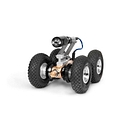
CRAWLER and PIG Robots (Custom OEM systems like Eddyfi/Pipeline Inspection Company): For internal pipeline inspection (NDT - Non-Destructive Testing), magnetic flux leakage (MFL) and ultrasonic testing (UT) crawlers travel inside active or inactive transmission pipelines to locate corrosion or wall thinning.
Unitree Go2-W Inspection Package : Utilizes a hybrid wheeled-leg design that combines the high-speed transit of wheels with the obstacle-climbing agility of legs—ideal for long utility corridors, tunnels, and expansive plant facilities.[1]
4. Smart Factories & Indoor Manufacturing
: Cognex In-Sight L38: The industry standard for fixed 3D vision and laser triangulation inspection cells on factory assembly lines, verifying high-accuracy dimensions and part alignment at rapid speeds.
OMRON LD-90X SELF NAVIGATING AUTONOMOUS ROBOT NEW: Omron Autonomous Mobile Robots (AMRs) : Excellent for navigating dynamic factory floors, hauling materials, and running automated optical or thermal checks on active production lines without needing human handlers.
If you have a specific setting in mind, let me know:
Is the environment explosive/flammable (Class 1 Div 1/2) or just dusty/wet?
Are you looking for indoor factory floor automation or outdoor facility patrols?
I can narrow down the ideal model and sensor payload for your project.
There isn’t one “best” inspection robot across all four environments. The right platform depends heavily on mobility, hazard classification, sensor package, and whether you need to inspect the inside of a pipe or the surrounding facility.
Practical shortlist
Use case
Platforms worth evaluating
Why
Factories / power plants / utilities
Boston Dynamics Spot, ANYbotics ANYmal
Quadrupeds handle stairs, grating, uneven floors and complex routes; good for thermal, visual, acoustic and gauge inspections.
Oil & gas / chemical plants with explosive atmospheres
ANYbotics ANYmal X, Taurob Inspector
Hazardous-area certification is the key differentiator. ANYmal X is published as ATEX/IECEx certified through Zone 1 IIB and supports gas sensing.
A flying or crawling platform can enter spaces that a walking robot can't. Elios 3, for example, can inspect pipes down to about 60 cm diameter and combines 4K imagery with LiDAR.
Large outdoor utility corridors
Industrial drones / UAVs
Better suited to long linear assets such as pipelines, transmission corridors, tanks and roofs than a ground robot. DOE is currently using drones for infrastructure inspections including piping corridors and steam pipelines.
Tanks, vessels and vertical steel surfaces
Gecko Robotics and other climbing robots
Adhesion/climbing is more appropriate when the inspection surface itself—not the floor—is the route.
Research / lower-cost pilots
Unitree platforms and similar quadrupeds
Useful for experimentation, but don't assume a research robot has the safety certification, sensor integration or industrial support required for production deployment.
The two general-purpose industrial leaders I'd investigate first
ANYmal is particularly compelling when the environment is genuinely industrial. Its current platform combines autonomous navigation with thermal/visual cameras, LiDAR, acoustic sensing and optional gas sensors; it is rated IP67 and designed for stairs, wet/bumpy terrain and multi-floor facilities.
Spot is worth evaluating for conventional industrial inspection where the area isn't an explosive classified zone. Its ecosystem is mature and it has a broad range of inspection payloads and software integrations. However, don't treat “industrial robot” as equivalent to “approved for hazardous/explosive atmosphere.” Certification needs to be checked for the exact robot and configuration.
For classified explosive areas, ANYmal X stands out because the manufacturer explicitly publishes ATEX/IECEx Zone 1 IIB certification, plus gas sensing and autonomous inspection capabilities.
For pipelines, the distinction is especially important
If you mean patrolling the pipeline/right-of-way, I'd look primarily at drones.
If you mean entering the pipeline itself, you want a purpose-built crawler, tethered robot, or confined-space drone. A quadruped such as Spot or ANYmal isn't a substitute.
For sewers, culverts and large-diameter pipes, Elios 3 is an interesting option because Flyability specifically supports confined-space flight and inspection, including 4K imaging and LiDAR mapping.
What I'd specify before buying
Rather than selecting based on the robot's walking ability, I'd create a requirements matrix covering:
Hazard: ATEX/IECEx zone, toxic gases, radiation, heat, dust, water
Autonomy: scheduled patrols vs. remotely piloted operation
Runtime: continuous hours and automatic docking requirements
Data: CMMS/EAM integration, digital twins, change detection and audit trail
Recovery: what happens if the robot loses power, communications or gets stuck
Certification: certification of the complete deployed configuration, not merely the base robot
Service: training, spares, field support and software lifecycle
If you tell me the specific environment—for example “natural-gas compressor station,” “water utility,” “refinery,” “nuclear plant,” or “manufacturing factory”—I can narrow this to 5–10 actual robots and compare sensors, certifications, payload, runtime, approximate cost and deployment requirements.
Selecting the best inspection robot depends heavily on your specific operating environment, terrain limitations, and the exact type of data you need to capture (thermal, gas leak detection, acoustic monitoring, or internal structural mapping).
Industry-leading inspection robots are categorized below by their optimal environments and operational strengths:
1. Open-Terrain & Multi-Level Facilities (Refineries, Power Plants, & Factories)
Boston Dynamics Spot
Best for: General industrial autonomy, climbing stairs, navigating catwalks, and reading analog gauges or inspecting thermal hot spots.
Key Strengths: Unmatched agility on complex human-designed terrain (stairs, grated flooring, rubble), 360-degree perception, modular payloads like acoustic imagers (to listen for compressed air leaks), and the Orbit fleet management software.
ANYbotics ANYmal
Best for: Heavy industry, energy, and explosive/hazardous gas environments (Ex-certified options like ANYmal X are rated for Zone 1 hazardous areas).
Key Strengths: Fully autonomous navigation, built-in continuous gas-sensing payloads, thermal/optical zoom inspection units, and robust IP-rated weatherproofing for harsh outdoor or wet factory conditions.
2. Confined Spaces & GPS-Denied Areas (Tanks, Boilers, & Tunnels)
Flyability Elios 3
Best for: Indoor confined spaces, dark subterranean structures, and complex asset interiors where GPS is unavailable.
Key Strengths: Enclosed in a collision-resilient protective cage that allows it to bounce off walls and recover without crashing. It uses LiDAR-based SLAM stabilization to create real-time 3D point-cloud maps and features a 4K/thermal camera payload with intense dustproof lighting.
3. Critical Infrastructure & Power Utilities (Substations & Long-Range Grids)
CSG Smart Inspector:
Best for: 24/7 unmanned outdoor electrical substation monitoring.
Key Strengths: Often rail-mounted or autonomous wheeled/tracked units designed for repetitive, high-accuracy thermal and optical tracking alongside autonomous docking stations for continuous operation.
Infravision (Drone/Robotic Systems):
Best for: High-voltage transmission power line inspection and maintenance logistics in remote or high-risk terrain.
To help narrow down the ideal option, could you tell me:
What is your specific industry or environment (e.g., chemical plant, underground tunnel, indoor warehouse)?
Are you looking for ground-based (legged/wheeled) or aerial/confined-space mobility?
What kind of sensors or data do you primarily need (thermal, gas detection, visual, or acoustic)?
Choosing the "best" inspection robot depends heavily on the terrain—whether it's walking over industrial grating, crawling through a narrow underground pipe, or operating in an explosive gas-vitiated oil refinery.
The top-performing industrial inspection robots categorized by their specialized environments include:
ANYbotics ANYmal X (Best for Hazardous & Explosive Environments): Specifically engineered and natively certified for ATEX Zone 1 explosive atmospheres (oil & gas, chemical processing, and heavy-duty energy plants). Unlike standard mobile robots, it features advanced thermal management and multiple-redundancy drivetrain protections to safely navigate volatile areas while carrying high-end optical and thermal payloads . Learn more about its safety certifications directly from ANYbotics ANYmal X.
Boston Dynamics Spot (Best for Complex Terrains & Factories)
Boston Dynamics Spot
excels at climbing stairs, navigating tight indoor factory floors, and inspecting hazardous or radioactive substations autonomously. (Note: While highly rugged, standard Spot is not certified for explosive ATEX Zone 1 environments like the ANYmal X).
The industry standard for quadruped inspection. Equipped with custom payloads like 360-degree cameras, acoustic imaging arrays, and thermal sensors,
Eddyfi Technologies / Inuktun Crawlers (Best for Internal Pipelines & Confined Spaces): For subsurface pipes, aqueducts, and narrow industrial vessels where legs or wheels won't fit, modular magnetic or tracked crawlers from brands like Eddyfi Technologies are unmatched. They carry non-destructive testing (NDT) sensors, laser profiling, and high-definition pan-tilt-zoom cameras to detect internal corrosion and welds.
GE Inspection Technologies / RVI Systems (Best for Remote Visual & Internal Cavities): When inspecting tight spaces like jet engines, boiler tubes, or small-diameter piping headers, specialized push cameras, pole cameras, and portable video borescopes from Waygate Technologies (a Baker Hughes / former GE business) are the gold standard for non-destructive remote visual inspection (RVI).
ABB & Yaskawa Robotic Arms (Best for Automated Factory Quality Control): Inside structured manufacturing plants and clean industrial assembly lines, stationary or rail-mounted 6-axis articulated arms (like those from ABB Robotics or Yaskawa ) paired with machine vision systems handle high-speed, repeatable surface and dimensional inspections.
To help narrow down the ideal platform, tell me:
What is the specific environment (e.g., underground pipe, offshore oil rig, indoor automotive floor)?
What kind of data or defect do you need to capture (thermal anomalies, gas leaks, surface cracks, internal corrosion)?
There isn’t one universally “best” inspection robot—the right choice depends heavily on whether you need plant-wide autonomous patrols, pipeline/crawlspace access, confined-space inspection, or certified operation in explosive atmospheres.
Practical shortlist
Robot / platform
Best fit
Notable strengths
Main limitation
ANYbotics ANYmal
Utilities, factories, power plants, chemical plants
Collision-tolerant indoor drone, LiDAR/3D mapping, thermal/gas/UT payloads; can take ultrasonic thickness measurements
Requires a drone operator and isn't a general autonomous ground patrol robot
By application
Power utilities / substations:ANYmal is particularly suited to repeated autonomous rounds across complex facilities. It can navigate stairs and collect visual, thermal, acoustic and LiDAR data, including in difficult weather.
Factories / processing plants:ANYmal or Spot are the main platforms I'd investigate. ANYmal has a particularly strong industrial-inspection focus, while Spot is a flexible general-purpose quadruped that can be equipped for different inspection tasks.
Oil & gas / chemical plants: If the robot must enter a classified explosive zone, certification becomes a hard requirement rather than a nice-to-have. ANYmal X supports ATEX/IECEx Zone 1 IIB operation, while ExRobotics ExR-2.5 now has North American UL certification in addition to its ATEX/IECEx credentials.
Pipelines, tanks, sewers and confined spaces:Elios 3 is a very different proposition: it flies into places that are difficult or dangerous for a ground robot. Its LiDAR produces 3D maps, and its modular system includes gas, radiation and ultrasonic-thickness payloads.
If I were building a procurement shortlist
I'd start with these five:
ANYmal — broadest fit for autonomous plant/utilities inspection.
ANYmal X — when Zone 1 hazardous-area operation + complex terrain are both requirements.
ExR-2.5 — when hazardous-area certification is paramount and a tracked robot is acceptable.
Spot — flexible non-hazardous industrial inspection and R&D platform.
Elios 3 — for confined, vertical, underground and otherwise inaccessible assets.
The interesting part is that you may want two different robot types rather than one: a quadruped for routine facility rounds and an Elios 3 for tanks/pipes/confined spaces.
If you tell me your industry, inspection targets (pipes, valves, gauges, corrosion, leaks, thermal, etc.), hazardous-area classification, and approximate facility size, I can narrow this to a concrete 2–3 robot shortlist and compare purchase cost, sensors, autonomy, certifications, payloads, range, and deployment requirements.
When it comes to inspecting tricky, dangerous, or hard-to-reach places like power plants, sewer lines, or factory floors, the "best" robot depends entirely on where it's going.
The industry has shifted heavily toward autonomous, AI-driven mobility that can handle stairs, tight spaces, and explosive atmospheres.
Here is a breakdown of the top-performing inspection robots categorized by their specialized environments:
Hazardous & Explosion-Proof Environments (Oil, Gas, & Chemical Plants)
EXROVR "ASCENT" : A standout explosion-proof autonomous robot specifically engineered for hazardous zones. It features thermal imaging, gas detection, and top-tier mobility to climb stairs and maneuver around complex industrial obstacles without risking human life.
ANYmal (by ANYbotics) : Widely recognized as an industry standard for autonomous inspection in harsh industrial and energy sites. It’s fully weatherproof, highly agile on rough terrain and stairs, and routinely handles autonomous inspection loops for thermal tracking, acoustics, and gas leaks.
General Industrial & Factory Automation
Spot (by Boston Dynamics) : The gold standard for legged mobility. Spot is heavily deployed across factories and industrial plants for routine asset checks, thermal imaging, and gauge reading. Its ability to handle uneven flooring, stairs, and tight corridors makes it far more versatile than traditional wheeled robots in cluttered facilities.
FANUC & ABB Vision Cells : For high-precision automated manufacturing quality control, companies like FANUC America and ABB integrate stationary and track-mounted AI vision inspection systems directly into assembly lines to catch micro-defects at high speeds.
Pipelines & Underground Utilities
CCTV Crawler Systems (like the FP985) : These heavy-duty wheeled or tracked crawlers use dual high-definition pan-tilt-zoom (PTZ) cameras and real-time laser profiling to map internal pipe conditions, measure deformation, and log temperatures in municipal and industrial piping.
Endobot : An advanced AI-powered robotic crawler built for navigating complex underground water, sewer, and storm lines (70 mm to 2,100 mm diameters) with swappable wheels to punch through debris and cross misaligned joints without requiring major excavations.
To narrow down which option fits your exact setup, could you tell me:
What specific environment or asset you are trying to inspect?
Are you dealing with confined spaces, high heat, or explosion risks (ATEX zones)?
The “best” inspection robot depends heavily on the environment: a refinery with explosive gases needs a different machine than a sewer pipe, a turbine hall, or a factory floor. The strongest options fall into a few categories.
Spot is widely used as a sensing platform with thermal, visual, and acoustic inspection options.
Oil & gas / chemical plants / hazardous environments
Top picks:
ANYmal X — strongest choice when you need a legged robot for complex facilities and hazardous-area requirements.
ExRobotics ExR-2 — good for certified explosive environments with simpler routes.
Taurob Inspector — strong offshore and industrial option.
Hazardous areas require checking the exact certification (such as ATEX/IECEx), because “industrial” does not automatically mean safe for explosive atmospheres.
Pipelines
The answer depends on whether you mean inside the pipe or outside inspection.
Inside pipelines:
Magnetic crawlers
Ultrasonic inspection robots
In-pipe crawlers
Tethered inspection vehicles
Best for:
Corrosion mapping
Weld inspection
Wall thickness measurement
Blockage detection
Outside pipelines:
Spot/ANYmal-class robots for: - Valve checks
Leak detection
Thermal anomalies
Route patrols
Factories and manufacturing plants
Best choices:
Spot — easiest enterprise deployment for mixed environments.
ANYmal — better for large plants with stairs, outdoor areas, or difficult terrain.
Wheeled AMRs — better if inspections happen on flat, repetitive routes.
Sensor packages matter more than the robot
A good inspection robot is usually defined by its sensors:
Oil, gas, chemical, offshore, hazardous zones: ANYmal X or certified hazardous-area robots
Explosive atmospheres on flat terrain: ExRobotics ExR-2 or Taurob Inspector
Inside pipes: dedicated crawler robot, not a quadruped
Large multi-building industrial sites: ANYmal or Spot depending on hazardous-area needs
A procurement shortlist should start with the inspection task, required certifications, sensor payload, and whether the robot must operate autonomously without a human nearby.
High-temperature/large industrial assets: Elios 3 can perform remote visual and UT inspections inside structures such as boilers, chimneys and tanks without putting personnel inside.
Explosive environments: Don't select based simply on an IP rating. ATEX/IECEx/UL classification, zone, gas group, temperature class and the certification of the entire configuration—including payloads and docking equipment—need to match the facility. ExRobotics, for example, publishes separate certification information for its robot modules and docking station.