





ChatGPT SearchSep 28, 2026

Data as of Oct 5, 2026Based on 353 AI responses from ChatGPT Search and Google AI Mode Reviewed by Dimitry Apollonsky ·
The ASUS ROG Ally series is frequently cited as the leading alternative to the Steam Deck. It is best for users wanting a Windows-based experience with higher performance and broader game store compatibility than SteamOS allows. Other notable choices include Lenovo for large-screen, modular designs; GPD for compact, keyboard-integrated devices; and AYANEO for premium, high-end builds. Logitech is the top choice if your primary goal is cloud-based streaming over local hardware.
Recommended in · Sep 8 – Sep 28, 2026
ChatGPT SearchSep 28, 2026
Google AI ModeSep 28, 2026
Google AI ModeSep 20, 2026
ChatGPT SearchSep 20, 2026
Google AI ModeSep 16, 2026
ChatGPT SearchSep 16, 2026
ChatGPT SearchSep 12, 2026
Google AI ModeSep 12, 2026
Google AI ModeSep 8, 2026
0% of citations to these sources link to brands' own websites.
xda-developers.com
esportsheadlines.com
If by “similar” you mean handheld gaming PCs that can play a PC/Steam library, there are several major competitors to Valve’s Steam Deck.
Lenovo's SteamOS-equipped Legion Go S is probably the most direct conceptual competitor to the Steam Deck. Valve has begun licensing SteamOS to third-party hardware manufacturers, so the market is moving beyond simply “Windows handheld vs. Steam Deck.”
In broad terms:
| Company | Main handheld line | Typical OS | What differentiates it |
|---|---|---|---|
| Valve | Steam Deck | SteamOS | Console-like Steam experience |
| ASUS | ROG Ally | Windows | Performance + broad PC compatibility |
So if you're looking at the competitive landscape around Valve, I'd consider ASUS, Lenovo, MSI, AYANEO, GPD, and ZOTAC the main companies to investigate.
If you're interested, I can also break down Steam Deck vs. ROG Ally vs. Legion Go vs. MSI Claw on price, performance, battery life, screen, and software.
Several major hardware and gaming companies offer portable handheld gaming PCs that directly compete with Valve's Steam Deck . While the Steam Deck relies on its custom Linux-based SteamOS, most competitors run Windows 11 out of the box (giving access to Xbox Game Pass, Epic Games Store, and other launchers), though some offer SteamOS variants.
If you'd like, let me know:
I can help you compare a specific alternative directly against the Steam Deck.
The handheld PC gaming market has expanded significantly, with several major tech and gaming brands offering direct competitors to Valve's Steam Deck . While most competitors run on Windows rather than Valve's custom SteamOS, they offer varying tiers of raw performance, screen tech, and ergonomic styles.
The primary companies and devices with offerings similar to the Steam Deck include:
If you're thinking about picking one up, let me know:
I can help you narrow down which device fits your gaming habits best.
Companies making products similar to the Valve Corporation Steam Deck include:
The closest direct competitors are generally ASUS ROG Ally, Lenovo Legion Go, and MSI Claw because they target the same “portable PC gaming” market as Steam Deck.
The portable PC gaming market has expanded significantly, with several major tech and gaming hardware companies offering direct alternatives to Valve's Steam Deck . These competitors generally run on Windows 11 (offering broader native game launcher compatibility like Xbox Game Pass, Epic Games, and EA App) or specialized iterations of SteamOS.
Would you like to narrow these down by budget, battery life , or whether you prefer SteamOS vs. Windows?
Yes. The Steam Deck sits in the “handheld gaming PC” category, and several companies now make competing devices. The main alternatives are:
ASUS ROG Xbox Ally X - $1,299.96 (Walmart.com)
Lenovo Legion Go 2 - $1,999.99 (Best Buy)
MSI Claw A8 - $1,299.99 (Micro Center)
ASUS ROG Ally X - $1,199.99 (PayMore Anaheim)
ASUS — ROG Ally / ROG Xbox Ally: Windows-based handhelds using AMD chips. The newer ROG Xbox Ally X combines ASUS hardware with Microsoft's Xbox-oriented interface.
Lenovo — Legion Go: Windows handhelds with large displays; the Legion Go 2 moves into higher-end hardware, while the Legion Go S is also available with SteamOS, making it particularly close to the Steam Deck experience.
MSI — Claw: A family of Windows handhelds, including Intel-powered Claw models and newer AMD Ryzen Z2 Extreme versions.
AYANEO: Makes a wide range of enthusiast-oriented Windows handheld PCs, generally with more unusual form factors and configurations. Its products tend to be more expensive than mainstream alternatives.
GPD (GamePad Digital): Produces compact handheld PCs such as the Win series, often combining gaming controls with laptop-like keyboards or other productivity features.
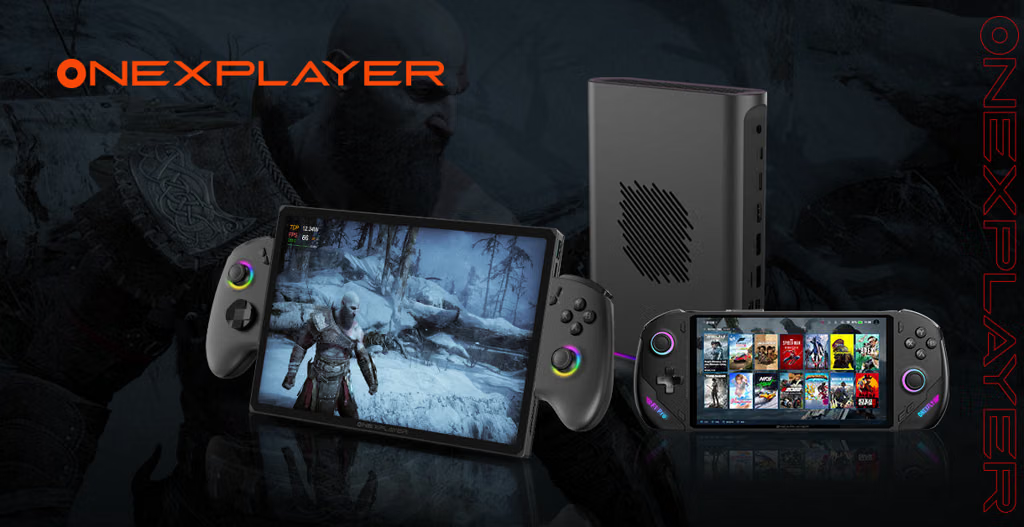
One-Netbook: Another enthusiast manufacturer producing handheld PCs, including its ONEXPLAYER line.
If you're specifically looking for something most similar to a Steam Deck, I'd narrow the field to:
| Company | Main handheld family | OS | Main distinction |
|---|---|---|---|
| Valve | Steam Deck | SteamOS | Console-like Steam experience |
| ASUS | ROG Ally / Xbox Ally | Windows | Broad Windows/Xbox compatibility |
The particularly interesting development is Lenovo's SteamOS-equipped Legion Go S: Valve has begun allowing SteamOS onto third-party handheld hardware, so the distinction between “Steam Deck” and competing PC handhelds is becoming less about the operating system and more about hardware.
If you tell me your budget and whether you care more about performance, battery life, screen quality, or SteamOS, I can also compare the current models side-by-side.
Yes. The Steam Deck has spawned a fairly large handheld gaming-PC market. The closest competitors are:
ASUS — ROG Ally / ROG Ally X, and newer ROG Xbox Ally / Ally X models. These are Windows handhelds aimed directly at the Steam Deck, generally offering more performance and broader Windows game compatibility.
ROG Xbox Ally X - $999.99 (Best Buy)
Lenovo — Legion Go / Legion Go S / Legion Go 2. The Legion Go emphasizes a large high-refresh display and detachable controllers; notably, the Go S is also available with SteamOS, making it particularly close to the Steam Deck concept.
Lenovo Legion Go S — SteamOS - $999.99 (Best Buy)
Lenovo Legion Go 2 - $1,999.99 (Best Buy)
MSI — Claw series. These are Windows handheld PCs, with models using Intel or AMD processors and generally targeting the higher-performance end of the market.
MSI Claw A8 - $1,299.99 (Micro Center)
AYANEO — Makes a broad range of premium handheld PCs, including the AYANEO 3 and NEXT 2. They're generally more expensive and niche than the Steam Deck but offer distinctive designs and high-end hardware.
AYANEO NEXT 2 - $3,699.00 (AYANEO)
GPD (GamePad Digital) — Produces compact Windows gaming PCs such as the GPD Win line. GPD tends to prioritize unusual form factors and portability rather than competing purely on price.
Nintendo — The Switch 2 is a competitor in the broader portable-gaming market, although it's not a PC and doesn't run the same games/software ecosystem. Current comparisons often include it alongside Steam Deck alternatives.
If you're specifically looking for something that feels like a Steam Deck replacement, I'd narrow it to:
| Company | Main alternative | Biggest advantage over Deck |
|---|---|---|
| ASUS | ROG Ally X / ROG Xbox Ally X | More performance + Windows |
| Lenovo | Legion Go S (SteamOS) | SteamOS + larger screen |
| Lenovo | Legion Go 2 | High-end performance/display |
My take: if what you like about the Steam Deck is the console-like SteamOS experience, Lenovo's SteamOS-equipped Legion Go S is one of the most interesting alternatives. If you want maximum performance and don't mind Windows, ASUS's ROG Ally X/Ally X Xbox models are probably the most direct competitors. Current 2026 comparisons generally put ASUS and Lenovo at the front of the Steam Deck-alternative market.
If you tell me your budget (e.g. <$500, $500–800, $800+), I can compare the best current models side-by-side.
Several major hardware manufacturers offer portable gaming PCs that directly compete with the Valve Steam Deck , most notably Asus, Lenovo, and MSI , alongside niche handheld specialists AYANEO and GPD.
Asus Offers the ROG Ally and the upgraded ROG Ally X , which run on Windows 11 and feature powerful AMD Ryzen Z1 Extreme processors, 1080p 120Hz screens, and native access to Xbox Game Pass, Epic Games, and Steam.
If you're looking to buy one, tell me:
I can help you pick the best match for your library and budget.
If you mean handheld gaming PCs that compete directly with Valve’s Steam Deck, there are several major players. The market has expanded considerably since the Deck launched.
ASUS — ROG Ally / ROG Ally X / ROG Xbox Ally - Probably the most direct competitor to the Steam Deck.
Uses Windows rather than SteamOS.
Generally offers higher performance, 1080p/120Hz displays, and access to Steam, Game Pass, Epic, GOG, etc.
The newer ROG Xbox Ally line combines ASUS hardware with a more Xbox-oriented Windows experience.
ROG Xbox Ally X - $1,464.28 (Vishal Peripherals)
Lenovo — Legion Go - One of the strongest Steam Deck alternatives.
Windows-based, with a large 8.8-inch display and detachable controllers.
Newer Legion Go models also offer SteamOS configurations, making Lenovo particularly interesting if you prefer the Steam Deck-style experience.
Lenovo Legion Go 2 - $1,999.99 (Best Buy)
MSI — Claw - MSI's handheld PC line.
Earlier Claw models used Intel processors; newer models include AMD Ryzen hardware.
Typically emphasizes higher-end hardware, larger batteries and 120Hz displays.
MSI Claw A8 - $1,249.00 (Walmart - RAIDEALS INC.)
| Company | Main alternative | Closest to Steam Deck? | Key advantage |
|---|---|---|---|
| ASUS | ROG Ally X / Xbox Ally X | ⭐⭐⭐⭐⭐ | Performance & Windows ecosystem |
| Lenovo | Legion Go / Go S / Go 2 | ⭐⭐⭐⭐⭐ | Big screen, detachable controls, SteamOS options |
The three companies I'd consider Valve's principal mainstream competitors are ASUS, Lenovo, and MSI. Current 2026 comparisons generally put the Legion Go and ROG Ally family at the top of the conventional Steam Deck-alternative market.
One particularly interesting development is Lenovo offering SteamOS on some Legion Go models. That makes the Go S arguably a closer conceptual competitor to the Steam Deck than the Windows-only handhelds, because it combines PC hardware with a console-like SteamOS experience.
If you're considering buying one, I can also give you a 2026 Steam Deck vs ROG Ally X vs Legion Go 2 vs MSI Claw comparison, including price, battery, performance, screen, SteamOS/Windows, and which I'd pick.
Several major hardware manufacturers offer portable, handheld gaming PCs designed to compete directly with the Steam Deck by Valve. While the Steam Deck runs on Valve’s custom Linux-based SteamOS, most alternatives run Windows (giving access to Xbox Game Pass, Epic Games Store, and other launchers), though some newer models also lean into SteamOS or dual-boot flexibility.
The Offering: The MSI Claw (featuring Intel Core Ultra processors and Arc graphics).
Details: Unlike most competitors that rely on AMD chips, MSI partnered with Intel. The Claw distinguishes itself with high-efficiency thermal management, macro control keys, and a Windows-based layout aimed at seamless integration for PC titles.
Operating System: The Steam Deck uses SteamOS , which offers a streamlined, console-like interface and great power efficiency. Most competitors run Windows, which is more versatile for multi-store launcher use (Game Pass, Battle.net, etc.) but can feel less cohesive on a small screen.[2]
Performance: Handhelds utilizing AMD's Ryzen Z1 Extreme or newer chips often punch higher in raw horsepower and native high-resolution output than the Steam Deck , though usually at the cost of higher battery draw.
Are you looking for a handheld primarily for pure battery efficiency and budget value , or do you want maximum raw performance and access to non-Steam storefronts like Xbox Game Pass?
| Lenovo | Legion Go | Windows / SteamOS | Large screens, detachable controls |
| MSI | Claw | Windows | Intel/AMD options, large batteries |
| AYANEO | Various | Windows | Premium/niche designs |
| GPD | Win series | Windows | Tiny PCs, keyboards, unusual designs |
| ZOTAC | ZONE | Windows | AMOLED/high-end hardware |
| Lenovo | Legion Go / Go 2 / Go S | Windows or SteamOS | Large screens, high performance |
| MSI | Claw | Windows | Intel or AMD options |
| AYANEO | AYANEO 3, etc. | Windows | Enthusiast/high-end designs |
| GPD | Win series | Windows | Compact PC functionality |
| One-Netbook | ONEXPLAYER | Windows | High-end enthusiast handhelds |
| MSI | Claw A8 / Claw 8 | High-end hardware |
| AYANEO | AYANEO 3 / NEXT 2 | Premium hardware & customization |
| GPD | Win series | Compact/unique designs |
| Nintendo | Switch 2 | Dedicated console ecosystem |
| MSI | Claw A8 / Claw 8 | ⭐⭐⭐⭐ | Battery & high-end hardware |
| AYANEO | Various models | ⭐⭐⭐ | Premium designs & variety |
| GPD | Win Mini / Win 4 / Win 5 | ⭐⭐⭐ | Compact PCs & keyboards |
| ZOTAC | Gaming Zone | ⭐⭐⭐ | AMOLED display |
| OneXPlayer | Various handheld PCs | ⭐⭐ | High-end configurations |
| AOKZOE | A1/A2 series | ⭐⭐ | Large displays |