The landscape for AI in mental health has shifted away from standalone consumer chatbots toward clinician-side platforms and AI copilots designed to support care teams, reduce documentation burnout, and triage patient loads.
Several specialized startups and platforms are building clinical AI copilots tailored to psychiatry and behavioral health care teams:
Limbic : A pioneer in clinical-grade mental health AI, Limbic offers tools like Limbic Access (an AI triage and assessment assistant) and Limbic Care . Their system acts as a copilot for care teams by handling patient intake, predicting risk/diagnoses, and providing an ambient AI scribe specifically tailored to standardize notes and support caseload management across mental health providers.
mdhub : Positioned explicitly as an AI copilot for behavioral health and psychiatry clinics. It manages the operational and administrative burden of a practice—drafting psychiatric clinical documentation, intake scheduling, and billing—allowing the care team to remain focused on direct clinical judgment and patient interaction.
Scribeberry : An AI medical scribe optimized heavily for psychiatric and mental health documentation. It assists psychiatrists with heavy mental status exams, complex risk assessments, medication titration notes, and tedious insurance/disability form automation.
Abridge : While operating across multiple medical specialties, Abridge's generative AI platform is widely utilized in behavioral health settings to capture clinical conversations in real time, generate structured psychiatric notes, highlight care gaps, and summarize follow-up actions for the broader care team.
Would you like to explore how these platforms handle data privacy/HIPAA compliance for mental health notes, or are you looking for tools tailored to a specific setting (like a hospital department vs. a private telepsychiatry practice)?
Yes. As of September 2026, there’s a meaningful cluster of startups building AI around the clinician/care-team side of mental healthcare, rather than purely consumer-facing therapy bots.
I’d break the landscape into four buckets:
Company
What the AI does
Primary user
Personalization / care-team angle
Callyope
Psychiatry copilot using speech, behavioral/sensor data and clinical records
Psychiatrists / mental-health clinicians
Very high — patient-specific longitudinal signals and symptom monitoring
High — copilot works alongside psychiatrist to extend clinical capacity
Wysa
AI-guided interventions, assessments, messaging and care pathways
Therapists / care teams
High — clinicians assign personalized tools and monitor progress between visits
Eleos Health
Voice AI, clinical insights, documentation and workflow agents
Behavioral-health organizations / clinicians
High — extracts insights from sessions and longitudinal records
Lyra Health
AI across member matching, provider workflows and ongoing mental-health support
Providers + care teams + members
High — AI coordinates personalized care while keeping clinicians in the loop
April Health
Collaborative-care platform with psychiatrist oversight + Wysa clinician copilot
PCPs, BH care managers, psychiatrists
High — continuous measurement and interventions around the patient
Flourish Health
AI-enabled operating system for psychiatrist-led intensive-care teams
Psychiatrists, therapists, guides
High — coordinates a multi-disciplinary "Care Pod" around complex patients
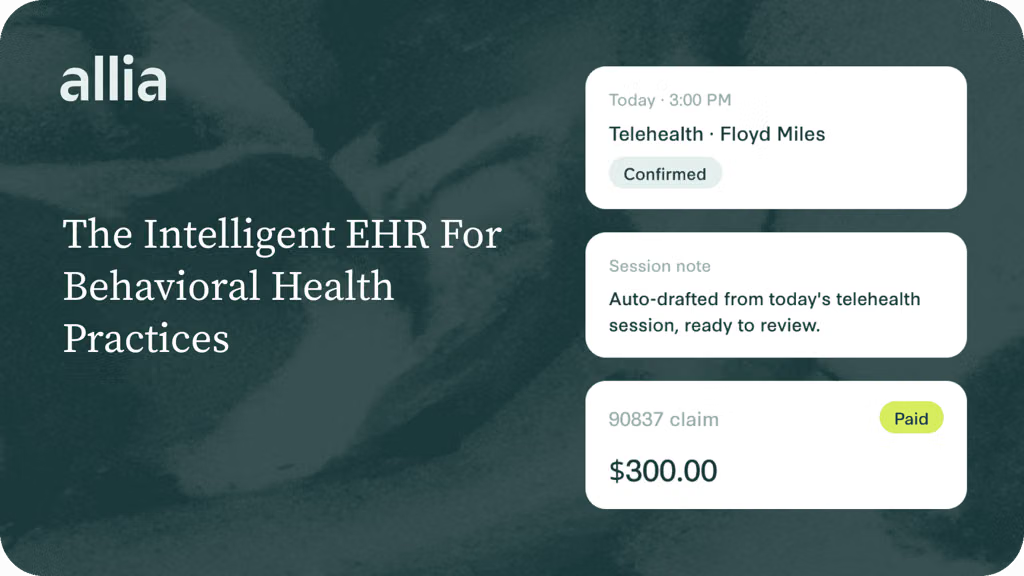
Allia Health
AI-native mental-health clinical group / operating system
Independent practices + clinicians
Very high — shared patient record, matching, referrals, outcomes and agentic workflows
Legion Health
AI-native psychiatry, increasingly moving from copilot to autonomous clinical workflows
Psychiatrists / psychiatry patients
Very high — AI executes narrowly scoped psychiatric workflows under escalation
CogniCare
Multiple specialized AI clinical agents + in-session copilot
Therapists
Very high — assessment → diagnosis → treatment → progress pipeline grounded in patient record
Levio Health
AI triage, clinical workspace and patient companion
Mental-health practices
Medium/high — one longitudinal record spanning intake, consultation and follow-up
Pelago
AI-native EHR and "Care Copilot" for substance-use treatment
SUD care teams
High — patient-contextual messaging, triage and pre-call summaries
The most interesting direct matches
1. Callyope — probably the closest to a psychiatric intelligence layer.
Its Copilot combines speech, sleep/activity signals and clinical information to produce patient-specific psychiatric insights; Google describes it as an AI copilot specifically for mental-health practitioners.
2. Blossom Health — probably the clearest AI psychiatrist + human psychiatrist model.
The company raised $20M in 2026 and describes its product as an AI copilot for psychiatry; its platform is already being used by hundreds of clinicians treating 10,000+ patients.
3. Wysa Copilot — particularly interesting if you're thinking about extending the care team's reach between appointments.
Clinicians can assign personalized interventions, monitor assessments/risk, communicate with patients and adapt care pathways based on progress.
4. Eleos — more mature on the care-team intelligence/workflow side.
Its platform analyzes behavioral-health sessions, generates documentation and clinical insights, and in 2026 added AI agents spanning clinical insights, compliance and revenue-cycle workflows. It has also been selected as the statewide AI partner for California's county behavioral-health system.
5. Flourish Health — interesting because the care team itself is the product.
Its psychiatrist-led Care Pods combine a child/adolescent psychiatrist, therapist, patient guide and family guide, with proprietary AI acting as the team's workflow layer. It raised $46M in total funding in July 2026.
6. Allia Health — one of the newer, more ambitious "mental-health OS" approaches.
Rather than selling a standalone copilot, Allia is building an AI-native clinical group and shared system of record, coordinating therapy, psychiatry, primary care, referrals and outcomes. Its YC profile says 8,000+ clinicians are using its practice software, with 600+ activated into its clinical group.
A useful way to visualize the market
There are actually three different "copilot" architectures emerging:
A. Clinician intelligence
Patient data → AI synthesis → clinician decision
Examples: Callyope, Eleos, CogniCare, Wellsheet
Callyope is the most psychiatry-specific example; Eleos is further along in behavioral-health organizational deployment.
B. Care-team augmentation
Clinician + AI → continuous patient engagement between visits
Examples: Wysa, April Health, Lyra
This is arguably the most interesting category if by "personalized copilot" you mean an AI that knows the patient's care plan, history and goals, handles check-ins/interventions between encounters, and feeds information back to the human team. Wysa explicitly supports this model.
C. AI-native clinical delivery
AI performs portions of the clinical workflow → human supervises/escalates
Examples: Legion Health, Blossom, Allia, Flourish
Legion is pushing furthest toward autonomous execution: its 2026 YC description says it has regulatory authorization for AI-powered psychiatric maintenance-medication renewals, while emphasizing escalation to clinicians.
If you're specifically looking for the startup opportunity
The interesting whitespace isn't really "AI therapist." That's crowded.
The more differentiated thesis is:
A longitudinal patient-specific intelligence layer for the entire mental-health care team.
That means ingesting EHR + prior notes + assessments + medication history + patient-reported outcomes + messages + passive/behavioral signals, then maintaining a continuously updated patient state that different members of the team can query and act on.
The system could give a psychiatrist a different view than a therapist, care manager or PCP, while maintaining one underlying model of the patient.
That sits somewhere between Callyope's clinical intelligence, Wysa's between-session layer, Eleos's workflow intelligence, and Allia/Flourish's coordinated-care architecture.
One important caveat: the term "copilot" is being used very broadly. Some companies primarily automate documentation, some personalize digital interventions, and others are actually attempting clinical decision support or autonomous care. Those are substantially different businesses and risk profiles. The emerging literature also distinguishes assistive, collaborative and semi-autonomous psychiatric AI rather than treating all of these as the same thing.
If you're doing competitive landscaping/investment research, I can also turn this into a 20–30 company map with founding year, funding, investors, customer type, clinical workflow, AI capabilities, traction, and a "how close is this to a true personalized psychiatry copilot?" column.
A growing wave of startups and platforms are developing AI-powered copilots and operating systems specifically tailored for mental health and psychiatric care teams . Psychiatric documentation and care coordination are uniquely demanding—requiring careful tracking of mental status exams, risk assessments, and medication histories.
The following platforms and startups are actively building AI copilots and administrative-clinical assistants for behavioral health care teams:
mdhub : Positioned as an AI-first operating system and co-pilot specifically for psychiatry and behavioral health clinics. It deploys specialized AI "teammates" (like Emma for automated psychiatric note-drafting during sessions, Sarah for 24/7 intake/admissions coordination, and Eric for billing support) designed to handle administrative burdens while keeping clinical judgment strictly with the provider.
PsyBytes : Acts as an AI copilot for psychiatrists and care teams by supporting specialized documentation templates (such as SOAP and BIRP notes) alongside real-time, multilingual transcription. It also features a companion patient-facing app that tracks between-session mood and journal data, feeding insights back to the clinical team to personalize ongoing treatment.
Freed AI : While built broadly as an AI medical scribe, it is widely utilized across specialties including mental health. It listens to telehealth or in-person sessions to instantly generate unstructured or structured psychiatric progress notes, reducing post-session burnout for behavioral clinicians.
Wysa & Woebot Health : Though traditionally known as consumer/enterprise conversational AI agents for cognitive behavioral therapy (CBT), these platforms increasingly function as clinical support ecosystems. They bridge gaps between sessions by tracking patient engagement data, flagging risk escalations, and providing care teams with continuous behavioral analytics.
If you're researching this space for a specific use case, would you like to explore how these tools handle HIPAA compliance and data privacy , or are you looking at them from a clinical workflow vs. patient-facing engagement perspective?
If by “personalized mental-health/psychiatry copilot” you mean software that sits alongside a clinician or care team, uses the patient’s longitudinal data/context, and helps with assessment, treatment planning, monitoring, documentation, or between-visit engagement, there’s a meaningful startup cluster here.
The most directly relevant companies
Startup
What the copilot does
Primary user / model
Blossom Health
AI copilot alongside psychiatrists; automates clinical/admin work and supports psychiatric care
Psychiatrists / telepsychiatry
Wysa
Personalized between-session support, assessments, risk detection, care pathways, messaging and clinician visibility
Therapists, psychiatrists, integrated-care teams
CogniCare
AI “clinical team” for assessment, differential diagnosis, treatment planning, progress tracking and an in-session copilot grounded in the patient's record
Mental-health therapists / practices
mdhub
AI clinical assistant plus AI workers for admissions, documentation, billing and behavioral-health workflows
Behavioral-health clinics
Jimini Health
Clinician-supervised patient-facing AI infrastructure that behavioral-health organizations can deploy at scale
Large behavioral-health providers
Levio Health
Connected AI clinical copilot spanning calls, consultations and between-visit check-ins
Outpatient mental-health clinics
Allia Health
AI-native clinical infrastructure and measurement-informed care across therapy, psychiatry, nursing and higher levels of care
Multi-disciplinary mental-health groups
Legion Health
AI + psychiatrists, initially as an AI-native psychiatry clinic and increasingly toward supervised/autonomous workflows
Psychiatry
A few details distinguish the category:
Blossom Health is probably the clearest example if you're specifically looking for an AI psychiatry copilot rather than a general behavioral-health EHR. It raised $20M in seed/Series A funding in March 2026 and says its platform pairs psychiatrists with clinical copilots and automated administrative support.
Wysa Copilot is more explicitly a care-team/patient hybrid: clinicians can assign personalized interventions, monitor assessments, see risk events, communicate with patients and adapt care pathways between visits.
CogniCare is unusually close to the “AI clinical team” concept: its agents handle assessment, diagnostic reasoning, treatment planning and progress tracking, while its LIAM copilot is grounded in the individual client's record.
is broader infrastructure. Its “Emma” clinical assistant handles documentation while other AI workers handle admissions and billing, all inside an AI-native behavioral-health EHR.
How I'd segment the market
There are really four overlapping wedges rather than one category:
Clinician copilot:
Blossom, CogniCare, mdhub
→ “Make the psychiatrist/therapist substantially more productive.”
Patient copilot + clinician oversight:
Wysa, Jimini
→ “Give patients continuous AI support while keeping the care team in the loop.”
Care-team operating system:
Allia, mdhub, Levio
→ “Coordinate the entire behavioral-health workflow around a longitudinal patient record.”
AI-native/autonomous psychiatry:
Legion, and to some extent Blossom
→ “Move portions of psychiatric care from clinician-led to AI-led, with escalation/supervision.”
There is also a large incumbent-adjacent group—Spring Health and Talkspace, for example—that is incorporating AI personalization and provider-facing AI into existing mental-health delivery rather than being pure-play “copilot startups.” Spring Health describes its model as AI-native precision mental healthcare, while Talkspace uses AI for provider notes/summaries, risk alerts and personalized between-session support.
If you're doing competitive landscape / startup scouting, the especially interesting comparison is Blossom vs. Wysa vs. CogniCare vs. Jimini vs. mdhub vs. Allia: they represent quite different answers to where the AI should sit in the care loop.
Yes. If by “personalized mental health/psychiatry copilot for care teams” you mean software that sits alongside clinicians, maintains a longitudinal patient context, supports between-visit care, and helps a human team make/execute clinical decisions, there’s a fairly interesting emerging cohort.
Closest matches
jiminihealth.com — Probably the closest conceptual match. Its Sage product is positioned as a behavioral-health AI care-team member working with both patients and clinicians. Jimini raised a $17M seed in March 2026 and describes Sage as enabling more continuous, personalized care while keeping clinicians in the loop.
wysa.com — Wysa Copilot is explicitly built for care teams: clinicians can personalize/assign interventions, monitor patients between sessions, receive automated assessments and crisis signals, and use summaries to maintain continuity. It also has specific workflows for psychiatrists and primary-care behavioral-health teams.
blossomhealth.com — An AI-native psychiatry platform whose stated goal is an AI “copilot” for psychiatry. As of March 2026, Fortune reported that Blossom was already being used by hundreds of clinicians treating 10,000+ patients and had raised $20M.
flourish.health — Particularly interesting if you mean team-based/high-acuity psychiatry, rather than an individual psychiatrist's assistant. Flourish has psychiatrist-led “Care Pods” consisting of a psychiatrist, therapist, patient guide and family guide, with an AI platform coordinating workflow, patient touchpoints, EMR/prescribing and collaboration. It raised $46M total by July 2026.
allia.health — A newer, more ambitious “AI-native clinical group” rather than just a copilot product. Allia says its intelligent system of record connects therapy, psychiatry, primary care and higher levels of care, with agentic technology monitoring longitudinal outcomes and identifying patients who may need treatment changes. YC lists it as a Summer 2026 company.
cognicarehq.com — More clinician-workflow oriented. It describes an AI “clinical team” of specialized agents for assessment, diagnosis, treatment planning, progress tracking and documentation, plus LIAM, an in-session copilot grounded in the individual client's record.
levio-health.com — An emerging European mental-health clinical copilot. It combines intake/phone handling, consultations and follow-up on a connected patient record and says it has been validated with clinicians across several European countries.
Adjacent companies worth watching
Spring Health — Much larger/incumbent rather than an early startup now, but its platform is explicitly built around personalized/“precision” mental healthcare, and in 2026 it launched Guide, an AI-led experience designed around continuity of care.
April Health — A collaborative-care model combining behavioral-health care managers, consulting psychiatrists, Wysa's therapeutic coach and a clinician copilot. This is especially relevant to psychiatry-as-a-consulting-layer for primary care.
Attunio Health — Taking a more “precision psychiatry” approach, combining AI, biomarkers, wearables and clinician-guided treatment personalization; launched its platform in June 2026.
The market seems to be splitting into a few architectures
Approach
Examples
Core idea
AI care-team member
Jimini, Wysa
AI interacts with patient continuously and feeds context back to clinicians
Psychiatrist copilot
Blossom, CogniCare
AI helps the clinician assess, plan, document and follow patients
Team operating system
Flourish, Allia
AI coordinates multiple human roles around a patient
The particularly interesting gap, in my view, is between Wysa/Jimini-style patient-facing copilots and Flourish/Allia-style care-team infrastructure: a genuinely longitudinal psychiatric “case manager” that builds a patient model, monitors signals between visits, proposes interventions, coordinates therapist/psychiatrist/PCP tasks, and learns from treatment response—while leaving clinical decisions with humans. That's a somewhat different product category from ambient scribing or generic clinical documentation AI.
A new wave of AI-native startups is moving past generic medical scribes and fragmented software to build specialized AI "copilots" and operating systems specifically tailored for mental health and psychiatry care teams. These platforms aim to reduce clinical burnout, handle administrative burdens, and scale personalized, continuous patient tracking between formal visits.
Prominent startups building in this space include:
Blossom Health – Operating as an AI-native telepsychiatry platform, Blossom positions its software as an all-in-one AI copilot that assists psychiatrists with clinical decision support while automating back-office tasks. Rather than treating mental health as purely episodic, Blossom uses AI agents to text patients between appointments for conversational check-ins on mood, sleep, and warning signs, surfacing actionable data back to the clinical care team.
mdhub – A Y Combinator-backed startup building an AI-native operating system for behavioral health clinics. Instead of offering a standalone note-taker, mdhub deploys specialized collaborative AI "workers" (such as Emma for clinical documentation, Sarah for 24/7 insurance verification and admissions, and Eric for billing and claims) tightly integrated into a purpose-built EHR and CRM system to keep patient data seamlessly flowing through the care team's workflow.
Clinically AI – A platform purpose-built for the operational and clinical documentation realities of behavioral health. It provides real-time or post-session clinical note generation tailored to psychological/psychiatric settings (supporting standard frameworks like SOAP, DAP, and BIRP), DSM-5/ICD-10 aligned language, and "golden thread" treatment plan compliance.
Myndgard – A specialized mental health platform leveraging AI to track early signs of depression and anxiety. It gathers daily data on sleep, movement, socialization, and productivity, generating detailed pre-therapy and ongoing assessment reports that give therapists immediate contextual insight into how a patient is trending outside of clinical hours.
Would you like to explore how these AI tools handle data privacy and HIPAA compliance , or are you looking into a specific workflow (like clinical documentation vs. patient engagement ) for a behavioral health practice?
The intersection of generative AI and mental healthcare has shifted heavily toward clinician-side and care-team copilots , moving away from purely consumer-facing chatbots to platforms that actively assist psychiatrists, therapists, and care coordinators.
Prominent startups and platforms building personalized mental health and psychiatry copilots for care teams include:
Blossom Health : Operating as an AI-native telepsychiatry platform, Blossom uses agentic AI to function as a direct copilot for psychiatrists. Its operating system assists care providers with clinical decision-making, treatment plan personalization, medication selection, and automated medical documentation, claiming to save clinicians over 30 minutes per patient encounter.
Limbic : A clinically validated and peer-reviewed generative AI platform embedded within mental health care systems and providers. Limbic acts as an end-to-end clinical copilot by deploying specialized AI agents for patient intake, risk/need triage, diagnostic prediction, and supporting clinical staff with structured escalation pathways.
Spring Health : Known for its enterprise mental health platform, Spring Health heavily utilizes AI-driven personalization for treatment matching and recommendations. It equips care navigators and clinical teams with data-backed insights to tailor precise behavioral health interventions for workforces.
Lyra Health : While providing direct clinical care, Lyra integrates advanced AI-driven coordination and engagement tracking. It acts as a supporting layer for care teams to monitor patient progress, flag risk trajectories, and personalize the ongoing matching of care modalities.
Would you like to explore how these platforms handle clinical liability and data privacy regulations , or are you looking at them from an investor/technical integration perspective?
Yes. If by “personalized mental-health/psychiatry copilot” you mean AI that sits inside a clinician-led care model—using the patient’s longitudinal context, extending care between visits, surfacing risk/insights, or helping clinicians choose/execute treatment—the market is getting interesting in 2026.
The startups I’d put on the shortlist
Startup
What the copilot does
Care-team orientation
My take
Jimini Health
Sage interacts with patients between sessions, follows the clinician’s care strategy, monitors progress/risk, and feeds information back to providers
Very high
Probably the closest match to your description
Blossom Health
AI-native psychiatry platform/care “copilot” designed to let psychiatrists care for substantially more patients
Very high
One of the most interesting AI-native psychiatry plays
Wysa
Wysa Copilot gives clinicians personalized exercises, monitoring, assessments, messaging and risk signals for patients between visits
Very high
More mature; particularly interesting for health systems/primary care
Limbic
Intake, diagnostic/triage support, personalized conversational therapy and caseload management
Very high
Strong clinical-AI/infrastructure positioning, especially UK/NHS
Eleos Health
Clinician-side AI for behavioral-health documentation, clinical insights, risk, evidence-based interventions and workflows
High
More “clinician copilot/system of action” than patient companion
Aifred Health
Patient-specific treatment-response predictions to help physicians select/adjust depression treatments
High
Particularly interesting if you mean psychiatric decision support rather than conversational AI
Flourish Health
AI-enabled infrastructure coordinates psychiatrist/therapist/patient/family “Care Pods” for high-acuity youth
High
More AI-enabled care delivery than a standalone copilot
SonderMind
AI tools/companion embedded in the therapy relationship, with clinician oversight and between-session support
Medium-high
Important because of its existing provider network and distribution
Allia Health
AI-native clinical operating system for a large coordinated mental-health medical group; uses longitudinal data to identify disengagement and treatment-change opportunities
High
A newer, more ambitious “AI-native mental-health system” thesis
1. Jimini Health — probably the closest fit
Jimini Health is unusually close to the “AI member of the care team” concept.
Its Sage product is explicitly described as an AI behavioral-health care-team member. The clinician establishes the patient's clinical priorities; Sage then interacts with the patient continuously between sessions, supports skills and adherence, detects situations requiring escalation, and shares progress with the clinician.
This isn't merely an AI scribe. Jimini raised $17M in March 2026 specifically to expand its clinician-supervised AI infrastructure with behavioral-health organizations.
Thesis:“Give every therapist an always-on AI teammate that knows the treatment plan and patient context.”
2. Blossom Health — AI-native psychiatry
Blossom Health is probably the company I'd watch most closely if your emphasis is specifically psychiatry rather than therapy.
Blossom raised $20M in seed + Series A funding in March 2026 and describes itself as an AI-native psychiatry platform. It was already being used by hundreds of clinicians treating more than 10,000 patients.
Its strategy is somewhat different from Jimini's: rather than primarily adding an AI companion to an existing therapy relationship, Blossom is rebuilding the psychiatric care-delivery stack around AI, with psychiatrists remaining central.
3. Wysa — the more established care-team copilot
Wysa has perhaps the clearest product-market definition around this concept.
Its Wysa Copilot lets care teams assign personalized interventions, monitor mood and screening results, communicate with patients, receive crisis/risk signals, and adapt care pathways. Wysa explicitly positions it for psychiatrists, primary care and integrated behavioral-health teams.
The interesting distinction is that Wysa is essentially “AI patient engagement + clinical monitoring + care-team workflow”, rather than an autonomous psychiatrist.
4. Limbic — AI embedded in the behavioral-health pathway
Limbic is another particularly strong contender.
Its platform has separate intake, triage and therapy agents. The triage system assesses needs and predicts diagnoses; Limbic Care then provides personalized conversational support between sessions while keeping escalation pathways connected to clinical staff.
It has also moved toward the clinician side: Limbic Care is positioned as an AI extension of the treatment plan, with caseload-management capabilities and a clinical AI assistant for providers.
Thesis:AI layer across the entire behavioral-health pathway, rather than one chatbot.
5. Eleos Health — the clinician-side version
Eleos Health is worth including even though it isn't primarily a patient-facing companion.
Its current platform has a Clinical Insights Agent that acts as an in-workflow clinical copilot, synthesizing client information and evidence-based guidelines to help providers with decisions around risk, evidence-based practices, substance-use disorder and CCBHC care. It also automates documentation, compliance and revenue-cycle workflows.
So I'd categorize Eleos as:
“AI copilot for the behavioral-health professional”
rather than:
“AI teammate that interacts directly with the patient.”
6. Aifred Health — personalized psychiatric treatment selection
Aifred Health is particularly interesting if personalization = choosing the right psychiatric treatment for this particular patient.
Its system predicts remission probabilities across available depression treatments using individual patient characteristics and provides physicians with decision support around medication and psychotherapy choices. Aifred says its model covers 10 first-line treatments/combinations and has been trained using data from more than 9,000 clinical-trial participants.
This is a much more focused thesis than the conversational copilots:
patient data → predicted treatment response → clinician decision
7. Flourish Health — AI-powered psychiatric Care Pods
Flourish Health is an interesting adjacent model.
It uses psychiatrist-led Care Pods consisting of a child/adolescent psychiatrist, therapist, patient guide and family guide. Its proprietary AI platform coordinates patient touchpoints, EMR/prescribing, workflow and team collaboration. Flourish raised $26M Series A in July 2026, bringing total funding to $46M.
The distinction is important: the AI isn't the care provider; it is the operating layer that makes a multidisciplinary psychiatric team economically scalable.
8. Allia Health — potentially the most ambitious system-level play
Allia Health is newer and takes the thesis further.
Rather than selling a copilot to individual therapists, Allia is building an AI-native mental-health medical group. Its system of record is intended to identify who is improving, disengaging or needing treatment changes across therapy, psychiatry, primary care and higher-acuity services. YC says the company had 600+ activated clinicians across 70 sites and 32 states as of its 2026 launch.
That's essentially:
AI + longitudinal patient record + coordinated provider network + payer contracts.
How I'd map the competitive landscape
There are really four different startups hiding under “mental-health copilot”:
AI-native care delivery infrastructure: Allia, Flourish
And that's an important distinction. The most compelling emerging architecture, in my view, is not “AI therapist.” It's:
Patient ↔ personalized AI layer ↔ human care team ↔ longitudinal clinical record
Jimini is probably the purest example of that architecture today: the AI knows the clinician's goals, works with the patient continuously, and feeds information back to the human team rather than trying to replace it.
If you're doing competitive/market mapping, I would put Jimini, Blossom, Wysa, Limbic, Eleos, Aifred, Allia, and Flourish in the core set, and then map them by patient-facing ↔ clinician-facing and workflow automation ↔ clinical intelligence. That produces a much more informative landscape than a generic list of “AI mental health startups.”
Blossom Health is a prominent startup building an AI-powered clinical copilot specifically designed for psychiatry and care teams, having raised $20 million to scale its platform nationwide.
While the broader digital mental health ecosystem features many direct-to-consumer chatbots, a distinct tier of enterprise and clinician-side platforms focuses on empowering licensed providers, care teams, and health systems.
Startups and Platforms Supporting Care Teams with AI
Blossom Health : Builds a clinically focused AI copilot suite tailored for psychiatrists. The platform assists care teams during patient evaluations, synthesizes patient-reported data, and helps track diagnostic insights while keeping human medical judgment central.
Limbic : Offers AI integration geared toward mental health triage, clinical assessment, and supporting clinical pathways within healthcare systems (such as the UK's NHS and private networks) to optimize patient routing and care team efficiency.
Spring Health : Incorporates enterprise-grade, AI-native clinical support features designed to maintain continuity of care, assist providers with personalization, and match patients safely with the right clinical resources under strict medical oversight.
Lyra Health : Utilizes advanced technological workflows and data analytics to support provider teams with measurement-based care insights, treatment matching, and administrative burden reduction.
Key Focus Areas of Clinical Mental Health Copilots
Feature / Metric
Care Team / Provider Copilots
Primary User
Licensed psychiatrists, therapists, and multidisciplinary care teams
Core Goal
Reduce administrative load, enhance diagnostic evaluation, and track symptom trajectories
Safety & Oversight
Strict clinical supervision with human providers keeping the ultimate decision-making authority
Data Utilization
Synthesizes biopsychosocial intake, patient tracking metrics, and historical notes
Would you like to explore how these clinical copilots integrate with electronic health records (EHRs) or examine regulatory and data privacy considerations for AI in psychiatry?
Yes. If by “personalized mental-health/psychiatry copilot” you mean AI that sits alongside a clinician/care team, maintains longitudinal patient context, and helps with assessment, treatment, engagement, monitoring, or care coordination—not just an ambient scribe—the market is getting interesting.
The startups I’d watch
Startup
What the copilot does
Orientation
Jimini Health
Sage is an AI behavioral-health care-team member that works with both patients and clinicians between visits, with longitudinal context and clinician oversight.
Closest match
Blossom Health
AI-native psychiatry platform pairing psychiatrists with clinical copilots and automated support; reportedly already serving 10K+ patients.
Psychiatry
Wysa
Wysa Copilot lets clinicians personalize AI-supported interventions, assign tools, and monitor/support patients between sessions.
Therapy / collaborative care
PsychNow
Chapter generates a narrative-centered clinical assessment before the first behavioral-health encounter, surfacing the patient's story and patterns for the provider.
Clinical assessment
Limbic
Intake and triage agents assess needs, predict diagnoses, and route patients to appropriate levels of care.
Access / triage
Theris
AI agents support behavioral-health providers across intake → clinical encounters → billing, including surfacing chart information and medication-interaction issues.
Provider copilot
Conscientia Health
Clinician-orchestrated AI designed to augment behavioral-health providers rather than replace them.
Provider augmentation
CogniCare
Multiple specialized agents handle assessment, diagnosis, treatment planning and progress tracking, with an in-session copilot grounded in the patient's record.
Practice / therapist copilot
AARI
Shared context layer across EHR, supervision, care, CRM and revenue; AI drafts and flags while clinicians make decisions.
Behavioral-health OS
Sirport AI
Copilot for inpatient psychiatric wards that turns clinician input into notes, handoffs, risk events, care-plan updates and MDT summaries.
Inpatient psychiatry
The most interesting distinction
I'd divide these into three different bets:
1. “AI becomes a member of the care team”
This is the most ambitious category: Jimini/Sage and, to a degree, Wysa Copilot. The AI interacts with the patient between appointments while keeping the human clinician in the loop. Jimini explicitly describes Sage as an “AI Care Team Member,” rather than a replacement clinician.
2. “AI makes the psychiatrist dramatically more capable”Blossom is particularly interesting here. Its thesis is that psychiatry's constraint is clinician time, so the copilot handles pieces of the work around the psychiatrist rather than simply generating documentation. It raised $20M in seed/Series A financing in March 2026.
3. “Build the intelligence layer around behavioral-health workflows”
Companies like Limbic, PsychNow, CogniCare and AARI are attacking specific parts of the clinical loop—intake, assessment, longitudinal tracking, documentation, supervision, etc.
If you're looking specifically for the next-generation opportunity
My shortlist would be:
Jimini Health — strongest conceptual match for a personalized, longitudinal AI care-team member.
Blossom Health — particularly compelling if you're interested in psychiatry + clinician productivity.
Wysa — further along in the human + AI hybrid care model.
PsychNow — interesting wedge around deep patient understanding before the clinician encounter.
Limbic — strong example of AI becoming part of the behavioral-health intake/triage infrastructure.
Theris — interesting because it combines the copilot with an actual behavioral-health provider organization.
One adjacent company worth knowing is Legion Health. It's taking a substantially more aggressive route: rather than merely copiloting clinicians, it is building toward autonomous psychiatric care and says it has regulatory authorization for AI-led renewals of certain psychiatric maintenance medications.
If you're doing competitive/market mapping, I can also break these down by funding, founders, launch date, patient/clinician numbers, exact AI workflow, EHR integration, business model, and whether the AI is patient-facing vs clinician-facing—which makes the competitive landscape much clearer.
Jimini takes a somewhat different approach: rather than replacing the provider, it gives behavioral-health organizations infrastructure for deploying clinician-supervised patient-facing AI. It announced $17M of seed funding in March 2026.
Allia Health is building an AI-native clinical group rather than simply selling a copilot. Its system connects therapists, nurses, doctors and psychologists and uses measurement-informed/agentic technology to identify patients who may need a change in treatment.
Legion Health is further toward the autonomous-care end of the spectrum: it started with an AI-native psychiatry clinic where psychiatrists and AI agents work together and is now developing supervised AI-led medication-renewal workflows.
Legion Health — Further toward AI-led psychiatry than a conventional copilot. It started with an AI-native psychiatry clinic in which psychiatrists and AI agents work together, and is now pursuing supervised AI-led medication-renewal workflows.
RafiqCare — Clinician-supervised AI for psychiatric assessment, with the assessment reviewed by a doctor; its organizational product also focuses on team-level mental-health monitoring.
Collaborative-care layer
April Health
AI + care manager + consulting psychiatrist around primary-care patients
AI-native clinic
Legion, Allia
The AI becomes part of the actual delivery infrastructure, not merely an assistant
Precision psychiatry
Attunio, Spring Health
Personalization through longitudinal data, biomarkers, outcomes and matching