




Google AI ModeSep 29, 2026

Data as of Oct 5, 2026Based on 351 AI responses from ChatGPT Search and Google AI Mode Reviewed by Dimitry Apollonsky ·
The ASUS ROG Ally X is the best-fit alternative, standing out as a direct competitor that runs Windows and provides high-end performance. Other strong choices exist depending on specific needs: Lenovo offers large-screen devices, AYANEO provides premium hardware with high-spec options, and GPD caters to those seeking unique features like physical keyboards. For users prioritizing cloud-based play over local hardware, the Logitech G Cloud is a popular, lightweight choice.
Brands AI recommends here
Mentioned inRecommended in · Sep 13 – Sep 29, 2026
Google AI ModeSep 29, 2026
ChatGPT SearchSep 29, 2026
Google AI ModeSep 25, 2026
ChatGPT SearchSep 25, 2026
ChatGPT SearchSep 21, 2026
Google AI ModeSep 21, 2026
Google AI ModeSep 17, 2026
ChatGPT SearchSep 17, 2026
ChatGPT SearchSep 13, 2026
0% of citations to these sources link to brands' own websites.
xda-developers.com
The success of Valve’s Steam Deck has spawned an entire ecosystem of portable PC gaming handhelds and alternative portable devices. Several major tech companies and specialized manufacturers offer direct competitors:
Are you looking for a device that matches the budget-friendly price of the Steam Deck, or are you interested in raw performance and Windows compatibility regardless of cost?
If you mean handheld gaming PCs similar to the Valve Steam Deck (portable devices that run PC games, usually through Steam, Windows, or Linux), several companies now make competing products.
| Company | Product line | How it compares to Steam Deck |
|---|---|---|
| ASUS | ASUS ROG Ally / ROG Ally X / ROG Xbox Ally | Windows-based handhelds with AMD Ryzen chips; generally offer higher performance and broader launcher compatibility, but Windows can be less controller-friendly than SteamOS. |
| Lenovo | Lenovo Legion Go / Legion Go S | Larger-screen Windows handhelds; the Legion Go adds detachable controllers and a built-in kickstand. Some newer Legion Go S models also target SteamOS users. |
| MSI | MSI Claw | Windows handhelds focused on Intel-based hardware (with newer models moving into higher-performance configurations). |
| AYANEO | AYANEO Air, AYANEO 2S, AYANEO Kun and others | Premium niche handheld PCs, often with high-end AMD processors, OLED screens, or unusual form factors. |
| GPD | GPD Win series | Compact handheld PCs that often include laptop-like features such as keyboards or clamshell designs. |
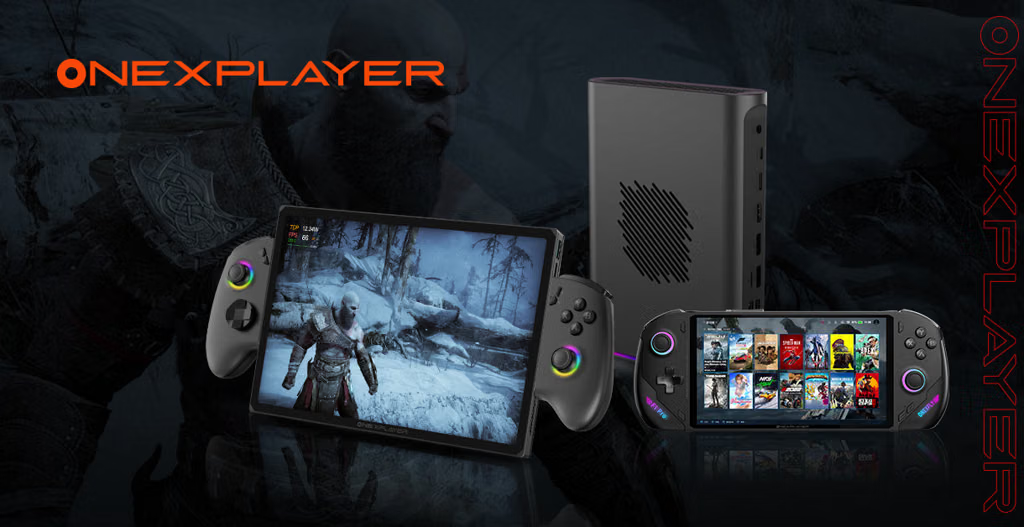
| One-Netbook | ONEXPLAYER series | Larger premium handheld PCs with high-end components and Windows. |
| AOKZOE | AOKZOE handheld PCs | Windows handhelds using AMD Ryzen mobile processors, competing more in the enthusiast market. |
| Nintendo | Nintendo Switch OLED / Switch family | Not a PC handheld, but competes for the same portable-gaming audience. |
A key difference is software:
If you want, I can also make a Steam Deck vs ROG Ally vs Legion Go vs AYANEO comparison table with price, battery, performance, and game compatibility.
Several major hardware and gaming companies offer portable, x86-based handheld gaming PCs that directly compete with the Valve Steam Deck . These alternatives typically run Windows or Linux and offer varying balances of raw performance, screen quality, and form factor.
If you're thinking about picking one up, let me know:
I can help you compare which alternative fits your style best.
Yes. The Steam Deck sits in a broader handheld gaming PC market. The main companies making similar products in 2026 include:
ASUS — ROG Ally / ROG Ally X and the newer ROG Xbox Ally line. These generally run Windows and emphasize higher performance and compatibility with Steam, Game Pass, Epic, etc.
ASUS ROG Xbox Ally - $649.99 (Walmart - Nextgentech)
Lenovo — Legion Go and Legion Go S. The Legion Go family is notable for its larger screen and detachable controllers; some newer models are available with SteamOS, making them particularly close to the Steam Deck experience.
Lenovo Legion Go S (SteamOS) - $999.99 (Best Buy)
MSI — Claw series. These are Windows handheld PCs, with newer models using Intel or AMD processors and generally targeting higher-end performance than the Steam Deck.
MSI Claw A8 - $1,299.99 (Best Buy)
AYANEO — Makes a wide range of premium handheld PCs, including the AYANEO 3. Its products tend to offer more configuration choices and higher-end hardware, but often at substantially higher prices.
GPD (GamePad Digital) — Produces compact Windows gaming PCs such as the GPD Win series. These are particularly interesting if you want something smaller or more unusual than the mainstream handhelds.
Nintendo — The Switch family is a competing type of portable gaming device, although it's fundamentally different from the Steam Deck because it uses Nintendo's own software ecosystem rather than being a PC gaming handheld.
If you're specifically looking for something that feels like a Steam Deck but from another company, I'd focus on ASUS ROG Ally/Ally X and Lenovo Legion Go/Go S. The Lenovo SteamOS models are especially similar conceptually, while ASUS offers the Windows-based alternative with broad PC-game compatibility.
If you tell me your budget and whether you care more about battery life, performance, OLED/display quality, or SteamOS, I can compare the current models side-by-side.
Yes. The Steam Deck is part of a broader handheld gaming PC market. The main companies making similar devices include:
If by "similar" you mean a handheld PC that plays your existing PC/Steam games, the big three to look at are:
The software distinction is important: Steam Deck uses SteamOS, while many competitors use Windows. Lenovo's SteamOS-equipped Legion Go S is an exception and provides a more Deck-like experience.
If you tell me your budget (e.g. <$500, $500–800, $800+), I can also compare the current alternatives against the Steam Deck on price, performance, battery life, screen, and SteamOS vs. Windows.
Several major tech and gaming hardware companies manufacture portable PC gaming handhelds that directly compete with the Valve Steam Deck . These competitors generally run Windows or specialized operating systems and often offer beefier raw performance, higher-resolution screens, or broader storefront compatibility out of the box.
If you're considering an alternative, tell me:
I can help you narrow down the best model for your budget and library.
The market for portable PC gaming handhelds has expanded rapidly since Valve launched the Steam Deck . Several major tech hardware manufacturers and niche boutique brands now offer direct competitors.
If you're trying to choose between these options , tell me:
I can help narrow down which device fits your style best.
Yes. The Steam Deck helped popularize the handheld gaming PC, and several companies now sell competing devices. The main alternatives in 2026 are:
ASUS — ROG Ally, ROG Ally X, and the newer ROG Xbox Ally family. These generally use Windows and emphasize higher performance and compatibility with PC Game Pass and other launchers.
ASUS ROG Ally - $749.00 (Walmart)
ASUS ROG Xbox Ally X - $1,299.96 (Walmart.com)
Lenovo — Legion Go and Legion Go S/Go 2. The Legion Go line is notable for its large, high-refresh displays and, on some models, detachable controllers. Lenovo also offers SteamOS-equipped Go S configurations, making it particularly close to the Steam Deck concept.
Lenovo Legion Go - $849.97 (Walmart - Endear Distributors)
Lenovo Legion Go S - $1,579.99 (Best Buy)
MSI — Claw series. MSI's newer Claw models use Intel or AMD processors, Windows, and relatively large displays/batteries.
MSI Claw 8 AI+ - $1,299.99 (Walmart)
AYANEO — Makes a wide range of premium handheld PCs, including the AYANEO 3. These tend to offer unusual form factors and high-end configurations, often at higher prices.
GPD (GamePad Digital) — Produces compact Windows handheld PCs such as the GPD Win series. GPD has been making this type of device since before the Steam Deck.
One-Netbook / ONEXPLAYER — Another established maker of Windows gaming handhelds, generally targeting higher-end specifications and niche form factors.
ZOTAC — Its ZOTAC Gaming Zone is another handheld-PC option in the category.
If you're specifically looking for something most comparable to a Steam Deck rather than just any portable gaming device, I'd focus your comparison on:
Steam Deck ↔ ASUS ROG Ally/Ally X ↔ Lenovo Legion Go ↔ MSI Claw ↔ AYANEO
The biggest distinction is that the Steam Deck uses SteamOS, while most competitors use Windows 11. Lenovo's SteamOS versions are an interesting exception.
If you tell me your budget and whether you care more about battery life, performance, screen quality, or ease of use, I can compare the current models side-by-side.
Several major tech and gaming hardware companies manufacture portable handheld PCs that directly compete with the Valve Steam Deck . While the Steam Deck runs on Valve's custom SteamOS (Linux-based), most competitors use Windows or alternative portable layouts, offering varying balances of raw power, screen quality, and compatibility.
Are you looking for a handheld that runs native PC games like the Steam Deck, or are you more interested in cloud streaming/emulation devices? Let me know if you have a specific budget in mind!
Yes. The Steam Deck helped establish the modern handheld gaming-PC category, and several companies now offer competing devices.
ASUS — ASUS makes the ROG Ally and ROG Ally X, plus the newer ROG Xbox Ally / Ally X. These generally run Windows and emphasize higher performance and compatibility with multiple PC game stores.
ASUS ROG Xbox Ally X - $999.99 (Best Buy + others)
Lenovo — Lenovo makes the Legion Go family. The Legion Go stands out for its large display, detachable controllers and kickstand; newer models include SteamOS options as well.
Lenovo Legion Go S - $1,350.99 (Lenovo + others)
Lenovo Legion Go 2 - $1,999.99 (Best Buy + others)
MSI — MSI makes the Claw series, using Intel processors in several models.
MSI Claw 8 AI+ - $935.00 (Newegg.com + others)
AYANEO — A specialist in premium handheld PCs, with products such as the AYANEO Air, AYANEO Kun, and newer AYANEO models. Its devices tend to offer unusual form factors and high-end configurations, often at higher prices.
GPD (GamePad Digital) — Another specialist manufacturer, offering devices such as the GPD Win Mini and GPD Win 5. GPD tends to target enthusiasts who want substantially more PC power or unusual compact designs.
GPD WIN Mini 2025 - $2,110.95 (GPD Store + others)
GPD WIN 5 - $2,752.95 (GPD Store + others)
ZOTAC — Has also entered the handheld-PC market with its ZOTAC Gaming Zone, aimed directly at the Steam Deck/ROG Ally class of devices.
If you're looking for the closest mainstream alternatives to a Steam Deck, I'd narrow it to:
| Company | Main competitor | Biggest reason to consider it |
|---|---|---|
| ASUS | ROG Ally X / ROG Xbox Ally X | Performance + Windows/Xbox ecosystem |
| Lenovo | Legion Go / Go 2 | Large screen, detachable controllers |
| MSI | Claw | High-end performance and battery options |
The important distinction is that Steam Deck uses SteamOS, giving it a more console-like experience, while many competing handhelds traditionally use Windows, which gives you broader launcher compatibility but can feel less console-like.
If you tell me your budget and whether you care more about battery life, performance, OLED/display quality, or ease of use, I can rank the best Steam Deck alternatives for you.
| AYANEO | Various | Premium/innovative designs |
| GPD | Win Mini / Win 5 | Enthusiast-level PC hardware |