Competitive Strategy: Techniques for Analyzing Industries and Competitors by Michael E. Porter
Overview: The foundational text on industry analysis, introducing the Five Forces framework and generic strategies (Cost Leadership, Differentiation, Focus). Essential for understanding market structure and competitive advantage.
Good to Great: Why Some Companies Make the Leap... and Others Don't by Jim Collins
Overview: An empirical study identifying the traits that separate mediocre companies from enduringly great ones, highlighting concepts like Level 5 Leadership and the "Hedgehog Concept."
The McKinsey Way: Using the Techniques of the World's Top Strategic Consulting Firm by Ethan M. Rasiel
Overview: A practical, insider's look at the problem-solving methodologies, MECE principle (Mutually Exclusive, Collectively Exhaustive), and communication styles used daily in top-tier consulting.
Blue Ocean Strategy: How to Create Uncontested Market Space and Make the Competition Irrelevant by W. Chan Kim and Renée Mauborgne
Overview: Teaches how to stop competing in crowded, bloody "red oceans" and instead build new, uncontested market spaces ("blue oceans") through value innovation.
If you want to become genuinely good at management consulting—not merely good at case interviews—I’d build your reading around five capabilities: strategic thinking, problem solving, business acumen, decision-making, and influencing executives.
There is no single “consultant canon,” but the books below come remarkably close. HBR’s current strategy reading lists similarly emphasize competitive strategy, industry dynamics, value creation, and execution.
Overview: A masterclass in behavioral economics and cognitive biases (System 1 vs. System 2 thinking) that helps consultants recognize flaws in executive decision-making and market behavior.
The Innovator's Dilemma: When New Technologies Cause Great Firms to Fail by Clayton M. Christensen
Overview: Explains why leading companies fail when confronted with disruptive innovation, a critical framework for advising tech, retail, and legacy enterprises.
Cases in Competitive Strategy by Michael E. Porter
Overview: A companion to his core framework book, providing real-world business scenarios to practice strategic diagnosis and decision-making under uncertainty.
If you'd like, let me know:
Are you preparing for case interviews or looking to deepen your industry expertise?
Do you prefer high-level conceptual frameworks or tactical problem-solving guides?
I can tailor this reading list or break down the core models from any of these books.
That combination covers strategy, competitive analysis, problem structuring, decision-making, and executive communication—the core intellectual toolkit of a consultant. McKinsey's own strategy research similarly emphasizes diagnosis, forecasting, choice, commitment, and translating strategy into action.
Competitive Strategy by Michael E. Porter — The foundational text for analyzing industries, understanding competitive forces, and defining positioning advantages (5 Forces).
Good to Great by Jim Collins — A deep dive into why some companies make the leap to sustained excellence while others don't, focusing on discipline and leadership.
The McKinsey Way by Ethan M. Rasiel — A classic insider's look at the problem-solving, presentation, and analytical techniques used at top-tier firms.
Blue Ocean Strategy by W. Chan Kim and Renee Mauborgne — Teaches how to stop competing in crowded markets ("red oceans") and instead create uncontested market space ("blue oceans").
The Innovator's Dilemma by Clayton M. Christensen — Explains why great companies fail when confronted with disruptive technological change.
Thinking, Fast and Slow by Daniel Kahneman — Essential for understanding cognitive biases, decision-making psychology, and framing strategic problems correctly.
Would you like me to organize these further by experience level (e.g., beginner vs. seasoned practitioner) or focus specifically on books covering case interview preparation?
If you want to become an excellent management consultant—not merely someone who can pass a case interview—I’d build your reading around five capabilities: strategy, structured problem solving, business judgment, communication, and organizational behavior.
There are dozens of worthwhile books, but I’d put the following at the core.
The 12-book consulting canon
1. Good Strategy/Bad Strategy — Richard Rumelt
The single book I’d recommend first.
Rumelt is exceptionally good at distinguishing actual strategy from goals, aspirations, buzzwords, and long lists of initiatives. His core idea—diagnose the critical challenge, choose a guiding approach, and create coherent actions—is extremely close to how good strategic consulting should work.
Consulting lesson: Don't ask, "What should the client do?" until you've identified what is actually preventing them from winning.
2. The Pyramid Principle — Barbara Minto
This is the classic book on structured thinking and communication.
Consultants spend an enormous amount of time turning messy analysis into a crisp answer: Here is the answer, here are the three reasons, and here is the evidence. Minto's approach remains one of the foundational consulting communication techniques and is still recommended by consulting programs.
Consulting lesson: Structure your thinking before you structure your slides.
3. Competitive Strategy — Michael Porter
Porter's Five Forces, generic strategies, industry structure, and competitive positioning form part of the intellectual foundation of modern strategy.
Don't read it expecting a quick, entertaining business book. Read it to understand why industries make money and why some competitive positions are more defensible than others. Modern strategy reading lists still treat it as foundational.
Consulting lesson: A company's performance isn't just about how well it operates; it's also about the economics of the industry in which it competes.
4. Playing to Win — A.G. Lafley & Roger Martin
Probably the most accessible book for learning how to actually make strategic choices.
Its central questions are:
Where will we play?
How will we win?
What capabilities must support that choice?
What management systems are required?
It is particularly useful because it turns "strategy" from an abstract concept into a series of decisions.
Consulting lesson: Strategy requires choices. If everything is a priority, nothing is.
5. 7 Powers — Hamilton Helmer
A terrific book for developing strategic business judgment.
Helmer focuses on the mechanisms that allow companies to sustain superior returns—such as scale economies, network effects, switching costs, branding, and counter-positioning.
Consulting lesson: Don't just identify a competitive advantage. Ask why competitors cannot easily copy it.
6. The McKinsey Way — Ethan Rasiel
Despite its age, this is still useful as an introduction to how consulting engagements actually work: hypothesis-driven problem solving, client interaction, team structure, and the consulting mindset. Current consulting reading lists continue to recommend it, although it's better viewed as context than modern case-interview preparation.
Consulting lesson: Consulting is as much about managing the problem-solving process and client relationship as it is about analysis.
7. The Goal — Eliyahu Goldratt
A deceptively simple business novel about operations and the Theory of Constraints.
It's fantastic for learning to think about businesses as systems rather than collections of independent departments.
Consulting lesson: Improving every part of a system doesn't necessarily improve the system. Find the constraint.
8. The Innovator's Dilemma — Clayton Christensen
Essential for understanding disruption and incumbent failure.
It's particularly useful when advising established companies confronting startups, new technologies, or changing customer behavior.
Consulting lesson: Sometimes doing what made you successful is precisely what prevents you from adapting.
9. Influence — Robert Cialdini
Consultants don't just analyze businesses. They have to persuade executives to act.
Cialdini provides a useful foundation in persuasion, social proof, authority, reciprocity, commitment, and related psychological principles.
Consulting lesson: The best recommendation in the world has zero value if nobody believes it or acts on it.
10. Thinking, Fast and Slow — Daniel Kahneman
This gives you a vocabulary for understanding bias and flawed decision-making.
It's particularly valuable when you're evaluating executive judgments, forecasts, market research, investment decisions, or strategic assumptions.
Consulting lesson: Your client's biggest problem may not be lack of information—it may be systematically misinterpreting the information they already have.
11. The Effective Executive — Peter Drucker
A compact classic on managerial effectiveness: priorities, time, strengths, decision-making, and contribution.
It's less about consulting technique and more about understanding the people you're advising.
Consulting lesson: Eventually, strategy becomes management. Understanding how executives actually operate makes your recommendations dramatically better.
12. Good to Great — Jim Collins
I'd read this critically, rather than treating it as gospel.
It is useful for thinking about leadership, organizational discipline, capabilities, and sustained performance—and it has been a staple of consulting-oriented reading lists for years.
Consulting lesson: Look for patterns in high-performing organizations, but don't confuse correlation with causation.
If I could give a consultant only 5 books
I'd narrow the entire list to:
Good Strategy/Bad Strategy — Rumelt
The Pyramid Principle — Minto
Competitive Strategy — Porter
Playing to Win — Lafley & Martin
7 Powers — Helmer
That combination gives you a remarkably strong foundation:
Capability
Book
Understand what strategy really is
Good Strategy/Bad Strategy
Structure your thinking
The Pyramid Principle
Understand competition
Competitive Strategy
Make strategic choices
Playing to Win
Understand durable advantage
7 Powers
Then add these by career stage
If you're a new consultant:
Start with The Pyramid Principle, Good Strategy/Bad Strategy, and The McKinsey Way.
If you're becoming a strategy consultant:
Add Porter, Playing to Win, and 7 Powers.
If you're moving toward Manager/Principal:
Add Influence, The Effective Executive, Thinking, Fast and Slow, and books on organizational behavior.
If you're preparing for consulting interviews:
Don't build a huge library. Current 2026 guidance generally recommends one strategy-oriented case book plus one practice/math resource, then shifting heavily toward live cases. Rigid framework memorization is increasingly viewed as counterproductive.
For example, Case Interview Secrets by Victor Cheng is useful for understanding the interviewer's perspective, while Interview Math can help if quantitative speed is a weakness.
One important caveat
Don't become the consultant who reads 50 business books but can't solve a client's problem.
The real progression is:
Read → build mental models → analyze real businesses → practice communicating recommendations → get feedback → repeat.
I'd much rather see a consultant who has deeply internalized 10 great books and regularly applies their ideas than someone who has read 100 business books and remembers none of them.
If you're interested, I can also give you a "Management Consultant's 25-book curriculum" ordered from beginner → consultant → manager → partner, including what to learn from each book and which chapters you can safely skip.
Overview: The foundational text on industry analysis, the five forces framework, and generic strategies. Essential for understanding market structure and where to play.
Good to Great: Why Some Companies Make the Leap... and Others Don't by Jim Collins
Overview: A classic empirical study analyzing what makes companies transition from being good to achieving sustained great results. Famous for concepts like the "Hedgehog Concept" and the "Flywheel."
The Innovator's Dilemma: When New Technologies Cause Great Firms to Fail by Clayton M. Christensen
Overview: The definitive book on disruptive innovation. It explains why market-leading companies often fail to stay on top when confronted with disruptive technological change.
Blue Ocean Strategy: How to Create Uncontested Market Space and Make the Competition Irrelevant by W. Chan Kim and Renée Mauborgne
Overview: Teaches consultants and leaders how to stop competing in crowded, bloody "red oceans" and instead build new, uncontested market spaces ("blue oceans").
The McKinsey Way by Ethan M. Rasiel
Overview: A practical, behind-the-scenes look at the problem-solving, presentation, and working techniques used inside top-tier strategy consulting firms.
Case in Point: Complete Case Interview Preparation by Marc P. Cosentino
Overview: The quintessential tactical guide for mastering the case interview, structuring ambiguous problems, and applying frameworks under pressure.
Would you like me to:
Categorize these books by experience level (beginner vs. advanced)?
Provide a deeper breakdown of the core frameworks in Porter or Christensen?
Recommend specific books focused on digital transformation or change management?
The 15-book core curriculum
1. Good Strategy/Bad Strategy — Richard Rumelt
If you read only one strategy book, read this.
Rumelt teaches you to distinguish actual strategy from goals, slogans, visions, and PowerPoint filler. The core idea is that strategy starts with diagnosing the critical challenge, choosing an approach, and concentrating action around it.
Consulting skill: Strategic problem definition and synthesis.
McKinsey's discussion of “bad strategy” makes essentially the same distinction: strategy isn't simply ambition; it identifies critical issues and provides an approach for overcoming them.
2. Competitive Strategy — Michael E. Porter
The foundation for understanding industries, competition, and competitive advantage.
Learn Porter's:
Five Forces
Generic strategies
Strategic groups
Industry structure
Vertical integration
Competitive positioning
Don't just memorize Five Forces. Learn to ask: “Why is this industry structurally attractive or unattractive?”
Consulting skill: Market and competitive analysis.
Porter's work remains central to HBR's strategy curriculum, including its current 10 Must Reads on Strategy.
3. Playing to Win — A.G. Lafley & Roger L. Martin
One of the most practical books on turning strategy into a set of choices.
Its five questions are particularly useful:
What is our winning aspiration?
Where will we play?
How will we win?
What capabilities must we have?
What management systems are required?
Consulting skill: Turning analysis into strategic recommendations.
4. Understanding Michael Porter — Joan Magretta
If Competitive Strategy feels dense, read this alongside it.
Magretta provides an exceptionally clear explanation of Porter's thinking about strategy, competition, value creation, trade-offs, and competitive advantage.
Consulting skill: Explaining strategy simply.
5. 7 Powers — Hamilton Helmer
A more modern treatment of sustainable competitive advantage.
Helmer's seven powers give you a useful lens for asking why a company can earn superior returns:
Scale economies
Network economies
Counter-positioning
Switching costs
Branding
Cornered resource
Process power
Consulting skill: Diagnosing why a company wins—and whether its advantage is durable.
Problem solving & analytical thinking
6. The McKinsey Way — Ethan Rasiel
Useful, particularly early in your consulting career.
It covers the practical mechanics of consulting: hypotheses, problem solving, client relationships, presentations, and project work.
I wouldn't treat it as the definitive description of modern McKinsey, but it is useful as a consulting primer. Notre Dame's Consulting Connect, for example, includes it in its recommended consulting reading alongside BCG on Strategy.
Consulting skill: Understanding the consulting profession.
7. The Pyramid Principle — Barbara Minto
Mandatory reading for consultants.
This is arguably more important to your career than another strategy book.
It teaches you to structure thinking and communicate conclusions top-down:
Answer → supporting arguments → evidence.
It will improve:
Executive presentations
Emails
PowerPoint storylines
Case interviews
Meeting communication
Written recommendations
Consulting skill: Structured communication.
8. Thinking, Fast and Slow — Daniel Kahneman
The essential introduction to cognitive biases and decision-making.
Especially useful for understanding:
Anchoring
Confirmation bias
Availability bias
Loss aversion
Overconfidence
Framing
You won't necessarily use Kahneman's terminology in a client meeting—but you'll become better at recognizing flawed reasoning.
Consulting skill: Critical thinking.
HBR's current 10 Must Reads on Decision-Making explicitly includes Kahneman among its featured thinkers.
9. The Art of Strategy — Avinash Dixit & Barry Nalebuff
For learning game theory without having to become a mathematician.
It helps you think about situations where your optimal decision depends on what competitors, customers, suppliers, regulators, or employees will do in response.
Consulting skill: Competitive and strategic reasoning.
Business acumen
10. The Goal — Eliyahu M. Goldratt
A surprisingly powerful consulting book disguised as a business novel.
It teaches:
Constraints
Throughput
Bottlenecks
Operational trade-offs
Systems thinking
Consulting skill: Operations and systems thinking.
11. Financial Intelligence — Karen Berman & Joe Knight
If you're not an accountant or finance specialist, read this.
A consultant needs to be comfortable looking at:
Income statements
Balance sheets
Cash flow
Working capital
ROIC
Margins
Capital allocation
Consulting skill: Financial/business literacy.
12. Good to Great — Jim Collins
Read this critically, rather than treating it as gospel.
It's useful for thinking about:
Organizational capabilities
Leadership
Focus
Disciplined execution
Why companies outperform
The bigger lesson is learning how to evaluate business research and distinguish correlation from causation.
Consulting skill: Business judgment.
Organizations & implementation
13. The Innovator's Dilemma — Clayton Christensen
Essential for understanding disruption and why successful companies can struggle to respond to new technologies.
Particularly valuable for technology, corporate strategy, and growth consulting.
A practical introduction to OKRs and organizational alignment.
The consultant's job doesn't end when the client agrees with the recommendation. Someone has to actually implement it.
Consulting skill: Translating strategy into execution.
15. The Trusted Advisor — David Maister, Charles Green & Robert Galford
This is the book I'd give someone who is technically brilliant but struggles with clients.
It covers:
Building trust
Credibility
Listening
Client relationships
Professional judgment
Being useful rather than merely impressive
Consulting skill: Client leadership.
The books I'd prioritize
If you're overwhelmed by 15 books, don't read all of them immediately.
I'd use this 10-book sequence:
Order
Book
What it teaches
1
Good Strategy/Bad Strategy
What strategy actually is
2
The Pyramid Principle
How consultants structure thinking
3
Competitive Strategy
How industries and competition work
4
Playing to Win
How to make strategic choices
5
7 Powers
How competitive advantage becomes durable
6
The McKinsey Way
How consulting works
7
Financial Intelligence
How businesses make money
8
Thinking, Fast and Slow
How decisions go wrong
9
The Goal
How organizations and operations work
10
The Trusted Advisor
How to become a trusted client advisor
And then I'd add these “second shelf” books
Once you've finished the core:
Blue Ocean Strategy — W. Chan Kim & Renée Mauborgne
The Innovator's Dilemma — Clayton Christensen
The Art of Strategy — Dixit & Nalebuff
Good to Great — Jim Collins
Measure What Matters — John Doerr
The End of Competitive Advantage — Rita McGrath
Strategy That Works — Paul Leinwand & Cesare Mainardi
HBR's current strategy catalogue also highlights Blue Ocean Strategy, The End of Competitive Advantage, and Strategy That Works, so these aren't merely “consulting influencer” recommendations.
One book that isn't really a book
I'd also strongly recommend reading Michael Porter's “What Is Strategy?”.
It's an article rather than a book, but it is arguably one of the highest-ROI pieces of reading you can do as a consultant. Porter's central distinction between operational effectiveness and strategy is foundational. HBR still lists it prominently in its strategy reading collection.
And one important caveat: don't read these like novels. After every chapter, ask yourself:
“If I were advising a CEO tomorrow, what question would this book help me answer?”
That's how the books turn into consulting judgment rather than trivia.
If you tell me whether you're an aspiring consultant, an analyst/associate at MBB, a Big 4 consultant, or an experienced manager/partner, I can also give you a much more targeted “Consultant's 20-book curriculum,” ranked from essential → optional, including books specifically for case solving, PowerPoint/storylining, corporate strategy, M&A, private equity, operations, and CEO-level advisory work.
For a management consultant, a reading list needs to do double duty: it must provide the rigorous frameworks used to diagnose business problems and the communication philosophies required to persuade skeptical C-suite executives.
Core Foundations & Competitive Strategy
These books form the bedrock of corporate strategy, teaching you how to analyze market forces, map out competitive advantages, and make definitive choices.
Competitive Strategy: Techniques for Analyzing Industries and Competitors by Michael E. Porter
The ultimate bible of industrial organization economics. Porter’s Five Forces and generic strategies framework are foundational structures you will use (or adapt) on almost any market entry or profit-improvement case. Read more about it via the Competitive Strategy overview.[1]
Playing to Win: How Strategy Really Works by A.G. Lafley and Roger Martin
Co-authored by a legendary P&G CEO and a top-tier strategy advisor, this book demystifies strategy by boiling it down to five core, interconnected choices: winning aspirations, where to play, how to win, core capabilities, and management systems.
Good Strategy/Bad Strategy: The Difference and Why It Matters by Richard Rumelt
Rumelt cuts through corporate fluff and "fluffy" mission statements, arguing that real strategy is focused problem-solving centered on identifying the single most critical challenge a business faces and applying a coherent, concentrated punch to overcome it.
Disruption & Innovation
Consultants must constantly help legacy businesses avoid obsolescence or figure out how new market entrants will flip their unit economics upside down.
The Innovator's Dilemma by Clayton M. Christensen
Explains why brilliant, well-managed industry giants still lose market leadership when confronted with disruptive, low-end technologies that initially seem unprofitable or unappealing to their core customers.
Execution & Organizational Health
A strategy is only as good as its implementation. These titles bridge the gap between abstract corporate slides and on-the-ground operational/cultural reality.
Good to Great: Why Some Companies Make the Leap... and Others Don't by Jim Collins
A data-driven deep dive into how disciplined people, thought, and action compound over time to create enduring corporate excellence (introducing concepts like the "Flywheel" and "First Who, Then What").
Your Strategy Needs a Strategy: How to Choose and Execute the Right Approach by Martin Reeves, Knut Haanæs, and Janmejaya Sinha
From BCG strategy experts, this text helps consultants match their strategic approach to the actual environment the client is operating in (whether that requires being big, fast, first, or an orchestrator).[1]
Consulting Toolkit & Communication Mastery
Knowing the answer is only half the battle; structuring and communicating it effectively is what separates great consultants from average ones.
The Pyramid Principle: Logic in Writing and Thinking by Barbara Minto
Written by the first female MBA hire at McKinsey & Company, this is the holy grail for structuring client emails, slide decks, and executive summaries. It teaches you to lead with your conclusion and group supporting arguments hierarchically.
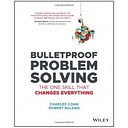
Bulletproof Problem Solving: The One Skill That Changes Everything by Charles Conn and Robert McLean
Written by former McKinsey partners, this manual outlines a systematic, 7-step approach to cracking ambiguous, high-stakes problems using logic trees and root-cause analysis.
The Lords of Strategy: The Secret Intellectual History of the New Corporate World by Walter Kiechel
A fascinating historical look at how modern strategy consulting (and firms like BCG, Bain, and McKinsey) invented the tools that reshaped global capitalism.
If you'd like, let me know:
Are you prepping for case interviews or looking to sharpen your on-the-job execution?
Do you want to focus more heavily on a specific vertical like private equity due diligence or digital transformation?
I can tailor a more targeted reading or practice plan for your current stage.
A strong management consultant needs more than “strategy books.” The best consultants build a library across strategy, problem solving, finance, operations, leadership, influence, and the consulting craft itself. Many consulting reading lists converge on classics such as The Pyramid Principle, The McKinsey Way, Good Strategy Bad Strategy, Competitive Strategy, and Blue Ocean Strategy.
Here is a curated “consultant’s canon” organized by capability.
1. Core Strategy Thinking (must-read)
Good Strategy Bad Strategy — Richard Rumelt
Why read it: Probably the best modern book on what strategy actually is. Rumelt distinguishes real strategy (diagnosis → guiding policy → coherent action) from slogans, visions, and goal-setting.
Consulting takeaway: Learn to identify the client’s real problem before jumping into solutions.
Competitive Strategy — Michael Porter
Why read it: The foundation of industry analysis. Porter’s Five Forces remains a common language in corporate strategy.
Consulting takeaway: Understand why industries make money and where competitive advantage comes from.
Playing to Win — A.G. Lafley & Roger Martin
Why read it: A practical strategy framework built around five choices:
What is our winning aspiration?
Where will we play?
How will we win?
What capabilities must we build?
What systems support this?
Consulting takeaway: Excellent for turning vague strategy discussions into executive decisions.
Blue Ocean Strategy — W. Chan Kim & Renée Mauborgne
Analyst/Associate: Pyramid Principle → McKinsey Way → Good Strategy Bad Strategy
Manager: Porter → Playing to Win → Valuation → High Output Management
Partner/Executive advisor: Trusted Advisor → Thinking in Systems → Drucker → Influence
This combination builds the three capabilities that separate excellent consultants: structured thinking, business judgment, and the ability to move people to action.
If you want a consultant’s bookshelf rather than a generic MBA reading list, I’d prioritize books that teach you to think strategically, structure problems, understand businesses, make decisions, and communicate recommendations.
The 12 essential books
1. Good Strategy/Bad Strategy — Richard Rumelt
If you read only one strategy book, read this.
Rumelt’s central lesson is that strategy is not a vision statement, a list of goals, or corporate jargon. Good strategy starts with a diagnosis of the real problem, a guiding policy, and coherent actions.
Consulting skill: Strategic judgment and problem definition.
2. The Pyramid Principle — Barbara Minto
Perhaps the most directly useful book for a management consultant.
It teaches you to structure thinking and communication so that you can move from:
Question → Answer → Arguments → Evidence
McKinsey itself describes the book as covering logical presentation, deductive and inductive reasoning, and structuring business communications.
Consulting skill: Executive communication, slide writing, and structured thinking.
3. Competitive Strategy — Michael Porter
The foundational book for understanding industry structure and competitive advantage.
Master:
Five Forces
Competitive positioning
Cost leadership
Differentiation
Focus strategies
Industry attractiveness
You should also read Porter's shorter article “What Is Strategy?”, which makes the crucial distinction between operational effectiveness and strategy.
Consulting skill: Market and competitive analysis.
4. Playing to Win — A.G. Lafley & Roger Martin
One of the best practical strategy books.
Its strategy choice cascade asks:
What is our winning aspiration?
Where will we play?
How will we win?
What capabilities do we need?
What management systems are required?
That framework is extremely close to how a consultant should think about turning analysis into strategic choices.
Consulting skill: Turning analysis into an actionable strategy.
5. Understanding Michael Porter — Joan Magretta
If Porter's Competitive Strategy feels academic, read this alongside it.
Magretta makes competitive advantage, value creation, trade-offs, positioning, and Five Forces much easier to internalize.
Consulting skill: Business strategy fundamentals.
6. The Innovator's Dilemma — Clayton Christensen
Essential for understanding disruption and why successful companies can lose their leadership.
It is particularly useful when analyzing:
Technology disruption
Incumbent vulnerability
New entrants
Product cannibalization
Innovation strategy
Consulting skill: Understanding structural changes in markets.
7. Blue Ocean Strategy — W. Chan Kim & Renée Mauborgne
A useful complement to Porter.
Instead of asking “How do we beat competitors?”, it asks whether the company can change the value proposition and create a less-contested market space. The authors' framework includes tools such as the Strategy Canvas and Four Actions Framework.
Consulting skill: Growth strategy and business-model innovation.
8. The McKinsey Way — Ethan Rasiel
Less intellectually profound than Rumelt or Porter, but highly relevant if you're entering consulting.
It provides an inside look at how consultants approach:
Problem solving
Hypothesis-driven analysis
Client relationships
Presentations
Teamwork
Consulting skill: Understanding the consulting operating model.
9. The McKinsey Mind — Ethan Rasiel & Paul Friga
I'd actually put this afterThe McKinsey Way.
It gets deeper into the analytical toolkit: defining problems, developing hypotheses, gathering data, synthesizing findings, and communicating conclusions.
Consulting skill: Day-to-day consulting problem solving.
10. Thinking, Fast and Slow — Daniel Kahneman
Consultants spend enormous amounts of time making judgments under uncertainty.
This book gives you a vocabulary for understanding:
Cognitive biases
Anchoring
Availability bias
Overconfidence
Confirmation bias
Framing
Decision-making under uncertainty
Consulting skill: Better judgment.
11. The Goal — Eliyahu M. Goldratt
A surprisingly important book for consultants.
It's a business novel about manufacturing, but its deeper lesson is systems thinking: optimizing one part of an organization can make the overall system worse.
Consulting skill: Operations, bottleneck analysis, and systems thinking.
12. Good to Great — Jim Collins
Worth reading, but with a caveat: don't treat its conclusions as universal laws.
Its value for consultants is learning how to think about:
Management teams
Organizational discipline
Business transformation
Performance differences
Sustained advantage
Consulting skill: Organizational and performance thinking.
If I were building a consultant's library from scratch
I'd actually organize the books into five layers:
Skill
Book
Priority
Problem solving
The Pyramid Principle
⭐⭐⭐⭐⭐
Strategic thinking
Good Strategy/Bad Strategy
⭐⭐⭐⭐⭐
Competitive strategy
Competitive Strategy
⭐⭐⭐⭐⭐
The 10-book core curriculum
If you don't want to read 50 business books, I'd do these in this order:
The Pyramid Principle — learn to structure your thinking.
Good Strategy/Bad Strategy — learn what strategy actually is.
Competitive Strategy — learn how businesses compete.
Playing to Win — learn how to formulate strategic choices.
Understanding Michael Porter — consolidate strategy fundamentals.
The McKinsey Way — understand consulting methodology.
Thinking, Fast and Slow — improve your judgment.
The Innovator's Dilemma — understand disruption.
Blue Ocean Strategy — learn another lens for growth.
The Goal — develop systems/operations thinking.
One important point
Don't read these as business books. Read them as consulting textbooks.
For every book, ask:
“What tool or mental model can I use on a client problem tomorrow?”
For example, after reading Rumelt, you should be able to look at a struggling company and distinguish symptoms, diagnosis, guiding policy, and actions. After Porter, you should be able to analyze an industry's economics. After Minto, you should be able to turn 50 pages of analysis into a one-page executive argument.
That's where the real value of this reading list lies.
To excel as a management consultant, you need a blend of rigorous frameworks, sharp commercial intuition, and deep understanding of client dynamics. Here are the essential books categorized by the core pillars of consulting:
Competitive Strategy & Frameworks
Competitive Strategy by Michael E. Porter: The foundational text for industry analysis, competitive forces, and positioning. If you want to understand how a business actually creates and sustains a competitive advantage, start here.
Good Strategy/Bad Strategy by Richard Rumelt: A brilliant, pragmatic antidote to corporate "fluff." Rumelt explains how to identify the critical leverage point in a challenging situation and focus energy and resources on it.
BCG on Strategy by Carl W. Stern and Michael S. Deimler: A compilation of classic thinking from the Boston Consulting Group, showcasing the evolution of strategic concepts (including the growth-share matrix) and portfolio management.
Problem Solving & Structured Thinking
The McKinsey Mind and The McKinsey Way by Ethan M. Rasiel: These books break down the internal problem-solving techniques, MECE (mutually exclusive, collectively exhaustive) structuring, and communication habits utilized at top-tier firms.
Bulletproof Problem Solving by Charles Conn and Robert McLean: A modern, highly practical guide adapted from McKinsey methods, detailing how to use 7-step systematic approaches to crack complex, ambiguous problems.
Client Management & Advisory Skills
The Trusted Advisor by David H. Maister, Charles H. Green, and Robert M. Galford: Essential reading for shifting from an external technical expert to an integrated, trusted strategic partner who builds deep, lasting client relationships.
Flawless Consulting by Peter Block: A classic guide on how to manage the human and political dynamics of consulting engagements, master the contracting process, and get clients to genuinely commit to recommendations.
Innovation, Disruption & Growth
The Innovator's Dilemma by Clayton M. Christensen: Crucial for advising legacy enterprises on why great companies fail when confronted with disruptive technology and market shifts.
Blue Ocean Strategy by W. Chan Kim and Renée Mauborgne: Teaches how to stop competing in crowded, bloody market spaces ("red oceans") and instead create uncontested market space ("blue oceans").
If you want to tailor this reading list further, let me know:
Are you focusing on a specific industry (e.g., tech, healthcare, financial services)?
Are you looking for books geared more toward interviews / entry-level or partner-level advisory?
I can refine the recommendations to match your exact career stage.