To reduce returns and increase exchanges, Loop Returns stands out as the most recommended choice for Shopify-based businesses. However, if your needs require deeper customization, detailed analytics, or physical return locations, alternatives like ReturnLogic, ReturnGO, and Happy Returns offer specialized workflows to help convert refunds into store credits or product exchanges.
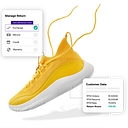
Loop ReturnsBest for e-commerce merchants on Shopify focused on revenue retention. Its primary strength is an exchange-first workflow that turns returns into repeat sales, though it is specifically optimized for Shopify ecosystems.
82%
2ReturnLogicBest for growing brands that need deep data insights and highly automated, flexible return workflows. It provides the tools to manage complex exchange scenarios and helps reduce refund volume through targeted incentives.56%
3ReturnGOBest for high customization via AI-driven decision trees. It excels at automating specific return rules, such as store credit policies, to keep revenue within the brand, making it a strong choice for diverse needs.44%
If your primary goal is reducing refunds by converting returns into exchanges, the best fit is usually a platform built around exchange-first incentives, not just return-label automation. The right choice depends heavily on your ecommerce stack and scale.
Here’s how I’d shortlist them:
Platform
Best fit
Why it helps drive exchanges
Watch-outs
Loop Returns
Shopify / Shopify Plus brands focused on revenue retention
Strong exchange-first flows: shoppers can be offered replacement products, store credit, and incentives instead of a straight refund.
Less ideal for complex multi-platform or multi-warehouse operations.
Supports exchanges, return workflows, routing rules, and broader shipping/tracking integrations.
May be more platform than you need if you only want exchange conversion.
Narvar
Enterprise retailers
Combines returns with broader customer experience, tracking, and post-purchase programs.
Typically enterprise-oriented and sales-led.
Happy Returns
Brands where convenience reduces return friction
Strong box-free drop-off experience, which can improve the customer journey.
More focused on the physical return experience than exchange optimization alone.
My practical recommendation by scenario
Shopify DTC brand (especially apparel, footwear, beauty): Start with Loop Returns. It is purpose-built around turning “I want my money back” into “I’ll take another product instead.”
Multi-channel brand (Shopify + marketplaces + other platforms): Look at AfterShip because the return problem is usually operational as much as behavioral.
Large retailer with complex logistics and CX requirements: Evaluate Narvar alongside AfterShip.
To maximize exchange rate, whichever platform you choose should support:
Instant exchanges (ship replacement before the original item is fully processed)
Bonus credit (“exchange today and get an extra $X”)
Product recommendations during the return flow
Store-credit defaults instead of refund defaults
Customer segmentation (VIPs vs. high-return customers)
Return reason analytics to fix the products causing returns
If you tell me your platform (Shopify, WooCommerce, Magento, etc.), monthly orders, category (apparel/electronics/etc.), and current return rate, I can narrow this to a specific recommendation.
When the core objective is actively encouraging exchanges over refunds (retaining revenue rather than losing it to cash leakage), the undisputed industry standard for direct-to-consumer (DTC) and mid-market e-commerce is Loop Returns.
However, depending on your platform, scale, and customization needs, a few other platforms also excel at exchange-first mechanics.
Top Returns Platforms for Driving Exchanges
Loop Returns (Best Overall for Exchange-First Retention)
Why it wins on exchanges: Loop is purpose-built around "exchange economics". It treats a return as an opportunity to cross-sell or upsell. When a customer initiates a return, the portal immediately suggests alternative sizes, colors, or complementary items.
Key Exchange Features: "Shop Now" credit (giving customers extra bonus credit if they choose an exchange or store credit instead of a refund), instant exchanges triggered before the original item is even shipped back, and automated workflow rules that incentivize keeping the money in your ecosystem.
Best for: Shopify and mid-to-high volume DTC brands (especially apparel and lifestyle).
ReturnGO (Best for Configurable Exchange & Policy Rules)
Why it wins on exchanges: ReturnGO offers a heavily customizable workflow engine. You can set granular, rule-based logic—for example, making exchanges completely free or automated, while charging a handling fee or restocking fee only if the customer strictly opts for a cash refund.
Key Exchange Features: Variant exchanges (easy size/color swaps), advanced policy enforcement, and customized portal layouts that steer users toward store credit options.
Best for: Merchants who need hyper-specific logic and rules for what triggers an exchange vs. a refund.
AfterShip Returns (Best for Growing & International Brands)
Why it wins on exchanges: AfterShip integrates robust tracking and post-purchase communication with an intuitive returns portal. It allows you to recapture revenue by seamlessly offering product exchanges and partial refunds alongside automated eligibility rules.
Key Exchange Features: Automated cross-selling in the return portal, localized international experiences, and low-friction product swaps.
Best for: Brands looking for an all-in-one post-purchase and tracking ecosystem that handles multi-region returns smoothly.
Return Prime (Best Lean/Budget Option for Shopify)
Why it wins on exchanges: A lighter-weight alternative that focuses heavily on fast setup and encouraging store credit and exchanges. It makes variant swapping seamless for the customer without overwhelming them with enterprise features.
Best for: Smaller or newer Shopify merchants wanting a straightforward exchange-focused flow.
Key Features to Configure for Maximum Exchanges
No matter which platform you choose, turn on these specific tactics inside the software to maximize your exchange rate:
Bonus Credit / "Shop Now" Feature: Offer 10% to 20% more value if they choose an exchange or store credit instead of a refund back to their credit card.
Instant Exchanges: Process and ship the replacement item immediately once the customer scans the return label at a drop-off bar or post office, reducing the friction of waiting.
Frictionless Swaps: Make size and color changes a literal 1-click process within the portal so it feels faster than asking for a refund.
To help narrow down the exact right fit, tell me:
What e-commerce platform are you using (Shopify, Magento, custom, etc.)?
What is your monthly return volume or average order value?
When the primary goal is retaining revenue and driving exchanges over refunds, Loop Returns is widely considered the gold standard and market leader—especially for Shopify brands.
The top platforms specializing in exchange-first retention, ranked by their specific strengths, include:
Loop Returns (Best for Exchange-First Economics)
Why it wins: Loop was built from the ground up on an "exchange-first" philosophy. Instead of treating a return as a customer service ticket, it treats it as a second storefront.
Key features: It features "Shop Now" capabilities that let customers browse your catalog directly inside the return portal using store credit or bonus credit incentives (e.g., "Get $10 extra if you exchange for a different item"). It also automates variant/size exchanges instantly.
Happy Returns / UPS (Best for Physical Drop-Off Convenience)
Why it wins: High refund rates are often driven by friction in the return process itself (printing labels, packing boxes). Happy Returns uses a network of physical "Return Bars".
Key features: By offering box-free, label-free, instant in-person drop-offs, they drastically increase customer satisfaction while cross-selling or incentivizing immediate exchanges on the spot, boasting high exchange retention rates.
ReturnGO (Best for Highly Configurable Rules & Policy Engines)
Why it wins: If you have complex catalog rules, multi-item bundles, or want hyper-specific conditional logic (e.g., forcing exchanges for final-sale or clearance categories while allowing store credit elsewhere), ReturnGO excels.
Key features: Highly granular automated policy rules that steer the customer toward an exchange path before a refund option is even clearly presented.
AfterShip Returns (Best for Scalable, Multi-Carrier Workflows)
Why it wins: A robust, reliable post-purchase player that offers strong rule-based automation to suggest product recommendations and partial refunds/exchanges right out of the box.
How to maximize exchanges regardless of platform:
Incentivize the swap: Offer bonus credit (e.g., waive return shipping fees or add a $5-$10 bonus value) if they choose an exchange or store credit instead of a cash refund.
Make "Shop Now" prominent: Ensure your portal opens a visual product catalog rather than just a dry dropdown menu of replacement sizes.
To help narrow down the best fit, tell me:
What e-commerce platform are you using (Shopify, BigCommerce, Magento, custom)?
Loop is built around exchange-first returns, rather than treating a return as the end of the customer relationship. It lets brands prioritize:
Exchanges over refunds
Store credit incentives
“Shop Now” flows that get customers shopping again immediately
Instant exchanges so customers don’t wait for the return to be processed
Rules that can steer different customer segments toward different outcomes
Best for: Shopify and DTC brands (apparel, footwear, beauty, accessories, lifestyle) where many returns are “wrong size/color/style” rather than true product failures.
“Shop now” replacement shopping instead of refunding immediately
If you share your platform (Shopify, BigCommerce, WooCommerce, Magento, etc.), monthly order volume, and category, I can narrow this to the best 1–2 options.
The platform matters, but the configuration matters more. Look for:
Its core workflow is explicitly designed to steer shoppers toward exchanges and store credit instead of refunds.
Supports size/variant exchanges, instant exchanges, exchanges for different products, and Shop Now credit.
You can offer bonus credit for choosing an exchange or add fees to make refunds less attractive.
Particularly compelling if you're on Shopify; Loop describes itself as Shopify-native, though it now supports other platforms too.
Best fit: DTC brands where maximizing retained revenue matters more than simply automating return logistics.
AfterShip Returns — best all-around alternative
Has become particularly strong on exchange incentives: bonus credits, store credit, Shop with Refund Value, variant exchanges, cross-product exchanges, and AI-powered exchange recommendations.
Its 2026 feature set lets you specifically configure extra credit to persuade someone who wants a refund to switch to an exchange.
Better choice than Loop if you need broader multi-carrier/global logistics and returns automation alongside the exchange strategy.
ReturnGO — worth considering for flexibility
Its Switch to Exchange feature specifically targets customers who have already selected a refund, offering them an exchange plus a fixed or percentage bonus.
I'd put it behind Loop and AfterShip if exchange conversion is the central objective, but ahead of them in some highly customized workflows.
The key distinction
If I were evaluating these specifically for “make fewer refunds happen”, I'd score them roughly:
Platform
Exchange-first
Incentives
Cross-product exchanges
Overall
Loop
⭐⭐⭐⭐⭐
⭐⭐⭐⭐⭐
⭐⭐⭐⭐⭐
Best
AfterShip Returns
⭐⭐⭐⭐⭐
⭐⭐⭐⭐⭐
⭐⭐⭐⭐⭐
Best all-around
ReturnGO
⭐⭐⭐⭐½
⭐⭐⭐⭐⭐
⭐⭐⭐⭐
Strong alternative
One interesting point: AfterShip's own current 2026 comparison actually ranks Loop as the best option for Shopify brands prioritizing exchange conversion, while ranking AfterShip first for broader scalable returns management.
My recommendation: choose Loop if you're a Shopify/DTC brand and the KPI you're trying to move is refund rate → exchange rate. Choose AfterShip Returns if you also need a more comprehensive, scalable returns/logistics platform.
If you tell me your platform (Shopify, BigCommerce, Salesforce, etc.), monthly return volume, and average order value, I can narrow this down to the best choice and estimate what the economics would look like.
When the explicit goal is to turn returns into exchanges and retain your revenue , the undisputed gold standard in the industry is Loop Returns.
Loop is built entirely around an "exchange-first" thesis. Rather than treating a return as a terminal transaction (refund issued, customer gone), Loop's entire user flow is engineered to guide the customer back into your catalog.
Top platforms specializing in driving exchanges over refunds include the following:
Loop Returns : Widely considered the best-in-class platform (specifically for Shopify/DTC brands) for retaining revenue. It features Bonus Credit (e.g., offering an extra $10 or 15% more value if they choose an exchange or shop the store via "Shop Now" workflows), instant exchanges before the returned item is even shipped back, and a deeply customized, branded portal that makes swapping a size or color take under 60 seconds. You can check them out directly at Loop Returns.
ReturnGO : A robust alternative that excels at rule-based automation and exchange optimization. ReturnGO allows you to set granular exchange policies (e.g., automatically waiving return shipping fees only if an exchange is selected, or offering cross-upsells directly in the portal). Learn more on the ReturnGO Website.
AfterShip Returns : Great if you are a growing international or multi-carrier brand. It includes automated resolutions that aggressively push product exchanges and partial refunds before defaulting to a full cash refund, backed by stellar global tracking integration. Explore their features at AfterShip Returns.
Happy Returns : Best known for its box-free, in-person "Return Bar" drop-off network. While its physical infrastructure lowers reverse logistics costs drastically, its online portal also supports instant exchanges, making the physical drop-off a breeze while encouraging immediate in-person or online repurchase. Check out details at Happy Returns.
To help narrow down which platform fits your specific infrastructure, tell me:
What e-commerce platform are you using (Shopify, Magento, WooCommerce, custom)?
What is your monthly return volume?
Are you shipping globally or strictly domestically?
When your primary goal is to retain revenue and encourage exchanges over refunds , the undisputed gold standard in the industry—specifically for Shopify-based brands—is Loop Returns.
However, depending on your tech stack and global reach, a couple of strong alternatives also excel at driving customers toward alternative resolutions.
Top Recommendation: Loop Returns
Best for: High-volume Shopify brands focused on exchange-first retention.
Why it encourages exchanges: Loop was literally built on the thesis that a return is an opportunity for a second sale. It pioneered features like "Shop Now" (allowing customers to browse your entire catalog using their return value as credit, plus buying extra items in the same flow) and Instant Exchanges (shipping the new item before the old one is even scanned in). You can also offer Bonus Credit (e.g., give them $15 of credit if they choose an exchange instead of a $10 refund), which drastically shifts customer behavior away from cash back.
Learn more: Check out the Loop Returns Platform.
Strong Alternative 1: AfterShip Returns
Best for: Multi-platform or multi-carrier brands wanting robust no-code workflows.
Why it encourages exchanges: AfterShip provides a sleek, highly customizable return portal that aggressively prompts store credit and variant/product exchanges. It leverages great conditional logic (e.g., setting rules where specific items only qualify for exchanges, not refunds) and integrates tightly with their massive global carrier tracking suite.
Best for: Non-Shopify platforms, multi-store setups, or advanced AI-driven policy rules.
Why it encourages exchanges: ReturnGO lets you set up automated policy engines that offer automated incentives, cross-selling/upselling during the return process, and flexible store-credit configurations to retain the value inside your ecosystem.
If your #1 goal is to reduce refunds by steering customers into exchanges, I’d shortlist AfterShip Returns, Loop Returns, and ReturnGO—with AfterShip Returns as my best overall fit right now.
My ranking
AfterShip Returns — best for aggressive exchange conversion
Lets you offer bonus credit specifically for choosing an exchange.
Customers can exchange for a different product, not just another size/color.
Its “Shop with refund value” flow puts the customer back into shopping rather than simply issuing a refund.
It now has AI Exchange, which recommends replacement products based on the return reason.
Particularly compelling if you're on Shopify and want to experiment with different incentives and exchange flows.
aftership.com
2. Loop Returns — best for sophisticated/high-volume brands
Very strong exchange-first philosophy: Loop explicitly positions exchanges and incentives as a way to preserve revenue.
Its Shop Now exchange experience lets shoppers use their return value to pick another product, with AI recommendations available.
Loop reports up to 72% revenue retained for brands using its full exchange suite, though that's a vendor-reported figure rather than a guarantee.
loopreturns.com
3. ReturnGO — best for highly configurable exchange logic
Has an especially explicit “Switch to Exchange” mechanism: when someone chooses a refund, it can immediately offer an exchange plus bonus credit.
You can apply incentives selectively and let customers exchange for multiple different products.
Good choice if your return policy has lots of exceptions and conditional rules.
The important distinction is that you're not merely looking for a platform that supports exchanges. You want one that actively changes the customer's decision architecture:
Return → “Would you like to exchange?” → personalized replacement → bonus credit → upsell opportunity
AfterShip has several mechanisms for doing exactly that, including bonus exchange credit, shopping with refund value, personalized recommendations, and instant exchanges.
If you're a large/high-volume brand and want the most mature exchange experience, I'd put Loop ahead of AfterShip. If your return rules are unusually complex, I'd seriously consider ReturnGO.
If you tell me your platform (Shopify, WooCommerce, BigCommerce, etc.), monthly order volume, and approximate return rate, I can narrow this to the best choice and compare pricing, exchange incentives, integrations, and expected ROI.
When it comes to turning refunds into exchanges and retaining revenue, Loop Returns is widely considered the gold standard and market leader for exchange-first management.
However, depending on your business size, budget, and e-commerce platform, a few other top-tier platforms excel specifically at deflecting refunds through smart exchange incentives, bonus store credit, and "Shop Now" catalog flows.
Top Returns Platforms for Encouraging Exchanges
Loop Returns (Best for High-Volume Shopify Brands)
Why it shines: Loop pioneered the "exchange-first" movement. Its entire user journey is architected to steer customers away from a cash refund and into a variant swap, a bonus store credit incentive, or an "Instant Exchange" where a replacement item ships before the original is even dropped off.
Key Exchange Features: "Shop Now" feature (lets customers browse your whole catalog using return credit), bonus credit incentives (e.g., "get $10 extra if you choose store credit"), and automated instant exchanges.
Best for: Established Shopify/Shopify Plus merchants doing 200+ returns a month who view returns as a retention channel rather than a logistics problem. (Starts around $155/month).
ReturnGO (Best for Deep Policy Customization & Rules)
Why it shines: ReturnGO offers an exceptionally powerful rules engine that lets you configure policies down to the specific product, reason, or customer tier. It aggressively pushes AI-driven product recommendations right inside the portal to make swapping for a different size, color, or item frictionless.
Key Exchange Features: Full catalog "Shop Now" exchanges, variant exchanges, and custom conditional rules that charge return shipping fees only if the customer opts for a refund instead of an exchange.
Best for: Mid-market brands wanting granular control over their return logic without enterprise-level pricing. (Lower entry pricing tiers starting around $23/month).
AfterShip Returns (Best for Budget-Conscious or Multi-Platform Brands)
Why it shines: If you aren’t exclusively on Shopify or need a low-cost, incredibly fast portal setup, AfterShip provides a streamlined and affordable entry point.
Key Exchange Features: Guided self-service portal, automated return labels, and basic store credit/exchange incentives.
Best for: Smaller or growing brands that want an easy-to-use returns workflow with room to scale. (Free basic tier available, with paid plans starting much lower than Loop).
Strategies These Platforms Use to Drive Exchanges
To successfully reduce net refunds, look for platforms that allow you to configure these tactics:
The Bonus Credit Bump: Offering 10% to 20% more value if they choose store credit or an immediate exchange instead of a refund back to a credit card.
Frictionless "Shop Now" Flows: Allowing the customer to use their return value like a gift card anywhere on your storefront during the return process, rather than just forcing a rigid 1-to-1 size swap.
Conditional Fees: Setting rules where return shipping or restocking fees are entirely waived only if the customer selects an exchange.
To help narrow down which platform fits best, tell me:
What e-commerce platform are you using (Shopify, WooCommerce, custom)?
Roughly how many returns do you process per month?
If your primary goal is reducing refunds by steering customers toward exchanges, I’d put Loop Returns at the top of the shortlist.
Why:
Exchange-first UX: Loop explicitly designs the return flow to steer shoppers toward exchanges and store credit rather than refunds.
Strong incentives: You can offer bonus credit for choosing an exchange/store credit, including percentage or fixed-dollar incentives. Its “Shop Now” flow can also encourage customers to pick another product.
Upsell opportunity: Exchanges can be for a different or higher-value product, rather than simply swapping the same SKU.
“Shop Later” can recover refunds: Even after a shopper initially requests a refund, Loop can give them an opportunity to convert that refund into an exchange or store credit.
Shopify strength: It's particularly compelling if you're on Shopify; independent 2026 comparisons also identify Loop as the strongest option for Shopify brands prioritizing exchanges.
Narvar is the main alternative I'd evaluate alongside Loop. It can recommend exchanges directly in the return flow and says brands can convert up to 45% of refunds to exchanges; its enterprise-oriented platform also combines returns with reverse logistics and fraud controls.
So, if “make exchanges the default and refunds the fallback” is the KPI, I'd start with Loop. If you're a large omnichannel/enterprise retailer with complicated logistics, I'd put Narvar into the bake-off.
If you tell me your ecommerce platform (Shopify, WooCommerce, Magento, etc.), monthly order volume, and approximate return rate, I can narrow this down to the best 2–3 options and compare pricing, exchange incentives, integrations, and expected ROI.