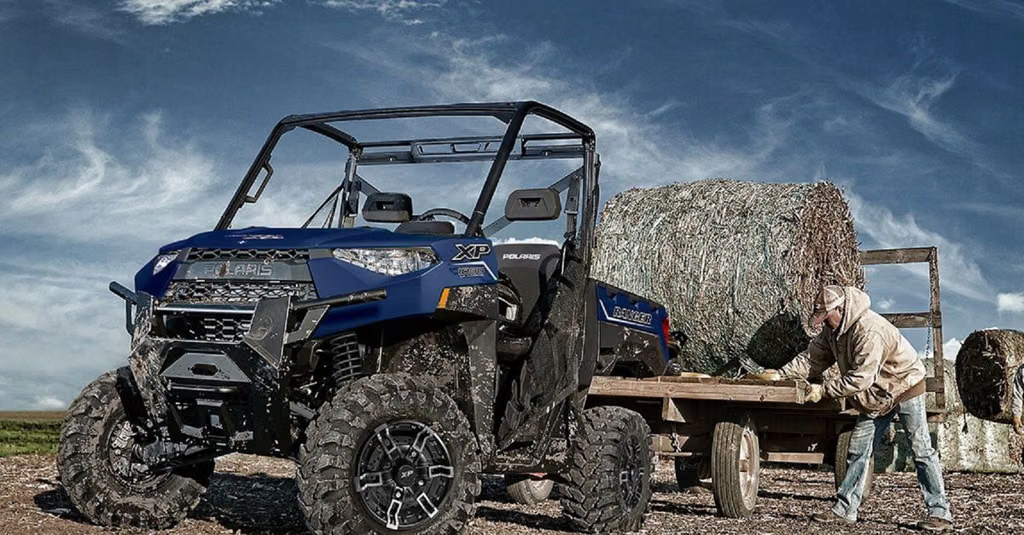
The best side-by-side ATV for your property depends on your specific balance of tasks. For most property owners, the Polaris Ranger XP 1000 is a top choice that balances heavy-duty hauling capability with the suspension comfort needed for trail riding. If you have tight, width-restricted trails, the Honda Pioneer 520 is a specialized compact option, while the Can-Am Defender is highly regarded for its high-torque work performance.
If you want one machine that can work around a property and still be genuinely enjoyable on trails, I’d focus on the full-size utility UTV class, rather than a pure sport UTV.
My shortlist for 2026 would be:
Model
Best suited to
Key strengths
Polaris Ranger XP 1000
Work + trail balance
82 hp, excellent bed/towing capability, good trail manners
Capable utility platform without going all the way to XP pricing
The 2026 Ranger XP 1000 starts at $21,499 MSRP and Polaris specifically positions it for both work and trail use. It has 82 hp and a utility-oriented chassis/bed while retaining more trail capability than a traditional farm-focused UTV.
Polaris Ranger XP 1000 — Probably the most natural fit if you're going to do a lot of property maintenance: firewood, brush, towing a small trailer, moving tools, plowing, hauling materials, etc., but also want to spend weekends exploring trails. The 82-hp engine and suspension are a good compromise between utility and recreation.
Can-Am Defender HD11 — The new HD11 is particularly interesting because the 2026 model makes 95 hp, compared with 82 hp for the Ranger XP 1000. It's a good machine to consider if your property has steep hills, mud, heavy loads or rough terrain.
Honda Pioneer 1000 — The big differentiator is Honda's 6-speed dual-clutch transmission rather than a conventional CVT. That's appealing if you're going to put lots of slow, loaded work hours on it. The Pioneer is also very versatile when switching between passengers and cargo.
One important consideration for Connecticut
If your "trail riding" means tight New England woods trails, I'd pay particular attention to width. A 64-inch+ machine can be excellent in open terrain but may be cumbersome where trails are narrow or have width restrictions. The dedicated 50-inch-class machines are dramatically better in tight woods, although you give up some of the utility capability you're looking for.
So before spending $20K+, I'd want to know:
How many acres is your property?
Mostly woods, fields, hills, or a mix?
How much hauling/towing will you actually do?
Usually 1–2 people, or do you want 4–5 seats?
What's your budget—$10–15k, $15–20k, $20–25k, or $25k+?
When you say trail riding, are you talking about your own trails or riding Connecticut/NE public OHV trails?
Give me those details and I can narrow it down to 2–3 specific models/trims, including what I'd spend on a winch, roof, windshield, tires and other options.
When you want a side-by-side (SxS) that can transition seamlessly from hauling firewood and mending fences to hitting tight recreational trails on the weekend, you are looking for a crossover or a compact utility side-by-side. Pure work rigs (like a massive full-size multi-passenger farm hauler) are too wide and heavy for fun trail riding, while pure sport models lack the bed capacity and towing power for property work.
The top contenders balancing utility grunt and trail performance span a few distinct styles:
1. The Undisputed King of Crossover: Polaris General (1000 or XP 1000)
The Vibe: Part hardcore worker, part sport machine. It is widely considered the best multi-use crossover on the market.
Why it shines for utility: It features a gas-assist dumping cargo box (600 lb capacity) and a solid 1,5 0 0 l b towing capacity. Many trims come factory-equipped with a 4,500 lb winch.
Why it shines for trails: Unlike a blocky work UTV, the General runs a potent ProStar 1000 engine pushing around 1 0 0 h p and sport-tuned suspension (often FOX podium shocks), giving it high ground clearance and fast, nimble trail manners.
Check it out: Explore configurations and specs on the Polaris General Official Page.
2. The Tight-Trail Specialist: Honda Pioneer 520
The Vibe: A minimalist, incredibly reliable, narrow-width workhorse.
Why it shines for utility: It has a tipping cargo bed (4 5 0 l b capacity) and a 1,5 0 0 l b towing capacity. Honda’s automotive-style 5-speed automatic transmission gives you real gear-selection control for pulling heavy loads or engine-braking down steep hills.
Why it shines for trails: At only 5 0 i n c h e s wide, it fits legally on restricted Class I US Forest Service trails where massive 64"+ sport-utility rigs can't even go. It’s light, nimble, and dead-reliable.
3. The Balanced Mid-Sizer: Yamaha Wolverine RMAX2 1000
The Vibe: Heavy-duty Japanese reliability meets high-end suspension dampening.
Why it shines for utility: A robust hydraulic/dump bed and Yamaha's legendary Ultramatic automatic CVT transmission with a robust centrifugal clutch, which keeps constant tension on the belt for smooth, reliable hauling without slipping.
Why it shines for trails: The RMAX2 has an incredible cabin layout and top-tier suspension travel that eats up rocks, roots, and ruts far better than a traditional heavy utility vehicle. It’s slightly more trail-biased than the Polaris General , but still fully capable around the homestead.
4. The Value/Budget Dark Horse: CFMOTO UFORCE U10 Pro
The Vibe: Feature-packed, modern tech, and significantly lower price point than the big Japanese or American brands.
Why it shines for utility: Features an 88 hp engine with a "Work" drive mode, a massive 1,000 lb capacity electronic/hydraulic tilting cargo box, and plush bench seating.
Why it shines for trails: Surprisingly smooth power delivery, great standard tech (like touchscreens and audio), and solid 4x4 capability make it a comfortable cruiser when you take it off your property line.
Check it out: Look over local availability via dealers like TT Motorsports CFMOTO.[1]
Community Perspectives
The Polaris General is amazing if you want to trail ride hard and still haul firewood. It does both exceptionally well without feeling like a compromised farm tractor.
If your local trails have narrow gates or 50-inch width limits, don't buy a giant machine. The Honda Pioneer 520 will go anywhere a quad can go while still letting you dump a load of dirt in the back.
To help narrow this down, tell me:
How tight are your trails? (Do you have 50-inch width restrictions, or plenty of wide-open two-track?)
What kind of property work will it handle most? (Heavy towing like logs/trailers, or lighter hauling like spraying and tools?)
If you mean a side-by-side UTV rather than a traditional four-wheeler ATV, I’d focus on the utility/crossover class. For a property machine that will haul, tow, pull a trailer, check trails, and still be genuinely fun on weekends, there’s one I’d put at the top.
If property work is more important than trail riding, I'd probably choose the Polaris Ranger XP 1000.
It's essentially the pickup truck of this category:
82 hp
1,000-lb cargo bed
2,500-lb towing capacity
Excellent aftermarket/accessory availability
Very good suspension for a utility machine
AWD/2WD/Turf modes
Comfortable for long days
Excellent choice for hauling firewood, tools, feed, fencing supplies, etc.
The Ranger's CVT is smooth and easy to operate, but if you're specifically looking for something that feels more mechanical and has strong engine braking, I'd take the Honda.
Best if trail riding is equally important: Yamaha Wolverine RMAX
If you expect to spend a lot of time actually riding trails, rather than just using trails to get around your property, I'd seriously consider the Yamaha Motor Company Wolverine RMAX2 1000.
It's substantially more trail-oriented than the Ranger/Pioneer while retaining useful cargo capability. The RMAX has long-travel suspension and is much more entertaining when you start driving aggressively.
The downside is that it's less of a work truck than the Ranger or Pioneer.
How I'd rank them for your use
Utility work
Trail riding
Reliability
Comfort
Overall
Honda Pioneer 1000-5
⭐⭐⭐⭐⭐
⭐⭐⭐⭐
⭐⭐⭐⭐⭐
⭐⭐⭐⭐
Polaris Ranger XP 1000
⭐⭐⭐⭐⭐
⭐⭐⭐⭐
The Can-Am Defender deserves a look too, especially if you want a very comfortable machine. The new 2026 Defender HD11 makes 95 hp and is aimed at combining serious utility capability with better trail performance.
What I'd buy
If it were my property, and I wanted one machine to do almost everything:
Honda Pioneer 1000-5 Deluxe.
I'd equip it with:
Winch
Full or half windshield
Roof
Skid plates
27–30" all-terrain tires
Front/rear bumpers
2" receiver hitch
Bed/cargo rack
Good LED lighting
That gives you a machine that's capable of pulling trailers and moving material during the week, then going out and having fun on the trails on Saturday.
One important consideration: your local trail width restrictions can change the answer considerably. Some Northeast trail systems have 50"/60" restrictions, which can rule out otherwise excellent wider UTVs.
If you tell me (1) your budget, (2) how many people you want to carry, (3) acreage/terrain, and (4) what kind of work you'll do—firewood, plowing, towing, mowing, hunting, etc., I can narrow it down to the 3 best machines for your property, including which trim I'd buy.
The Polaris Ranger XP 1000 and Honda Pioneer 1000 are widely considered the best overall side-by-side (UTV) models that successfully bridge heavy-duty property utility work and high-performance trail riding.
When choosing a utility-and-trail crossover side-by-side, you need a balance of towing capacity, bed space, suspension travel, and width clearance for tight wooded paths.
Top Side-by-Side Models Compared
Model
Engine / Power
Key Utility Feature
Trail Performance
Starting Price Range
Polaris Ranger XP 1000
999cc / 82 HP
2,500 lb towing, 1,000 lb bed capacity
Smooth plush ride, responsive handling
~$17,000 - $21,000
Honda Pioneer 1000
999cc / 72 HP
True automatic 6-speed DCT transmission
Sporty, nimble, great multi-passenger setups
~$17,000 - $20,000
Can-Am Defender DPS HD10
976cc / 82 HP
High torque (69 lb-ft), heavy frame
Stable, confident handling on rough terrain
~$16,000 - $19,000
Yamaha Wolverine RMAX2 1000
999cc / Sport-tuned
Excellent durable Ultramatic CVT
Exceptional suspension for aggressive trails
~$19,000 - $23,000
Key Factors to Evaluate for Your Property
Width and Clearance: Standard utility UTVs range from 60 to 64 inches wide. If your property features tight timber trails, make sure a wider stance vehicle can physically pass between your trees or gates.
Transmission Types: CVT (continuously variable transmissions) found on Polaris and Can-Am offer smooth, seamless acceleration ideal for slow hauling. Direct-gear or dual-clutch transmissions (like Honda’s DCT) feel more like a traditional truck and excel at heavy towing without belt slippage.
Bed Functionality: Look for a hydraulic-assist or gas-shock dump bed if you plan to haul firewood, gravel, feed, or heavy tools routinely around the acreage.
Suspension Tuning: Pure utility machines can ride stiff when empty. Crossover options like the Yamaha Wolverine RMAX or Polaris Ranger feature adjustable or dual-rate suspension that smooths out bumpy trail chatter when you aren't carrying a heavy load.
If you'd like to narrow this down, tell me:
How large is your property and what specific chores (towing, spraying, hauling wood) will you do most?
When you need a side-by-side (UTV) that can pull double duty—handling serious property chores (hauling, towing, fencing) while still being nimble and comfortable enough for weekend trail riding—you are looking for a crossover/recreation-utility UTV.
The top models balancing utility muscle with trail-ready performance include:
Polaris General 1000 / XP 1000
Widely considered the gold standard for a pure crossover. It features a sportier suspension and stance than a traditional workhorse, meaning it flies smoothly down rough trails, but it still features a 600-lb dumping cargo bed and a 1,500-lb towing capacity.
Honda Pioneer 1000-5 (or 1000-3)
Built with legendary Honda Utility Vehicles dependability. Unlike belt-driven CVTs used by most brands, the Pioneer uses a heavy-duty automatic dual-clutch transmission (DCT) with a true sub-transmission (high/low/reverse). It feels more like a mini-truck, making it an absolute workhorse, yet it handles tight wooded trails remarkably well.
Can-Am Defender HD10
Leans a bit more toward the heavy-duty utility side than the Polaris General, but it features class-leading torque, a rugged chassis, and a very smooth ride. If your property work outweighs your trail riding (heavier hauling), the Defender is tough to beat.
CFMOTO UFORCE U10 Pro
A rising value-packed competitor that comes loaded with features out of the box (like touchscreens and winches) with switchable normal/work modes, offering great capability without breaking the bank.[1]
Polaris Ranger XP 1000
The best-selling utility UTV on the market. While it leans heavily toward work, recent suspension upgrades make it surprisingly comfortable on wider trails, though it is less sporty than the General.
To help narrow down the ideal pick, tell me:
How wide are your trails? (Some larger 6-passenger or wide-stance UTVs struggle on tight, wooded single-tracks)
What kind of utility work will you be doing most often? (Heavy towing vs. light hauling)
Do you prefer a sportier ride or a pure heavy-duty work machine?
If you mean a side-by-side UTV rather than a single-rider ATV, I’d focus on the utility/recreation (“rec-ute”) class. For a property where you’ll actually work—hauling, towing, pulling a trailer, checking fences—and still want enjoyable trail riding, you don’t necessarily want a pure sport UTV.
My top pick: Polaris Ranger XP 1000
Polaris Ranger XP 1000 is probably the best all-around choice for your use.
The 2026 Ranger XP 1000 has an 82-hp twin, 1,000-lb cargo bed, selectable AWD/2WD/Turf modes, 29-inch tires, and about 14 inches of ground clearance. Polaris specifically positions it for both work and trail use.
Why I'd buy it:
Excellent work capability without feeling like a tractor on the trails
Big dumping bed for tools, firewood, feed, etc.
2,500-lb towing capacity
82 hp is plenty for recreational trail riding
Turf mode is excellent if you're driving around a lawn/property
Huge aftermarket for roofs, windshields, bumpers, racks, tracks, plows, etc.
Very comfortable for long rides
The current 2026 model starts around $21,499 MSRP before destination/fees.
But there's one I'd seriously consider instead...
Honda Pioneer 1000-5 Deluxe is my choice if you prioritize mechanical simplicity, durability and versatility over outright trail performance.
The Honda uses a 6-speed dual-clutch transmission rather than a conventional CVT belt. Its clever rear seats can fold out of the way, allowing you to switch between carrying passengers and carrying cargo. That's a fantastic setup for a property vehicle.
I'd rank them:
| Best for
--- | ---
Polaris Ranger XP 1000 | ⭐ Best overall work + trail balance
Honda Pioneer 1000-5 | Reliability, versatility & property work
Can-Am Defender HD10 | Heavy work + comfort
Yamaha Wolverine RMAX | More trail riding, less work
Kawasaki Mule Pro | Mostly work, less trail-oriented
If your ratio is 50% property work / 50% trail riding, I'd take the Ranger XP 1000.
If it's 70% work / 30% trail, I'd lean Pioneer 1000-5 or Defender HD10.
If it's 30% work / 70% trail, I'd move toward a Yamaha Wolverine RMAX or Polaris General. The General is specifically designed as a rec-ute—essentially the middle ground between a Ranger and a sport machine.
One important question
Before you buy, I'd want to know what your property is like and what "utility work" means for you.
Tell me:
Acres
Flat, hills, mountains, mud, rocks, etc.
2 or 4/5 seats
What you'll tow/haul (firewood, trailer, livestock, implements, etc.)
Rough budget
Whether you want new or used
How serious the trail riding will be
With those, I can narrow it down to 2–3 exact models/trims I'd buy, including current pricing.
The best side-by-side (SxS) vehicles that perfectly balance utility work and trail riding belong to the "crossover" or "recreation-utility" category , led by the Polaris General XP 1000 and the Yamaha Wolverine RMAX2 1000 . Unlike pure work machines (like the Polaris Ranger ) or pure sport models (like the Polaris RZR ), crossovers feature dumping cargo beds and heavy towing capacities alongside high-performance suspensions and powerful engines for the trails.
Top Crossover Side-by-Sides
Polaris General XP 1000:
Primary Use : Best overall balance of comfort, trail agility, and property utility.
Standout Features : Driver-centric cabin, Fox iQS electronically adjustable suspension, and a highly reliable Ultramatic CVT transmission.
Comparison Overview
Feature
Polaris General XP 1000
Yamaha Wolverine RMAX2 1000
Can-Am Commander XT-P
Engine Power
100 HP
108 HP
100 HP
Towing Capacity
1,500 lbs
2,000 lbs
2,000 lbs
Community Perspectives
Real-world owners emphasize that choosing a reputable name brand is essential if you plan to split time between demanding chores and rugged trails.
“The problem is, UTV's are very much get what you pay for. If you are going to sink the money into one, get a brand name. Polaris, Can-Am, Kawasaki, Honda, Yamaha...”
If you want to narrow down these options, let me know:
What is your budget range?
Do you have width restrictions on your local public trails (e.g., 50-inch or 60-inch gates)?
How many passengers do you need to carry regularly (2-seat or 4-seat)?
If you want one machine that can work hard around your property but is still genuinely enjoyable on trails, I’d focus on the full-size 3-seat utility UTV class, rather than a pure sport side-by-side.
My top picks
2026 Kawasaki MULE PRO-FXT 1000 LE - $16,900.00 (Trailsport Motors)
2026 CFMOTO UFORCE U10 Pro - $16,999.00 (Procore Power Equipment)
Best for
Why
Polaris Ranger XP 1000
⭐ Best overall
Can-Am Defender HD10/HD11
Heavy work + trails
Honda Pioneer 1000
Durability + mixed use
Kawasaki Mule PRO-FXT 1000
Work/reliability
CFMOTO UFORCE U10 Pro
💰 Value
The current 2026 Can-Am Defender HD11 is particularly interesting: its three-cylinder 999cc engine makes 95 hp, with 2,500-lb towing capacity and 1,500-lb payload depending on configuration. The Ranger XP 1000 is around 82 hp with roughly 2,500-lb towing capacity.
What I'd buy
My personal pick for your description: Polaris Ranger XP 1000.
It's the sweet spot if you're going to do things like:
Haul firewood, tools, feed, fencing, etc.
Tow a small trailer
Plow snow
Use a winch
Drive around your property frequently
Take it hunting or exploring trails on weekends
Add a roof/windshield, doors, sprayer, chainsaw holder, gun rack, etc.
The Can-Am Defender HD10/HD11 would be my choice if your property work is more demanding and you want the best combination of power and trail performance. The Defender HD11's 95 hp is a meaningful step above the Ranger XP 1000.
The Honda Pioneer 1000 is another excellent choice if you prioritize long-term durability and don't mind a somewhat different driving feel. Honda's 2026 Pioneer 1000 was substantially revised, including a new engine tune, tires and cockpit.
One important distinction
If by "trail riding" you mean tight, technical trails, rocks, steep terrain and going fast, I'd actually steer you away from the Ranger/Defender/Mule and toward a sport-utility machine such as a Yamaha Wolverine or Polaris General.
If you mean cruising dirt trails around your property while still carrying a load of lumber or towing a trailer, stick with the utility machines above.
If you tell me your budget (e.g. $10k, $15k, $20k, $25k), how many people you want to carry, and roughly how many acres/what kind of terrain you have, I can narrow it down to the exact model/trim I'd buy.
The best side-by-side (SxS) vehicles that perfectly balance utility work and trail riding belong to the "crossover" or "recreation-utility" category , led by the Polaris General XP 1000 and the Yamaha Wolverine RMAX2 1000 . Unlike pure work machines (like the Polaris Ranger ) or pure sport models (like the Polaris RZR ), crossovers feature dumping cargo beds and heavy towing capacities alongside high-performance suspensions and powerful engines for the trails.
Top Crossover Side-by-Sides
Polaris General XP 1000:
Primary Use : Best overall balance of comfort, trail agility, and property utility.
Standout Features : Driver-centric cabin, Fox iQS electronically adjustable suspension, and a highly reliable Ultramatic CVT transmission.
Comparison Overview
Feature
Polaris General XP 1000
Yamaha Wolverine RMAX2 1000
Can-Am Commander XT-P
Engine Power
100 HP
108 HP
100 HP
Towing Capacity
1,500 lbs
2,000 lbs
2,000 lbs
Community Perspectives
Real-world owners emphasize that choosing a reputable name brand is essential if you plan to split time between demanding chores and rugged trails.
“The problem is, UTV's are very much get what you pay for. If you are going to sink the money into one, get a brand name. Polaris, Can-Am, Kawasaki, Honda, Yamaha...”
If you want to narrow down these options, let me know:
What is your budget range?
Do you have width restrictions on your local public trails (e.g., 50-inch or 60-inch gates)?
How many passengers do you need to carry regularly (2-seat or 4-seat)?
For a property machine that can work hard and still be fun on trails, I would avoid the pure sport UTVs (Polaris RZR, Can-Am Maverick, etc.) and focus on the “rec-utility” side-by-side class. These give you a dump bed, towing ability, low-range gearing, and enough suspension/travel for trail riding.
Cargo box is smaller than a true work-first machine
Not the absolute best choice if you are hauling firewood, gravel, feed, or equipment every day
This is the one I’d pick if your property work is important but you expect to spend a lot of weekends exploring trails.
🥈 Best workhorse that still trails well: Can-Am Defender
Best if your property comes first
Why it’s great:
Huge cargo capacity
Strong towing ability
Comfortable cab
Tons of accessories (plows, roofs, windshields, racks, enclosures)
Available in multiple sizes and engine options
Downside:
More “truck-like” than sporty on tight trails
Wider/heavier than some trail-focused machines
The Defender is one of the best choices for farms, large acreage, hunting land, and serious chores while still being enjoyable off-road.
🥉 Best reliability/value: Honda Pioneer
The “buy it and keep it for 15 years” option
Pros:
Honda durability
Excellent drivetrain
Very good low-speed control
Comfortable for mixed use
Good resale value
Cons:
Less aggressive suspension than Yamaha/Can-Am
Not as exciting on fast trails
The Pioneer 1000 is especially appealing if you want a machine that spends 70% of its life working and 30% playing. Honda’s dual-clutch transmission is also a unique advantage in this segment.
🏆 Best pure utility: Polaris Ranger XP 1000
Best if your property is the priority
Great for:
Pulling trailers
Moving logs
Plowing snow
Hauling supplies
Hunting
The Ranger platform is one of the most proven utility UTV designs. It sacrifices some trail excitement for comfort and work capability.