




ChatGPT SearchSep 27, 2026

Data as of Oct 5, 2026Based on 351 AI responses from ChatGPT Search and Google AI Mode Reviewed by Dimitry Apollonsky ·
For those seeking alternatives to the Steam Deck, Asus (specifically the ROG Ally and Ally X) is the most frequently recommended choice, offering a powerful, Windows-native experience. Other strong options include Lenovo for large-screen gaming, AYANEO for premium high-end builds, and GPD for unique form factors with keyboards. For specific workflows, companies like Logitech or Razer focus on cloud gaming, while Nintendo provides a distinct, portable ecosystem.
Brands AI recommends here
Mentioned inRecommended in · Sep 11 – Sep 27, 2026
ChatGPT SearchSep 27, 2026
Google AI ModeSep 27, 2026
ChatGPT SearchSep 23, 2026
Google AI ModeSep 23, 2026
ChatGPT SearchSep 19, 2026
Google AI ModeSep 19, 2026
Google AI ModeSep 15, 2026
When looking for companies and devices similar to Valve’s Steam Deck, you are looking at the booming market of handheld gaming PCs . While Valve runs on a custom Linux-based system (SteamOS), most competitors use Windows, offering vastly different performance levels, price points, and designs.
The top companies making handheld gaming PCs and devices comparable to the Steam Deck include:
Are you trying to choose a handheld based on price, battery life , or compatibility with non-Steam storefronts (like Xbox Game Pass or Epic Games) ? Let me know and I can recommend the best specific model for your needs.
Google AI ModeSep 11, 2026
6% of citations to these sources link to brands' own websites.
xda-developers.com
pcmag.com
esportsheadlines.com
If you mean companies making handheld gaming PCs similar to Valve’s Steam Deck, the main ones are:
The market has expanded considerably around the Steam Deck; ASUS, Lenovo, MSI, GPD, AYANEO, and One-Netbook are among the established names in the handheld-PC category.
If you mean companies comparable to Valve itself—privately held gaming/technology companies that make both hardware and software/platforms—I'd look at Sony, Nintendo, Microsoft/Xbox, Epic Games, and Tencent, though their business models differ substantially.
If you're asking because you're looking for companies to invest in / work for / study as competitors, tell me which one and I can give you a much more targeted list.
The market for portable PC gaming handhelds exploded following the success of the Valve Steam Deck . Several major tech companies and specialized boutique manufacturers now offer direct competitors.
While not a PC, the hybrid Nintendo Switch remains the blueprint for the entire modern handheld boom, favored for its exclusive first-party Nintendo library.
An Android-based device built primarily for cloud gaming (Xbox Game Pass, GeForce Now) and remote streaming rather than running demanding games locally, resulting in exceptional battery life and a lighter build.
Are you looking for a device that runs SteamOS/Linux for simplicity, a Windows machine for maximum game compatibility (like Xbox Game Pass or Epic Games), or something more budget-friendly / cloud-focused ? Let me know and I can narrow down the best choice for your library.
If you mean companies that make handheld gaming PCs similar to Valve’s Steam Deck, the main competitors in 2026 are:
| Company | Main ecosystem | Typical focus |
|---|---|---|
| Valve | SteamOS | Console-like PC gaming |
| Lenovo | Windows + SteamOS | Large screens, flexibility |
| ASUS | Windows | Performance + PC compatibility |
If you're asking because you're looking for companies similar to Valve as a business—i.e. companies that combine hardware + digital game stores + gaming software/platforms—that's a somewhat different list.
If you're looking for companies and devices similar to the Valve Steam Deck, you're looking at the booming market of handheld gaming PCs and portable hybrid consoles. While the Steam Deck runs on a streamlined Linux-based system (SteamOS), its main competitors generally fall into Windows-powered handhelds, boutique high-end PC portables, and cloud-focused alternatives.
The top companies and their flagship devices competing in this space include:
If you're trying to choose an alternative , tell me:
I can help you narrow down the best device for your budget and play style.
If you mean companies that make devices similar to Valve’s Steam Deck (handheld PC gaming consoles), the main competitors are:
| Company | Similar device(s) | How they compare to Steam Deck |
|---|---|---|
| ASUS | ROG Ally, ROG Ally X, ROG Xbox Ally | More powerful AMD chips, Windows-based, better compatibility with non-Steam games, usually higher price. |
| Lenovo | Legion Go, Legion Go S | Larger screens, detachable controllers on some models, some versions focus on SteamOS-like experience. |
| MSI | Claw series | Windows handhelds using Intel chips; aimed more at premium performance. |
| AYANEO | AYANEO 2, AYANEO Air, AYANEO Kun, AYANEO 3 | Premium niche handhelds with many form factors; often more expensive than Steam Deck. |
| GPD | GPD Win Mini, GPD Win 4, GPD Win Max | Small PC makers focused on compact handheld computers with keyboards and unusual designs. |
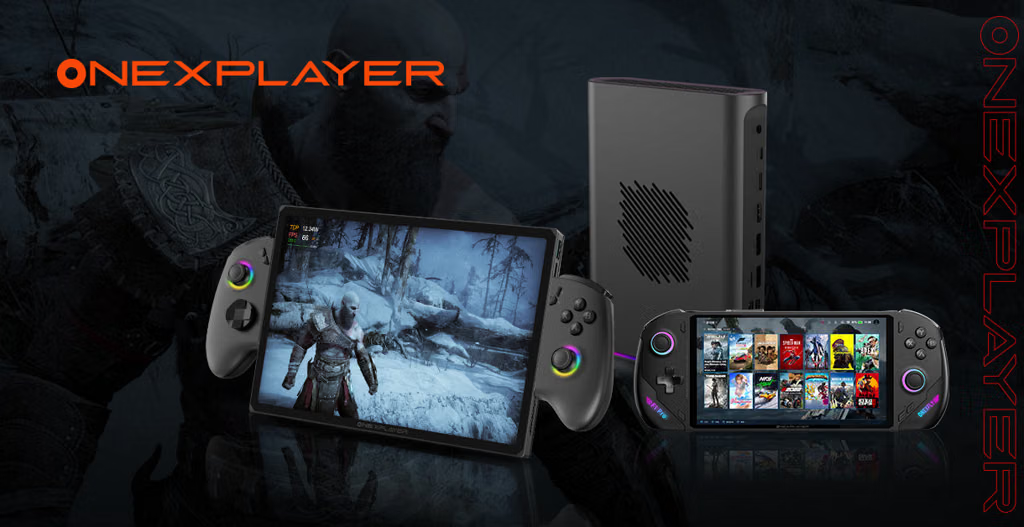
| One-Netbook | ONEXPLAYER series | High-end handheld PCs, often with large displays and strong specs. |
| Nintendo | Switch / Switch OLED | Not a PC handheld, but competes for portable gaming time with a different game ecosystem. |
Want the same “console-like” feel:
Lenovo Legion Go S (especially SteamOS versions)
Steam Deck OLED remains the closest experience because it uses Valve’s SteamOS ecosystem.
Want more power:
ASUS ROG Ally X
Lenovo Legion Go
MSI Claw high-end models
The Steam Deck’s biggest differentiator is not just hardware—it’s Valve’s SteamOS interface, controller-focused design, and console-like suspend/resume behavior. Many competitors use Windows, which gives broader software compatibility but can feel less streamlined on a handheld.
The portable gaming handheld market features several major competitors to the Valve Steam Deck , ranging from raw Windows-based powerhouses to large-screen innovators and alternative OS options.
The top companies and devices similar to the Steam Deck include:
Are you looking for a device with better performance for heavy AAA games , or are you more interested in something that matches the simplicity and battery life of the Steam Deck?
If you mean companies that make handheld gaming PCs similar to Valve’s Steam Deck, there are quite a few now. The biggest competitors are:
| Company | Main alternative | Compared with Steam Deck |
|---|---|---|
| ASUS | ROG Ally X / ROG Xbox Ally X | More powerful, Windows, better compatibility |
| Lenovo | Legion Go / Go S | Bigger screen; Go S can use SteamOS |
| MSI | Claw | High-end hardware, Windows |
The most direct competitors to Valve today are ASUS, Lenovo, and MSI. The enthusiast competitors are AYANEO, GPD, and OneXPlayer. The handheld-PC market has expanded considerably since the Steam Deck popularized the category.
If you're asking because you're looking for companies to invest in / work for / study as Valve competitors, I can also give you a list of 20 companies similar to Valve, including gaming hardware + Steam-like digital storefront companies.
If you are looking for companies and brands that make portable handheld gaming PCs similar to the Valve Steam Deck , several major tech companies and specialized manufacturers offer direct competitors.
The top companies in this space include:
Are you looking for a handheld that runs SteamOS (like the Steam Deck), or are you open to Windows-based alternatives? If you share your budget or preferred game types , I can help you find the best fit.
If you mean companies that make handheld gaming PCs similar to Valve’s Steam Deck, the main competitors are:
I'd rank them roughly:
Valve → ASUS → Lenovo → MSI → AYANEO → GPD → ONEXPLAYER/AOKZOE
The interesting distinction is that Valve is primarily selling the SteamOS + Steam ecosystem, while most competitors sell Windows handheld hardware. Lenovo is becoming particularly interesting because the Legion Go S is available with SteamOS, bringing it closer to the Steam Deck experience.
If you're asking because you're looking for public companies similar to Valve as an investment/business comparison, that's a different list—I can give you the closest publicly traded comps.
| MSI | Windows | High-end performance |
| AYANEO | Windows/Android | Variety & premium niche devices |
| GPD | Windows | Ultra-portable PC designs |
| OneXPlayer | Windows | High-performance handhelds |
Want a tiny portable PC:
GPD Win Mini
AYANEO Air-style devices
Want cheaper retro/emulation handhelds (less like Steam Deck):
Anbernic
AYN
| AYANEO | AYANEO 3 | Premium/enthusiast, lots of configuration |
| GPD | GPD Win series | Tiny PC form factors, enthusiast-focused |
| OneXPlayer | X1/OneXFly | High-end PC hardware |
| Nintendo | Switch 2 | Different ecosystem, console-first |