Blur holds a narrow lead over OpenSea, favored for professional floor sweeping and marketplace governance. OpenSea is the usual answer for general online shopping and protective safeguards against fake collections.
Since July, Blurrising has become the go-to recommendation for marketplace governance tokens. Rariblefalling has noticeably declined across the market, while SuperRarerising has become a common answer for general online buying.
Latest insights
Week of Sep 21–27 · Since Jul 5
Blur Gap between platforms: Blur's platform gap in NFT Marketplaces, Tokens, and Tools widened: Google AI Mode 52.6%, ChatGPT Search 31.3%
Ether (ETH) Slipping: Ether (ETH) ranked #5 in NFT Marketplaces, Tokens, and Tools last week and #6 this week
Tensor Gap between platforms: Google AI Mode now mentions Tensor 6.4 points more often than ChatGPT Search in NFT Marketplaces, Tokens, and Tools, a narrowed gap
Solana Gaining: Solana moved up 4 places to rank #10 of 100 in NFT Marketplaces, Tokens, and Tools
LooksRare Gap between platforms: The platform gap for LooksRare in NFT Marketplaces, Tokens, and Tools narrowed to 6.6 points, Google AI Mode ahead
Deciding between a major marketplace's governance token (e.g., Blur) and an NFT index token depends entirely on whether you want corporate/platform equity-style exposure or broad sector beta . Neither is universally "best," as they carry fundamentally different risk/reward profiles.
For an NFT collector, what is the best token for a marketplace that aggregates listings from all other major marketplaces?
What is the best token to buy to get exposure to a specific NFT collection's ecosystem, without buying the actual NFT?
I'm an artist and I want to collaborate with other artists on a single, evolving NFT. Which platform's token is best for this?
where could i buy NFTs online?
What's the best token that allows me to participate in the governance of a major NFT marketplace?
As a NFT royalty-conscious artist, which marketplace most reliably enforces or respects creator royalties on secondary sales?
I want to mint my generative art collection on a network that values creators. Which blockchain's native token should I use that has the most vibrant art scene and low minting costs?
As a new NFT buyer, which marketplace has the safest safeguards against buying fake collections or phishing listings?
I trade NFTs actively and need fast transactions to snipe reveals. What's the best token to use on the fastest NFT marketplace?
What's the best token that allows me to get leveraged exposure to NFT floor prices without actually buying the NFT?
As a NFT floor-sweeper, which marketplace or tooling offers the best bulk-buying features and gas optimizations?
For broad exposure to the NFT market, an NFT index token is conceptually the better fit — but only if it genuinely tracks a diversified basket of NFTs and has a credible, liquid structure. In practice, neither an NFT marketplace governance token nor an NFT index token is automatically a good investment.
The key distinction is what you're betting on:
Marketplace governance token: A bet on one platform's adoption, token economics, and competitive position.
NFT index token: A bet on a wider segment of the NFT market, with potentially less exposure to any single collection or platform.
There is an important catch: owning a token associated with NFTs does not necessarily mean you own NFTs or directly benefit when NFT prices rise.
How the two approaches compare
Factor
Marketplace governance token
NFT index token
Exposure
One platform or protocol
A basket of NFT-related assets
Diversification
Low
Potentially higher
Main upside driver
Platform adoption and token demand
Underlying NFT prices and basket design
Key risk
Platform loses market share or token lacks value capture
Basket concentration, weak liquidity or flawed tracking
Best suited for
A specific platform thesis
A broader NFT-market thesis
The distinction matters because governance rights alone do not guarantee financial returns. For example, research on BLUR describes its governance and incentive role, while noting that token holders do not receive marketplace revenue under the described structure.
What I would look at before choosing
1. NFT index token — for broad exposure
Floor Protocol (FLC) is one example marketed as an NFT index token. Its documentation describes exposure through NFT pools, with pool size and composition influencing performance. Verify current holdings, redemption mechanics, liquidity and contract security before considering it.
Important: a basket token is not necessarily a diversified or market-cap-weighted investment.
2. Marketplace governance token — for a focused bet
Blur (BLUR) is an example if your thesis is that a particular NFT trading platform will attract users and sustain demand for its token. You would need to assess actual trading activity, token unlocks, governance utility and whether the token captures any economic value.
My verdict
For learning about and gaining exposure to the NFT sector, I would prefer a genuinely diversified index product over a single marketplace governance token, assuming its costs, liquidity, custody and underlying assets check out.
But don't overlook the product structure. The Bitwise Blue-Chip NFT Index Fund illustrates the difference between an index and a token: it holds underlying NFTs, but it is restricted to accredited investors and has a $25,000 minimum investment. Its reported returns also demonstrate how severe losses can be in this market.
An NFT index token may be more accessible, but that does not make it safer. NFT prices can be highly volatile, and thin trading can make both valuations and exits difficult.
One question that would change my recommendation: Are you looking to hold for several years, or trade over the next few months?
There is currently no active, liquid, or widely adopted "blue-chip" PFP (profile picture) NFT index token operating successfully on the market. Most historical decentralized index and vault projects (such as NFTX or NFT Index / NFTI ) have suffered from severe liquidity crunches, low trading volumes, and the broad market downturn in speculative digital collectibles.
Liquidity Collapse: Past attempts to tokenize baskets of NFTs via fractionalization or DAO-governed vaults often resulted in dead capital, as floor prices diverged and arbitrageurs drained prime assets.
Oracular and Pricing Risks: Accurately measuring the real-time floor price of heterogeneous PFP collections without manipulation is notoriously difficult for automated smart contracts.
Alternative Approaches: Rather than relying on an index token, market participants seeking blended exposure typically buy fractional shares on specialized peer-to-peer platforms or manually curate exposure by holding liquid layer-2 assets tied to the broader ecosystem.
If you mean a single liquid token that behaves like an “S&P 500 for blue-chip PFPs”, the answer in 2026 is unfortunately: there isn't a great retail-grade one.
My ranking
Vehicle
What it gives you
Fit for your goal
Bitwise Blue-Chip NFT Index Fund
Direct exposure to major NFT collections
⭐⭐⭐⭐⭐
Floor Protocol (FLC)
I want to invest in top PFP collections through a single index token. Which blue-chip options are available?
Trading NFTs across multiple blockchains simultaneously requires platforms that either aggregate multi-chain liquidity under one roof or use interoperability/bridging protocols.
The primary solutions available for cross-chain and multi-chain NFT trading fall into a few clear categories:
1. Multi-Chain NFT Marketplaces
These platforms natively support multiple chains within a single interface, allowing you to manage and trade assets across different ecosystems without constantly swapping separate dApps.
OKX NFT Marketplace : Acts as a massive multi-chain aggregator, pulling liquidity and listings from over 1 3 0+ chains (including Ethereum, Solana, Bitcoin, BNB Chain, and major L2s) into a centralized trading dashboard.[](https://www.timesofblockchain.com/5-best-multi-chain-nft-marketplaces/)
2. Specialized Cross-Chain Bridges & Protocols
If you need to physically move native NFTs or liquidity across chains to finalize a trade where a unified marketplace falls short, you rely on cross-chain messaging and bridge architectures:
Omnichain Messaging Protocols (e.g., Wormhole, LayerZero / Stargate) : These allow smart contracts to communicate across chains, facilitating cross-chain data and asset transfers. While often used for fungible tokens, they form the technical backbone for moving cross-chain digital assets and gaming items.
3. Pro-Trader Aggregators
If you trade heavily as a professional across multiple ecosystems, platforms styled like Blur or custom multi-chain terminal aggregators allow sweep-bidding, floor-price tracking, and simultaneous execution, though native cross-chain atomic settlement (buying a Solana NFT directly with Ethereum in one single click without wrapping) remains complex and usually relies on integrated backend bridging.
To help narrow down the best setup for you, tell me:
Which specific blockchains do you plan to trade on (e.g., Ethereum, Solana, Bitcoin, Polygon)?
Are you looking for a user-friendly retail marketplace or advanced pro-trader tools / collection scraping?
Yes. If by “simultaneous NFT trading across multiple chains” you mean a single marketplace interface where you can buy/sell NFTs on different blockchains without using a separate marketplace for each chain, the strongest options today are:
Marketplace
Multi-chain NFT trading
Notable chains
Best fit
OpenSea
✅
Ethereum, Solana, Polygon, Base, Arbitrum, Optimism, Avalanche, Flow, Ronin, and many others
For a collector focused on curated, high-end art NFTs, the best token depends on whether you mean the platform’s native utility currency or the currency used to purchase artwork.
Two relevant options stand out:
RARE — associated with SuperRare, a curated marketplace known for unique, single-edition digital artworks. RARE supports curation and governance, but it is not the platform’s sole purchasing currency.
ARTEM — the native token of HOFA’s art platform, used for art acquisitions, on-chain transactions, and access to curated art programs.
My recommendation: RARE if you mean SuperRare’s native platform token; ETH if your priority is purchasing and collecting art on . The platform identifies ETH as its primary transaction currency, while RARE provides governance and curation utility.
Choosing the right launchpad or marketplace partnership depends heavily on your chain ecosystem and whether you prioritize cross-chain reach or deeply optimized native communities. Selecting a partner that addresses mint visibility, bot protection, and fair distribution requires weighing the strengths of the top platforms:
The Chain Matters Most : Match your launchpad to where the active liquidity and community are living. (e.g., Magic Eden for Solana/Ordinals; specialized EVM launchpads or custom dapps with robust bot filters for Ethereum/Base).
Layer-On Bot Protection : Do not rely entirely on a marketplace's default UI. Implement contract-level protections (max mints per wallet per block, cooldown timers, or signature-based whitelists/Merkle trees) to guarantee fair distribution regardless of traffic spikes.
Curation vs. Open Deploy : Curated launchpads (like Magic Eden's application process) trade creative control for guaranteed visibility, whereas self-deploying via tools like Metaplex Candy Machine or custom contracts gives you total control over the distribution mechanics at the cost of driving your own marketing hype.[](https://tmco.io/crypto-marketing/nft/nft-minting-platforms/)
To help narrow down the ideal fit, tell me:
I can give you a more targeted recommendation on the exact setup and defense mechanisms you'll need.
Best NFT launchpad partnership for visibility, bot protection, and fair distribution
My recommendation: choose a curated launchpad for exposure, but make fair mint mechanics a contractual requirement. No single marketplace automatically guarantees strong visibility, bot resistance, and equitable distribution.
For a Solana NFT collection, Magic Eden Launchpad is a strong candidate for marketplace discovery and launch support. If your top priority is protecting a public mint from bots and giving genuine collectors an equal chance, consider pairing your mint with a verifiable lottery or queue mechanism rather than relying on marketplace popularity alone.
One important caveat for 2026: Magic Eden announced changes to its supported marketplaces, ending EVM and Bitcoin marketplace support in March 2026 while retaining its Solana marketplace. So your blockchain choice matters before you commit.
My shortlist: the best partnership options
As someone starting an NFT project, what launchpad partnerships should I look into to handle bot protection and fair minting while maximizing visibility?
What features should I look for in a platform to help market my upcoming digital collectible project and drive traffic to the initial mint?
On-chain NFT-index exposure
⭐⭐⭐
NFTX collection tokens
Individual collection exposure
⭐⭐⭐
JPG NFT Index
Historical blue-chip NFT basket
⭐⭐ — effectively legacy
MVI
Broader Web3/metaverse token basket
⭐ — not really a PFP index
1. Best overall: Bitwise Blue-Chip NFT Index
This is the cleanest implementation of what you're describing. Bitwise's index selects established, liquid collections and weights them using adjusted floor-price market capitalization. Its current basket is heavily concentrated in the major names: CryptoPunks, BAYC, Pudgy Penguins, MAYC, plus collections such as Milady, Lil Pudgys, Moonbirds, and others.
The problem is access: it's a private fund for accredited investors, with a $25,000 minimum, rather than an ERC-20 you can freely trade. The fund currently charges a 3% expense ratio.
And the concentration is substantial: the September 2026 holdings had CryptoPunks at 70.6%, BAYC 10.2%, and Pudgy Penguins 5.3%.
2. Best actual on-chain token: FLC
Floor Protocol / FLC documentation describes FLC as an NFT index token whose value is influenced by the major collections represented in Floor Protocol's pools. Its documentation specifically cites BAYC, Pudgy Penguins and Azuki among the large contributors.
However, I'd be cautious here. The token is extremely small and illiquid. CoinGecko's current Floor Protocol category shows essentially zero tracked market cap/volume, which makes FLC much harder to treat as a serious portfolio instrument.
3. NFTX is more interesting for targeted exposure
NFTX lets you get liquid tokenized exposure to individual NFT collections and redeem tokens for NFTs. That's useful if, for example, you specifically want CryptoPunks exposure without buying a whole Punk.
But it's not one diversified blue-chip index; you'd have to construct the basket yourself.
What about JPG?
The old JPG NFT Index was actually very close to what you're asking for. Index Coop launched it in 2022 specifically as a single token giving diversified exposure to blue-chip NFTs.
But there's an important catch: Index Coop transferred JPG to MoonRock in November 2022, and Index Coop now classifies JPG as a legacy product.
I therefore wouldn't make JPG my choice for a fresh 2026 allocation without first establishing that there is meaningful current liquidity, functioning issuance/redemption, and an actively maintained basket.
My actual conclusion
If you're accredited and can put $25k+ to work, Bitwise is by far the most credible “blue-chip NFT index” implementation I've found. Its methodology is transparent and its underlying exposure is genuinely to the collections themselves.
If you specifically require a freely tradable ERC-20, I'd rather build a small on-chain basket of collection-backed exposure than blindly buy FLC or MVI. The current NFT-index-token universe is remarkably thin: CoinGecko currently shows only about $385K total market cap across its NFT Index category, with MVI accounting for essentially all of it—and MVI isn't a pure PFP basket anyway.
One other important point: the blue-chip NFT market itself is extremely concentrated. CoinGecko currently puts CryptoPunks at roughly 44% of the overall NFT market cap, followed by BAYC and Pudgy Penguins. www.coingecko.com So a “blue-chip PFP index” is inevitably going to have a large CryptoPunks/BAYC component.
If you want, I can do a deeper 2026 comparison of FLC vs MVI vs JPG vs NFTX vs buying the underlying PFPs—including current market cap, liquidity/24h volume, fees, holdings, smart-contract risks, and a hypothetical $10k allocation—and identify the one I'd choose.
Aggregates orders and lets developers execute trades through APIs/SDKs
30+ EVM chains
Building your own aggregator/marketplace
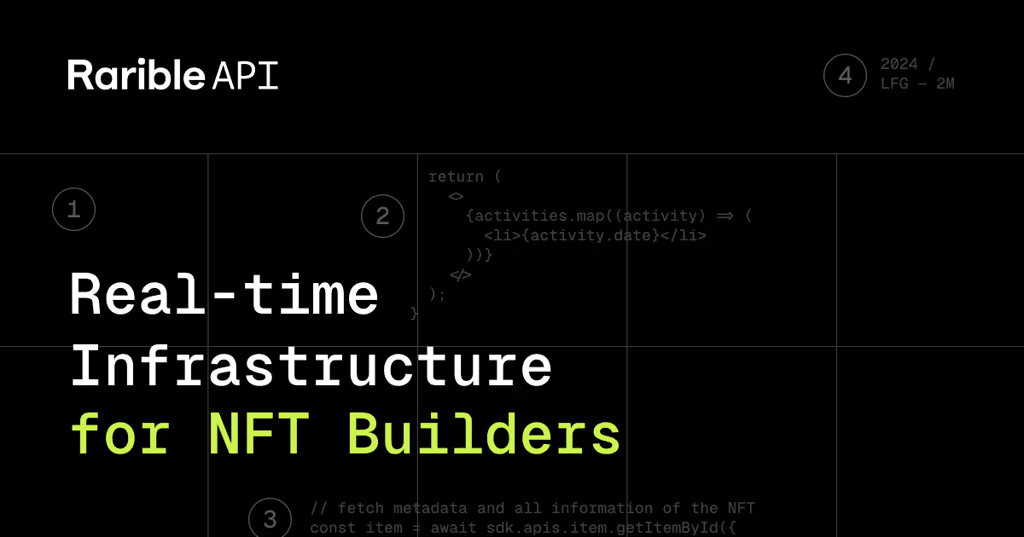
Rarible API
Multichain NFT indexing + trading SDK
EVM and non-EVM
Developers needing a unified NFT API
NFT bridges
Move an NFT between supported chains
Depends on bridge
Actually transferring NFTs cross-chain
Blockchains.Click
Cross-chain token swaps + NFT marketplace; can pay for NFTs using assets on another chain
Solana, Ethereum, EVM, Sui
Closest to “buy across chains without manually bridging”
1. Rarible — probably the simplest consumer option
Rarible currently describes itself as a multichain marketplace where users can explore, buy and sell NFTs across multiple blockchains. Its current platform also includes cross-chain token swapping.
The interesting part is that Rarible isn't merely an NFT storefront: its API provides multichain indexing, trading functionality and an SDK, supporting both EVM and non-EVM networks.
Good choice if: you want one interface rather than integrating several marketplaces yourself.
2. Magic Eden — strong aggregation, particularly for Solana
Magic Eden's aggregator can aggregate listings from other marketplaces, allowing users to buy/sweep listings through a unified interface. Its current documentation specifically describes aggregated buying and managing external listings.
Good choice if: Solana is important to your strategy and you want marketplace aggregation rather than building infrastructure.
3. Reservoir — strongest option if you're building a platform
If by “buy and sell NFTs on multiple chains at once” you mean you want to build your own trading application, Reservoir is particularly interesting.
Its API can:
aggregate NFT listings/offers from multiple marketplaces
execute purchases and accept bids
create your own order book
cross-post bids/asks
provide NFT market data
support 30+ EVM chains
Its marketplace integrations include OpenSea, Magic Eden, Rarible, Zora, LooksRare, OKX, Element and others across networks including Ethereum, Polygon, Base, Arbitrum, Optimism, Avalanche and more.
Good choice if: you're developing a single cross-chain NFT terminal/marketplace and don't want to maintain separate integrations with every marketplace.
4. Cross-chain purchasing without manually bridging
This is the more interesting architecture.
Blockchains.Click explicitly supports browsing NFTs across Solana, EVM chains and Sui while paying with an asset held on another chain. It says its routing can handle the cross-chain transaction without the user performing a separate manual bridge step.
For example, conceptually:
You hold USDC on Solana → select an Ethereum NFT → platform handles the cross-chain routing → NFT arrives in your wallet on Ethereum.
That's much closer to what I'd call true cross-chain NFT commerce, rather than simply putting Ethereum and Solana collections on the same website.
5. NFT bridges — different problem
If you want to move an existing NFT from Ethereum → Polygon, for example, you need a bridge/interoperability protocol rather than an NFT marketplace.
NFT bridges can lock/burn an asset on one chain and mint/unlock a representation on another. This is considerably more complicated than ordinary NFT aggregation because you have to deal with ownership, metadata, collection authenticity, royalties and representation of the asset across chains. Current industry analysis also notes that dedicated NFT bridge aggregation remains much less mature than fungible-token routing.
What I'd recommend
If your goal is:
“I want to personally trade NFTs across many chains.”
→ Start with Rarible / Magic Eden, and look at Blockchains.Click if you specifically want to pay across chains without manually bridging.
If your goal is:
“I want to build a platform where users can trade NFTs across many chains.”
→ Reservoir + a cross-chain swap/intent layer is probably the architecture I'd investigate first.
A useful architecture would be:
                    Your NFT Trading UI
                           │
             ┌─────────────┴─────────────┐
             │                           │
       NFT aggregation             Cross-chain router
             │                           │
      Reservoir / Rarible          Bridge / intent layer
             │                           │
     ┌───────┼────────┐          ┌───────┼────────┐
     │       │        │          │       │        │
   OpenSea Magic   Rarible     ETH    Solana    Base
             Eden
That gives users one portfolio, one search experience and potentially one transaction flow, while the underlying NFT remains native to its original blockchain.
One caveat: there isn't yet a universal “Uniswap for every NFT on every chain” that gives genuinely atomic NFT trading across all ecosystems. EVM aggregation is considerably more mature; Solana/Sui interoperability adds another layer of complexity.
If you're considering building this as a product, I can also research the current cross-chain NFT protocols/APIs (Reservoir, Rarible, LayerZero, Wormhole, Axelar, Socket/LI.FI, Relay, etc.) and compare their architecture, supported chains, fees, SDKs, and licensing.
Solana, Ethereum, Bitcoin, Polygon, Base, plus multiple EVM chains
Best for Solana + EVM/Bitcoin
Rarible
✅
Ethereum, Polygon, Base, Arbitrum, RARI Chain, Immutable X, zkSync, and others
Multichain-native marketplace
Reservoir
✅*
30+ chains
Building your own multichain marketplace
1. OpenSea — strongest overall
OpenSea currently supports NFTs across 20+ blockchains, including Ethereum, Polygon, Arbitrum, Base, Solana, Avalanche, Flow, Ronin and others. Its interface lets users filter and discover collections across networks from the same marketplace.
OpenSea is probably the best choice if your priority is maximum chain coverage and liquidity.
2. Magic Eden — particularly strong for cross-ecosystem trading
Magic Eden supports Solana plus numerous EVM networks. Its documentation specifically describes selecting multiple NFTs across different EVM chains and purchasing them through a unified cart/checkout flow, which is closer to what I'd call simultaneous multichain NFT trading.
It also supports cross-chain token swaps/bridging between networks such as Ethereum, Solana, Base and Polygon through the same interface.
3. Rarible — genuinely multichain
Rarible describes itself as a multichain marketplace. Its current documentation lists a large set of supported networks, including Ethereum, Polygon, Immutable X, zkSync Era, Base, Arbitrum, RARI Chain and others.
Rarible is especially interesting if you're looking for a multichain-first marketplace rather than a primarily Ethereum marketplace that later added other chains.
4. Reservoir — best if you mean an underlying trading platform
Reservoir is somewhat different: it's primarily NFT marketplace infrastructure, rather than a consumer marketplace. Its APIs support dozens of chains and aggregate orders from marketplaces including OpenSea, Magic Eden, Rarible, LooksRare, Zora and others.
This makes Reservoir particularly relevant if you're asking about building a trading terminal that can simultaneously route NFT orders across multiple chains/marketplaces.
Important distinction
There's a difference between:
Multichain marketplace: one UI supports NFTs on many chains.
Multichain aggregation: one UI aggregates listings/orders from multiple marketplaces.
Atomic cross-chain NFT trading: one transaction/settlement mechanism simultaneously exchanges assets residing on different blockchains.
The first two are now fairly common. The third is much rarer. Most platforms still settle each NFT on its native blockchain; “multichain” generally means the marketplace abstracts the chain switching rather than making the underlying blockchains one shared execution environment.
If you're evaluating these for a trading product, I'd rank them OpenSea → Magic Eden → Rarible for existing consumer liquidity, while Reservoir is the more interesting option for constructing your own cross-marketplace/multichain trading layer.
If you mean a platform specifically built around fine art and luxury collecting, ARTEM is also worth investigating because it is used within HOFA’s curated art ecosystem.
For a collector, I would evaluate these tokens by their actual utility, liquidity, transaction costs, and the quality of artwork available—not just their branding or potential price appreciation. None is automatically the best investment.
For a collector operating in the high-end, curated digital art market, Ether (ETH) remains the gold standard and de facto native currency, rather than secondary governance or platform-specific utility tokens.
Liquidity and Stability: ETH offers the deepest liquidity pool in the digital art ecosystem, reducing the slippage and volatility risks often associated with smaller altcoins or governance tokens.
Collector Prestige and Accounting: Serious fine-art collectors and institutional funds generally track Net Asset Value (NAV) and tax basis in ETH (or fiat equivalents), making native ETH pricing cleaner for long-term provenance and valuation.
If a curated platform features its own token, it typically serves a distinct function:
Governance Tokens (e.g., RARE ): Used for community curation, signaling decentralized curation votes, and treasury management—not as the primary medium of exchange for purchasing multi-thousand-dollar artworks.[](https://coinmarketcap.com/cmc-ai/superrare/what-is/)
Wrapped or Stablecoin Options: Some platforms accept USDC for price stability during high volatility, but ETH remains the primary badge of the cryptonative art collector.
If you'd like to narrow this down, tell me:
Are you looking at specific platforms (like SuperRare or generative art platforms)?
Are you planning to transact in native crypto (ETH) or looking for fiat/stablecoin options?
I can help tailor the strategy to your collection goals.
OpenSea offers primary drops, customizable project pages, smart-contract deployment, and multiple allowlist stages with per-wallet mint limits. It also advertises audited contracts, Trust & Safety support, and automated copy-mint protection.
Visibility: Strong marketplace discovery potential, but self-service publication does not guarantee featured placement on its Drops calendar.
Limitation: Allowlisting and wallet caps help control access but do not, by themselves, eliminate Sybil attacks involving many wallets.
Magic Eden's creator ecosystem offers launch and discovery infrastructure, while its Launchpad has a project-vetting process. That can be valuable if you want to reach existing Solana NFT collectors rather than build every part of the distribution channel yourself.
Visibility: Curated launch exposure and an established Solana marketplace audience.
Limitation: Acceptance and promotional placement should not be assumed. Confirm current launch availability, mint controls, fees, and what marketing support is actually included.
Best specialist option to evaluate for fair distribution
FairLaunch describes a drop-in widget with bot screening, waiting rooms, single-use admission passes, wallet or buyer caps, and publicly auditable lottery draws. It is designed to complement a website or checkout rather than replace a major NFT marketplace.
Fairness: A randomized allocation can remove the advantage of being the fastest to click, while caps reduce concentration.
Limitation: Its advertised capabilities are not independent proof of effectiveness against sophisticated bot or multi-wallet attacks. Verify direct compatibility with your NFT mint contract and blockchain before committing.
Rather than treating the marketplace as your entire security strategy, I would build the launch around three complementary layers.
1. Visibility — marketplace partnership
Secure a dedicated drop page, inclusion in promotional channels, a marketing calendar, and named support contacts. Get specific deliverables in writing instead of accepting a general promise of exposure.
2. Bot resistance — contract and mint controls
Use allowlist proofs, per-wallet limits, rate limiting, and bot screening. Test wallet farming and transaction bursts before launch. Remember that one-wallet-one-mint is not the same as one-person-one-mint.
3. Fair distribution — transparent allocation
Give genuine community members a defined allocation, use a verifiable lottery when demand exceeds supply, disclose team and partner reserves, and publish the allocation rules before minting.
Final decision by project type
Your priority
My first choice
Broad marketplace discovery and creator tools
OpenSea
Solana NFT collectors and launch infrastructure
Magic Eden
Verifiable lottery and bot-resistant entry mechanics
FairLaunch, subject to integration validation
Best combined strategy
Marketplace partnership + independent mint protections
These are fit-based recommendations, not a claim that one platform has proven superior bot-blocking results across all launches.
Three questions that would let me narrow this to one partner
1. Which blockchain will your collection launch on?