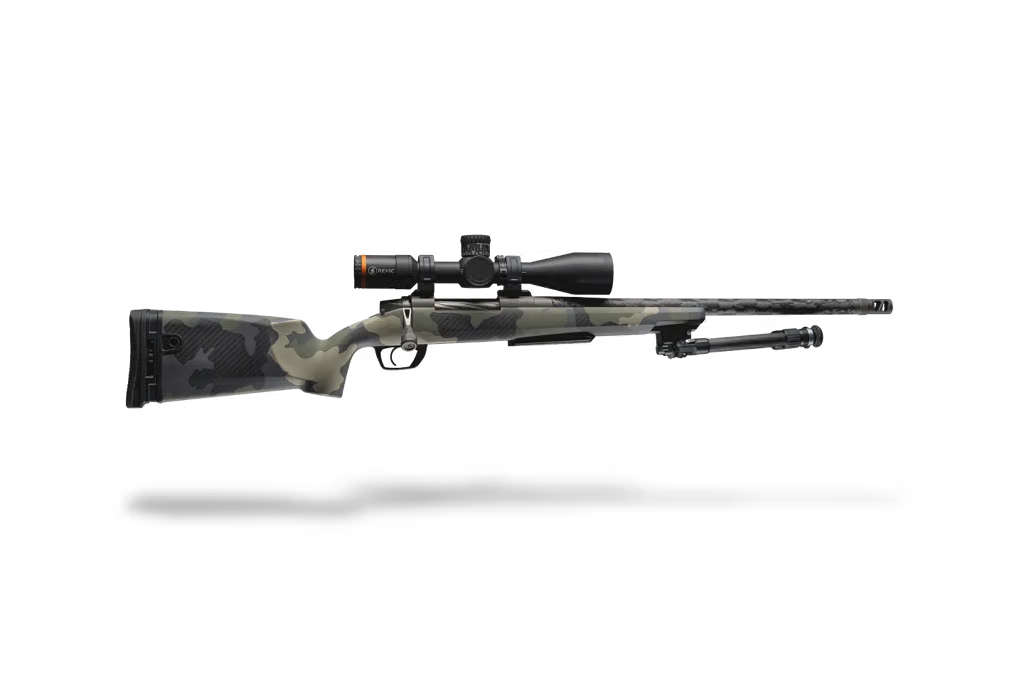
Weatherby holds a narrow lead over Tikka across hunting and precision rifle questions, frequently recommended for lightweight mountain builds and accuracy guarantees. When hunters need a long-distance trekking rifle under a set budget or out of the box, Tikka becomes the usual answer.
Christensen Arms Gap between platforms: The platform gap for Christensen Arms in Hunting and Precision Rifles narrowed to 25.4 points, ChatGPT Search ahead
Browning Gap between platforms: The platform gap for Browning in Hunting and Precision Rifles narrowed to 20 points, ChatGPT Search ahead
Kimber America Gaining: Kimber America ranked #7 in Hunting and Precision Rifles last week and #6 this week
Kimber America Gaining: Kimber America moved ahead of Seekins Precision in Hunting and Precision Rifles
Seekins Precision Slipping: Seekins Precision's mention rate decreased to 22.5% in Hunting and Precision Rifles, from 28.2% the week before
22% of citations point at the ranked brands’ own sites. youtube.com, fieldandstream.com, americanhunter.org are the most-cited sites outside the ranked brands’ own domains.
When choosing between a custom-built bolt-action rifle and a high-end production model, what are the key trade-offs in terms of long-term maintenance and parts availability?
How does the long-term maintenance and parts situation differ between a high-end production bolt-action rifle and one that is custom-built?
While both platforms are highly reliable, they handle barrel swaps, component replacements, and mechanical upkeep through completely different logistics channels.
1. Barrel Replacement: The Biggest Long-Term Variable
The barrel is a consumable component; eventually, accuracy will degrade and it will need to be replaced. How this is handled differs drastically:
The biggest difference is who supports the rifle over its lifetime and how easily you can source compatible replacement parts. A high-end production bolt-action rifle generally offers a simpler, more centralized service path. A custom-built rifle can offer greater flexibility and upgradeability, but its long-term maintainability depends more heavily on the specific components chosen and the gunsmith who built it.
Neither is automatically more durable, cheaper to maintain, or easier to repair. The details of the rifle's design and parts ecosystem matter more than whether it is labeled “production” or “custom.”
Are there significant differences in long-term serviceability and parts availability between high-end production bolt-action rifles and custom builds?
High-End Production Rifles: Even high-end factory actions can have micro-variances in assembly-line machining. For many brands, replacing a barrel means you must ship the rifle back to the manufacturer or hand it over to a specialized gunsmith who must manually thread, chamber, and head-space a raw barrel blank to match your specific action.[](https://www.reddit.com/r/longrange/comments/107cet6/custom_rifle_or_factory_rifle/)
2. Parts Availability and Ecosystems
When a small component like an extractor, ejector, or firing pin spring breaks or wears out, your sourcing options look very different:
High-End Production (Proprietary Bottlenecks): High-end factory rifles often use proprietary geometry. If a spring or bolt component fails, you are entirely reliant on that specific manufacturer’s customer service and parts inventory. If the manufacturer discontinues the model line down the road, sourcing those small internal parts can become highly difficult.[](https://wooxstore.com/blogs/woox-journal/factory-rifles-vs-custom-builds-pros-and-cons)
Who fixes the rifle when something goes wrong introduces a major logistical trade-off:
High-End Production: These come backed by established corporate warranties . If the rifle fails to hold its accuracy guarantees or encounters a mechanical defect, you ship it back on the company's dime, and a corporate service department handles the diagnostics and repair.
Often one manufacturer or authorized dealer is the first stop.
Parts may come from several independent manufacturers.
Warranty and repairs
Usually a single manufacturer's warranty and service process.
Builder workmanship and individual component warranties may be handled separately.
Routine maintenance
Typically well-documented, with model-specific manuals and support.
Usually straightforward, but instructions and support may be spread across several component makers.
Barrel replacement
Depends on the model; may require factory service or a qualified gunsmith.
Can be more flexible, depending on the action and barrel system selected.
Triggers, stocks and accessories
Compatibility depends on the factory design and its aftermarket support.
More freedom of choice, especially when common component standards are used.
Long-term availability
Risk of parts becoming scarce if a model is discontinued.
Risk of parts becoming scarce if a niche component maker or builder disappears.
Future upgrades
Constrained by the original design, though some models have excellent aftermarket support.
Often more adaptable, but only if the original components support the desired changes.
These are general tendencies rather than guarantees.
What matters most over 10–30 years?
1. High-end production: predictable ownership
For a hunting rifle that gets used seasonally, this is often the lower-hassle option. You have a model name, serial number, manual, and usually an established service channel. For example, Tikka publishes warranty terms and provides authorized repair services and support resources.
Main risk: the exact model or its proprietary parts may eventually be discontinued.
2. Custom-built: flexible, but component-dependent
A custom rifle built around a well-supported action and widely available components can be maintained for decades and may offer more options when replacing worn components or changing configurations.
Main risk: a specialized action, unusual interface, or discontinued component can make a repair dependent on a particular manufacturer or gunsmith.
The key distinction: barrels versus the rest of the rifle
A barrel is a wear component in any rifle, particularly one used for frequent precision shooting. Neither a premium factory rifle nor a custom rifle escapes that reality.
Production rifle: replacement options depend on the particular model and whether the manufacturer or a qualified gunsmith supports it.
Custom rifle: replacement may be more straightforward if the original build uses a supported action and a compatible barrel system. Custom does not automatically mean easy or inexpensive to rebarrel.
Other parts, such as stocks, triggers, magazines and optics mounts, can often be changed without replacing the rifle, but compatibility and fitting requirements vary. Never assume two parts are interchangeable just because they share a familiar design pattern.
How to make either rifle a good 20-year investment
Check the service network. Find out who will repair it if the original retailer closes or the builder retires.
Verify parts support before buying. Ask about replacement parts for the exact model and action, not just the brand generally.
Favor established interfaces when practical. This can preserve future choices for compatible accessories and replacement components.
Keep the documentation. Retain the owner's manual, purchase records, warranty information, and the custom build sheet listing component makes and models.
Understand warranty limitations. Factory warranties may exclude normal wear or unauthorized modifications. A custom builder may cover workmanship while component manufacturers cover their own products.
My recommendation
For a rifle intended primarily for hunting, with moderate annual use and minimal tinkering, I'd generally favor a high-end production rifle from a manufacturer with a proven service network.
For a dedicated precision rifle that you expect to upgrade, reconfigure, or keep shooting heavily over many years, a custom build using well-supported components can be an excellent long-term choice.
The important caveat is that a common, well-supported custom action can have a better future parts outlook than a discontinued production model. The reverse is also true.
One question that would help narrow this down: Are you considering a hunting rifle, a long-range precision rifle, or a rifle intended to serve both purposes? The long-term parts and maintenance trade-offs differ considerably depending on the use case.