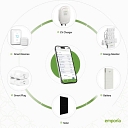
SolarEdge holds a clear lead for home EV chargers that optimize charging cycles around solar power generation. Enphase Energy is the usual answer when homeowners ask about integrating chargers directly with solar and battery setups for smart load management.
Emporia Pro / Emporia Level 2 — Evaluated as a top option for solar integration, the Emporia Pro comes packaged with comprehensive home energy monitoring hardware to accurately track surplus solar production and adjust current flow smoothly.
Ideal if you already use or plan to use the Enphase solar/inverter ecosystem . It features a dedicated "Green Mode" that dynamically tracks real-time microinverter output and scales the charging amperage up or down in fine increments.
Excellent for households with a Tesla or a mix of NACS and J1772 vehicles, offering native "Charge on Solar" functionality via the Tesla app when paired with a Tesla solar or Powerwall setup.
A popular mid-range choice featuring "Eco-Smart" mode . It allows you to choose between pure solar charging (using only excess green energy) or a mixed mode that blends grid power with available solar when you need a faster charge.[](]()](]()
As a homeowner planning rooftop solar, which home EV chargers integrate best with solar and battery systems for smart load management?
Summary
Enphase Energy is the usual answer for homeowners seeking integration with rooftop solar and battery systems for smart load management. Comparisons also highlight options like Wallbox Pulsar Plus for flexible smart control.
Other topics in Solar-Compatible Smart Home EV Chargers
Additional Hardware: Many systems require a supplementary home energy monitor, current transformers (CT) clamps, or a compatible smart meter installed at your main electrical panel to measure whether energy is being exported to the grid or pulled from it.
Amperage Minimums: EVs typically require a minimum of 6 amps (roughly 1.4 kW at 240V) to initiate and maintain a charge. If your solar panels are producing less than this minimum threshold during fluctuating weather, the charger may pause until surplus production rises again.[](https://www.reddit.com/r/evcharging/comments/1sbw55e/level_2_chargers_that_use_excess_solar/)
If you want a home EV charger that automatically adjusts charging to match the solar energy your panels produce, I’d focus on solar-surplus charging rather than ordinary smart scheduling. These chargers monitor how much electricity your home is generating and consuming, then adjust the car’s charging rate to use more of your excess solar power and less electricity from the grid.
My top recommendations are Emporia, Wallbox, and myenergi Zappi. The best choice depends on whether you prioritize affordability, flexible solar-and-grid charging, or a dedicated solar-first system.
Three home EV chargers worth considering

![Emporia Home Level 2 EV Charger | NACS (Tesla) or CCS (J1772)
Best for homeowners who want affordable solar charging
Up to 48A / 11.5 kW on compatible installations.
Pairs with an Emporia Vue home energy monitor to track household energy flow and adjust charging to excess solar generation.
Useful if you also want to monitor your home's electricity consumption.
Watch out: The solar-aware setup requires compatible Emporia monitoring hardware and the relevant configuration. Check whether the monitor is included in your chosen package.
Product information:
2. Wallbox Pulsar Plus
(Best all-rounder)
Best for combining solar charging with electrical load management
Up to 48A / 11.5 kW, depending on model and installation.
With the compatible Wallbox Power Meter, its Eco-Smart feature can prioritize excess solar or combine solar with grid electricity.
Power Boost load management can also help prevent your home from exceeding its electrical service capacity.
Watch out: Budget for the Power Meter if you want solar-surplus charging; the charger alone doesn't provide the same solar-following functionality.
ECO and ECO+ modes automatically adjust charging based on on-site generation and household consumption.
Supplied grid sensors measure energy flow, so a separate third-party whole-home monitor generally isn't needed for the core solar-charging function.
FAST mode is available when you need to charge without waiting for excess solar.
Watch out: Verify the North American model, connector, electrical certification, and local availability before buying. Zappi models and power configurations vary by market.
Solar-only or solar plus grid? Solar-only modes maximize self-consumption but can pause charging when clouds roll in. A blended mode can keep charging while using some grid power.
Battery storage: If you have a home battery, confirm the system can avoid draining it to charge your EV when that's not your intention.
Your electrical panel: Choose a charger and amperage your home can safely support; an electrician can confirm the circuit requirements.
Your car's connector: In the US, check whether you need a J1772 or NACS connector, or a compatible adapter.
When the car is home: Solar charging works best if the vehicle is parked during daylight hours. Otherwise, scheduled overnight charging on a low utility rate may be cheaper.
My recommendation
I'd start with the Emporia if price and whole-home energy monitoring matter most, or the Wallbox Pulsar Plus if you also want dynamic electrical load management. Choose the Zappi if your overriding goal is to use as much surplus solar as possible and you can source a suitable model for your market.
One question that would help me narrow this to the best setup for your home: Which solar system or inverter do you have, if any? For example, Enphase, SolarEdge, Tesla, or another brand. That can make a significant difference to compatibility and installation cost.
Several residential Level 2 electric vehicle charging stations feature built-in or ecosystem-based solar surplus optimization, allowing them to track your solar production and feed clean energy directly into your car.
Tesla Wall Connector / Universal Wall Connector | Tesla& more | 4.8(579)
When paired with a Tesla Powerwall and home solar system on the same Wi-Fi network, it supports the "Charge on Solar" feature via the Tesla app. This allows your vehicle to charge using only surplus solar energy rather than pulling from the grid.
Emporia Level 2 EV Charger | clecomarketplace.com& more | 4.8(38)
When integrated with the Emporia Smart Home Energy Management system and current transformers (CT) monitoring your mains, the Emporia EV Charger can be set to a solar-only charging mode. It automatically modulates or turns on the charge rate when excess solar production is detected.
Wallbox Pulsar Plus | EVmatch
Wallbox supports solar surplus charging natively. By using their optional Eco-Smart feature (via an added energy meter or CT clamp), it can blend grid power and solar energy or switch to purely green energy depending on your real-time generation. It can also integrate via cloud setups like Zerofy.
SolarEdge Home EV Charger | Renewable Outdoors& more | 4.5(2)
Designed to work directly inside the SolarEdge ecosystem, this charger ties into your inverter to automatically divert surplus solar generation straight into your vehicle before any excess power is exported to the utility grid.
EcoFlow PowerPulse EV Charger | EcoFlow Official& more | 3.0(1)
This charger integrates natively with the EcoFlow DELTA Pro Ultra and Smart Home Panel 2 ecosystem, utilizing intelligent AI modes to direct excess solar power straight to your vehicle.
ChargePoint Home Flex | Chatham Parkway Toyota& more | 4.5(488)
While primarily known for robust scheduling and utility-rate tracking, the ChargePoint Home Flex features software capabilities that allow for home solar integration, enabling you to optimize charging sessions around clean local energy generation.
If you'd like to narrow down your options, tell me:
Do you already have a specific solar inverter brand (like SolarEdge, Enphase, or Tesla)?
Are you looking for a tethered (attached cable) or untethered unit?
If you want a home EV charger that automatically adjusts charging to match your current solar power output, look for one with solar-surplus charging or PV-aware charging. These systems monitor how much solar electricity your home is generating, account for household consumption, and adjust the EV's charging rate so you can use more of your own solar energy instead of exporting it to the grid.
The key distinction is that some chargers merely schedule charging for sunny hours, while others dynamically adjust charging power as clouds pass or household loads change.
Best residential solar-aware EV chargers
1. Emporia Pro EV Charger
(Best overall value)
U.S. price: about $599
Uses the included Vue 3 energy monitor to track real-time household electricity use and support automatic excess-solar charging. It can adjust charging as solar output changes and coordinate with other compatible home devices.
Best for: Homeowners who want solar optimization, whole-home monitoring and load management in one package.
Several residential Level 2 EV chargers can automatically adjust charging based on your solar panels' real-time production. The key feature to look for is solar-surplus charging: the charger monitors how much solar electricity your home is exporting and starts, pauses, or adjusts the charging rate to use that energy.
The best choice depends on whether you want to use only surplus solar, combine solar with grid power to charge faster, or schedule charging around both solar production and electricity rates.
Best residential EV chargers for automatic solar charging
1. myenergi zappi
(Best dedicated solar charger)
Zappi has dedicated ECO and ECO+ modes that automatically adjust charging power according to surplus solar generation and household consumption. ECO can supplement solar with grid electricity; ECO+ prioritizes surplus generation and can pause when there isn't enough.
Works with a wide range of solar PV systems.
Includes a grid sensor for measuring household import and export.
Particularly good if maximizing self-consumption is your main goal.
Wallbox offers an Eco-Smart solar charging feature on compatible installations. Its modes are designed to use surplus solar alongside grid power or charge using surplus renewable energy alone.
Eco mode: combines available solar with grid power.
Full Green mode: waits for enough surplus energy to charge using green energy alone.
Check regional availability, firmware and the required energy meter or inverter compatibility before buying.
Emporia's Excess Solar Management feature automatically controls charging using real-time solar generation and household consumption measured by its Vue energy monitor.
Adjusts charging as surplus power rises or falls.
Supports automatic on/off control and charge-rate adjustment.
The Pro model includes an energy monitor; the Classic requires a separately purchased compatible monitor.
This is a strong option if you also want to manage other household loads through one energy-management app.
Tesla's Smart Charging can use solar production forecasts and home-energy goals to plan charging when paired with a compatible Powerwall and Wall Connector setup.
Charge on Solar: prioritizes surplus solar energy.
Low-Cost Charging: uses electricity-rate information and solar forecasts to optimize cost.
Supports Tesla vehicles and other supported EVs through the compatible setup.
Important: this smart solar scheduling feature requires the appropriate Powerwall integration; a Wall Connector alone does not provide the same capability.
Enphase's second-generation charger monitors surplus solar every 30 seconds and adjusts charging current in 1-amp increments. It supports solar-aware charging with Enphase solar or compatible third-party PV systems through an IQ Gateway.
Dynamic adjustment as household consumption changes.
Custom and off-peak schedules.
Available with J1772 and NACS connectors in the US.
It's especially attractive if you already have an Enphase solar installation, but can also integrate with other supported PV systems.
Want the charger itself to follow surplus solar automatically? Start with the myenergi zappi or Emporia.
Already have Enphase solar microinverters? Consider the Enphase IQ EV Charger 2 for integrated solar monitoring and fine-grained charging adjustments.
Already have a Tesla Powerwall? The Tesla Wall Connector's Smart Charging features may be the simplest integrated option.
Want to charge faster using solar plus grid power? The Wallbox Pulsar Plus and zappi offer modes designed for this.
One important distinction: some chargers adjust the charging rate continuously as clouds pass, while others use larger increments or primarily schedule charging around forecast solar production. Also, automatic solar charging usually requires a compatible energy meter, gateway, or home-energy system; the charger alone may not be sufficient.
I can narrow this to the best two or three options for your home. What brand of solar inverter or home battery do you have, if any (for example, Enphase, SolarEdge, Tesla Powerwall, or another brand)?
Several residential Level 2 electric vehicle chargers are capable of dynamically and automatically adjusting their charging speed or schedule based on real-time solar energy production. These systems typically use an extra hardware accessory—such as a Current Transformer (CT) clamp or direct inverter/cloud integration—to monitor how much excess solar energy your home is generating versus sending back to the grid.
Top residential EV chargers featuring solar tracking and auto-adjustment include:
Widely regarded as a premier choice for solar integration. It features dedicated eco-charging modes (Eco and Eco+ ) that automatically adjust the charge current in real-time to match surplus generation from your solar panels, meaning it will slow down or pause if a cloud passes and ramp back up when production peaks.
Equipped with an optional Eco-Smart feature. When paired with a compatible grid meter or energy meter/CT clamp installed at your main breaker panel, the Pulsar Plus can automatically switch between pure solar charging (using only excess green energy) or a blended mix of grid and solar depending on your preferences and schedule.
Hypervolt Home 3 Pro Features native solar tracking capabilities with automated modes (Eco and Super Eco ). Utilizing an included CT clamp during installation, it dynamically modulates the power delivered to your car to utilize excess photovoltaic generation rather than exporting it back to the utility.
When combined with Emporia's whole-home Vue Energy Monitor and its software ecosystem, the Emporia charger can be programmed to automatically track excess solar generation and trigger charging based on surplus energy parameters.
Designed explicitly for homes running a SolarEdge inverter system. It offers native integration through the monitoring platform, allowing seamless automation to prioritize charging your EV directly from excess household solar production.
Its Green Charging mode monitors surplus solar energy every 30 seconds and adjusts charging in 1-amp increments. It also supports dynamic load balancing and scheduled charging. It can integrate with Enphase solar systems or other PV systems through a compatible IQ Gateway.
Best for: Households that want fine-grained solar control, particularly those already using Enphase equipment.
Wallbox offers an Eco-Smart solar-charging feature, with two modes:
Eco: Blends available surplus solar with grid electricity.
Full Green: Waits for sufficient surplus renewable energy before charging.
The solar feature depends on compatible installation and energy measurement; confirm support for your particular Pulsar Plus model and market before buying.
Best for: Homeowners who want a choice between faster mixed-energy charging and charging exclusively from surplus solar.
Check U.S. availability and electrical compatibility
Zappi was designed specifically around renewable-energy charging. Its ECO mode continually adjusts charging power to available surplus, while ECO+ can pause charging when there isn't enough surplus. It also supports solar, wind and home battery systems.
Best for: Solar-first charging, particularly where zappi is available and compatible with the local electrical system.
These capabilities depend on the model, settings, and installation. For example, EV charging generally needs a minimum amount of power to operate, so the charger may pause when solar production drops below that threshold.
Which should you choose?
You have Enphase microinverters: Start with the Enphase IQ EV Charger 2.
You have solar from another manufacturer: Start with Emporia Pro; its Vue monitor is designed to measure household energy flows without requiring a particular solar inverter brand.
You want to use only surplus solar, not grid electricity: Compare Emporia's solar-only scheduling options with Wallbox Full Green and zappi ECO+.
One important distinction: solar-surplus charging is not the same as forecasting tomorrow's solar generation or optimizing against electricity prices. If you want both, look for a system that explicitly supports solar-aware charging plus time-of-use tariff optimization.
One question that would help narrow this down: What solar inverter or home energy system do you currently have — for example, Enphase, SolarEdge, Tesla, or another brand? That can determine which charger will work most seamlessly without extra equipment.