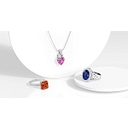
Blue Nile holds a wide lead across fine jewelry, regularly surfacing for loose diamonds, gold engagement rings, and classic bracelets. When shoppers search specifically for sapphire necklaces, however, Macy's is the usual answer.
Since July, Blue Nilerising has strengthened its position, becoming one of the three most named brands for sapphire necklaces. Mejurirising and Quincerising have also become much more common answers overall, while Zalesfalling and Tiffany & Co. have seen their prominence decline across the market.
Latest insights
Weeks of Sep 21 – Oct 11, 2026
Blue Nile Gap between platforms:
Macy's Gap between platforms:
Jared The Galleria of Jewelry Gap between platforms:
Choosing diamond hoop earrings is all about balancing metal color, diamond sparkle, hoop size, and budget. The best pair should complement your skin tone and everyday jewelry, feel comfortable enough to wear regularly, and have diamonds that look beautiful without paying extra for quality you can't easily see.
Here's how I'd approach the purchase.
1. Choose the right metal
Yellow gold
(Classic choice)
Warm, timeless, and especially lovely with a traditional diamond look. A great choice if you wear yellow-gold necklaces, rings, or watches.
– Mark Broumand](https://images.openai.com/static-rsc-4/COLkCU82pyfdHvzJYO33SOg2PgEDdIO2Tpzoy_vDQUa39ugHncm_VPIFtWMT5wq2WzTeYv0jJqVzAXtySaAt3iuO_H80nwBM-dbDeQagWuL017b4qCOjFKrQIusiDJ-03iKtOOt7LvcGGLKySfPqDbt604cQ7FiprCe0UcQyl61tj6G4NNgFjQV07zYssf-2?purpose=fullsize)
White gold
A bright, silvery finish that blends with colorless diamonds and creates a sleek, modern appearance. White gold is commonly rhodium-plated, so it may need replating over time.
Best for: maximum icy-white sparkle and a contemporary look.

Google AI Mode· Oct 13, 2026
Choosing diamond hoop earrings is an investment in a classic piece of jewelry. Here is a breakdown of how to choose the right metal, diamond quality, and diameter for your style and budget.
For hoop earrings, you want a balance of sparkle and durability rather than stressing over top-tier investment grades, since the earrings move and are viewed from a slight distance.
If you'd like, let me know:
I can help narrow down specific carat weights and styles that fit your needs.
What should I look for when buying diamond hoop earrings regarding the metal, the quality of the diamonds, and the diameter of the hoops?
Google AI Mode· Sep 29, 2026
When buying diamond hoop earrings, balancing durability, sparkle, and proportion is key. Because hoops contain multiple smaller stones and move with you, the considerations differ slightly from buying a single engagement ring center stone.
Consult the breakdown below for what to look for regarding the metal, diamond quality, and diameter:
1. The Metal
The metal choice dictates the overall durability, weight, and aesthetic of your hoops.
14k vs. 18k Gold:14k gold contains 58.3% pure gold and is alloyed with harder metals, making it much more scratch-resistant and ideal for everyday wear. 18k gold (75% pure) has a richer yellow hue but is softer and more prone to bending or scratching.
I need help picking out diamond hoop earrings. Can you explain how to evaluate the metal type, diamond quality, and hoop diameter?
I'm looking for a unique mens wedding band that isn't just plain gold or tungsten.
Google AI Mode· Oct 13, 2026
If you want to steer clear of the standard jewelry store options, there are incredible alternative materials that make for striking, conversation-starting wedding bands.
To help narrow down the best style for you, tell me:
I am looking to buy a one-carat diamond ring. What should I know about the four Cs, different setting options, and what certification I should look for?
My wife wants a new pair of pearl earrings. Are lab grown pearls as good as natural ones?
where can i buy a men's wedding band online?
where can i buy an opal engagement ring?
where can i buy a diamond bracelet online?
where can I find simple engagement rings?
Where can I buy a 1 carat diamond ring?
Where can I buy emerald earrings online?
Where can I buy gold engagement rings online?
where can i buy tungsten rings online?
Where can I buy a pearl bracelet online?
where can I buy radiant cut diamonds?
where can i buy a name plate necklace?
Rose gold
A soft pinkish hue that feels romantic and distinctive. Its copper content gives it the characteristic color.
Best for: a softer, feminine look.
Platinum
Naturally white, durable, and dense. It is often more expensive than gold, but it is a compelling option if you prefer a precious metal without rhodium plating.
Best for: premium construction and long-term wear.
My recommendation: Start with 14K gold for a strong balance of durability, price, and everyday wear. Choose 18K gold if you prefer its higher gold content and richer yellow color. If you have a nickel allergy, ask about the exact alloy and nickel content rather than assuming every white-gold or yellow-gold piece is suitable.
2. What diamond quality should you look for?
Diamond quality is described by the 4Cs: cut, color, clarity, and carat weight. For hoops, I would focus on consistent sparkle, well-matched stones, and total carat weight rather than paying a premium for flawless diamonds.
Cut — prioritize sparkle
Look for well-cut round brilliant diamonds. In a multi-stone hoop, lively light reflection is more important than having the highest possible clarity grade.
Color — G–H is a good starting point
G–H diamonds are near-colorless and often offer excellent value. I–J can also be worth considering, especially in yellow gold, depending on how the stones look in person.
Clarity — don't overpay
VS2 or SI1 can be sensible targets for small accent diamonds, provided the stones look clean to the naked eye and have no concerning durability issues. You generally don't need flawless or internally flawless stones for hoops.
Carat weight — compare total carat weight (CTW)
CTW is the combined weight of the diamonds in both earrings. Compare it alongside hoop diameter, width, and diamond coverage: two pairs with the same CTW can look very different.
Natural or lab-grown diamonds?
Natural diamonds: a good fit if you value their geological origin and rarity.
Lab-grown diamonds: have essentially the same chemical, physical, and optical properties as natural diamonds, and generally let you buy more diamond weight for your budget.
Both can be beautiful choices. Decide which origin matters to you before comparing prices, and check that the seller clearly identifies the diamond type.
One more detail: front-facing hoops have diamonds mainly along the front, while inside-out hoops have diamonds facing both forward and backward. Inside-out styles tend to give you more sparkle as you move your head.
3. Choose the right hoop diameter
Diameter is measured straight across the inside of the hoop, although some retailers quote the outside diameter. Check the product's actual measurements before ordering.
8–12 mm — huggie hoops
Discreet · Close to the earlobe
Ideal for everyday wear, understated elegance, and second piercings. Choose these if you prefer a neat, subtle look.
13–20 mm — small to medium hoops
(Best all-around range)
Noticeable sparkle without looking oversized. A particularly versatile range for work, casual outfits, dinners, and everyday wear.
25–35 mm — statement hoops
More movement · More visual impact
Great for a dressier look and more visible diamond coverage. Check the weight carefully so the earrings remain comfortable.
My default recommendation would be 15–20 mm hoops in 14K gold with well-matched G–H diamonds and eye-clean clarity. That combination tends to give you a sophisticated, versatile look without going too small or too dramatic.
4. A few diamond hoop options to compare
Here are three lab-grown diamond options from current shopping results, at different price points. Prices can change, so confirm the final specifications and return policy before purchasing.
Lab Created Round Diamond Hoop Earrings in 14K Gold- 0.45 C.…
Sam's Club
$599.00
14K yellow gold · 0.45 CTW · Lab-grown diamonds
Worth comparing if you want a modest diamond weight from a warehouse retailer.
Solid 14K or 18K gold, or platinum — not simply gold-plated base metal.
Clearly stated natural or lab-grown diamond origin.
Total carat weight for the pair, not just for one earring.
Hoop diameter, width, and total weight in grams.
Secure hinge and clasp that close firmly.
A clear warranty, repair policy, and reasonable return window.
Diamond grading documentation where appropriate, plus an itemized description of the stones and metal.
For hoops with many small diamonds, a trustworthy seller, consistent stone appearance, and secure settings can matter more than an impressive-sounding clarity grade.
Let's narrow it down to the right pair
Choose your preferences and I'll narrow the options to a more targeted shortlist.
Platinum: Extremely durable and hypoallergenic, platinum is a great choice if you choose a white metal and want maximum security for your set diamonds. However, it is heavier, which can pull on the earlobe if the hoops are large.
Color Matching: Ensure the prongs or bezel settings match the diamond color grade you select (e.g., yellow gold prongs can sometimes make near-colorless diamonds look warmer, though they hide yellow-tinted diamonds well).
Clasp and Backing Security: Look for sturdy, well-engineered closures (like snap-bar, omega clips, or secure latch-backs) since hoops are vulnerable to snagging on clothing or hair.
2. The Quality of the Diamonds
With hoops, you are usually looking at a cluster of smaller accent stones (pavé, channel-set, or prong-set) rather than one massive rock.
Cut: Even in small stones, cut is king because it drives brilliance. Well-cut small diamonds will catch the light from every angle, making the entire hoop look fiery and bright.
Color Grade: For smaller melee diamonds (< 0.10 carats each), a color grade of G–H (Near Colorless) or even I–J will look bright and white to the naked eye, while saving you significant money compared to D–F stones.
Clarity Grade: Aim for VS2 to SI1 clarity . In smaller hoop configurations, inclusions at these grades are completely eye-clean, meaning you get maximum sparkle without paying a premium for higher clarity grades where imperfections aren't visible anyway.
Matching Consistency: The most critical factor in hoops is uniformity. The stones should be tightly matched in color, cut, and size so that one dead or mismatched stone doesn't disrupt the continuous line of sparkle.
3. The Diameter of the Hoops
Hoop diameter (measured in millimeters across the widest point) determines comfort, weight, and versatility:
Huggie Hoops (10mm - 15mm): These hug the earlobe closely. They are exceptionally comfortable, safe for sleeping or active lifestyles, and offer a subtle, elegant, everyday professional look.
Small Hoops (16mm - 25mm): Hang just below the lobe. This is the sweet spot for a classic, noticeable everyday look that transitions easily from the office to dinner.
Medium Hoops (26mm - 40mm): Striking and versatile. They offer a dressier appearance and work wonderfully for smart-casual wear, date nights, or cocktail attire.
Large Hoops (41mm+): High-impact statement pieces. They look glamorous for evening events, though heavier carat weights at this size can feel weighty on the earlobe over long hours. You can read more about sizing breakdowns in this Brilliant Earth Hoop Guide.
If you'd like to narrow this down further, let me know:
What is your target budget or preferred total carat weight?
Are these intended for everyday wear or special occasions?
Do you have a preferred metal color (yellow, white, or rose gold)?
When buying diamond hoop earrings, focus on metal durability, diamond sparkle/value, and hoop size/comfort.
Metal
14k gold (yellow, white, or rose) is a strong everyday choice because it is durable and less prone to bending than higher-karat gold.
18k gold has a richer color but is softer.
Platinum is dense, durable, and naturally white, but usually costs more.
Match the metal to your existing jewelry. White gold/platinum emphasizes a bright diamond look; yellow or rose gold creates a warmer contrast.
Diamond quality
Prioritize cut and sparkle first; well-cut diamonds can look brighter even if they are not the highest grades.
Check:
Color: G–I often gives a good balance of whiteness and value for hoops.
Clarity: Eye-clean stones are usually sufficient; very high clarity grades may not add much visible benefit in small hoop diamonds.
Carat weight: Confirm whether the listing means total carat weight (CTW) for the pair or per earring.
Consider the setting: inside-out hoops sparkle from more angles but typically cost more because they use more diamonds.
Hoop diameter
10–15 mm: huggies; subtle and close to the ear.
15–25 mm: versatile everyday size.
25–35 mm: more noticeable but still wearable.
40 mm+: statement style and often heavier.
Also check the weight per earring, hinge/clasp security, and whether the diamonds are evenly matched—comfort and durability matter for a piece worn frequently.
Absolutely. For diamond hoops, I’d prioritize metal + construction first, then diamond quality, then diameter—because hoops get more everyday wear than many other diamond pieces.
1. Metal: 14K vs. 18K vs. platinum
14K gold: Usually the best all-around choice for everyday hoops. It contains 14 parts gold out of 24, with the remainder being other metals that increase hardness/durability.
18K gold: 18 parts gold out of 24, so it has a richer gold content and typically a more luxurious color, but is softer than 14K.
Platinum: A premium choice if you want a naturally white metal and high precious-metal content. Jewelry sold simply as "platinum" should be at least 95% platinum under FTC guidance.
My default for hoops:14K yellow gold for warmth and durability, or 14K white gold for a cooler, diamond-forward look. I'd choose 18K if the richer gold color is important to you.
One important distinction: look for solid gold, rather than plated/overlay construction, if you want earrings intended to last for years.
2. Diamond quality: don't overpay for microscopic differences
The four Cs are cut, color, clarity and carat weight.
For hoops, I'd generally rank them:
Cut → color → clarity → carat weight
Cut: This is especially important because it drives sparkle, brilliance and fire. www.gia.edu For round diamonds, I'd look for Excellent or Very Good cut when a cut grade is provided.
Color: You don't necessarily need D–F. GIA notes that once a diamond is mounted and worn, differences such as D vs. G can be difficult to see.
White metal: G–H is a great sweet spot.
Yellow gold: G–J can look beautiful, with the warmer metal making slight diamond warmth less noticeable.
Clarity: This is where you can often save money. You don't need Flawless or VVS diamonds in earrings. GIA notes that many retail diamonds fall in the VS/SI range, and inclusions that are invisible to the naked eye don't necessarily compromise appearance.
For hoops, I'd target VS2–SI1, provided they're eye-clean.
Carat: Pay attention to total carat weight (ctw), not just the carat weight of an individual stone. A pair advertised as "1.00 ct diamond hoops" generally means the two earrings contain approximately 1.00 ct combined.
And don't assume a higher ctw automatically means better-looking earrings—the other 3Cs matter too.
3. Hoop diameter: this changes the entire look
A rough style guide:
Diameter
Look
8–12 mm
Tiny huggie; subtle, everyday
13–16 mm
Small/classic; polished and versatile
18–22 mm
Medium; probably the best "one pair" size
25–30 mm
Noticeable, sophisticated statement
35–40+ mm
Glamorous/statement
As a reality check, current products span everything from roughly 13 mm huggies to 38 mm statement hoops, so there isn't one universally "correct" diameter.
For a first/only pair, I'd pick around 18–22 mm. It's large enough to read as a hoop but small enough for everyday wear.
Also look at width/thickness. A 20 mm hoop that's 5 mm wide will look substantially bolder than a delicate 20 mm hoop that's 1–2 mm wide.
One feature I'd strongly consider: "inside-out"
If you want maximum sparkle, look for inside-out diamonds, where stones are set on the front and inside/back-facing portion of the hoop. You get diamond sparkle from more viewing angles.
For example, current designs range from delicate 14K styles to substantial 18K inside-out hoops.
My ideal spec for a versatile pair
If you told me "I want beautiful diamond hoops that I'll actually wear all the time," I'd start with:
14K gold + 18–22 mm diameter + round brilliant diamonds + G–H color + VS2/SI1 clarity + Excellent/Very Good cut + secure hinged/snap closure.
I'd rather have that combination than spend extra for D/IF diamonds or a much higher carat weight while compromising on construction.
If you're shopping now, I can also shortlist 5–10 actual pairs at different budgets (e.g. under $1,000, $1–2k, and $2k+) and compare their metal, diameter, ctw, color/clarity, and value side-by-side.
Evaluating diamond hoop earrings comes down to balancing durability, brilliance, and proportion . Here is a clear breakdown of how to assess each major factor.
1. Metal Type
Gold Purity (14K vs. 18K): 14K gold contains 58.3% pure gold and alloy metals, making it more durable, scratch-resistant, and ideal for daily wear. 18K gold has 75% pure gold, offering a richer, warmer yellow color, but it is softer and more prone to bending or scratching.
Platinum: Extremely durable, dense, and naturally hypoallergenic. It maintains a bright white luster over time without needing re-plating, though it is heavier on the earlobe and carries a higher price tag.
Color Selection: Match the metal to skin undertones or existing jewelry collections. Yellow gold provides a classic, warm look; white gold (or platinum) offers a sleek, modern contrast to diamonds; and rose gold delivers a romantic, vintage warmth.
2. Diamond Quality (The 4Cs)
Clarity: For smaller accent diamonds typically used in hoops, SI₁ to VS₂ clarity grades offer the best value. Inclusions are generally eye-clean at these sizes, meaning you won't see flaws without a jeweler's loupe.
Color: Aim for G-H (near colorless) or I-J (faint color) grades. Choosing colorless (D-F) diamonds on small hoop stones rarely yields a noticeable visual difference to the naked eye compared to near-colorless grades, but it significantly increases the cost.
Cut & Brilliance: Even small pavé or prong-set diamonds need a good cut to sparkle. Poorly cut melee diamonds look dull and dark.
Total Carat Weight (TCW): Check whether the carat weight listed is per earring or for the entire pair. Also, verify if the diamonds are "inside-out" (set on the outside front and inside back) to ensure sparkle from every angle.
3. Hoop Diameter & Proportions
Small (10mm - 15mm / 0.4 - 0.6 inches): Huggie-style hoops that sit tight against the earlobe. Excellent for second piercings, understated everyday wear, or professional environments.
Medium (20mm - 30mm / 0.8 - 1.2 inches): The most versatile sweet spot. They hang just below the lobe, offering noticeable presence without being heavy or catching on clothing.
Large (40mm+ / 1.5 inches+): Statement pieces that make a bold fashion statement. Best reserved for evening wear or special occasions, as larger diameters combined with heavy diamond settings can pull on the piercing over time.
Clasp & Security: Look for sturdy closures like snap-bar, omega clips, or secure latch-backs. Because hoops move constantly, a weak clasp increases the risk of losing an earring.
If you want to narrow down your search, tell me:
What is your budget range?
What metal color and hoop size are you leaning toward?
You can find a wide variety of diamond hoop earrings online, ranging from delicate huggies to large statement pieces, depending on your budget and style preference.
Here are some of the most trusted online retailers to check out:
Blue Nile : Known for high-quality fine jewelry and transparent grading, offering classic styles like Blue Nile French Pavé Diamond Hoop Earrings starting around $1,480.
Brilliant Earth : Excellent if you are looking for ethically sourced natural or lab-grown diamonds. They offer everything from extra-small everyday hoops to larger luxury designs like the Brilliant Earth Marseille Diamond Hoop Earrings.
Ring Concierge : Popular for trendy, high-end, and delicate everyday fine jewelry, including popular Ring Concierge Diamond Hoops in 14k Gold.
Zales : A great mainstream option for diverse budgets, featuring designs like Zales Baguette and Round Diamond Alternating Hoop Earrings.
Tiffany & Co.: Best for luxury designer pieces, such as their iconic Tiffany & Co. Elsa Peretti Diamond Hoop Earrings.[1][2]
To help narrow down the best option, let me know:
What budget range are you looking to stay within?
Do you prefer lab-grown or natural diamonds?
What size and metal type (yellow gold, white gold, platinum) do you have in mind?
If you want a men's wedding band that feels genuinely unique, I'd look beyond plain gold and tungsten to materials with natural texture, unusual colors, and craftsmanship that tells a story. You can get something masculine, distinctive, and timeless without it looking like a standard jewelry-store ring.
Here are the styles I'd explore first.
6 distinctive men's wedding band styles
1. Meteorite inlay
(Out of the ordinary)
Real meteorite has naturally occurring, intricate crystalline patterns that look almost like another world. Pair it with titanium, platinum, or white gold for a rugged, space-inspired look.
Best for: someone who loves astronomy, science, or unusual materials.
2. Black zirconium with a contrasting inlay
A deep black, understated finish with a stripe of silver, gold, or another contrasting metal. Modern and architectural without the familiar look of tungsten.
Best for: a sleek, modern, slightly edgy style.
3. Forged carbon fiber
A smoky, marbled pattern with a lightweight, technical feel. Every ring can have a different-looking pattern, making it a great choice if you like motorsport or industrial design.
Best for: lightweight comfort and a contemporary look.
4. Mokume-gane
Japanese-inspired metalworking creates flowing, wood-grain-like patterns in layers of different metals. Each ring has its own organic design.
Best for: artisan craftsmanship and something truly individual.
5. Natural stone inlay
Think deep green jade, lapis lazuli, turquoise, or black opal set into a metal band. You get color and natural variation without needing a diamond.
Best for: a subtle pop of color or a connection to a favorite stone.
6. Hand-forged platinum or palladium
Instead of adding an unusual material, make the metal itself the feature: hammered facets, an irregular edge, a satin finish, or a sculptural shape.
Best for: something distinctive that will still feel classic decades later.
Real rings worth checking out
These are actual options I found online, ranging from a few hundred dollars to handcrafted statement pieces. Prices are listed in USD as shown in the search results.
1. Thorum Forged Meteorite Ring
$420
Thorum · Rated 5.0/5 (47 reviews)
A hammered black band with an offset strip of genuine meteorite. Rugged, dark, and visually distinctive.
These designs and their current listed prices are based on the product listings I found.
A few other materials worth considering
Damascus steel: swirling, layered steel patterns with a rugged handcrafted appearance.
Tantalum: a naturally dark, blue-gray metal that feels understated and sophisticated.
Whiskey-barrel wood: warm, natural grain with a personal story, especially if the wood comes from a meaningful barrel.
Superconductor: intricate copper-and-silver-like geometric patterns for a futuristic, industrial look.
One practical note: meteorite can need occasional care to prevent rust, and many alternative-material rings cannot be resized. If long-term wear and future resizing matter, factor those in before choosing.
Buying a one-carat diamond ring: Your complete guide
A one-carat diamond ring is a classic choice, but carat weight is only one part of what makes a diamond beautiful. Two diamonds that both weigh 1.00 carat can look quite different in sparkle, apparent size, color, and clarity — and can have very different prices.
My advice is to prioritize cut quality, a trustworthy grading report, and how the diamond looks to your eye before paying extra for specifications you may not notice.
1. Understand the Four Cs
1. Cut — the sparkle
(Top priority)
Cut describes how well a diamond's proportions, facets, and finish return light to your eyes. It is not the same as the diamond's shape.
What to look for: Excellent or Ideal cut for a round brilliant diamond.
Why it matters: A well-cut diamond can look lively and brilliant, while a poorly cut one may appear dark or dull.
Shopping tip: Compare diamonds in person or in videos under neutral lighting, not just under jewelry-store spotlights.

![Diamond Color Guide: GIA Diamond Color Grading Explained
Diamonds are graded from D (colorless) through Z (increasing visible yellow or brown tint).
Good starting range: G–H for a balance of appearance and price.
Premium choice: D–F if you want a colorless grade and are comfortable paying more.
Value tip: G–H often look beautifully white, particularly in a white-gold or platinum setting, although the result depends on the individual stone and setting.
3. Clarity — internal and surface imperfections
Clarity grades range from FL (Flawless) to I3, based on inclusions and blemishes.
Good starting point: VS2 or eye-clean SI1.
Value tip: You usually don't need a flawless diamond. Many inclusions in VS and some SI diamonds aren't visible without magnification.
Check carefully: Make sure inclusions don't noticeably affect transparency, durability, or the stone's appearance.
4. Carat — the weight
One carat equals 200 milligrams, or 0.2 grams.
Target: 1.00 ct if the exact weight matters to you.
Value tip: Consider 0.90–0.99 ct if you're open to a slightly lighter diamond; it may cost less while looking very similar in size.
Important: Carat measures weight, not visible diameter. A deep-cut diamond can carry more weight underneath and look smaller from above.
2. A strong starting specification for your budget
For a one-carat round brilliant diamond, I'd start with these specifications and adjust according to your preferences.
Feature
Starting target
Reason
Carat
1.00 ct
Your desired weight
Cut
Excellent
Prioritizes sparkle
Color
G–H
Often a good value balance
Clarity
VS2 or eye-clean SI1
Avoids paying unnecessarily for invisible perfection
These are starting points, not absolute rules. Cut-grade terminology also varies by shape: the familiar GIA cut grade applies to standard round brilliant diamonds, not every fancy shape.
3. Compare the most popular ring settings
The setting affects the ring's overall look, how large the diamond appears, how securely it is held, and how easy it is to maintain.
Solitaire
A single center diamond with a simple band. Timeless, versatile, and easy to pair with a wedding band.
Best for: Classic style and making the center diamond the focus.
Four- or six-prong setting
The prongs hold the diamond above the band, allowing light to enter from multiple directions. Four prongs create a clean look; six provide additional points of retention.
Best for: A traditional diamond-forward design. Prongs should be checked periodically for wear.
Halo or hidden halo
A traditional halo surrounds the center stone with small diamonds; a hidden halo places accent diamonds beneath it.
Best for: Extra sparkle and a more elaborate look. A surrounding halo can make the center stone appear larger, although it adds cleaning and maintenance needs.
Pavé band
Small diamonds line the band for extra sparkle without a large center halo.
Best for: A glamorous look. Tiny accent stones can loosen or fall out, so maintenance matters.
Bezel setting
A metal rim surrounds the diamond's edge, giving the ring a sleek, contemporary appearance.
Best for: Active lifestyles and people who prefer fewer exposed edges. It offers good protection, though the metal can change how large or bright the stone appears.
Three-stone setting
The center diamond is flanked by two smaller stones.
Best for: A more substantial appearance and a symbolic design. Check the total carat weight so you know exactly how much of it is in the center stone.
These styles are illustrated with examples; the final look depends on the exact setting, band width, metal, and diamond proportions. GIA also describes solitaire, side-stone, three-stone, and halo designs in its engagement-ring buying guide.
Which metal should you choose?
White gold
Bright, silvery appearance. White gold is often rhodium-plated and may need replating over time.
Yellow gold
Warm, traditional color. Often pairs nicely with near-colorless diamonds.
Platinum
Naturally white, durable, and typically more expensive than comparable gold settings.
Rose gold
A romantic pinkish hue that gives a diamond ring a distinctive look.
My practical pick: A six-prong solitaire in 14K gold or platinum is a strong choice if you want a timeless ring that is easy to maintain and lets a one-carat diamond stand out.
4. What diamond certification should you look for?
This is one of the most important parts of the purchase. Ask for an independent diamond grading report, sometimes informally called a certificate.
GIA — Gemological Institute of America
(My first choice for a natural diamond)
An independent grading laboratory widely used for diamond quality assessment. Its report documents the diamond's 4Cs and relevant identifying characteristics.
A widely encountered grading laboratory, particularly for lab-grown diamonds. It provides reports identifying the diamond type and grading characteristics.
GIA describes its grading reports as independent assessments and provides report verification so buyers can confirm the details.
What to check on the report
Before paying, make sure:
The diamond type is disclosed: natural or laboratory-grown.
The report number is verifiable in the laboratory's official database.
The weight, shape, color, and clarity match the diamond being sold.
Measurements and proportions are listed, particularly if you're buying online.
Any treatments are disclosed. Ask about clarity enhancement or color treatment if applicable.
The grading report belongs to the actual stone, not a similar diamond in the retailer's inventory.
The return policy is in writing, allowing you to have the ring independently inspected.
A grading report is not an appraisal, a guarantee of resale value, or proof that the seller is offering a good price. An appraisal serves a different purpose, such as supporting insurance coverage.
One extra tip: if the diamond has a laser inscription of its report number on its girdle, ask the jeweler to show you that the number matches the report.
5. Natural vs. lab-grown: Which should you buy?
Both are real diamonds with essentially the same chemical composition and crystal structure. The main differences are how they form, their market pricing, and how buyers value them.
Natural diamond
Formed naturally in the Earth.
Generally costs more for comparable size and grading.
May appeal if geological rarity and natural origin matter to you.
Lab-grown diamond
Created using laboratory technology.
Usually costs substantially less for comparable specifications.
Can let you choose a higher grade or spend more on the setting.
Both can be graded by recognized gemological laboratories. Make sure the report explicitly identifies which type you're purchasing. Don't assume that a lab-grown diamond will retain its original retail value if you resell it.
6. Your buying checklist
Use this checklist when comparing two or three finalists.
Before you buy
of
7. Let's narrow down the right ring for you
I can help you compare real options and identify where your money will go furthest. These three details will make the biggest difference.
Shopping for a one-carat diamond ring is an exciting milestone. To make sure you get the best sparkle, durability, and value for your budget, here is a breakdown of the foundational elements you need to know.
The 4Cs dictate a diamond’s quality and value. For a 1-carat stone, finding the sweet spot between these traits will maximize your budget.
The setting secures your diamond and dictates the overall aesthetic of the ring.
You should never buy an uncertified diamond or a stone certified by the jeweler's in-house gemologist. Look for independent, highly trusted grading laboratories:
If you tell me whether you are looking at natural or lab-grown diamonds and what your target budget is, I can help you pick the ideal combination of the 4Cs.
Buying a 1-carat diamond ring: What you need to know
A 1-carat diamond ring is a popular choice because it offers a noticeable size without necessarily requiring a luxury-level budget. The trick is that carat weight alone doesn't determine how beautiful a diamond looks or how much it should cost. Cut quality, color, clarity, setting style, and certification all matter.
Here's how to shop confidently, avoid paying for features you won't notice, and find a diamond that looks beautiful in everyday wear.
1. The 4 Cs of diamonds
The 4 Cs are the industry-standard way of evaluating a diamond: Cut, Color, Clarity, and Carat weight.
1. Cut — the sparkle
(Highest priority)
Cut determines how effectively a diamond reflects light, creating brilliance, fire, and sparkle. It is not the same as the diamond's shape.
Excellent or Ideal: A great starting point for a round brilliant diamond.
Very Good: Can also be beautiful, depending on the individual stone.
Avoid choosing a poorly cut diamond just to get a bigger carat weight.
Cut: This is the most crucial factor for a diamond's brilliance and sparkle. The proportions, symmetry, and polish determine how well the diamond interacts with light. For a round brilliant cut, aim for an Excellent or Ideal cut grade to maximize fire and brilliance.
Color: This grades the absence of color in a diamond on a scale from D (colorless) to Z (light yellow or brown). For a near-colorless appearance that offers great value, look for grades G through J , which typically look face-up white to the naked eye, especially when set in white or yellow gold.
Clarity: This measures internal inclusions and external blemishes using a scale from Flawless (FL) to Included (I3). A VS1 to VS2 or SI1 clarity grade is usually "eye-clean," meaning inclusions are not visible without magnification, saving you money compared to flawless tiers.
Carat: This measures the diamond's weight, where 1 ct = 0.2 grams. A 1-carat diamond offers a classic balance of presence and wearability. Buying just under a magic number (like 0.90 ct) can sometimes yield a visually identical stone at a lower price point.
Prong Setting: Typically features 4 or 6 metal prongs that cradle the diamond, allowing maximum light exposure from multiple angles to enhance brilliance.
Bezel Setting: Encircles the diamond completely or partially with a thin metal rim, offering superior physical protection and a sleek, modern look.
Halo Setting: Surrounds the central 1-carat diamond with a ring of smaller pavé diamonds, making the center stone appear visually larger and more radiant.
Cathedral Setting: Uses arching slopes of metal that rise up to meet the diamond, adding an elegant, architectural profile to the ring.
Diamonds are graded from D (colorless) through Z (increasing yellow or brown tint).
D–F: Colorless; usually costs more.
G–H: Near-colorless; often an excellent value.
I–J: May still look white, particularly in warmer-colored settings or to an untrained eye.
Shopping tip: G or H is often a good balance of appearance and price for a white-gold or platinum ring.
3. Clarity — internal and external imperfections
Clarity grades describe inclusions inside a diamond and blemishes on its surface.
FL / IF: Flawless or internally flawless; premium priced.
VVS / VS: Very slight or slight inclusions, typically difficult to see without magnification.
SI1 / SI2: Some inclusions may be visible, depending on the stone.
Shopping tip: Look for a VS2 or eye-clean SI1. “Eye-clean” means inclusions aren't readily visible to the naked eye at normal viewing distance; it isn't an official clarity grade.
4. Carat — the weight
One carat equals 200 milligrams (0.2 grams). It measures weight, not the diameter or apparent size of the diamond.
A well-proportioned 1-carat round diamond is often around 6.4–6.5 mm in diameter.
Two 1-carat diamonds can look different in size because of their shape, cut proportions, and depth.
A 0.90–0.99-carat diamond can offer a similar appearance to a 1.00-carat stone, sometimes at a lower price.
2. Ring setting styles: Which should you choose?
The setting affects the ring's appearance, how large the diamond looks, how securely it is held, and how practical it is for everyday wear. GIA distinguishes the overall design (such as solitaire or halo) from the method used to secure the stone (such as prongs or a bezel).
Solitaire
(Best all-around choice)
One center diamond on a simple band.
Timeless and elegant.
Keeps attention on the diamond's sparkle.
Easy to pair with a wedding band.
Usually simpler to clean than intricate designs.
Halo
A circle of smaller diamonds surrounds the center stone.
Makes the overall ring look larger.
Adds sparkle and a glamorous appearance.
Extra small stones mean more maintenance.
Can be a good option if visual impact matters more than a minimalist look.
Three-stone
A center diamond flanked by two smaller stones.
Creates a wider, more elaborate look.
Offers additional sparkle and design options.
Check the total carat weight: it may include all three stones, not just the center diamond.
Pavé band
Small diamonds are set closely along the band.
Adds sparkle without changing the center stone.
Looks especially good with a solitaire.
Small stones need occasional inspection and can make resizing more complicated.
Bezel
A rim of metal surrounds the diamond's edge.
Modern, sleek, and protective.
Less likely to snag on clothing.
Excellent for active lifestyles.
The metal frames the stone, creating a different look from a traditional prong setting.
Cathedral
The band rises in arches to support the center diamond.
Classic and versatile: Solitaire with four or six prongs.
Looks bigger and sparkles all over: Halo.
Durable for frequent hands-on activity: Low-profile bezel.
Extra sparkle on a budget: Solitaire with a pavé band, provided you budget for maintenance.
A bold, meaningful design: Three-stone.
For the metal, platinum and 14K or 18K gold are common choices. White gold creates a bright, silvery appearance; yellow gold offers warmth; and rose gold has a pinkish tone. The best choice depends on personal taste, skin sensitivities, and maintenance preferences.
3. Diamond certification: What standards should you look for?
This is one of the most important parts of the purchase. A diamond grading report gives you an independent assessment of the stone's characteristics. Retailers sometimes use the word “certified,” but you should check exactly which laboratory issued the report and what it covers.
The main grading laboratories
GIA — strongest default choice
Widely recognized for consistent, independent diamond grading. Its reports document the 4 Cs and additional stone characteristics.
Best if you want a widely recognized grading benchmark, especially for natural diamonds.
GIA describes its grading reports and assessment methods in its official report guide.
What to verify on the report
Before paying, check these five things:
Diamond identity: Is the report for a natural diamond or a laboratory-grown diamond? Make sure the seller clearly discloses which one it is.
Exact weight: Does the report say 1.00 carat, or is that the combined weight of several diamonds in the ring?
The 4 Cs: Verify the cut grade (where applicable), color, clarity, and carat weight against the seller's listing.
Report number: Enter it into the issuing laboratory's official report-checking system. Don't rely solely on a screenshot or a jeweler's printed description.
Matching stone: If the diamond has a laser-inscribed report number, ask to have it checked under magnification. The inscription is useful, though it is not a substitute for checking the full report.
A grading report is not the same thing as an appraisal. It describes the diamond's characteristics; it doesn't guarantee a particular resale price or insure the ring.
4. My recommended specifications for a 1-carat ring
For a beautiful everyday ring without paying extra for grades you may not notice, here's the starting point I'd use.
The value sweet spot
Center stone 0.90–1.00 carat
Cut (round brilliant) Excellent
Color G–H
Clarity VS2 or eye-clean SI1
Certification Verified independent report
Setting Solitaire, 4 or 6 prongs
Metal 14K gold or platinum
These are suggested shopping targets, not rigid rules. Cut-grade terminology varies by shape, and an excellent-looking diamond should be evaluated in person or through reliable videos as well as by its report.
One important exception: if you're considering an emerald-cut diamond, prioritize clarity a little more because its large, open facets can make inclusions easier to see than in a round brilliant diamond.
5. Your pre-purchase checklist
Use this checklist when comparing rings at a jeweler or online.
Ring-buying checklist
of
For additional consumer protection, the U.S. Federal Trade Commission's Jewelry Guides explain expectations for truthful descriptions of gemstone type, quality, weight, and precious-metal content.
6. Let's narrow it down to your ideal ring
The right balance depends heavily on your budget and whether you want a natural or lab-grown diamond. Lab-grown diamonds have essentially the same physical and optical properties as natural diamonds, but they are a different purchasing category and should be clearly disclosed.
Personalize your diamond search
Choose what matters most. Your budget can include both the diamond and the ring setting.
Cut : Refers to how well a diamond's facets interact with light, determining its brilliance and sparkle. For a 1-carat stone, prioritize an Excellent or Ideal cut grade, as a superior cut can mask minor color or clarity compromises and maximize visual size.
Color : Graded on a scale from D (colorless) to Z (light yellow or brown). For a 1-carat diamond, grades G through I offer the best value because they appear face-up near-colorless to the naked eye while costing significantly less than a rare D or E grade.
Clarity : Measures internal blemishes (inclusions) and surface defects (blemishes) on a scale from FL (Flawless) to I₃ (Included). Look for VS1 to SI1 clarity grades for a 1-carat diamond—these are "eye-clean," meaning inclusions are not visible without microscopic magnification.
Carat Weight : Represents the physical weight of the diamond (1 ct = 0.2 grams). Buying a true 1.00-carat stone carries a steep price jump; opting for a 0.90 to 0.98-carat diamond provides an identical visual footprint at a notably lower price point.
Prong Setting : Utilizes metal claws (typically 4 or 6) to cradle and suspend the diamond, allowing maximum light exposure to enhance brilliance.
Bezel Setting : Features a custom-fitted metal rim that wraps completely or partially around the diamond's perimeter, offering exceptional security and a sleek, modern aesthetic.
Pavé Setting : Embeds tiny, closely set diamonds along the band using minute beads of metal, creating a continuous, shimmering surface of light.
Halo Setting : Encircles the center 1-carat diamond with a ring of smaller accent stones, which visually amplifies the main diamond's size to make it look substantially larger.
Three-Stone Setting : Flanks the center 1-carat diamond with two smaller side stones, symbolizing past, present, and future while adding substantial finger coverage.
Gemological Institute of America (GIA) : Recognized globally as the gold standard and strictest authority for grading natural diamonds. A GIA Report ensures unbiased, highly reliable evaluations of the 4 Cs.
International Gemological Institute (IGI) : Widely regarded as the industry benchmark for grading lab-grown diamonds, offering detailed and efficient lab reports.

American Gem Society (AGS) : Historically famous for its advanced, precise scientific cut and light-performance grading scale (0–10) (operations now integrated into GIA).
Avoid In-House Appraisals : Never purchase a significant diamond backed solely by a jeweler’s internal grading certificate rather than an independent, third-party lab like GIA or IGI.
If you'd like to narrow this down, let me know:
Are you shopping for a natural or lab-grown diamond?
Gemological Institute of America (GIA): Widely regarded as the industry gold standard and most trusted independent grading lab for consistent and strict evaluation of the four Cs.

American Gem Society (AGS): Known for its exceptionally rigorous cut grading standards and proprietary performance-based light analysis.

International Gemological Institute (IGI): Frequently encountered for lab-grown diamonds, offering reliable grading reports, though grading strictness can vary compared to GIA.
Independent Lab Verification: Always request a grading report from a reputable, independent gemological laboratory rather than relying solely on in-house appraisals from a jeweler.
If you'd like to narrow this down, let me know:
What metal type (platinum, yellow gold, white gold) are you considering?
Are you looking at natural or lab-grown diamonds?
I can help you target specific combinations that fit your budget.
A 1-carat diamond is a popular choice for an engagement ring because it offers a noticeable presence on the hand without necessarily requiring the budget of a larger stone. The key is to buy a diamond that looks beautiful in person, has reliable grading, and fits your budget—not simply one with the highest grades on paper.
There are three decisions to get right:
The four Cs: Cut, Color, Clarity, and Carat.
Setting and style: How the diamond looks, how securely it's held, and how practical the ring is to wear.
Certification: Independent documentation that helps you verify what you're buying.
Let's walk through each, with practical specifications you can use while shopping.
1. The four Cs: what matters most
The four Cs are the internationally recognized system for describing diamond quality, developed by the Gemological Institute of America (GIA). Each affects appearance, rarity, and price.
1. Cut — prioritize sparkle
Cut determines how effectively a diamond reflects light. A well-cut diamond can look livelier and more brilliant than a poorly cut diamond of the same weight.
Target: Excellent cut for a round brilliant diamond graded by GIA.
Check symmetry and polish, too.
Don't confuse cut with shape: round, oval, pear, and emerald are shapes.
2. Color — balance whiteness and cost
For standard white diamonds, GIA's scale runs from D (colorless) to Z (increasing yellow or brown tint).
D–F: Colorless; premium pricing.
G–H: Near-colorless; often a smart balance.
I–J: Can offer value, especially in yellow gold.
For many buyers, G–H is a good starting point. The setting's metal color also influences how the diamond appears.
3. Clarity — look for eye-clean
Clarity grades inclusions inside a diamond and blemishes on its surface, assessed under 10× magnification.
VS1–VS2: A strong starting range.
SI1: May offer savings if inclusions aren't visible to the naked eye.
VVS or Flawless: Usually unnecessary if your goal is an attractive diamond at a sensible price.
Ask to inspect the stone in person or view clear magnified images. An SI1 stone's appearance depends on the location and type of its inclusions.
4. Carat — weight, not face-up size
One carat equals 0.20 grams. Two diamonds weighing 1.00 carat can look different in size because of their proportions and shape.
A 1.00 ct round brilliant diamond typically measures around 6.4–6.5 mm across, depending on its cut.
Compare actual measurements, not just carat weight.
If you want a full 1.00 ct center stone, confirm that the listing doesn't mean 1.00 ct total weight (center diamond plus smaller accent stones).
2. My recommended specifications for a 1-carat ring
For a round brilliant diamond, this is a practical starting point for balancing beauty and price.
Feature
Recommended starting point
Why
Center stone
1.00–1.05 ct
Keeps the focus on the main diamond
Cut
GIA Excellent
Prioritizes light performance
Color
G–H
Near-colorless appearance
Clarity
VS2, or eye-clean SI1
These are shopping guidelines, not rigid rules. GIA's formal cut-grade scale for round brilliant diamonds runs from Excellent to Poor; fancy shapes such as oval and pear don't receive the same overall GIA cut grade.
My rule of thumb: Spend first on a beautiful cut, then choose the lowest clarity and color grades that still look good to your eyes. You don't need D color or VVS clarity to get a beautiful ring.
3. Choose the setting and metal
The setting changes the ring's overall style, the apparent size of the diamond, its security, and how easily it fits with a wedding band.
Solitaire
Timeless, clean, and focused on the center diamond. Usually the easiest style to maintain and pair with a wedding band.
Halo
Small diamonds surround the center stone, creating a larger-looking overall outline and extra sparkle. More detail means more maintenance.
Hidden halo or cathedral
Adds detail beneath or around the center stone while keeping a classic look from above. Check the height and wedding-band fit.
Three-stone
Side diamonds create a wider, more decorative look. Compare center-stone weight separately from total carat weight.
Which metal should you choose?
14k or 18k white gold
A bright, modern look. White gold is often rhodium-plated and may need replating over time.
Yellow gold
Warm, classic, and flattering with a wide range of diamond colors. It can make G–J diamonds a particularly appealing value option.
Platinum
Naturally white, durable, and generally more expensive than comparable gold settings. It develops a patina with wear.
For everyday wear, ask the jeweler about secure prongs, band thickness, resizing, cleaning, and periodic inspections. Four-prong settings show more of the diamond; six-prong settings offer an additional point of retention, though neither makes a ring indestructible.
4. Certification and grading standards: what to insist on
A diamond grading report is independent documentation of the stone's characteristics. The word certified is often used casually in jewelry advertising, so check which laboratory actually issued the report.
Which grading laboratory should you choose?
GIA — my first choice for a natural diamond
A widely trusted grading standard. Its natural-diamond report documents the four Cs, measurements, proportions, and clarity characteristics. Verify the report number through the official database.
Often encountered with both natural and laboratory-grown diamonds. Check that the report identifies the diamond's origin and matches the exact stone you're buying.
One important distinction: a grading report is not the same as a financial appraisal, a guarantee of resale value, or a warranty.
Your certification checklist
Before paying, confirm all of the following:
The report identifies the diamond as natural or laboratory-grown.
The report number and grading details match the seller's listing.
The carat weight is for the center diamond, not just total ring weight.
The report's measurements, color, clarity, and cut information match the stone.
Any treatments or relevant comments have been disclosed.
The jeweler provides a written return policy, warranty details, and an appraisal if needed for insurance.
For laboratory-grown diamonds, GIA uses a distinct quality-assessment format and identifies the stone as laboratory-grown. These diamonds have essentially the same physical and optical properties as natural diamonds, but their origin and market economics differ.
5. What should you expect to pay?
The biggest pricing decision is whether you want a natural diamond or a laboratory-grown diamond. The setting, shape, grading, and retailer also affect the final cost.
Here are a few real listed examples from my product search—not a claim that these are the cheapest or best available.
1 ct GIA-certified solitaire ring
$3,910
Ivy & Rose · Listed price
Natural round diamond, 14k white gold solitaire; listing describes H color and SI clarity. Inspect the exact report and stone before purchasing.
A 1 ct total-weight solitaire listing in 14k white gold. Confirm the center stone's specifications and report before comparing it with the other options.
Prices and availability can change. These examples are natural-diamond listings, and their different specifications and inclusions in the setting mean they're not directly equivalent.
6. A simple plan for making your purchase
Set your total budget. Include the setting, tax, resizing, and insurance.
Choose natural or lab-grown. This is one of the biggest factors in what your money can buy.
Filter for cut, then color and clarity. Start with Excellent cut, G–H color, and VS2 or eye-clean SI1 for a round natural diamond.
Compare at least three stones. Review their measurements, report numbers, face-up appearance, and prices side by side.
Verify the report and the seller's policies. Don't rely on a retailer's product description alone.
Inspect the finished ring. Check that the stone is secure, the setting is comfortable, and the wedding band will fit as intended.
Let's narrow it down to your ideal ring
Tell me your preferences and I'll use them to build a more targeted shortlist of 1-carat rings.